
Siemens Healthineers traces its roots back to mid-19th-century Berlin, where it began as part of what is now Siemens AG. The company was founded on October 12, 1847, by Werner von Siemens and Johann Georg Halske, following the invention of the pointer telegraph. Unlike Morse code, the device used a needle to point to letters, making communication faster and easier. Operating under the name Siemens & Halske, the company opened its first workshop on the day it was founded and quickly expanded beyond telegraphy into electrical measurement equipment and medical technologies.

source: siemens official website
In 1896, just one year after Wilhelm Conrad Röntgen discovered X-rays, Siemens introduced the first mass-produced X-ray tubes designed for medical diagnostics, marking an early milestone in the company’s role in healthcare innovation.
In Aschaffenburg, Germany, X-ray pioneer Friedrich Dessauer founded his own company, which later gained prominence under the name Veifa-Werke. The two companies maintained close ties and ultimately merged in 1932 to form Siemens-Reiniger-Werke (SRW).
In 1933, Siemens introduced rotating-anode X-ray tubes that could withstand much higher electrical loads, laying the groundwork for modern X-ray tube development.
With Siemens’ support in Erlangen, Swedish physician Inge Edler and physicist Carl Hellmuth Hertz explored using ultrasound to improve cardiac diagnosis. In 1953, they became the first to apply ultrasound for echocardiography.
In 1958, Elema-Schönander AB (later Siemens-Elema AB) developed the first cardiac pacemaker implanted in a critically ill patient by surgeon Åke Senning.
In the 1960s, Siemens engineer Ralph Soldner developed the world’s first real-time ultrasound unit, the Vidoson.
This made it possible to view internal body motion on a screen as it occurred. In 1974, the company presented its first tomographic image of a human head at the annual meeting of the Radiological Society of North America in Chicago. A year later, it launched its first computed tomography (CT) scanner, the Siretom.
In 1998, Siemens introduced the first track-based laboratory automation system, the ADVIA LabCell Automation Solution.
Siemens Healthineers Nowadays
Siemens Healthineers is a global medical technology company with a strong focus on medical imaging and image-guided therapy, playing a significant role in modern diagnostic radiology and radiation oncology. In radiology, the company develops imaging systems across multiple modalities, including computed tomography (CT), magnetic resonance imaging (MRI), positron emission tomography (PET), single-photon emission computed tomography (SPECT), ultrasound, and conventional X-ray. These systems are designed to support a wide range of clinical applications, from routine diagnostics to advanced oncologic imaging, with increasing integration of quantitative imaging and functional assessment.
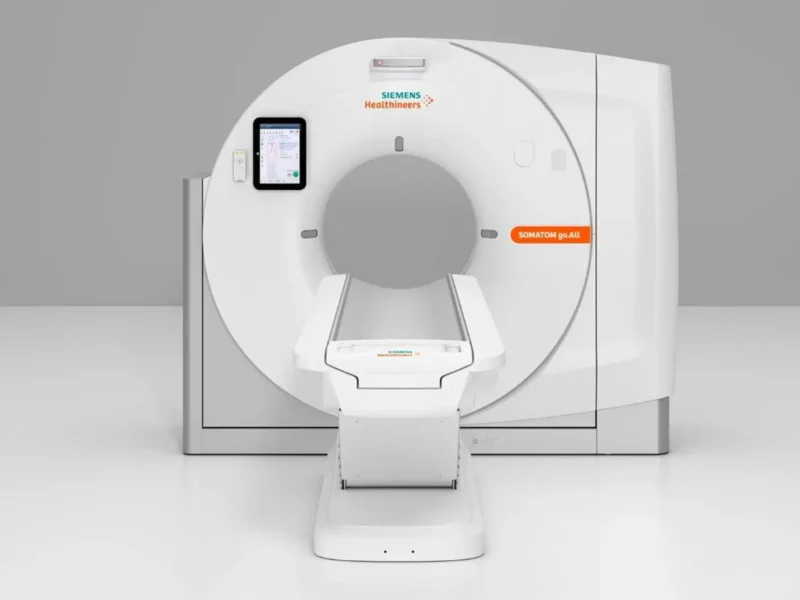
https://www.siemens-healthineers.com/
In contemporary radiation oncology, Siemens Healthineers contributes mainly through imaging and image-guidance technologies that are used before, during, and after radiotherapy. The most established role is in the diagnostic-quality imaging that supports treatment planning. CT simulators remain central for dose calculation and geometric definition of targets and organs at risk, while MRI is frequently used to refine soft-tissue contrast for target delineation and to support contouring in anatomically complex sites (for example, brain, head and neck, pelvis). In selected disease sites, hybrid imaging such as PET/CT—and where available PET/MRI—adds functional information that can be used for staging, biologic target definition, and response assessment. In routine practice, these data are typically handled through registration workflows (rigid and deformable), with attention to immobilization reproducibility, acquisition protocols, and consistent patient positioning to reduce systematic differences between simulation imaging and treatment delivery conditions.
For image guidance and verification, radiotherapy relies on repeated imaging to confirm patient setup and monitor anatomical changes over the treatment course. While the linear accelerator platform is often supplied by other vendors, Siemens Healthineers’ contribution is commonly positioned on the imaging side of the pathway, including systems used for simulation, diagnostic correlation, and longitudinal follow-up. In clinics that integrate multiple imaging modalities, day-to-day radiotherapy decision-making often depends on access to consistent image quality and standardized acquisition parameters. This is particularly relevant for adaptive strategies, where small geometric or density changes can influence dose distributions, and where repeat imaging may be used to trigger replanning or to support on-treatment evaluation.
Digital workflow tools are another area that intersects with radiotherapy practice, especially where imaging datasets must move reliably across planning and oncology information environments. In this context, Siemens Healthineers’ developments in reconstruction methods, automation, and AI-supported features can be relevant insofar as they reduce variability and improve reproducibility. In radiotherapy-related imaging tasks, automation may assist with organ segmentation, registration quality checks, and longitudinal comparisons across multiple timepoints. The practical value in a radiotherapy department is typically measured in reduced manual workload, fewer user-dependent differences between contours or registrations, and improved consistency of inputs used for planning decisions—rather than in the performance of a single algorithm in isolation.
A broader trend across radiology and radiotherapy is the shift from viewing imaging devices as standalone units toward emphasizing interoperability: connecting scanners, post-processing, planning workflows, and clinical data repositories. In multidisciplinary oncology care, radiotherapy depends on timely access to diagnostic imaging, pathology correlation, and follow-up studies, and these processes benefit from standardized data handling, traceability of image versions, and documented workflows for image transfer and registration. From this perspective, Siemens Healthineers’ role can be described as supporting the imaging infrastructure that radiotherapy teams use for planning, guidance, verification, and outcome assessment, with increasing attention to how imaging and data systems integrate across departments rather than only to scanner specifications.
.