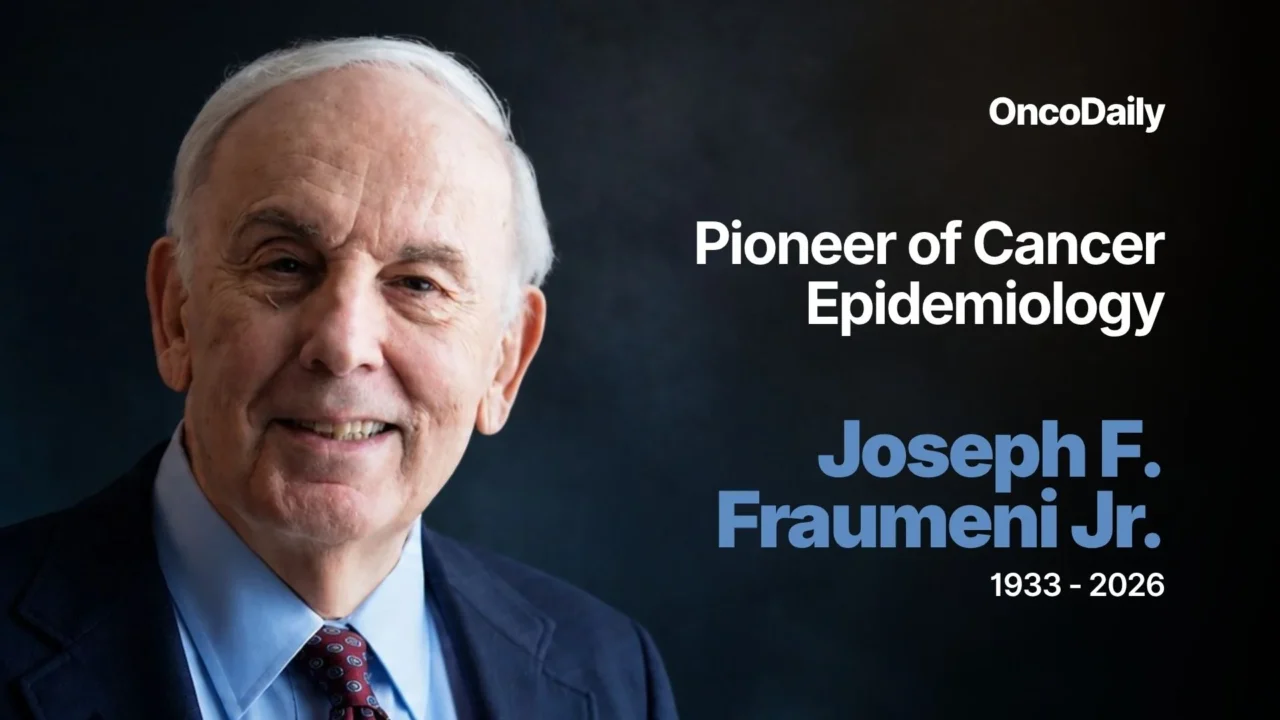
Joseph F. Fraumeni Jr., MD, FAACR, the American physician and cancer epidemiologist whose work reshaped the study of hereditary and environmental cancer risk, died on June 22, 2026, aged 93.
Across a career of more than five decades at the National Cancer Institute, Fraumeni helped establish cancer epidemiology as a discipline that could connect family histories, geographic patterns, workplace exposures, and population data to the causes of cancer. His name remains inseparable from Li-Fraumeni syndrome, one of the defining discoveries in hereditary cancer research.
But his influence reached much further. Fraumeni helped demonstrate that cancer could be studied not only through individual tumors and clinical cases, but also through patterns emerging across families, communities, occupations, and regions.
Early Life, Medical Training, and Scientific Foundations
Joseph F. Fraumeni Jr. was born in Boston on April 1, 1933. He completed his undergraduate studies at Harvard College before earning his medical degree from Duke University School of Medicine in 1958. He later completed medical residencies at Johns Hopkins Hospital and Memorial Sloan-Kettering Cancer Center. He also earned a master’s degree in epidemiology from the Harvard School of Public Health. This combination of clinical and population-health training shaped the direction of his career. Fraumeni understood cancer as a disease requiring both close clinical observation and broad investigation of the conditions in which it occurred.
How Joseph Fraumeni Entered Cancer Epidemiology
In 1962, Fraumeni joined the Epidemiology Branch of the National Cancer Institute as a commissioned officer in the U.S. Public Health Service. At that time, the causes of many cancers remained poorly understood. Cancer epidemiology was still developing as a field, and the relationship between inherited susceptibility, environmental exposure, and cancer risk had not yet been clearly defined. Fraumeni’s work helped move the field beyond descriptive observations. He focused on high-risk populations and unusual cancer patterns, asking whether the distribution of disease could reveal hidden causes, inherited vulnerabilities, or preventable exposures.
Building Cancer Epidemiology at the National Cancer Institute
At the National Cancer Institute, Fraumeni held several major leadership roles. He served as head of the Ecology Studies Section, chief of the Environmental Epidemiology Branch, director of the Epidemiology and Biostatistics Program, and founding director of the Division of Cancer Epidemiology and Genetics. His leadership helped build a research program that brought together epidemiology, genetics, statistics, clinical medicine, and public health. Rather than treating these as separate areas, Fraumeni promoted an integrated approach to understanding cancer risk.
He also helped launch the U.S. Atlas of Cancer Mortality, a series of county-level maps showing geographic variation in cancer deaths. These maps became more than a record of disease burden. They generated questions about why certain cancers occurred more often in particular places and helped guide studies of environmental and occupational carcinogens.
The Discovery of Li-Fraumeni Syndrome and Hereditary Cancer Risk
Fraumeni’s best-known contribution came through his collaboration with Frederick P. Li, MD. In 1969, the two researchers described families with an unusual clustering of early-onset cancers, including sarcomas, breast cancers, brain tumors, and other malignancies. Their observations challenged the prevailing view that cancer heredity, when it existed, was limited to a single organ or tumor type. Instead, they identified a broader familial pattern of cancer susceptibility.
The condition later became known as Li-Fraumeni syndrome. It is now recognized as a hereditary cancer predisposition syndrome most often associated with germline variants in the TP53 tumor suppressor gene. The discovery was pivotal for cancer genetics. It showed that inherited changes in a single gene could substantially increase the risk of multiple cancer types across a lifetime. It also helped establish the importance of family-history assessment, genetic counseling, surveillance, and early detection for individuals from high-risk families.
How Fraumeni Helped Link Cancer to Environmental Exposures
Fraumeni’s work was not limited to hereditary cancer. He also played a major role in the study of environmental and occupational cancer risk. His research examined how cancer patterns could provide clues about exposures in the workplace, home, and wider environment. The U.S. Atlas of Cancer Mortality, developed under his leadership, identified striking geographic variations in cancer deaths and prompted investigations in the United States and China.
Those studies helped identify carcinogenic exposures and strengthened population-level approaches to cancer control. His work reflected a central principle of epidemiology: where cancer occurs, in whom it occurs, and how frequently it occurs can reveal important information about its causes. For Fraumeni, cancer risk was rarely explained by a single factor. His work recognized the interaction between inherited vulnerability, lifestyle, occupation, environment, and broader social conditions.
Tobacco, Asbestos, and the Rise of Cancer Prevention Research
Fraumeni worked during a period when the relationship between cancer and modifiable exposures was becoming increasingly clear. Epidemiology was helping transform evidence on tobacco, asbestos, occupational chemicals, and other hazards into prevention strategies and public-health action. His contribution was to strengthen the field’s ability to identify patterns, test hypotheses, and investigate populations at increased risk. The result was a more rigorous foundation for cancer prevention research.
This work helped establish an enduring lesson for oncology: cancer prevention does not begin only in the clinic. It also depends on recognizing harmful exposures, reducing risk, and creating policies that protect people before disease develops.
Joseph Fraumeni’s Lasting Influence on Cancer Genetics and Public Health
Fraumeni authored or co-authored more than 900 scientific publications and mentored generations of researchers across epidemiology, genetics, cancer prevention, and public health. His influence was distinctive because it connected several fields that are now central to modern oncology. He showed that a family’s cancer history could lead to discoveries in molecular genetics. He showed that regional cancer patterns could direct researchers toward environmental causes. He showed that epidemiology could inform prevention, policy, and patient care.
His work also helped shape the National Cancer Institute’s long-term commitment to understanding the genetic and environmental causes of cancer. After retiring from the NCI in 2017, he was named Scientist Emeritus. Among his many recognitions, Fraumeni received the AACR-American Cancer Society Award for Research Excellence in Epidemiology and Prevention in 1993 and the AACR Award for Lifetime Achievement in Cancer Research in 2009.
Final Years, Death, and the Legacy of Joseph F. Fraumeni Jr.
Joseph F. Fraumeni Jr. died on June 22, 2026, leaving a legacy that continues to guide cancer research, genetic counseling, family-risk assessment, and prevention science. Li-Fraumeni syndrome remains one of the clearest examples of how careful clinical observation can lead to transformative scientific discovery. The syndrome changed how researchers understand inherited cancer risk and helped lay the groundwork for modern approaches to genetic testing and surveillance.
More broadly, Fraumeni helped establish cancer epidemiology as a powerful tool for understanding why cancer develops and how it can be prevented. His career demonstrated that cancer is not only a disease of cells and genes. It is also shaped by families, environments, workplaces, and populations. His scientific vision continues to influence the way oncology approaches risk, prevention, and the search for cancer’s underlying causes.
The OncoDaily Editorial Board joins the global oncology community in honoring a scientist whose rigorous, compassionate, and far-reaching work helped shape generations of cancer research and prevention.
You Can Also Read Is Cancer Hereditary? Myths and Facts about Cancer Genetics by OncoDaily

Written by Aharon Tsaturyan, MD, Editor at OncoDaily Intelligence Unit
FAQ
Who was Joseph F. Fraumeni Jr.?
Joseph F. Fraumeni Jr. was an American physician and cancer epidemiologist whose work helped establish modern research into hereditary cancer risk, environmental exposures, and cancer prevention.
When did Joseph F. Fraumeni Jr. die?
Joseph F. Fraumeni Jr. died on June 22, 2026, at the age of 93.
What is Joseph F. Fraumeni Jr. best known for?
He is best known for co-describing Li-Fraumeni syndrome with Dr. Frederick P. Li, helping reveal that some families have a strongly inherited predisposition to early-onset cancers.
What is Li-Fraumeni syndrome?
Li-Fraumeni syndrome is a hereditary cancer predisposition syndrome, most often linked to inherited changes in the TP53 gene. It is associated with a high risk of developing several cancers, often at young ages.
When was Li-Fraumeni syndrome discovered?
Joseph Fraumeni and Frederick Li first described the unusual familial cancer pattern in 1969. The syndrome was later linked to inherited TP53 mutations.
What was Joseph Fraumeni’s role at the National Cancer Institute?
Fraumeni joined the National Cancer Institute in 1962 and later became the founding director of its Division of Cancer Epidemiology and Genetics, helping shape research on inherited and environmental causes of cancer.
How did Joseph Fraumeni influence cancer prevention?
His work showed how patterns seen across families, occupations, and populations could identify cancer risks and guide prevention, public-health policy, and research into genetic susceptibility.