Over the past two decades, intensive chemoimmunotherapy incorporating high-dose cytarabine followed by autologous stem-cell transplantation (ASCT) consolidation, together with rituximab maintenance, became the standard frontline approach for younger, transplant-eligible patients with mantle cell lymphoma.
The development of BTK inhibitors, particularly ibrutinib, introduced a new therapeutic opportunity. Following the success of ibrutinib in relapsed and refractory MCL, interest grew in the role of BTK inhibition in frontline treatment.
The phase III TRIANGLE trial was designed to evaluate the addition of ibrutinib to first-line immunochemotherapy. Initial analyses demonstrated superior failure-free survival with ibrutinib-containing treatment. Extended follow-up from TRIANGLE allowed assessment of a second important question regarding the role of ASCT in the context of ibrutinib-containing induction and maintenance therapy.
Study Design and Methods
TRIANGLE was an international, randomized, tree-arm, open-label, phase III superiority trial, conducted across 165 centers in Europe and Israel. Eligible patients were 18-65 years old, had previously untreated stage II-IV MCL, and were considered suitable candidates for ASCT.
A total of 870 patients were randomized equally into three treatment groups:
- The control arm received six alternating cycles of R-CHOP and R-DHAP/R-DHAOx followed by ASCT, representing the historical standard of care (group A).
- The first experimental arm received the same treatment backbone with the addition of ibrutinib during induction and as maintenance for two years after ASCT (group A+I).
- The second experimental arm received identical ibrutinib-containing induction and maintenance therapy but omitted ASCT altogether (group I). Rituximab maintenance was permitted according to national guidelines.
The primary endpoint was investigator-assessed failure-free survival, a clinically relevant measure that included stable disease after induction, disease progression, or death, thereby capturing patients who required treatment escalation despite completing induction therapy. Secondary endpoints included overall survival, progression-free survival, response rates, duration of remission, and safety.
The enrolled population reflected a typical cohort of younger patients with advanced MCL. The median age was 57 years, 76% were male, and nearly 87% presented with stage IV disease. High-risk biological features were well represented, including elevated Ki-67 expression, blastoid morphology, and high p53 expression.
Addition of Ibrutinib Significantly Improved Disease Control
After a median follow-up of almost 55 months, four-year failure-free survival reached 82% in the ibrutinib plus ASCT arm compared with 70% in the conventional treatment arm, corresponding to a 37% reduction in the risk of treatment failure (HR 0.63). Improvements were also observed across additional efficacy endpoints, including progression-free survival and duration of remission, supporting the broad clinical benefit of BTK inhibition in newly diagnosed MCL.
The benefit appeared particularly pronounced in patients with high p53 expression, a subgroup historically associated with poor outcomes and resistance to conventional chemotherapy. These findings suggest that BTK inhibition may partially overcome some adverse biological features that traditionally predict inferior prognosis.
Treatment responses were also improved. Complete response rates increased from 36% with standard therapy to 44% in the pooled ibrutinib-containing groups, while overall response rates improved from 94% to 98%, indicating deeper and more frequent remissions with the addition of ibrutinib.
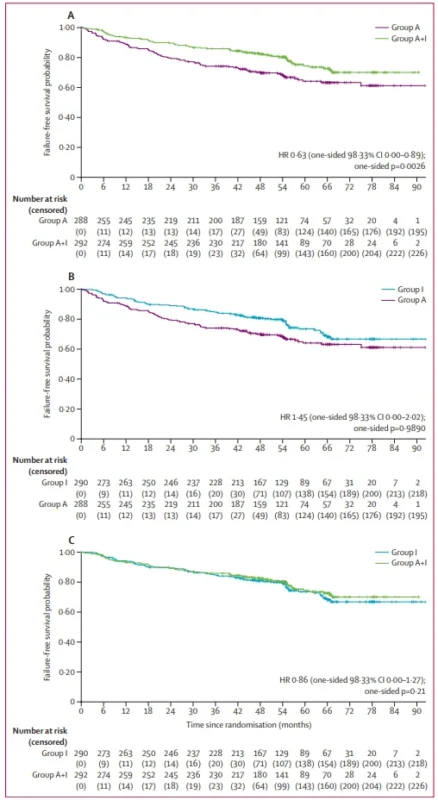
Failure-free survival for group A + I vs group A (A), group A vs group I (B), and group A + I vs group I (C)
ASCT Did Not Demonstrate Superior Efficacy Within an Ibrutinib-Based Strategy
The comparison between the two ibrutinib-containing arms demonstrated no significant advantage for transplantation. Four-year failure-free survival was virtually identical, reaching 82% in patients who underwent ASCT and 81% in those who received the same treatment without transplantation. Progression-free survival and duration of remission were similarly comparable between the two groups.
For many years, ASCT has been considered an essential component of treatment for younger patients. TRIANGLE suggests that when modern BTK inhibitor-based therapy is incorporated into both induction and maintenance, transplantation may no longer provide meaningful additional benefit for the majority of patients.
Although exploratory subgroup analyses hinted that patients with particularly aggressive biological characteristics, including blastoid morphology, very high Ki-67, high p53 expression, or other high-risk features, might still derive some benefit from ASCT, these analyses were not powered to provide definitive conclusions and should be considered hypothesis-generating.
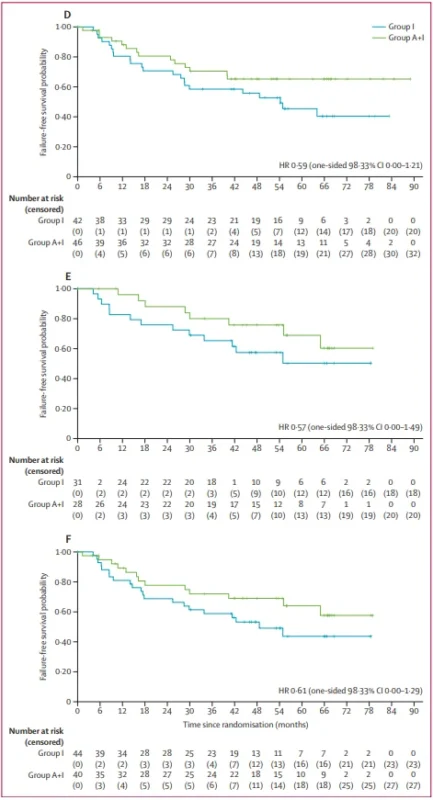
Failure-free survival in subgroups for group A+I vs group I(A), in subgroups of patients with high Ki-67 with 50% cut-off (D), high p53 expression (E), and high-risk biology (F) for group A+I vs group I
Overall Survival Advantage Emerged With Ibrutinib
Earlier reports from TRIANGLE established the superiority of ibrutinib-containing therapy based on failure-free survival, but its impact on overall survival remained unclear. With extended follow-up, a clear survival advantage became evident. Four-year OS was 81% in the conventional treatment arm vs 88% in the ibrutinib-plus-ASCT arm and 90% in the non-transplant ibrutinib arm. Relative to standard therapy, both experimental approaches reduced the risk of death by approximately 40%.
Safety and Toxicity
As expected, intensive cytarabine-based induction and transplantation were associated with substantial hematologic toxicity. During the transplantation phase, severe hematologic adverse events occurred frequently, with thrombocytopenia, neutropenia, febrile neutropenia, and infections representing the most common complications. Infections were also the leading cause of treatment-related deaths during ASCT.
Importantly, when the two ibrutinib-containing arms were compared directly, patients who underwent ASCT experienced substantially higher toxicity. During maintenance and follow-up, grade 3-5 hematologic adverse events occurred in 54% of patients receiving ASCT compared with 28% of those treated without transplantation. Severe infections were also more common in the transplant arm, occurring in 34% vs 26% of patients, respectively. Neutropenia remained the predominant severe hematologic complication.
Clinical Interpretation
TRIANGLE represents one of the most practice-changing studies ever conducted in mantle cell lymphoma. The trial not only confirms the value of incorporating BTK inhibition into frontline therapy but also questions the longstanding role of ASCT in younger, transplant-eligible patients.
Historically, improvements in MCL outcomes were achieved through treatment intensification. TRIANGLE suggests that improved disease control through targeted therapy may now provide greater benefit. The combination of cytarabine-containing immunochemotherapy, ibrutinib during induction, and fixed-duration maintenance achieved excellent long-term outcomes.
Patients with TP53 abnormalities, highly proliferative disease, or blastoid morphology continue to represent an area of unmet need, and future studies will need to clarify if selected high-risk populations may still benefit from ASCT.
Discussion
The role of ASCT should be considered in the context of modern frontline therapy. Similar findings were reported in a randomized US Intergroup trial, in which ASCT did not improve outcomes among patients who achieved molecular remission after induction.
Consistent with TRIANGLE, the phase III ECHO trial demonstrated improved progression-free survival and a trend toward improved overall survival with acalabrutinib plus bendamustine-rituximab. Given their greater selectivity and improved tolerability, second-generation BTK inhibitors may have potential as part of a TRIANGLE-like regimen instead of ibrutinib. However, no phase III data on such combinations are available.
Relapse after frontline BTK inhibitor exposure is an important consideration. The fixed-duration ibrutinib maintenance used in TRIANGLE differs from continuous BTK inhibitor therapy and may allow BTK inhibitor re-treatment or combination-based salvage approaches. CAR T-cell therapy, bispecific antibodies, non-covalent BTK inhibitors, and BTK degraders represent additional treatment options in that scenario.
Of Note
Additional molecular analyses from the TRIANGLE trial presented at EHA 2026 suggested that ibrutinib-containing treatment may partially abrogate the adverse prognostic impact of TP53 mutations, a finding that may help explain the favorable outcomes observed in some biologically high-risk patients.
Limitations
Several limitations should be considered when interpreting the study. Patient-reported outcomes were not collected, limiting assessment of treatment burden and quality of life. In addition, subgroup analyses, particularly those involving biologically high-risk disease, remain exploratory because of the relatively small number of patients. Longer follow-up will also be important to fully assess the durability of benefit compared with historical studies evaluating ASCT.
Conclusion
The findings support ibrutinib-containing therapy without ASCT as a practice-informing alternative to ASCT-based consolidation in younger patients with mantle cell lymphoma. In the context of ibrutinib-containing induction and maintenance, ASCT did not improve outcomes in the overall study population. At the same time, the findings in biologically high-risk disease remain hypothesis-generating and warrant further evaluation.