Hematology has become remarkably good at measuring whether a treatment works. Response rates, measurable residual disease, progression-free survival, and increasingly sophisticated molecular endpoints capture efficacy with real precision. What patients actually experience while on treatment is harder to pin down.
For decades, adverse events have mostly been reported as type and peak grade. That works for flagging severe toxicity, but modern hematologic therapies expose its limitations. A transient grade 3 event that resolves with treatment is not clinically equivalent to recurrent grade 2 toxicity that persists for months, leads to repeated interruptions, or causes treatment discontinuation. Nor does a toxicity table capture infections occurring after immune suppression, late cytopenias, cumulative cardiovascular effects, or the practical burden of continuous therapy.
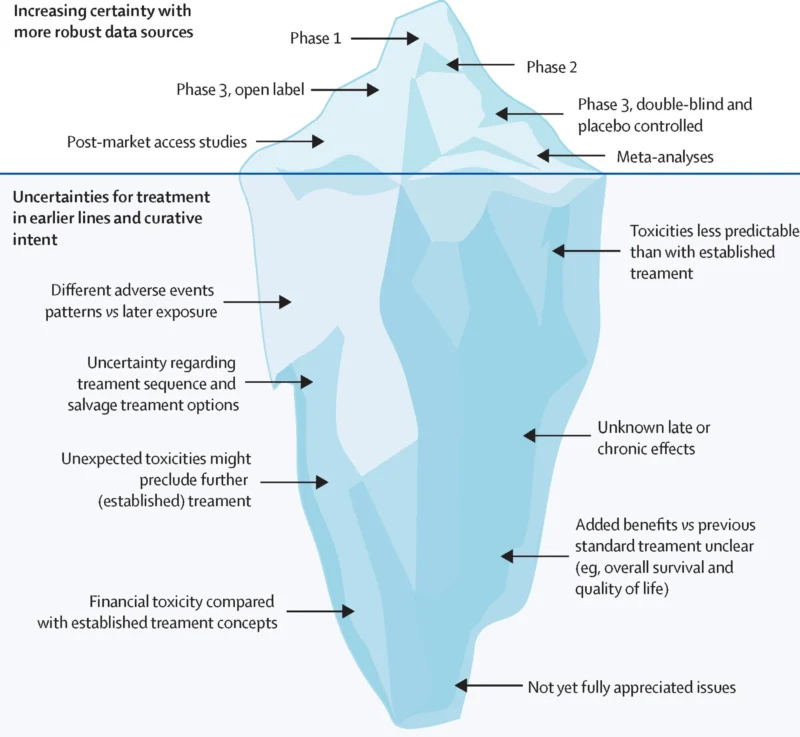
CAR T-cell therapies, bispecific antibodies, immune checkpoint inhibitors, antibody-drug conjugates, and selective small-molecule inhibitors have made this harder to ignore. Most of these drugs first reach patients through small, single-arm trials in heavily pretreated populations, and accelerated approval pathways can put a drug into practice while its long-term toxicity profile is still developing. Rare events haven’t had time to appear, delayed toxicities fall outside early follow-up, and adverse-event reporting often provides limited information about duration, recurrence, management, or consequences for treatment.
CAR T-Cell Therapy Shows Why Toxicity Assessment Has Had to Evolve
Early attention focused, reasonably, on cytokine release syndrome (CRS) and immune effector cell-associated neurotoxicity syndrome (ICANS), two toxicities most clinicians hadn’t seen before CAR T cells entered practice. Early studies used different definitions and grading approaches, which made comparing products and trials difficult.
Consensus grading systems from the American Society for Transplantation and Cellular Therapy turned these complications into recognizable, increasingly standardized clinical entities. Similar work followed for immune effector cell-associated hemophagocytic lymphohistiocytosis-like syndrome and immune effector cell-associated hematotoxicity.
That mattered beyond CAR T-cell therapy itself. Toxicity can’t be interpreted well when clinicians aren’t measuring the same event the same way. Standardized definitions let trials, registries, and real-world cohorts generate comparable evidence, and make it possible to tell whether a complication reflects one product, a therapeutic target, or a whole treatment class.
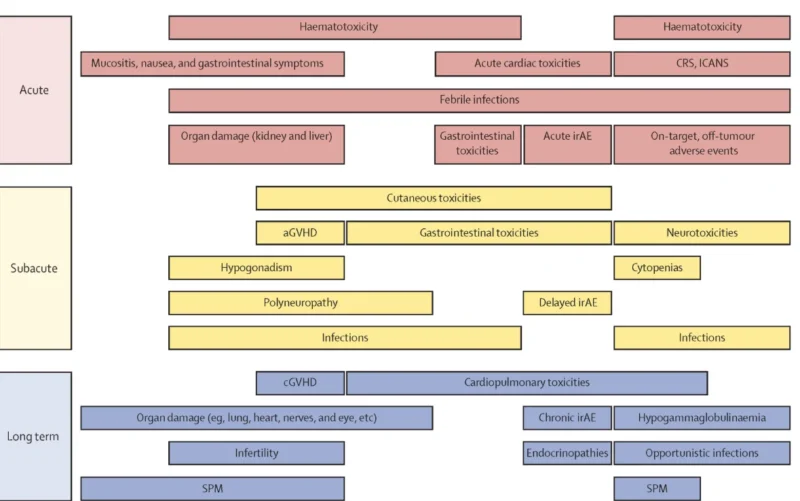
Longer follow-up after CAR T-cell therapy has surfaced complications that early trial reports barely mention, prolonged cytopenias, hypogammaglobulinemia, infections. Mild or moderate late toxicities can also slip through when follow-up papers focus mainly on efficacy and serious adverse events. In practice, these lingering complications drive transfusion needs, antimicrobial prophylaxis, immunoglobulin replacement, hospitalization, and how well a patient recovers from therapy at all.
The Most Visible Toxicity May Not Be the Most Consequential
A meta-analysis cited in the Lancet Haematology Commission looked at 574 non-relapse deaths among 7,604 patients on B-cell-directed CAR T-cell therapy. CRS caused 5% of these deaths, ICANS another 5%. Infections caused 51%. Among infection deaths with a pathogen identified, COVID-19 accounted for 53%, bacterial infections 21%, fungal infections 19%, and other viral infections 5%.
CRS and ICANS are highly visible, with established grading, defined monitoring windows, and increasingly standardized management. Infection risk runs longer, well past the acute treatment period, and comes from several overlapping causes, including cytopenias and prolonged loss of humoral immunity. The same meta-analysis found infection-related mortality was higher in real-world data than in clinical trials, even after adjusting for CAR T-cell product and underlying disease and excluding COVID-19 deaths.
Bispecific antibodies raise a similar concern. In a meta-analysis of 2,228 lymphoma patients on anti-CD20 bispecific antibodies, infections occurred in 44%, grade 3 or higher infections in 20%, and fatal infections in 3%. In multiple myeloma, infection risk also seems to depend on target and modality: severe infections have shown up more often with BCMA-directed bispecific antibodies than GPRC5D-directed therapy, and hypogammaglobulinemia appears to drive much of the infection risk during bispecific treatment.
Evidence that immunoglobulin replacement lowers infections is already changing supportive care beyond what the earliest trials used. Clinical experience has pushed wider use of Pneumocystis jirovecii prophylaxis and immunoglobulin replacement in vulnerable bispecific-antibody patients, and earlier intervention for CRS and ICANS.
thelancet.com
Efficacy in the Context of Tolerability
The limits of conventional safety reporting show up clearly when efficacy and toxicity pull in opposite directions. Several hematologic oncology trials show that improving a surrogate endpoint doesn’t automatically mean a better outcome for patients. In SHINE, adding ibrutinib improved median progression-free survival by 27.7 months in mantle cell lymphoma but didn’t improve overall survival, with added toxicity, including infections, part of the balance.
In BELLINI, venetoclax improved response and progression-free survival in multiple myeloma while overall survival was worse in the treatment group, again with infections implicated. Trials combining checkpoint inhibition with pomalidomide in myeloma ran into the same pattern: more treatment-related deaths, worse survival. Tolerability has to mean more than the worst grade recorded in a trial, it has to ask whether the efficacy gained is actually worth what it costs to get there.
Moving Effective Therapies Earlier Changes the Risk-Benefit Equation
Most novel therapies are studied first in relapsed or refractory patients who’ve already run through other options, where substantial toxicity can be acceptable if the drug offers real disease control. Move the same therapy toward first-line or curative-intent use, and the math changes.
A rare, persistent neurologic complication means something different for a heavily pretreated older patient with progressive myeloma than for a younger, treatment-naive patient with decades ahead of them. Earlier-line patients also differ from trial populations in prior treatment, comorbidities, immune function, and disease features.
Hodgkin lymphoma shows why this matters in a highly curable disease. Modern first-line regimens now include brentuximab vedotin and nivolumab, which makes long-term tolerability just as relevant. In HD21, treatment-related morbidity was built in as a coprimary endpoint, and gonadal function and patient-reported quality of life added information a standard adverse-event table wouldn’t capture. With checkpoint inhibition specifically, persistent immune-mediated organ damage is its own concern, since something that happens during a short course of treatment can leave lifelong consequences.
Treatment Duration Is Part of Toxicity
Continuous oral therapy may look quiet early on and still build up low-grade toxicity over years. A finite regimen might look rougher during treatment but leave the patient with less toxicity overall. Ibrutinib makes this concrete. In one long-term cohort cited by the Commission, 30% of 136 patients stopped treatment because of adverse events. It also took extended follow-up to catch rare but serious cardiovascular toxicities, including ventricular arrhythmias and related deaths. A snapshot from the first few months of treatment would have missed most of that.
This has fed growing interest in fixed-duration and response-adapted regimens. In chronic lymphocytic leukemia, combining targeted agents can produce deep remissions that let treatment stop, and measurable residual disease may help decide when. The FLAIR trial is a good example: response-guided ibrutinib-venetoclax outperformed fludarabine, cyclophosphamide, and rituximab on overall survival. The broader point is that treatment optimization isn’t just about picking the most active drug anymore. How long a patient stays on it can be part of the strategy itself.
Beyond the Maximum Tolerated Dose
The maximum-tolerated-dose model came out of cytotoxic chemotherapy, where more drug usually meant more tumor killing and more toxicity together. Targeted drugs don’t always work that way.
Pharmacologic studies of ibrutinib have found substantial target occupancy at doses below what’s approved, and real-world data show maintained outcomes after dose reduction. Belantamab mafodotin is another case: ocular and hematologic toxicity shifts with dose and interval, which opens room to adjust exposure without giving up an active target. These findings back a broader idea behind efforts like the FDA’s Project Optimus, that drug development should find a dose and schedule balancing efficacy with sustained tolerability.
thelancet.com
Tolerability Needs the Patient’s Perspective
Even thorough clinician-reported adverse events miss how treatment actually affects daily life. Fatigue, repeated hospital visits, infusion schedules, low-grade chronic symptoms, anxiety about recurring toxicity, and the day-to-day demands of supportive care can all decide whether a treatment feels livable.
Patient-reported outcomes matter most exactly where they’d otherwise go unnoticed: when a drug improves a lab value or disease measure while quietly adding a different burden. In lower-risk myelodysplastic syndromes, raising hemoglobin or cutting transfusion need doesn’t automatically mean better quality of life. Luspatercept can raise hemoglobin and still leave patients fatigued; imetelstat cuts transfusion need but requires monthly IV visits. The real clinical value of these drugs includes outcomes that hematologic response alone can’t capture.
What Should Replace the Maximum-Grade Mindset?
Maximum grade shouldn’t disappear. Severe toxicity is still essential information. The problem is treating it as if it were the whole picture. What’s missing is everything maximum grade doesn’t capture: severity alongside timing, duration, recurrence, cumulative burden, dose modification, discontinuation, hospitalization, late effects, non-relapse mortality, and patient-reported outcomes, tracked with enough follow-up to see how they actually unfold. Randomized comparisons also help with attribution.
Some of the most important toxicities only show up after approval: ventricular arrhythmias and sudden death with ibrutinib, parkinsonism after BCMA-directed CAR T-cell therapy, treatment-related neoplasms with lenalidomide. Pivotal trials don’t represent the patients who eventually receive these drugs, older, frailer, and more comorbid, with different exposures and immune function. Long-term registries, electronic health records, and broader access to trial data are what catch these patterns. But they also need to feed back into practice, and ultimately how tolerability is discussed with patients.
You can also read