
For many patients, hearing “stage 4 cancer” immediately suggests that the cancer has spread throughout the body and may no longer be curable. That interpretation comes largely from the way staging works in common solid tumors. In diffuse large B-cell lymphoma (DLBCL), stage 4 has a different clinical meaning.
DLBCL is an aggressive lymphoma, but it is potentially curable even when diagnosed at an advanced stage. Stage III or IV disease is one of the five original International Prognostic Index (IPI) risk factors, but it is only one piece. Patients with the same stage can still be separated into very different risk groups. Modern population-based data involving more than 5,000 patients continue to show that composite prognostic models outperform any attempt to interpret stage in isolation.
DLBCL Staging
DLBCL is staged using the Lugano classification, which updated the older Ann Arbor system and incorporated fluorodeoxyglucose (FDG) PET/CT into routine staging of FDG-avid lymphomas.
- Stage I involves a single lymph node region or a single extranodal site.
- Stage II involves two or more lymph node regions on the same side of the diaphragm and may include limited contiguous extranodal involvement.
- Stage III involves lymph node regions on both sides of the diaphragm and may also involve the spleen.
- Stage IV indicates diffuse or disseminated involvement of one or more extralymphatic organs, such as the bone marrow, liver, or multiple noncontiguous extranodal sites.
PET/CT can change the assigned stage in approximately 10%-30% of patients, usually by upstaging disease, though the resulting change in treatment is less frequent. In one DLBCL study cited by the Lugano group, marrow involvement was identified in 27% of patients, PET/CT detected 94% of these cases, while bone marrow biopsy detected only 40%. PET/CT can still miss low-volume or discordant marrow disease, which is why biopsy remains useful in selected situations. The key point is that stage measures anatomical extent.
Is Stage 4 DLBCL the Same as Stage 4 Solid Cancer?
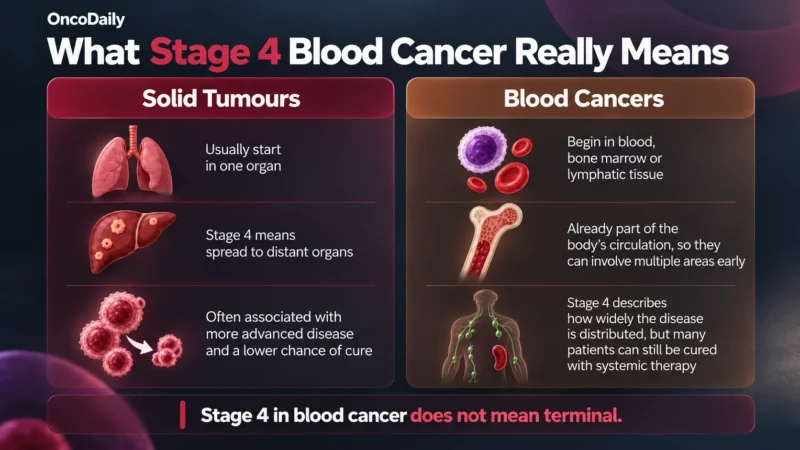
No, the same number is being applied to diseases with different staging systems. Many solid tumors originate in one anatomical organ. Stage IV commonly indicates that malignant cells have established distant metastatic deposits outside that organ and its regional drainage. For many solid cancers, although certainly not all, this substantially reduces the likelihood of cure.
Lymphoma does not follow the same anatomical model. DLBCL arises from lymphocytes, whose normal counterparts circulate and reside throughout the lymphatic and immune systems. Lymphoma can therefore involve lymph nodes, spleen, bone marrow and extranodal organs as part of a systemic lymphoid malignancy. Finding lymphoma in several anatomical regions does not carry exactly the same implication.
The Lugano recommendations note that lymphoma treatment is commonly organized around limited disease (stages I-II) versus advanced disease (stages III-IV) and emphasize that stage is only one component of pretreatment risk assessment.
Can Stage 4 DLBCL Be Cured?
Yes, curative-intent systemic treatment is used for many patients with advanced-stage DLBCL. In the rituximab era, the revised IPI study (Sehn et al.) found that even the poorest prognostic group treated with R-CHOP had a 4-year progression-free survival of 53% and overall survival of 55%. Patients in the favorable groups had substantially better outcomes, reaching 4-year overall survival rates of 79% and 94%.
In the phase III POLARIX trial, which enrolled patients with intermediate- or high-risk previously untreated DLBCL, 5-year progression-free survival was 64.9% with polatuzumab vedotin plus R-CHP and 59.1% with R-CHOP. The progression-free survival hazard ratio was 0.77 (95% CI, 0.62-0.97). Five-year overall survival exceeded 80% with pola-R-CHP in the updated analysis.
Anyway, these figures should not be presented as “stage 4 survival rates”: POLARIX was not restricted to stage IV disease, and trial populations differ from unselected patients in clinical practice. They show that advanced or clinically higher-risk DLBCL can still achieve prolonged disease control after first-line therapy.
How Much Does Stage 4 Affect Prognosis?
Advanced stage has remained an adverse prognostic variable across decades of DLBCL research. The original IPI uses five clinical risk factors:
- age greater than 60 years
- elevated serum LDH
- Eastern Cooperative Oncology Group performance status ≥2
- stage III or IV disease
- involvement of more than one extranodal site
The NCCN-IPI gives more detailed weight to age and LDH elevation and considers involvement of specific extranodal sites. In its external validation cohort, 5-year overall survival ranged from 96% in the lowest-risk group to 38% in the highest-risk group. The absolute separation between these groups was 58 percentage points, compared with 41 points using the original IPI.
More recent real-world evidence confirms that this risk separation persists. A Danish population-based analysis evaluated 5,126 patients with newly diagnosed DLBCL treated with immunochemotherapy and compared 13 prognostic models. Five-year overall survival was 97.1% in the NCCN-IPI low-risk group and 33.4% in the high-risk group. NCCN-IPI remained among the strongest-performing clinical models.
Not All Stage 4 DLBCL Is the Same
Patients may reach stage IV through very different patterns of disseminated disease. One may have relatively limited disease distributed across sites that satisfy stage IV criteria, another may have bulky, metabolically active lymphoma throughout multiple regions.
Bone marrow and central nervous system involvement are independently associated with poorer progression-free and overall survival after adjustment for standard prognostic variables.
Another Danish nationwide cohort of 1,972 patients found secondary CNS lymphoma in 3.4% at first relapse. Patients classified as high risk by the CNS-IPI had a 2-year cumulative CNS relapse incidence of 7.5%, and the number and location of extranodal sites were among the strongest predictors. Bone marrow, kidney/adrenal, testicular and several other sites were associated with increased risk.
Biology Can Separate Patients With the Same Stage
Cell-of-origin classification separates germinal-center B-cell-like and activated B-cell-like DLBCL. Historically, ABC DLBCL has shown poorer outcomes with R-CHOP than GCB type. MYC and BCL2 coexpression is associated with poorer outcomes, while MYC and BCL2 rearrangements identify a particularly aggressive subgroup. Modern genomics have divided DLBCL into still more detailed subgroups. Their practical value varies, and treatment decisions do not depend on every molecular distinction.
Response to Treatment Adds Prognostic Information
Stage is assigned at diagnosis and does not change. The patient’s clinical outlook evolves. A patient who presented with extensive stage IV disease but achieves complete metabolic response after curative-intent treatment is in a different situation from a patient whose lymphoma is refractory.
The Lugano criteria use the five-point Deauville scale: scores 1-3 generally correspond to complete metabolic response in the appropriate clinical setting, and scores 4-5 require interpretation according to changes in uptake and the timing of the scan. Importantly, a residual anatomical mass can remain on CT while the patient still meets criteria for complete metabolic response if abnormal FDG activity has resolved.
PET is not infallible. In aggressive non-Hodgkin lymphoma, the Lugano review reported negative predictive values of approximately 80%-100%, when positive predictive values were more variable. Because inflammation, infection and treatment-related changes can produce FDG uptake, biopsy or follow-up imaging is recommended when a positive result would trigger additional treatment.
What Should “Stage 4 DLBCL” Tell a Patient?
Stage 4 means advanced anatomical distribution at diagnosis, a recognized adverse prognostic factor that feeds into the IPI and related risk models. It does not mean the lymphoma is terminal, and it doesn’t provide an individual survival estimate on its own.
Asking “What stage is DLBCL?” has a relatively precise answer. Asking “What is the prognosis?” requires the entire clinical picture. Stage IV matters, but in DLBCL it is the beginning of prognostic assessment, not the verdict.
You can also read:

FAQ
Can Stage 4 DLBCL Go Into Complete Remission?
Yes. Patients with stage IV DLBCL can achieve a complete response after first-line treatment. Because DLBCL is treated with curative intent in many patients, complete remission can occur even when lymphoma involved multiple organs or the bone marrow at diagnosis.
Does Bone Marrow Involvement Automatically Mean Stage 4 DLBCL?
Bone marrow involvement generally qualifies DLBCL as stage IV. However, PET/CT does not detect every pattern of marrow disease, particularly low-volume or biologically discordant involvement. Bone marrow biopsy may therefore still be appropriate in selected patients.
Can DLBCL Come Back After a Complete Metabolic Response?
Yes. A complete metabolic response on PET/CT is a favorable finding, but it does not guarantee that DLBCL will never relapse. The risk of recurrence depends on several factors, including baseline clinical risk, lymphoma biology, and the depth and durability of treatment response.
Does Stage 4 DLBCL Always Require More Treatment Than Stage 1 DLBCL?
Not necessarily in a simple stage-by-stage way. Limited-stage DLBCL may sometimes be treated with fewer cycles of systemic therapy, with or without radiotherapy, while advanced disease generally requires a full course of systemic treatment. The exact approach also depends on age, risk factors, disease sites, and other clinical features.
Why Is LDH Important in DLBCL Prognosis?
Elevated lactate dehydrogenase (LDH) can reflect greater disease activity or tumor burden and is one of the original IPI risk factors. Its prognostic value is interpreted together with age, performance status, stage, and extranodal involvement rather than as an isolated laboratory result.