
The Phase 2 OPTI-AML trial (NCT03013998) was designed to compare 14-day and 28-day venetoclax schedules during the first two cycles of azacitidine-venetoclax in older patients with newly diagnosed, genomically agnostic AML. Primary results were presented by Uma Borate at EHA 2026.
The Evolving Question of Venetoclax Duration
The combination of azacitidine and venetoclax has become a standard frontline treatment for older patients with AML who are not candidates for intensive chemotherapy, following the results of the VIALE-A trial. However, 53% of patients required venetoclax dose modifications and 72% experienced cycle delays.
With azacitidine-venetoclax now forming the backbone of many emerging triplets, questions have emerged regarding the optimal duration of venetoclax exposure. Several retrospective studies have explored shorter schedules, with OPTI-AML being the first prospective randomized trial to address this question.

Integrating Targeted Therapies into HMA-Venetoclax in AML: Perspectives from ASCO 2026
Trial Design and Objectives
OPTI-AML was conducted across 12 academic centers. Patients aged ≥60 years with newly diagnosed AML who were considered unfit for intensive chemotherapy were randomized 1:1, stratified by age (60-74 vs ≥75 years), to receive azacitidine (75 mg/m² on days 1-7) combined with either venetoclax on days 1-28 (n=83) or days 1-14 (n=86) during the first two treatment cycles.
Bone marrow assessment was performed on day 21 of each cycle, and responses were evaluated according to modified ELN 2017 criteria. The primary endpoint was CR across the first two treatment cycles.
Secondary endpoints included composite CR, PFS, OS, neutrophil and platelet recovery, and safety. Following protocol treatment, patients continued therapy and long-term follow-up according to investigator discretion.
The Genomic Context of OPTI-AML
The molecular composition of the study population is important when interpreting the results. Unlike many contemporary studies focused on molecularly defined subsets, patients with diverse mutational profiles, including NPM1, IDH1/2, FLT3-ITD, and TP53 alterations, were enrolled.
The non-inferiority margin was set at 10%, meaning that the shorter schedule would be considered non-inferior if the upper bound of the 95% confidence interval for the difference in complete remission rates did not exceed 10%.
What the Data Showed
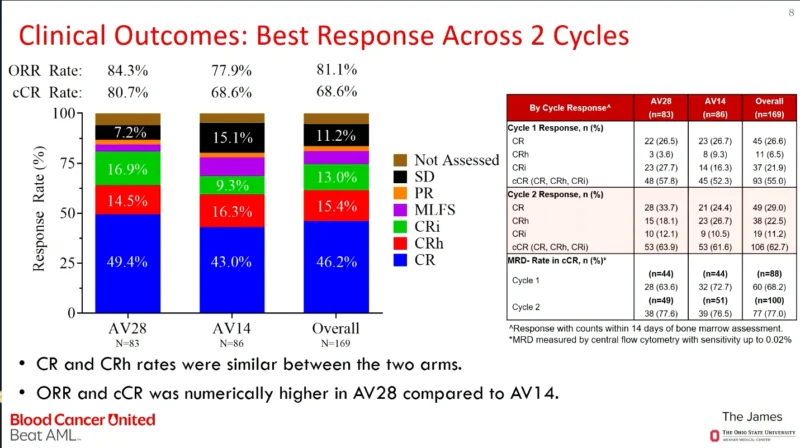
The primary endpoint was not met. After two treatment cycles, the CR rate was 49.4% with the AV28 vs 43.0% with AV14. Although the observed difference was not statistically significant, non-inferiority of AV14 was not established. (90% CI, -6.1% to 19.0%).
CR rates after cycle 1 were similar between treatment arms. By cycle 2, cCR and ORR numerically favored AV28 (63.9% vs 61.6% and 84.3% vs 77.9%, respectively). Among patients achieving cCR, flow cytometry-based MRD negativity was comparable.
Safety and Venetoclax Delivery
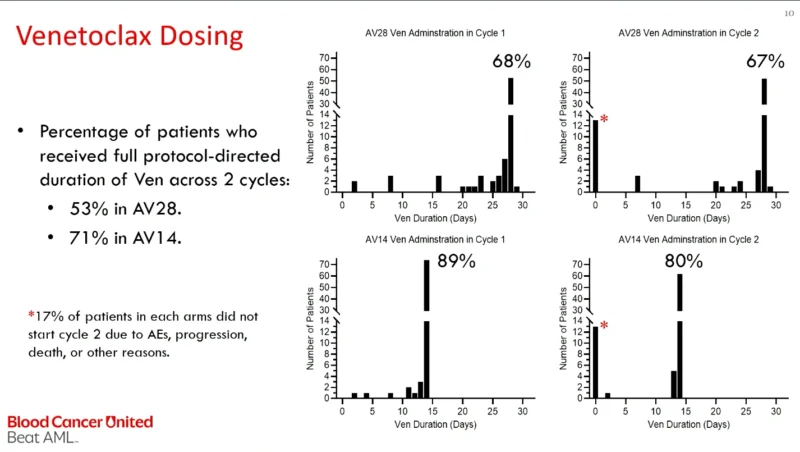
Safety profiles were similar between treatment arms, with no meaningful differences in grade ≥3 AEs, hospitalizations, or count recovery. Delivery of the planned venetoclax duration was more feasible with AV14: across the first two cycles, 71% of patients in the AV14 arm received the full protocol-directed venetoclax duration vs 53% in the AV28 arm.
Molecular Subgroup Analyses
Exploratory analyses suggested higher CR rates with AV28 among patients with NPM1- or IDH2-mutated AML. CR rates in the combined NPM1/IDH2 subgroup were 60.9% vs 33.3% , whereas outcomes were similar in patients without these mutations (45.0% vs 45.1%). Small subgroup sizes limit interpretation.
Survival Outcomes
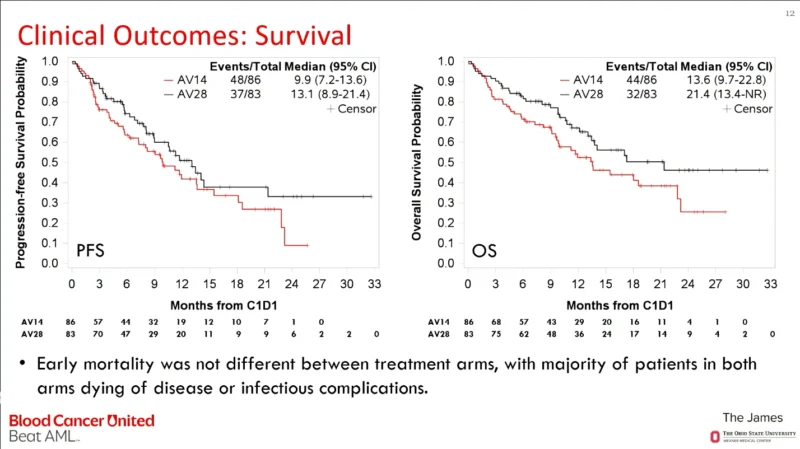
With a median follow-up of 9.6 months, median PFS was 13.1 months with AV28 vs 9.9, while median OS was 21.4 vs 13.6 months. However, treatment arm was not independently associated with OS in multivariable analyses.
Bottom Line
OPTI-AML did not establish non-inferiority of a 14-day venetoclax schedule compared with the standard 28-day approach. The study suggests that venetoclax duration may not have uniform effects across AML genomic subgroups, underscoring the importance of molecularly informed treatment optimization as venetoclax-based regimens become increasingly complex.