
Healthy hematopoiesis depends on a finely tuned balance between blood cell production and the body’s physiological demands. In myeloproliferative neoplasms (MPNs), acquired mutations lock hematopoietic stem cells into constitutively activated proliferative signaling pathways.
The result is persistent overproduction of one or more mature myeloid cell lineages, accompanied by chronic inflammation, constitutional symptoms, splenomegaly, thrombotic risk, and the potential for progressive bone marrow failure or leukemic transformation.
In the classical Philadelphia chromosome-negative MPNs, the predominant cell lineage involved defines the phenotype:
- Polycythemia vera (PV): predominantly erythrocytes, often accompanied by leukocytosis and thrombocytosis.
- Essential thrombocythemia (ET): predominantly megakaryocytes, resulting in sustained thrombocytosis.
- Myelofibrosis (MF): abnormal megakaryocyte proliferation drives cytokine release and progressive bone marrow fibrosis, with variable abnormalities affecting erythroid and granulocytic lineages.
MPNs are primarily caused by mutations in JAK2, CALR, and MPL, though additional somatic mutations substantially influence prognosis. Despite sharing these driver mutations and constitutive JAK-STAT signaling, patients experience highly variable disease courses with differences in symptom burden. Even patients with the same diagnosis may have markedly different prognoses and therapeutic needs, making risk assessment an integral component of MPN management.
Traditional scoring systems relied mainly on age, blood counts, and previous thrombotic events. Contemporary models increasingly incorporate genomic alterations, allele burden, cytogenetics, and even artificial intelligence-based algorithms, allowing clinicians to tailor treatment strategies more precisely and identify patients who may benefit from earlier intervention or allogeneic hematopoietic stem cell transplantation. These evolving approaches are reviewed by Noor Al-Zubaidi and colleagues.
Polycythemia Vera: Beyond Classical Thrombotic Risk
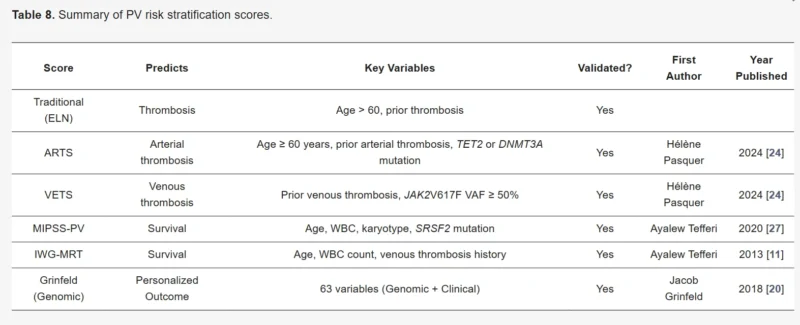
Thrombosis remains the leading cause of morbidity and mortality in PV. Conventional risk stratification recommended by the European LeukemiaNet classifies patients younger than 60 years without previous thrombosis as low risk, while all others are considered high risk. Although still widely used, this approach has been refined
One of the most important advances is recognition of the prognostic value of JAK2 variant allele frequency (VAF). Patients with a JAK2 VAF greater than 50% have a substantially higher risk of venous thrombosis. Arterial thrombosis appears to remain more strongly associated with conventional cardiovascular risk factors such as diabetes, dyslipidemia, and previous arterial events.
Monitoring JAK2 allele burden may also provide insight into treatment response. In the MAJIC-PV study, a 50% reduction in JAK2 VAF was associated with improved clinical outcomes. Current international guidelines do not yet recommend treatment modification solely according to allele burden, though ongoing research continues to evaluate this approach.
Additional mutations involving DNMT3A, TET2, and ASXL1 have also been implicated in thrombotic risk through inflammatory mechanisms. Newer prediction models such as the ARTS and VETS scores integrate molecular abnormalities with cardiovascular risk factors, yet further validation is needed before widespread implementation.

Survival prediction in PV has similarly evolved. More than 50% of patients harbor additional mutations beyond JAK2, many of which significantly worsen prognosis. Mutations involving SRSF2, IDH2, ASXL1, and U2AF1 are associated with shorter survival and increased progression to myelofibrosis or acute myeloid leukemia. Patients carrying adverse mutations demonstrated a median OS of 8.8 years, compared with 17.8 years in those without these alterations. These observations formed the basis for molecularly enhanced models such as MIPSS-PV, which combines clinical variables with mutational status.
Simpler tools including the IWG-MRT (International Working Group for Myelofibrosis Research and Treatment) and AAA score (age, absolute neutrophil count, and anemia) remain valuable where molecular testing is unavailable.
Leukemic transformation remains relatively uncommon in PV, but cumulative risk increases over time, reaching approximately 2.3% at 10 years, 5.5% at 15 years, and nearly 4% at 20 years in long-term studies. Continuous clinico-molecular prediction models now offer individualized estimates of disease progression beyond traditional categorical risk scores.
Essential Thrombocythemia: Integrating Clinical and Molecular Risk
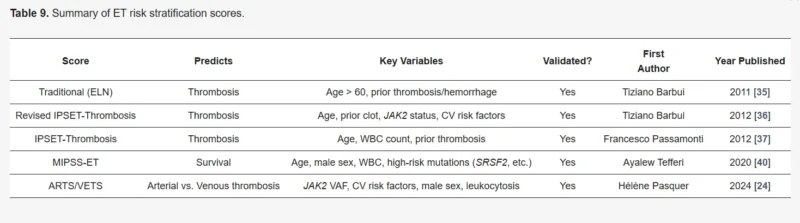
Management of ET also depends heavily on thrombotic risk assessment. The revised IPSET-Thrombosis model marked a major advance by incorporating JAK2 mutation status alongside age, cardiovascular risk factors, and previous thrombosis, improving discrimination between risk categories. Newer molecular models continue to separate arterial and venous thrombosis.
Although ET generally carries the most favorable prognosis among MPNs, survival remains shorter than in the general population. Reported median OS ranges from 12.1 to 18 years, depending on patient populations and follow-up duration. Additional mutations independently worsen prognosis and are incorporated into MIPSS-ET. Blood count-based tools such as the AAA and AAA+ scores provide practical alternatives by combining clinical characteristics with inflammatory markers including neutrophil-to-lymphocyte ratio and monocyte count, making them particularly valuable in healthcare systems without routine genomic testing.
Transformation risk in ET remains relatively low but increases steadily over time. Leukemic transformation occurs in approximately 0.7% of patients at 10 years and 2.1% at 15 years, while progression to overt myelofibrosis reaches 9.3% by 15 years. Triple-negative disease generally carries favorable outcomes, whereas MPL and CALR type 1 mutations are linked to greater fibrotic progression, and JAK2 mutations remain strongly associated with thrombotic complications.
Myelofibrosis: Comprehensive Prognostication Guides Treatment
Among MPNs, MF demonstrates the greatest clinical heterogeneity. Patients may experience indolent disease for years or progress rapidly with cytopenias, splenomegaly, constitutional symptoms, and transformation to acute leukemia. Accurate prognostication directly influences therapeutic decisions, particularly the timing of allogeneic hematopoietic stem cell transplantation, currently the only potentially curative treatment.
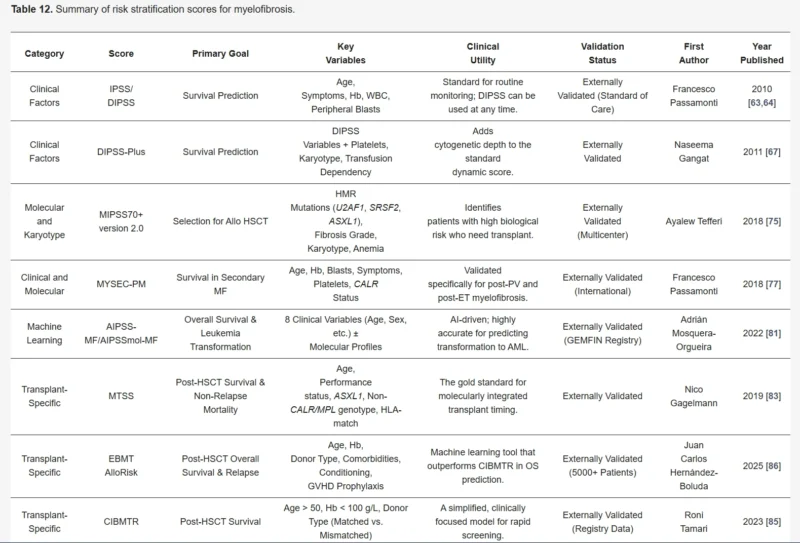
Classical prognostic systems including IPSS, DIPSS, and DIPSS-Plus remain widely used. DIPSS differs by assigning greater weight to anemia, reflecting its strong association with adverse outcomes. DIPSS-Plus further incorporates cytogenetic abnormalities, thrombocytopenia, and transfusion dependence. Patients requiring regular red blood cell transfusions have been reported to experience an approximately eightfold higher risk of death, emphasizing the prognostic importance of advanced bone marrow failure.
Molecular prognostic systems have substantially expanded risk assessment. MIPSS70 and MIPSS70+ version 2.0 integrate clinical variables with high-molecular-risk mutations including ASXL1, EZH2, SRSF2, IDH1/2, and U2AF1, improving selection of transplant candidates younger than 70 years. Evidence also highlights the major prognostic impact of TP53, particularly multi-hit alterations associated with markedly inferior survival following transplantation.

Patients with secondary MF arising from PV or ET benefit from disease-specific models such as MYSEC-PM, while the RR6 score (Response to Ruxolitinib After 6 Months) helps evaluate response after six months of ruxolitinib therapy by incorporating spleen reduction, transfusion requirements, and drug dose. These dynamic assessments support earlier therapeutic modification when treatment response is suboptimal.
Artificial intelligence is also entering routine prognostication. The AIPSS-MF model predicts OS and leukemia-free survival using eight readily available clinical variables (age, sex, hemoglobin, leukocyte count, platelet count, peripheral blood blasts, constitutional symptoms, and leukoerythroblastosis) without requiring molecular testing. The molecularly enhanced AIPSSmol-MF further improves predictive performance by incorporating mutations and outperforms several established prognostic systems in validation studies.
Transplant-specific models have also become increasingly sophisticated. Scores including MTSS, integrated MTSS, CIBMTR, and the recently developed Myelofibrosis AlloRisk Stratifier combine disease biology with patient fitness, donor characteristics, transplant variables, and laboratory parameters to estimate post-transplant survival more accurately. Current recommendations support integrating disease-specific prognostic models with transplant-specific tools when evaluating transplant eligibility and timing.
The Future of Risk Stratification
Continued validation in prospective studies remains essential before widespread implementation of many emerging molecular and artificial intelligence-based models. As genomic testing becomes more accessible and computational prediction continues to improve, personalized prognostication is expected to become an integral component of routine MPN management, supporting better long-term outcomes while optimizing therapeutic decisions for each individual patient.