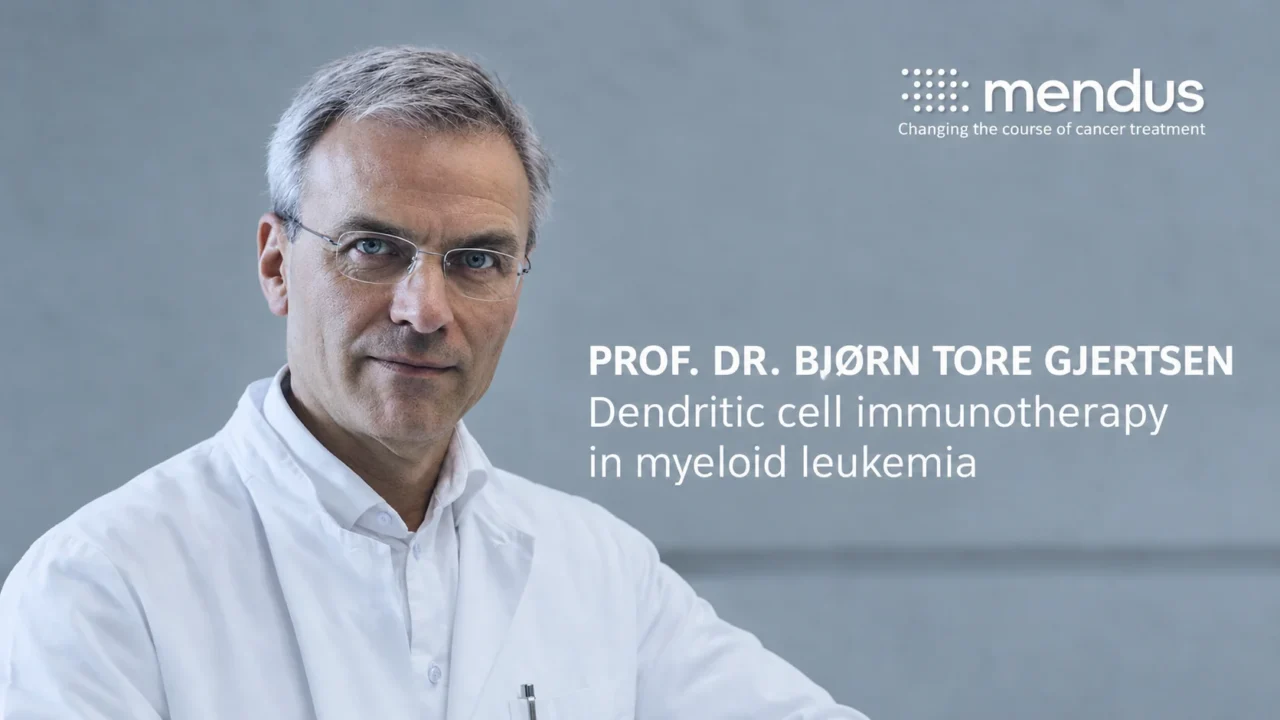
Mendus has presented updated five-year follow-up from its ADVANCE II trial of vididencel in acute myeloid leukemia (AML), alongside progress in the ongoing VITAL-CML study in chronic myeloid leukemia (CML).
Professor Bjørn Tore Gjertsen, of the University of Bergen and Haukeland University Hospital in Norway, presented the updates at the Second Bologna Workshop on Immunotherapy for AML, held September 29–30, 2026.
ADVANCE II: Long-Term Follow-Up in AML
The completed Phase 2a ADVANCE II trial enrolled 20 patients with persistent measurable residual disease following intensive induction chemotherapy. Median follow-up has reached 60 months, and all patients remaining in long-term follow-up have reached five-year survival.
Mendus reported that vididencel-induced immune responses were associated with durable clinical remissions. No product-related serious adverse events occurred; the main side effects were temporary, mild to moderate injection-site reactions.
Gjertsen, a principal investigator in both studies, commented:
“Immunotherapy has strong potential to reduce relapse in myeloid leukemias, combined with a favorable safety profile that preserves health and quality of life.”
These findings provide an early clinical signal supporting further investigation. However, the five-year survival statement concerns patients still in follow-up and does not represent a 100% survival rate across the original study population. A 20-patient, early-phase trial also cannot establish a comparative survival benefit.
How Vididencel Targets Residual Disease
Vididencel is an investigational cell-based immunotherapy designed to stimulate immune responses against remaining leukemia cells.
The treatment comprises irradiated leukemia-derived dendritic cells and is administered through injections into the skin. Local antigen-presenting cells take up the injected cells, initiating immune responses against the tumor antigens they carry. The intended effect is to support immune control of residual disease and help maintain remission.
Vididencel is manufactured from a proprietary cell line without requiring patient-derived material or genetic engineering. This approach supports centralized, large-scale production, an operational consideration as the treatment moves through clinical development.
VITAL-CML Moves Beyond Its Initial Safety Stage
The Phase 1b VITAL-CML trial evaluates vididencel alongside tyrosine kinase inhibitors (TKIs) in chronic-phase CML patients whose responses to standard treatment are suboptimal.
In September, Mendus announced that an independent Data Safety Monitoring Board had reviewed eight patients who completed four doses of vididencel. The review identified no safety or tolerability concerns with the combination, supporting continued enrollment. This initial assessment addresses the feasibility of adding immunotherapy to TKI treatment; evidence of clinical activity requires the forthcoming response analyses.
Enrollment has now reached 13 of the planned 24 patients. Initial molecular response data are expected in the fourth quarter of 2026, followed by topline results in mid-2027.
A Broader AML Development Program
Beyond ADVANCE II, Mendus is evaluating vididencel in the randomized Phase 2b AMLM22-CADENCE trial, in combination with oral azacitidine after intensive chemotherapy. This study extends development into a combination approach and includes patients with and without measurable residual disease.
The company also announced the initiation of the Phase 1b DIVA trial in September. DIVA will investigate vididencel following treatment with venetoclax and azacitidine in newly diagnosed AML patients with measurable residual disease who are considered unfit for intensive induction chemotherapy.
Led by Professor Andrew Wei at Peter MacCallum Cancer Centre and supported by the Olivia Newton-John Cancer Research Institute, DIVA is expected to deliver an initial safety readout in the first half of 2027.
Together, these studies will examine whether vididencel’s immune-based approach can translate into sustained disease control across different treatment settings. The next milestone in CML will be the molecular response data, which should begin to clarify whether the encouraging initial tolerability findings are accompanied by deeper treatment responses.
You can also read: Acute Myeloid Leukemia (AML) Survival Rates: Why Prognosis Differs Across Genetic Subtypes.