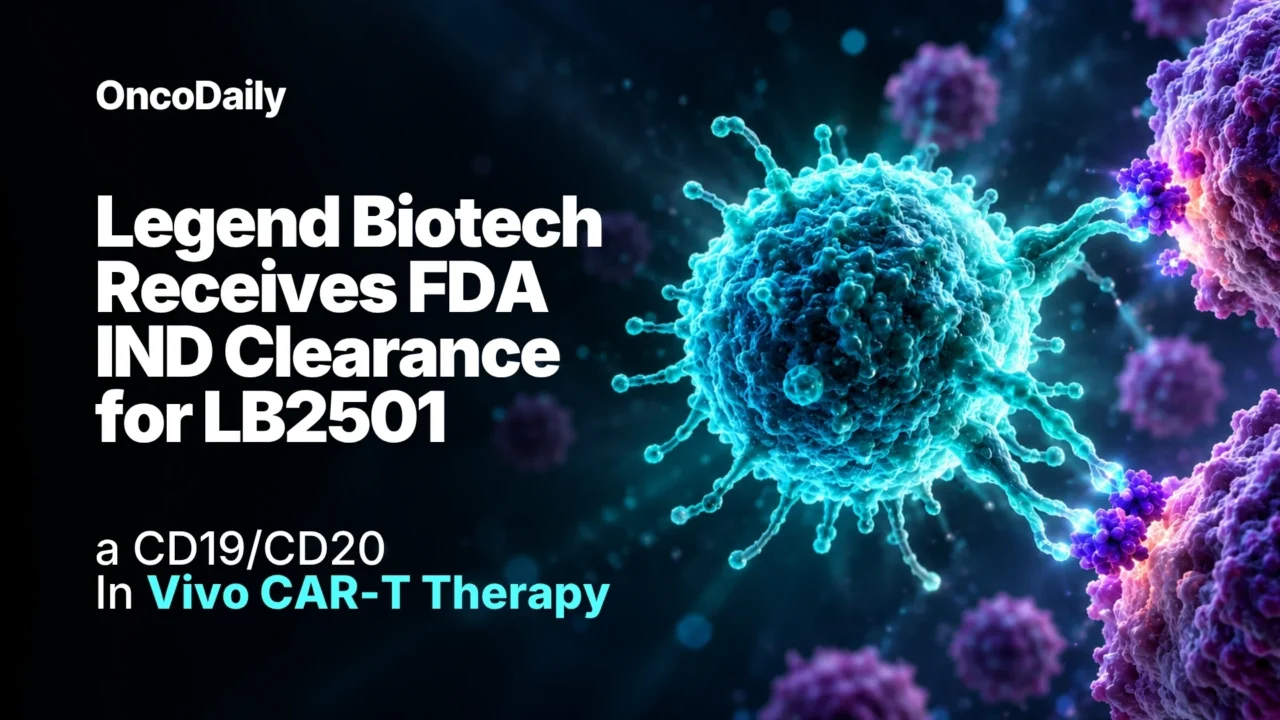
Legend Biotech announced that the U.S. Food and Drug Administration (FDA) had cleared its investigational new drug (IND) application for LB2501, an investigational in vivo CAR-T therapy for relapsed or refractory B-cell malignancies, including B-cell non-Hodgkin lymphoma.
According to the company’s announcement, LB2501 is designed to generate CAR-T cells targeting both CD19 and CD20 directly within the patient following a single infusion. Legend Biotech described it as the first known dual-targeting in vivo CAR-T therapy to receive FDA IND clearance.
The clearance supports a planned U.S. Phase 1/2 study evaluating the therapy’s safety, tolerability, pharmacokinetics, and preliminary efficacy.
Ingrid Zhang, Chief Executive Officer of Legend Biotech, said:
“We believe in vivo CAR-T represents the next frontier of cell therapy, with the potential to bring transformative, life-changing treatments to many more patients around the world”.
Zhang stated that the FDA’s IND clearance marked an important step in advancing LB2501 and the company’s broader in vivo cell engineering platform. She added that Legend was drawing on its CAR-T experience to develop an approach that could simplify access to and delivery of this treatment class.
LB2501: Generating CAR-T Cells Within the Patient
LB2501 is being developed as an off-the-shelf, single-infusion therapy. By generating CAR-T cells directly within the patient, the approach could potentially avoid several manufacturing steps required for conventional autologous CAR-T therapies.
The therapy is being evaluated without lymphodepleting chemotherapy. LB2501 is built on Legend Biotech’s proprietary TaVec platform, which uses an engineered, replication-incompetent lentiviral vector designed to selectively transduce T cells. Following transduction, these cells generate a chimeric antigen receptor that targets both CD19 and CD20.
The dual-targeting design is intended to help address antigen escape and other potential mechanisms of treatment resistance in B-cell malignancies.
Planned U.S. Phase 1/2 Study
The planned U.S. Phase 1/2 trial will assess four areas:
- Safety
- Tolerability
- Pharmacokinetics
- Preliminary efficacy
The IND clearance advances Legend Biotech’s development of its in vivo cell engineering platform and its strategy to develop additional CAR-T approaches.
Ongoing Phase 1 Study in China
Alongside the planned U.S. Phase 1/2 trial, LB2501 is being evaluated in an ongoing Phase 1, open-label study in China. The study is assessing the investigational therapy’s safety, tolerability, and preliminary efficacy in patients with relapsed or refractory B-cell malignancies.
LB2501 is designed to generate CAR-T cells targeting both CD19 and CD20 directly within the patient after a single infusion. The therapy is being evaluated without lymphodepleting chemotherapy. Its dual-targeting approach is intended to help address antigen escape and other potential mechanisms of treatment resistance in B-cell malignancies.
B-Cell Malignancies and the Treatment Setting
B-cell malignancies include cancers arising from B lymphocytes at different stages of development and vary in their biology, clinical behavior, and treatment requirements. B-cell lymphomas account for approximately 85-90% of non-Hodgkin lymphoma diagnoses in Western populations. These include diffuse large B-cell lymphoma, follicular lymphoma, mantle cell lymphoma, and marginal zone lymphoma.
Their clinical course ranges from slower-growing disease to aggressive forms requiring prompt treatment. Diffuse large B-cell lymphoma, the most common non-Hodgkin lymphoma subtype, accounts for approximately one-third of newly diagnosed cases and often presents as a rapidly enlarging lymph node or a mass outside the lymph nodes. Follicular lymphoma is the most common indolent subtype, although some patients experience progression, relapse, or transformation into a more aggressive lymphoma.
B-cell non-Hodgkin lymphoma accounts for 90% of malignant lymphomas. Although treatment advances have improved outcomes for some patients, those with relapsed or refractory disease, particularly following multiple lines of therapy, often have limited treatment options.
You can also read: Legend Biotech Highlights Early LB2501 Data at EHA 2026.