Polycythemia vera (PV) originates from a single transformed hematopoietic stem cell, but its expansion may depend on more than the mutation itself. Chronic inflammation appears to create conditions that favor JAK2V617F-mutant cells, while those same cells amplify inflammatory signaling in turn, a self-reinforcing loop.
A recent review by T. Barbui et al. explores this relationship through two major PV therapies: ropeginterferon alfa-2b and ruxolitinib. Both reduce inflammation, but their effects on the malignant clone appear to differ, and that distinction may explain why molecular responses to treatment vary and how they relate to disease modification in PV.
Inflammation Is More Than a Consequence of PV
Myeloproliferative neoplasms arise from mutations such as JAK2, CALR, and MPL that activate JAK-STAT signaling. But in PV, chronic inflammatory signaling looks like an active participant in disease development and progression.
IL-1 signaling makes the case well. In JAK2V617F experimental models, deleting IL-1R1 reduces abnormal blood counts, splenomegaly, fibrosis, and the number of mutant hematopoietic stem and progenitor cells. IL-1β, conversely, promotes myeloid expansion and fibrosis, and blocking it can reduce engraftment and expansion of the mutant clone while delaying progression to overt disease.
Other pathways point the same direction. NF-κB activation, involving both malignant and non-malignant cells, accelerates cytokine production and remodels the bone marrow environment. Integrin signaling offers another route to inflammation and may contribute to thrombosis.
Genotype matters too: JAK2V617F-mutant neutrophils show a stronger inflammatory and adhesive phenotype than CALR-mutant cells, a plausible link to the higher thrombotic risk seen with JAK2-mutant disease.
The Inflammation-Clone Relationship Works in Both Directions
The relationship between inflammation and JAK2V617F in PV looks bidirectional: the mutant clone promotes chronic inflammatory signaling, and that inflammatory environment gives mutant hematopoietic cells a competitive edge.
Additional mutations can accelerate the process: experimentally, JAK2V617F combined with loss of DNMT3A can support progression from PV toward myelofibrosis.
This reframes the therapeutic consideration. If inflammation actively fuels clonal expansion, reducing it might do more than ease symptoms. Whether different therapies achieve that in the same way is a separate matter.
Interferon May Target Both Inflammation and the Mutant Clone
Interferon-α has a distinctive relationship with the JAK2V617F clone. Preclinical work suggests it can force mutant stem cells out of quiescence and toward terminal differentiation, gradually exhausting the malignant stem-cell pool, a mechanistic explanation for the slow molecular responses seen with long-term interferon treatment.
Clinical data with ropeginterferon alfa-2b back this up. Unlike hydroxyurea, which mainly reduces proliferating cells and has more modest molecular effects, ropeginterferon produces a progressive, sustained decline in variant allele frequency.
But how much of that suppression tracks with inflammation may depend on the patient’s inflammatory state to begin with.
NLR May Connect Inflammation With Molecular Response
The neutrophil-to-lymphocyte ratio (NLR) has emerged as a simple candidate marker linking inflammation to JAK2V617F burden.
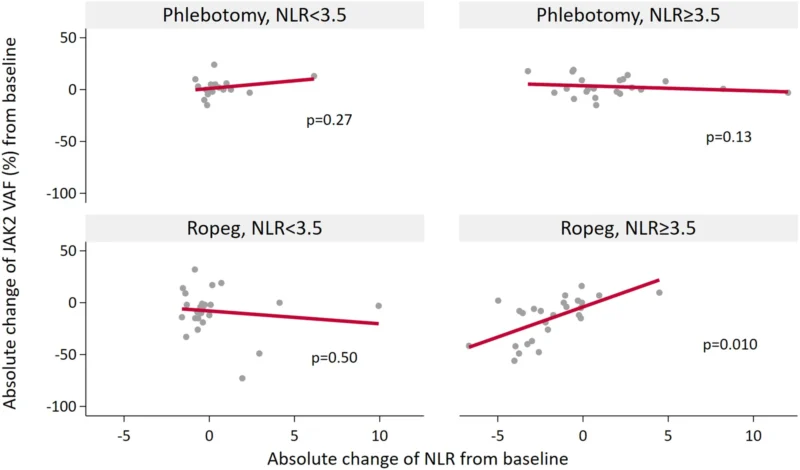
In the Low-PV trial, patients with baseline NLR ≥3.5 had higher VAF and a more proliferative disease phenotype than those with lower NLR. Ropeginterferon reduced NLR more effectively than phlebotomy alone, with the reduction correlating with VAF suppression and achievement of the study’s primary endpoint.
That relationship wasn’t uniform. The link between declining NLR and falling VAF held in patients with elevated baseline inflammation but not in those already below an NLR of 3.5 at 12 months, suggesting baseline inflammatory activity shapes the early molecular effects.
Longer-term data from PROUD-PV/CONTINUATION-PV point the same way. Ropeginterferon produced a sustained NLR reduction, particularly in patients with higher baseline inflammatory burden, an effect not seen with hydroxyurea.
A two-step model of interferon activity is proposed: an early anti-inflammatory, immunomodulatory phase followed by slower, progressive targeting of the malignant clone. In this model, inflammation may sit inside the mechanism that influences molecular response.
Does Ruxolitinib Affect the Clone Through Inflammation?
A longitudinal study by Guglielmelli and colleagues followed 41 patients with hydroxyurea-resistant or -intolerant PV on ruxolitinib for a median of 8.7 years. At baseline, NLR correlated with VAF, patients with high NLR had substantially greater allele burden than those with low NLR (81.8% vs. 54.8%).
Among patients with elevated baseline NLR, both measures fell together during treatment: NLR dropped from 9.6 to 4.2 at three years, VAF from 81.8% to 52.5% at four years. Patients with low baseline NLR showed no significant change in either measure over time.
That parallel movement strengthens the case that inflammatory activity and clonal burden are linked.The fact that ruxolitinib and interferon, mechanistically different drugs, both show this pattern is itself notable. What the data can’t settle is causality.
Ruxolitinib and Interferon May Reduce Allele Burden Differently
Experimental evidence leans toward an inflammation-centered explanation for ruxolitinib. In ruxolitinib-resistant MPN mouse models, efficacy depended less on directly suppressing oncogenic JAK2V617F signaling and more on reducing inflammatory cytokines from non-malignant cells in the microenvironment.
Interferon has evidence for directly targeting mutant stem cells on top of its immune and inflammatory effects. Ruxolitinib may work mainly by changing the environment those cells compete in, though it still produces substantial molecular responses.
MAJIC-PV backs the clinical relevance of that. Among 180 patients with hydroxyurea-resistant or -intolerant PV, ruxolitinib produced a higher complete response rate than best available therapy (43% vs. 26%). Molecular response, at least a 50% VAF reduction, occurred in 56% vs. 25% and tracked with better progression-free, event-free, and overall survival. The trial didn’t measure NLR or other inflammatory biomarkers, though.
Can VAF and NLR Capture Disease Modification in PV?
A falling JAK2V617F VAF is an appealing marker of disease modification, but it does not capture the full picture. Co-occurring mutations can influence both inflammation and clinical outcomes. In MAJIC-PV, ASXL1 mutations independently predicted worse event-free survival. They can also promote inflammation through pathways beyond JAK-STAT signaling.
NLR could provide a complementary view. It is inexpensive, readily available from routine blood counts, and its association with VAF across Low-PV, PROUD-PV/CONTINUATION-PV, and the long-term ruxolitinib cohort makes it an interesting marker of inflammatory activity. But NLR is not disease-specific, thresholds have varied across studies, and longitudinal data are still lacking in evolving or overt myelofibrosis. For now, neither VAF nor NLR should be interpreted alone as a measure of disease modification, their value may lie in combining molecular and inflammatory information.
Future Directions
The picture may become clearer as inflammatory markers are considered alongside other features of the clone. Telomere length may also be relevant. Short telomeres may reflect a longer replicative history of JAK2-mutant hematopoiesis, raising the possibility that different clonal histories carry different inflammatory patterns and treatment responses.
Combination strategies may also have a role. The Danish COMBI-I and COMBI-II studies support combining interferon and ruxolitinib, with improved hematologic and molecular responses and possible restoration of interferon responsiveness.
Statins and metformin have anti-inflammatory and immunomodulatory effects and are being explored as add-ons to established therapy, early evidence cited by the authors suggests statins may enhance interferon-α activity and potentially contribute to minimal residual disease in some patients. More broadly, pairing therapies that hit JAK-STAT-dependent and -independent inflammatory pathways could offer better control of the disease ecosystem.
You can also read about