
Primary central nervous system lymphoma (PCNSL) is an aggressive extranodal large B-cell lymphoma confined to the brain, spinal cord, leptomeninges, or eyes. Why some patients achieve durable remissions while others relapse despite similar treatment remains incompletely understood.
Increasing evidence suggests that the tumor microenvironment plays an important role in CNS lymphoma biology. In experimental models, the chemokine CCL19 has been implicated in retaining malignant B cells within the brain parenchyma, potentially creating supportive niches that favor lymphoma growth. Its receptor, CCR7, is already known to regulate immune-cell trafficking and lymphoma dissemination in systemic lymphomas. The relevance and role of the CCL19-CCR7 axis in human CNS lymphoma have remained largely unexplored.
Against this background, investigators performed a comprehensive multi-omics analysis of CNS lymphoma specimens, integrating genomic, transcriptomic, spatial, and single-cell technologies to define the origin, distribution, and prognostic significance of CCL19. The findings were published in the journal HemaSphere.
Study Design
This translational study analyzed tumor specimens from 82 patients with CNS lymphoma, including 70 cases of PCNSL and 12 cases of secondary CNS lymphoma. An additional 10 glioblastoma samples were included as a reference cohort.
The investigators combined multiple complementary technologies that enabled detailed characterization of tumor genetics, gene-expression programs, cellular composition, and spatial organization within the lymphoma microenvironment.
Patients were stratified according to CCL19 expression levels, and survival analyses were performed among those receiving curative-intent immunochemotherapy. Associations between CCL19 expression, clinical outcomes, tumor burden, genomic alterations, and immune-cell composition were systematically evaluated.
Multi-Omic and Spatial Profiling
Tumor samples underwent comprehensive molecular profiling. Bulk RNA sequencing was used to assess gene-expression patterns and estimate immune-cell composition, while targeted sequencing and shallow whole-genome sequencing characterized mutational profiles and copy number alterations.
Spatial transcriptomics was performed to determine where specific genes were expressed within tumor tissue, and single-nucleus RNA sequencing enabled identification of the individual cell populations responsible for these signals.
Patients were divided into CCL19-high and CCL19-low groups using the median transcript level as the cutoff. Progression-free survival and overall survival were evaluated using Kaplan-Meier and Cox regression analyses, with adjustment for established clinical and radiographic risk factors.
CCL19 Identifies a High-Risk Subgroup of CNS Lymphoma
CCL19 expression varied substantially across the cohort, with approximately 13% of tumors showing no detectable expression. Compared with glioblastoma, CNS lymphoma demonstrated significantly higher CCL19 levels, supporting a disease-specific role for this chemokine within the CNS lymphoma microenvironment.
Patients with high CCL19 expression experienced significantly worse clinical outcomes. Among those treated with curative intent, elevated CCL19 levels were associated with inferior PFS (HR 2.49) and OS (HR 2.43). Importantly, CCL19 remained an independent prognostic factor after adjustment for established risk variables.
The prognostic effect was even more pronounced among patients who completed consolidation therapy. In this subgroup, high CCL19 expression was associated with HR of 5.1 for PFS and 4.9 forOS. Nearly 79% of patients with CCL19-high tumors experienced progression or death within three years, whereas 82% of patients with low CCL19 expression remained disease-free at the same landmark time point.
A trend toward larger tumor volumes was also observed in tumors with higher CCL19 expression, suggesting a possible link between CCL19 abundance and disease burden.
High CCL19 Expression Is Associated With an Immunosuppressive Microenvironment
To better understand the biological basis of these outcome differences, the investigators examined genomic and transcriptomic features associated with CCL19 expression.
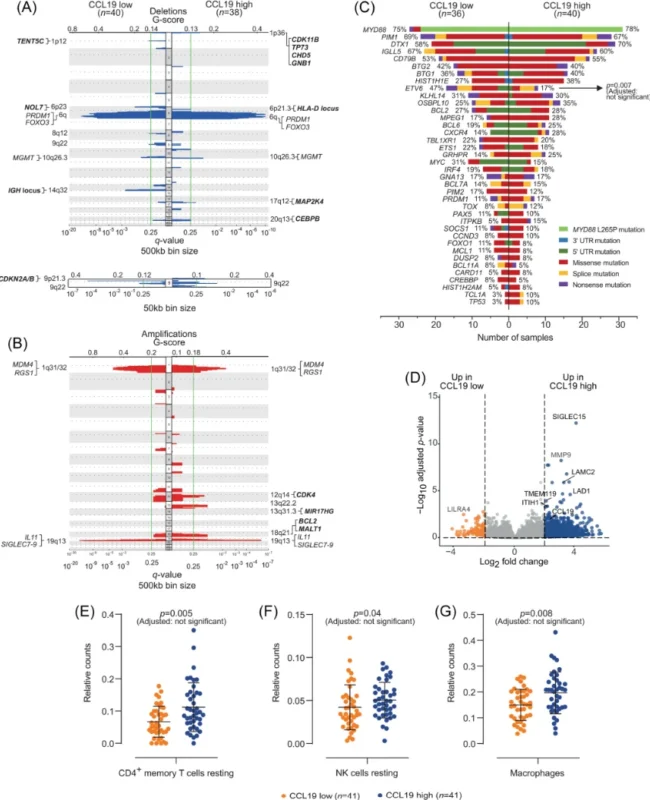
The mutational landscape was remarkably similar between CCL19-high and CCL19-low tumors. Canonical CNS lymphoma mutations involving MYD88, CD79B, PIM1, DTX1, and other commonly altered genes appeared comparable in both groups.
In contrast, important differences emerged at the level of copy number alterations, gene-expression programs, and immune-cell composition. Tumors with high CCL19 expression demonstrated genomic alterations associated with immune escape and resistance to apoptosis, including HLA-region losses, TP73 deletions, and BCL2 gains.
Transcriptomic analyses revealed increased expression of immune-suppressive genes such as SIGLEC15, while gene-set analyses suggested reduced antigen presentation and altered apoptotic regulation. Cellular deconvolution further identified enrichment of macrophages, resting NK cells, and resting CD4-positive memory T cells in CCL19-high tumors.
Pericytes Are the Major Source of CCL19
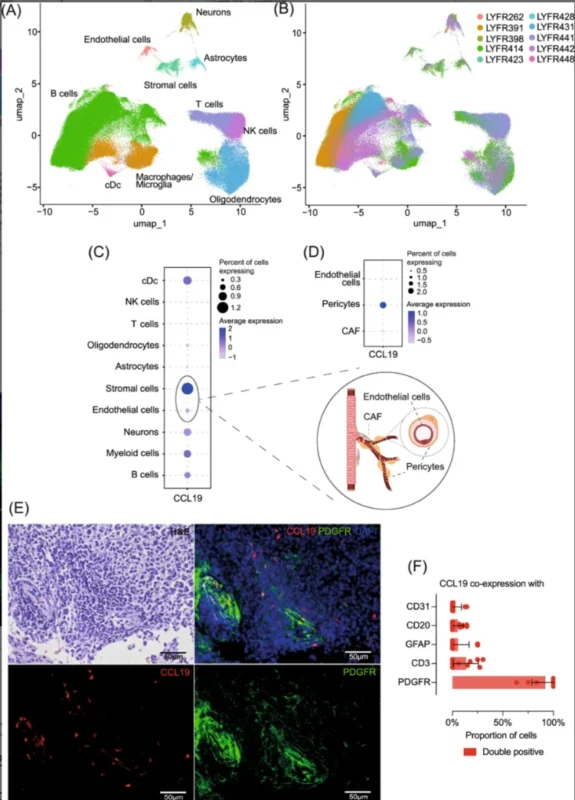
Spatial transcriptomic analyses demonstrated that CCL19 expression was concentrated within highly vascularized regions of lymphoma tissue. Expression progressively declined with increasing distance from vessel-rich areas, suggesting a close relationship between CCL19 production and the vascular compartment.
To identify the cellular source of CCL19, the investigators analyzed approximately 205,000 nuclei obtained from ten CNS lymphoma samples using single-nucleus RNA sequencing. CCL19 expression was found predominantly within stromal cells and was almost exclusively confined to pericytes, specialized cells that surround small blood vessels and contribute to blood-brain barrier integrity.
These findings were validated by immunohistochemistry. Approximately 92% of CCL19-positive cells co-expressed the pericyte marker PDGFR, whereas expression was largely absent in malignant B cells, T cells, astrocytes, and endothelial cells.
Evidence for an Active CCL19-CCR7 Signaling Axis
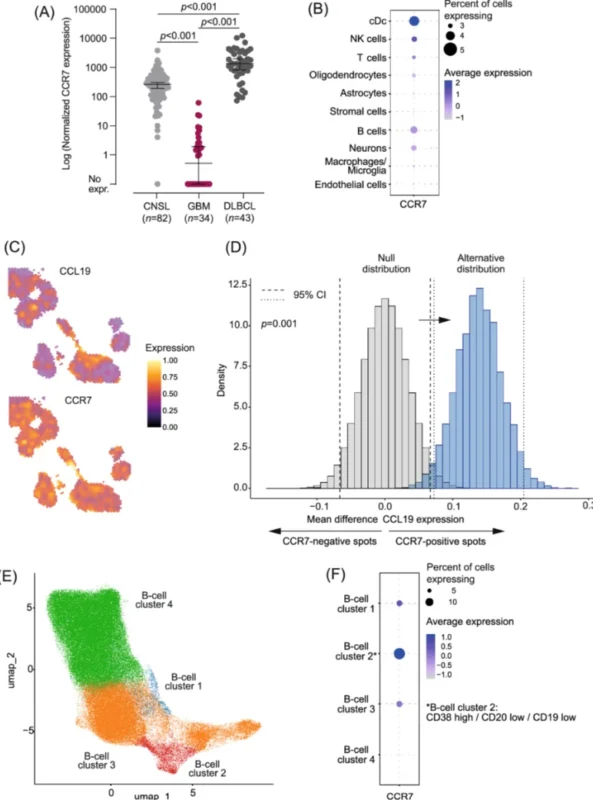
CCR7 (the primary receptor for CCL19) expression was readily detectable in CNS lymphoma and significantly higher than in glioblastoma. Single-cell analyses showed that CCR7 was most strongly expressed in dendritic cells, NK cells, T cells, and subsets of malignant B cells.
Spatial transcriptomic analyses demonstrated significant co-localization of CCL19 and CCR7 within tumor tissue. Particularly prominent CCR7 expression was seen among plasmablast-like malignant B cells, a cellular state previously associated with adverse outcomes.
Conclusion
This study provides one of the most comprehensive characterizations of the CNS lymphoma microenvironment to date and identifies CCL19 as a clinically relevant prognostic biomarker. Using integrated genomic, spatial, and single-cell analyses, the investigators demonstrated that CCL19 is produced primarily by pericytes within vascularized tumor regions and is associated with inferior progression-free and overall survival.
Tumors with high CCL19 expression exhibited features of immune suppression and enhanced resistance to apoptosis despite having a mutational landscape largely similar to that of CCL19-low tumors.
The observed spatial co-localization of CCL19 and CCR7 further supports a potential role for the CCL19-CCR7 axis in CNS lymphoma biology. Together, these findings point to an important role of the tumor microenvironment in disease progression and provide a rationale for exploring CCR7-directed agents in patients with CNS lymphoma.
You can also read: Spatial Omics for Characterizing the Dynamic Tumor Microenvironment