People with human immunodeficiency virus (PLWH) are living longer thanks to contemporary antiretroviral treatment, but lymphoma remains a serious and potentially life-threatening complication. PLWH continue to face a substantially increased risk of both non-Hodgkin lymphoma (NHL) and Hodgkin lymphoma (HL), which frequently present with advanced-stage disease, extranodal involvement, and aggressive clinical features. Globally, HIV is estimated to account for 6.9% of incident NHL and 6.1% of HL cases, contributing to approximately 12,800 NHL cases and more than 81,000 HIV-attributable cancers in 2022 alone.
Non-Hodgkin Lymphoma (NHL): A Practical Biological Map and Integrative Overview
Reconsidering ASCT in HIV-Associated Lymphoma
For patients with chemosensitive relapsed or refractory HL and aggressive NHL, autologous stem cell transplant (ASCT) is the standard consolidative treatment. Historically, HIV infection was considered a contraindication because of concerns regarding uncontrolled viral replication, immunosuppression, opportunistic infections, and treatment-related toxicity.
The advent of contemporary ART improved viral suppression and immune reconstitution, enabling carefully selected PLWH to safely undergo ASCT, with prospective studies over the past two decades demonstrating outcomes approaching those of HIV-negative patients.
The evidence base remains limited, relying largely on small prospective studies, non-comparative analyses, and registry-based reports from specialized transplant centers. The historical exclusion of PLWH from lymphoma clinical trials has further contributed to this evidence gap. Current guidelines encourage the inclusion of PLWH whenever appropriate.
Against this background, Maria F. Comelles and colleagues performed the first systematic review and meta-analysis evaluating prospective evidence for ASCT in HAL. Rather than relying on retrospective experience, the study synthesized prospective data to assess two clinically relevant questions:
How safe is ASCT in PLWH, as measured by non-relapse mortality (NRM)?
How effective is transplantation in patients with relapsed or refractory disease, as reflected by overall survival and progression-free survival?
Methodological Approach
This systematic review followed PRISMA 2020 guidelines. PubMed, Embase, the Cochrane Library, and ClinicalTrials.gov were searched for studies published between January 1996 and June 2026. To maximize evidence quality, only prospective English-language studies enrolling more than 10 eligible patients were included.
Studies evaluating first-line ASCT were included in the safety analysis, whereas efficacy analyses were restricted to relapsed or refractory HAL to avoid inflating survival estimates with lower-risk first-remission populations.
The primary endpoint was 12-month non-relapse mortality (NRM), with 2-year overall survival (OS) and progression-free survival (PFS) as secondary endpoints. When appropriate, pooled survival estimates were generated using random-effects models.
Study Design
The literature search identified 378 records, of which 350 unique studies underwent screening after duplicate removal. Following abstract and full-text review, only six prospective studies met the inclusion criteria, highlighting the limited evidence for ASCT in HIV-associated lymphoma. No randomized controlled trials were identified.
The six studies enrolled 181 patients, of whom 134 underwent ASCT, including 33 with HL and 101 with NHL. The cohorts included biologically aggressive histologies, such as Burkitt lymphoma, while patients with T-cell lymphoma contributed only to safety analyses because of their distinct disease biology and prognosis.
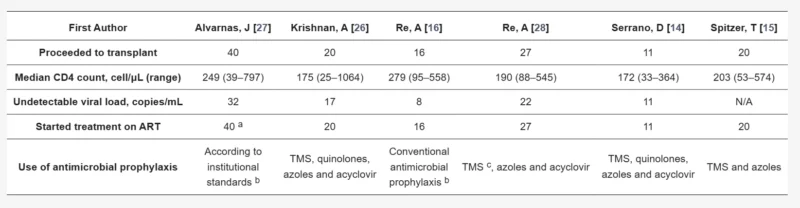
HIV status and infection prevention in transplanted patients in the analyzed studies
All patients received ART, most achieved viral suppression before transplantation, and median CD4 counts ranged from 172 to 279 cells/μL. Eligibility criteria, including minimum CD4 thresholds, viral suppression requirements, and conditioning regimens, varied across studies, reflecting the lack of standardized transplant criteria for PLWH.
Overall, the evidence was of moderate quality, limited by the absence of randomized trials, small sample sizes, heterogeneous transplant protocols, and differences in supportive care. Anyway, restricting the analysis to prospective studies provides the most robust assessment currently available of ASCT safety and efficacy in HIV-associated lymphoma.
Safety Outcomes
Six prospective studies involving 132 transplanted patients contributed to the safety analysis. Because the primary endpoint was transplant-related toxicity rather than disease control, both first-line and relapsed/refractory ASCT studies were included.
The pooled 12-month non-relapse mortality (NRM) was 5.39% (95% CI, 2.28-9.73). All transplant-related deaths occurred within the first six months after ASCT, with no additional NRM events reported between six and twelve months, indicating that the highest risk is confined to the early post-transplant period. Infectious complications accounted for most deaths, primarily bacterial and fungal infections, while cardiotoxicity, hepatic veno-occlusive disease, and gastrointestinal infection were reported less frequently.
The observed NRM was comparable to that reported historically in HIV-negative transplant populations, suggesting that HIV infection alone should not preclude ASCT in appropriately selected patients. These findings should be interpreted cautiously because HIV-specific eligibility criteria, including minimum CD4 counts and viral suppression requirements, varied across studies. All patients received contemporary ART and were treated at experienced transplant centers, factors that likely contributed to the favorable safety outcomes.
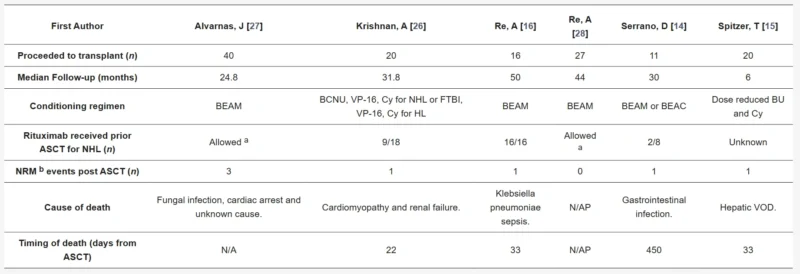
Treatment exposure and NRM in the analyzed studies.
Survival Outcomes
Efficacy analyses were restricted to patients with relapsed or refractory HAL, excluding those transplanted in first complete remission because of their more favorable prognosis. Although six prospective studies were identified, only two provided sufficiently comparable survival data for pooled analysis, yielding a cohort of 52 patients.
The pooled 2-year OS was 79.8%, while 2-year PFS reached 77.9%. Histology-specific analyses showed similarly favorable outcomes, with 2-year OS and PFS of 80.5% in HL and 2-year OS of 78.7% and PFS of 75.9% in NHL.
These outcomes are notable given the study population. The pooled cohorts included patients with Burkitt lymphoma and plasmablastic lymphoma, aggressive subtypes associated with poor outcomes after relapse, as well as patients who had received one or two lines of salvage therapy before transplantation. Despite this heterogeneity, long-term disease control remained favorable.
Compared with historical HIV-negative ASCT cohorts, where reported 2-year OS is generally around 70%, the observed outcomes appear favorable. These comparisons remain indirect because differences in transplant era, conditioning regimens, lymphoma subtype, supportive care, and patient selection preclude definitive conclusions regarding equivalence between HIV-positive and HIV-negative populations.
Clinical Perspective
This review demonstrates that ASCT can achieve favorable outcomes in carefully selected PLWH treated in the modern ART era. All transplanted patients received ART, most achieved viral suppression before ASCT, and advances in supportive care have reduced many of the concerns that historically limited the use of transplantation in this population.
Although based on a limited number of prospective, non-randomized studies, this review provides the highest-quality evidence currently available. Larger prospective studies are now needed to refine patient selection, establish standardized transplant eligibility criteria, and define how ASCT should be integrated with emerging therapies such as CAR T-cell therapy and bispecific antibodies. while ensuring the routine inclusion of PLWH in lymphoma clinical trials.
Hodgkin Lymphoma (HL): Microenvironmental Biology Behind a Therapeutic Success Story