
The earliest genetic events leading to acute myeloid leukemia (AML) often occur during childhood or early adulthood, more than 50 years before clinical diagnosis, a recent Nature study suggests. Early driver mutations generally produce slow-growing clones, and later drivers sharply increase their competitive advantage.
Using serial blood samples collected over a decade, Caroline J. Watson and colleagues reconstructed how preleukemic clones acquire successive mutations, compete within the hematopoietic system, and evolve into leukemia
Study Design: Tracking Blood Clones Up to 15 Years Before AML
Most AML genetic studies analyze samples taken at diagnosis. These reveal which mutations are present in leukemia cells but not when they arose or how individual clones evolved.
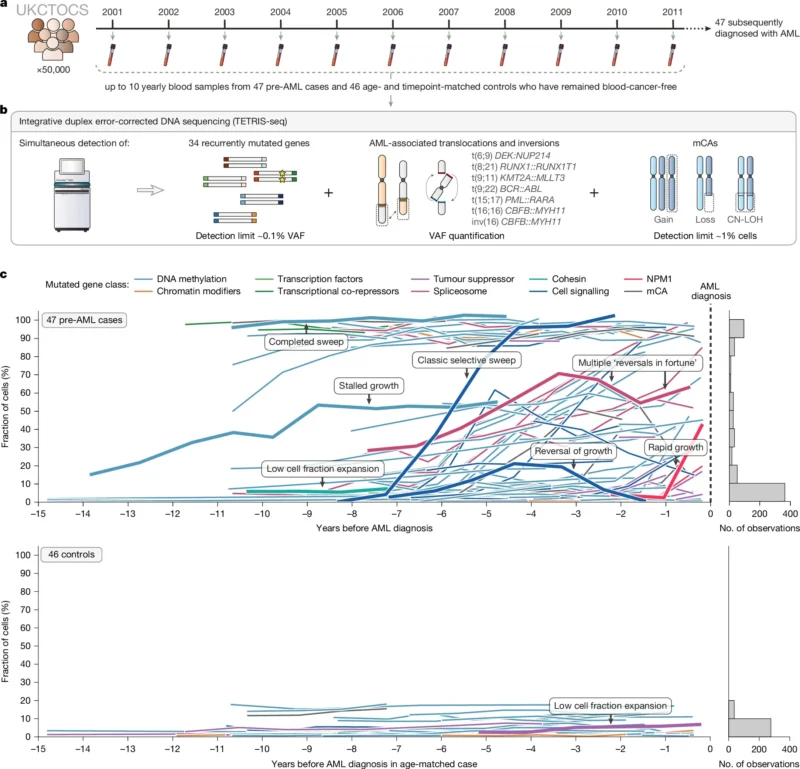
Watson and colleagues used samples from the United Kingdom Collaborative Trial of Ovarian Cancer Screening (UKCTOCS), which enrolled more than 200,000 postmenopausal women between 2001 and 2005. Participants in the multimodal screening arm gave annual blood samples. The researchers identified 47 women who later developed AML and had samples from at least two timepoints before diagnosis (median age at diagnosis, 72 years; 249 samples, up to ten timepoints per participant). Longitudinal samples from 46 age-matched controls without hematologic malignancy served as comparators.
The investigators developed TETRIS-seq, which combines duplex error correction, targeted detection of AML-associated alterations, and computational noise reduction. It reliably detected mutations at variant allele frequencies (VAFs) as low as 0.1%, allowing them to follow small clones that conventional sequencing would often miss. Changes in variant frequency over time showed when clones emerged, whether mutations shared a lineage, and how growth rates changed before diagnosis.
Clonal Hematopoiesis: Why Some Mutated Clones Progress Toward AML
Clonal hematopoiesis occurs when a hematopoietic stem cell acquires a somatic mutation that lets its descendants expand. Mutations in genes such as DNMT3A, TET2, and ASXL1 are common with aging, and most carriers never develop AML.
Clonal hematopoiesis was present in 89% of future AML cases and 72% of controls, but the clones behaved differently. In controls, clones generally stayed small (frequently under 20% of the hematopoietic population), changed little during follow-up, and mostly carried DNMT3A or TET2 mutations.
Future AML cases showed a broader mutation spectrum, including RNA splicing, cell signaling, and tumor suppressor pathways. Their clones changed more in size: some expanded rapidly, and others declined as competing lineages emerged. The decisive feature was acquisition of additional drivers within an existing clone, producing descendants with progressively stronger growth advantages.

Clones and Clonality: Darwinian Natural Selection at the Cellular Level
Three Evolutionary Patterns Preceding Acute Myeloid Leukemia
Longitudinal sequencing identified three patterns:
Linear evolution (26 of 47 cases, 55%): Drivers accumulated sequentially along a dominant lineage. Each new mutation produced a faster-growing descendant that could come to dominate hematopoiesis. Timing and extent of expansion varied substantially between patients.
Clonal interference (11 cases, 23%): Multiple lineages acquired drivers independently and expanded to substantial fractions. Some initially successful clones declined when genetically distinct competitors gained greater fitness. These lineages sometimes carried three or four drivers and showed growth followed by stagnation or contraction.
Late evolution (10 cases, 21%): Preleukemic clones appeared only in the final one or two years before diagnosis, or stayed undetectable within the panel. Explanations include genuinely rapid leukemogenesis, drivers outside the targeted regions, and clones below the detection threshold. Methylation-based evidence supported previously undetected clonal expansions in five of the ten.
The First AML Driver Mutations Often Arise Before Age 20
In approximately two-thirds of individuals who developed AML, the first driver mutation was inferred to have arisen by age 20. On average, these events preceded diagnosis by more than 50 years, when hematopoiesis was still highly polyclonal.
Estimated fitness advantages rose with each additional driver:
- First driver: approximately 10-30% per year, with clonal doubling every two to seven years.
- Second driver: present by age 50 in a third of cases, acquired about 30 years before diagnosis on average, with doubling times of one to three years.
- Third driver: approximately 50-200% per year.
- Fourth driver: some clones approached 1,000% per year.
Fitness increased roughly two- to threefold with each additional driver, suggesting strong cooperation between mutations in the same lineage. The molecular interactions were not established. Acquisition ages come from mathematical reconstruction of mutation trajectories, including extrapolation to periods before sampling began, so they are model-based estimates and not mutations observed in childhood.
How Additional Driver Mutations Accelerate Preleukemic Evolution
Individual trajectories showed how a slowly expanding clone becomes highly competitive. In one patient, a TET2-mutated clone emerged at about age 39 with a doubling time of 2.4 years. Almost three decades later it acquired two further drivers, shortening the doubling time to about eight weeks, and AML was diagnosed at age 70.
Another patient acquired an SRSF2 mutation at about age 47. The clone expanded slowly until an IDH2 R140Q mutation emerged around age 67. The double-mutant clone then doubled about every seven months, outcompeted smaller CHEK2 and IDH1 clones, and overtook hematopoiesis before AML diagnosis at age 80.
More complex cases involved successive waves of competition among clones carrying JAK2, MPL, and chromosomal alterations. In one individual, a lineage acquired additional events, displaced the previous dominant competitors, and swept through the blood in under two years. When observed trajectories could not be explained by known alterations, the researchers could infer the presence of undetected drivers from the growth patterns of other lineages.
Somatic Sweeps May Identify Individuals at Particularly High Risk
Somatic sweeps occur when descendants of a mutated hematopoietic stem cell become dominant across the blood-cell population. Sweeps were observed in at least one-third of future AML cases, often before longitudinal sampling began. No comparable complete or ongoing sweeps were detected in controls. A very large clone offers an expanded population in which further transforming mutations can arise, so a high-VAF mutation may mark a long-established lineage with considerable evolutionary potential.
In a stochastic model of mutation acquisition, clonal fitness, and competition, approximately 99% of simulated AML cases had a sweep more than five years before diagnosis, and approximately 98% had one more than ten years before. These are simulated proportions, not observed clinical frequencies.
The investigators then tested the association in UK Biobank sequencing data. Among 5,034 individuals carrying mutations at selected clonal hematopoiesis hotspots, 388 had at least one variant with VAF above 30%, the study’s operational threshold for a sweep. Of these, 42 later developed myeloid leukemia.
A high-VAF somatic hotspot variant was associated with markedly increased odds of future myeloid leukemia (odds ratio, 107; 95% confidence interval, 75-150; P = 2.7 × 10⁻⁶⁷). The analysis covered myeloid leukemia broadly and selected hotspots, so the magnitude may not apply to every high-VAF mutation or to AML alone.
Very high-VAF somatic mutations can resemble inherited variants, and standard pipelines may remove them during germline filtering. Sequencing a second tissue, such as a buccal sample, could separate somatic from inherited alterations.
nature.com
Evolutionary Model: Simple Rules Reproduce Population AML Incidence
The model assumed that stem cells acquire drivers at a roughly constant rate, that each mutation confers a fitness advantage, and that clones expand according to their fitness relative to the surrounding population. A lineage may expand initially and then decline when a fitter competitor emerges.
Approximately 200,000 simulated histories reproduced linear progression, competing lineages, and selective sweeps. Simulated cumulative AML incidence by age 85 was 0.47%, against a population estimate of 0.48%. Transformation was defined simply as four drivers in one clone followed by expansion beyond 50% of the hematopoietic population.
The same rules applied to every simulated individual produced very different outcomes. Random mutation acquisition determined whether highly fit clones emerged early enough to progress toward AML, and once established, their growth was relatively predictable from fitness. This separation helps explain why age-related driver mutations are widespread in healthy individuals while AML remains uncommon.
Implications for AML Risk Prediction and Prevention
Secondary and tertiary drivers often arise more than a decade before diagnosis, which opens a prolonged preclinical window for identifying high-risk clones. Conventional clonal hematopoiesis assessment considers mutation identity, clone size, and associated clinical abnormalities. The evolutionary framework adds mutation combinations, acquisition timing, and longitudinal growth dynamics.
In simulations, a dominant sweep combined with a second substantial driver clone marked particularly high future AML risk. These estimates depend on simulation assumptions and are not validated clinical thresholds.
Slowing the growth of highly fit preleukemic clones might lower their chance of acquiring further transforming mutations. The SRSF2/IDH2 R140Q clone grew for approximately 14 years before AML diagnosis, an interval in which a low-toxicity intervention could theoretically alter its evolution. The investigators discussed IDH inhibition and neoantigen-directed vaccination as possible approaches. Both remain hypotheses.
Study Limitations
Diagnostic AML tissue was unavailable, so the study cannot confirm that the tracked clones gave rise to the leukemia. Some final transforming mutations may have occurred after the last blood sample. The targeted panel could miss uncommon or unidentified drivers: NPM1 and FLT3 mutations, common at AML diagnosis, were rare in prediagnostic samples, consistent with later acquisition. The model also failed to reproduce the late-evolution cases, which made up about 20% of the cohort.
The population was exclusively female and older. Information on antecedent myeloid disease and previous treatment came from registries, and the model assumed a stem-cell population size. The inferred fitness values are effective competitive advantages and may also reflect changes in stem-cell behavior or differentiation.
Bottom Line
Large somatic sweeps, particularly those involving additional driver mutations, are potential markers of future myeloid leukemia risk. Clinical use will require independent validation, reliable discrimination between somatic and germline variants, and risk models that identify individuals who could benefit from preventive intervention.
Reference: Watson CJ, Poon GYP, MacGregor HAJ, et al. Evolutionary dynamics in the years preceding acute myeloid leukaemia. Nature. 2026.