This week’s posts feature expert recommendations on key trials to watch at ASH 2026 in acute myeloid leukemia and plasma cell disorders, practice-relevant discussions on BrECADD versus nivolumab-AVD in advanced Hodgkin lymphoma, and current challenges in managing TP53-mutated AML and MDS. Long-term outcomes cover treatment selection, progression, and histological transformation in splenic marginal zone lymphoma, and patient-reported late effects after allogeneic stem cell transplantation.
Some posts discuss the evolution of AML decades before diagnosis, access to next-generation sequencing for patients with AML in Mexico, and the growing role of artificial intelligence in hematology, including questions about its clinical responsibilities and limitations.
Here are 10 heme-onc posts not to miss from the second week of November.
Mette Schaufuss Engedal – PhD Researcher, Department of Hematology, Rigshospitalet, Copenhagen, Denmark
“Our nationwide study of patient-reported late effects after allogeneic stem cell transplantation is now published in Transplantation and Cellular Therapy.
895 survivors – 67% of those eligible – participated in the study, representing people transplanted in Denmark between 1973 and 2024.
The findings revealed a substantial burden:
• An average of 18 concurrent symptoms; only 1% reported none.
• Poorer health-related quality of life than Danish population norms.
• Low or moderate sexual functioning reported by 91%.
• Among participants aged 67 or younger, 45% were not working.
These findings highlight the need for survivorship follow-up that addresses symptoms, functioning and everyday life. Through AlloCare, we are building on this knowledge to develop and evaluate a stepped care approach to address survivorship challenges in follow-up.”
Maximilian Stahl – Director of the Leukemia and Myeloid Malignancy Program, Yale Cancer Center, USA
“What to do about TP53 mutated MDS/AML.
My thoughts from the 8th International Workshop on Acute Leukemias (iwAL) in Cambridge, MA.”
Samer Al Hadidi – Associate Professor at the Harold C. Simmons Comprehensive Cancer Center/UT Southwestern Medical Center
“My top ASH26 abstracts for plasma cell disorders, including myeloma and AL amyloidosis.
1. MonumenTAL-6: Teclistamab + talquetamab and talquetamab + pomalidomide versus EPd/PVd in relapsed/refractory multiple myeloma after 1–4 prior lines of therapy.
2. MagnetisMM-5: Elranatamab versus daratumumab, pomalidomide, and dexamethasone (DPd) in relapsed/refractory multiple myeloma.
3. iMMagine-1: Anitocabtagene autoleucel (anito-cel), a BCMA-directed CAR-T therapy, in fourth-line or later relapsed/refractory multiple myeloma.
4. EXCALIBER-RRMM: Iberdomide, daratumumab, and dexamethasone versus daratumumab, bortezomib, and dexamethasone in relapsed/refractory multiple myeloma after 1–2 prior lines of therapy.
5. IEC-Enterocolitis After Cilta-cel: Incidence and characterization of immune effector cell-associated enterocolitis following commercial ciltacabtagene autoleucel therapy.
6. NEXICART-2: NXC-201 BCMA-directed CAR-T therapy in relapsed/refractory AL amyloidosis.
7. BMS-986453: Dual BCMA×GPRC5D-targeted CAR-T therapy in relapsed/refractory multiple myeloma.
8. TALisman: Prophylactic strategies for talquetamab-associated oral toxicity, including dexamethasone mouthwash.
9. CaMMouflage: CB-011, an allogeneic CRISPR-edited BCMA-directed CAR-T therapy in relapsed/refractory multiple myeloma.
10. Frontline Teclistamab: Teclistamab monotherapy in newly diagnosed Mayo stage IIIB AL amyloidosis.
Looking for great meeting “
Hayder Saeed – Associate Vice President, Tampa General Hospital, and Associate Professor, University of South Florida, USA
” BrECADD or nivo-AVD?
GHSG and SWOG pooled their patient-level data. Stage III/IV, 18-60: 3-yr PFS 94.9% vs 90.6%, febrile neutropenia 29% vs 6%, OS similar. Weighted, not randomized. Gap mostly in IPS 3-7. Accept more toxicity there? ”
Mohamed Benlazar – Professor of Hematology and Head of the Hematology Department, Université de Sidi Bel Abbès, Algeria
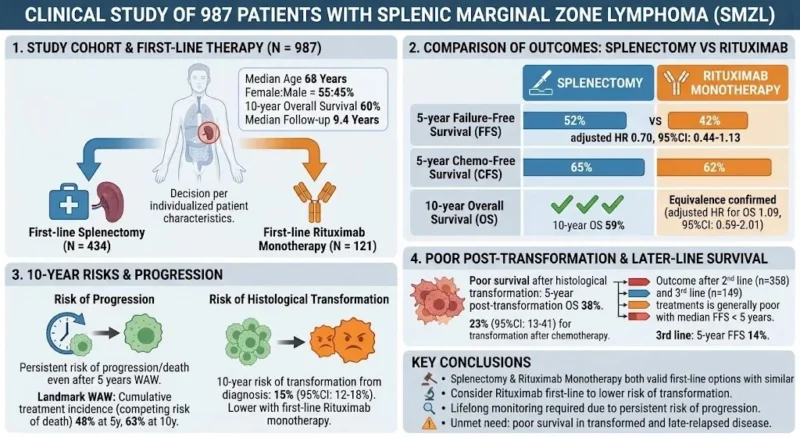
“Clinical characteristics, treatment, and long-term outcomes in 987 patients with splenic marginal zone lymphoma to inform treatment and surveillance strategies ”
Read the full article
Eleftheria Hatzimichael – Head of the Department of Medical Oncology, University General Hospital of Ioannina, Greece
“AI can now read a smear, score a prognosis, suggest a regimen. It still cannot hold a licence.
On 9 November 2026, the American Medical Association’s House of Delegates drew that line in policy: AI cannot be granted physician licensure, titles or certification. It belongs in physician-led teams, at the direction of the treating physician.
What stayed with me is the part about liability:
- If a physician uses an AI tool as intended, with sound judgement, and the tool errs, responsibility should rest with the manufacturer, not the physician.
- If a hospital or payer mandates the tool, it should share that responsibility.
- Contracts should not be allowed to shift product failure onto the clinician.
- A physician who chooses not to follow an AI recommendation should be protected for that choice.
That last point is the pivot. Clinical judgement is not deviation. It is the reason we are in the room.
A note for colleagues in Europe: this is AMA policy and advocacy, not law, and it does not apply here. Our framework is the AI Act, the MDR and the new EU Product Liability Directive, which explicitly covers software. The questions, though, are the ones we will face at our next procurement meeting.
In haematology, from morphology to prognostic models to trial matching, these tools are arriving fast. Let’s meet them prepared. Keep Medicine Human. Use AI wisely.”
Andrés Gómez De León – Associate Professor of Hematology, Universidad Autónoma de Nuevo León, and Partner at Clínica Gómez Almaguer, Monterrey, Mexico
“Precision medicine should also be possible for all patients.
I am very pleased to share our recent publication in Blood Global Hematology:
Next-generation sequencing implementation in Mexican adults with acute myeloid leukemia.
In this prospective study, we evaluated the implementation of next-generation sequencing (NGS) in 37 patients with acute myeloid leukemia treated at the “Dr. José Eleuterio González” University Hospital of the UANL.
We find that:
- The implementation of NGS was technically feasible in our environment.
- 78% of the patients presented genetic findings with potential clinical utility.
- We identified particular characteristics of the molecular profile of our population, which reinforce the importance of generating local evidence.
However, our study also reflects an important reality: having access to better diagnostic tools does not necessarily translate into better outcomes if patients are unable to access the treatments they need. This work represents an effort to bridge the gap between advances in precision medicine and its implementation in clinical practice in middle-income countries.
I thank all the collaborators who made this project possible, especially our team at the University Hospital and the Pathology Service that made it possible. It is not enough to import knowledge. We also need to generate, validate and implement it in our own health systems.”
Talha Badar – Leukemia Physician-Scientist and Associate Professor, Mayo Clinic, USA
“ASH 2026: 11 AML Oral Abstracts to Watch
With ASH 2026 approaching, here are AML presentations on my watchlist, spanning frontline therapy, targeted approaches, MRD, and emerging treatment strategies:
- Ivosidenib + intensive chemotherapy in newly diagnosed IDH1-mutated AML, phase 3 (HOVON150/AMLSG29-18)
Abstract 0001 - Gilteritinib vs midostaurin in newly diagnosed FLT3-mutated AML (HOVON156/AMLSG28-18/pasha)
Abstract 56 - Bleximenib in R/R KMT2A-rearranged or NPM1-mutated AML, phase 2 CAMELOT-1
Abstract 661 - Cladribine + LDAC + venetoclax vs 7+3 in newly diagnosed AML age ≥60
Abstract 57 - Discontinuation of HMA + venetoclax in newly diagnosed AML with undetectable MRD
Abstract 1009 - Sonrotoclax + azacitidine across ELN 2024 genetic risk groups in treatment-naive AML unfit for intensive chemotherapy
Abstract 60 - Venetoclax + 3-day multi-frequency decitabine vs AZA + VEN in older adults with newly diagnosed AML
Abstract 1012 - Whole-genome-informed MRD testing, prospective multicenter validation (MEASURE)
Abstract 390 - VEN + AZA vs daunorubicin + cytarabine in young adults with ELN adverse-risk AML, phase 2b
Abstract 1010 - Ziftomenib + gilteritinib in R/R NPM1/FLT3 co-mutated AML, first results from KOMET-008
Abstract 66 - FLAI-G frontline therapy in younger patients with FLT3-mutated AML, phase 2 GIMEMA AML2924
Abstract 903
A particularly interesting year for frontline AML, with randomized comparisons challenging established approaches, expanding targeted therapies, and increasing focus on MRD-guided treatment decisions. Looking forward to seeing the data and discussions in New Orleans.
Abstract 0001 is currently listed in the ASH press program; oral/plenary status is not yet confirmed.
Which AML abstracts are on your ASH 2026 watchlist?”

Larissa Zanetti – Cell Therapy Coordinator, Hospital Israelita Albert Einstein, São Paulo, Brazil
“Three papers approved at ASH 2026!
We are pleased to share that our group has had three papers selected for presentation at the 68th American Society of Hematology (ASH) Annual Meeting & Exposition, which will take place December 12-15 in New Orleans, USA.
Our participation will feature an oral presentation and two poster presentations, addressing advances in the development of CAR-T and CAR-NK cell therapies:
Oral presentation
• Extramedullary relapse emerges as a resistance mechanism following effective CD70- and BCMA-directed CAR-NK therapy in multiple myeloma.
Poster presentations
• IL-15 armoring enhances BCMA, CAR-T persistence and tumor eradication, but drives antigen-independent GVHD-like toxicity in preclinical models of multiple myeloma.
• Cord blood-derived CD70 CAR-NK cells mediate durable antileukemic activity and complete bone marrow leukemia clearance in aggressive AML models.
The works reflect different fronts of our research, from the investigation of mechanisms of resistance to cell therapies to the engineering and pre-clinical evaluation of new immunotherapy strategies.
This achievement is the result of our group’s dedication!
We continue to work to transform scientific knowledge into new therapeutic possibilities for cancer patients. See you at ASH 2026! “
Mohamad Mohty – Professor of Hematology at Sorbonne University, and head of the Clinical Hematology and Cellular Therapy Department at Saint-Antoine Hospital, Paris, France
“Could acute myeloid leukemia (AML) begin 50 years before diagnosis?
Just finished reading this fascinating new study published in Nature by Watson and colleagues. It definitely challenges our understanding of how acute myeloid leukemia (AML) develops.
Using longitudinal blood samples and ultra-sensitive sequencing, the investigators reconstructed the evolutionary history of preleukemic clones.
I can identify 3 key findings:
– Leukemia may begin remarkably early: in approximately two-thirds of future AML patients, the first driver mutation was estimated to have occurred before age 20!
– Clonal evolution progressively accelerates: as additional driver mutations accumulate, the selective advantage of preleukemic clones increases dramatically, sometimes allowing them to double within weeks or months.
– Clonal dominance matters: large somatic clonal expansions were associated with a strikingly increased risk of subsequent myeloid malignancy (OR 107 in an independent UK Biobank analysis).
The implications are profound. Perhaps the future of AML risk prediction will depend not only on identifying mutations, but also on understanding their evolutionary dynamics, clonal competition, and growth trajectories. Could we eventually identify high-risk clones decades before leukemia develops and intervene before malignant transformation?
Of course, clinical validation and prospective intervention studies remain essential, but we need to move beyond a static snapshot of clonal hematopoiesis and start understanding the entire movie of its evolution. Because the future of leukemia «prevention» may lie in changing the trajectory of clonal evolution before it becomes irreversible.”