The phase 2 REPRINT trial, presented by Giuseppe Procopio at the ESMO Congress 2026, reported first-stage results with pembrolizumab plus enfortumab vedotin in collecting duct carcinoma (CDC) and renal medullary carcinoma (RMC), two rare, aggressive renal malignancies.
The objective response rate was 22% among nine evaluable patients. Both responses occurred in patients with SMARCB1-deficient renal cell carcinoma unclassified with medullary phenotype (RCCU-MP), a subtype of RMC. No patient with CDC responded. The trial met its prespecified criteria to proceed beyond the first stage.
Background
Collecting duct carcinoma (CDC) and SMARCB1-deficient renal medullary carcinoma (RMC) are rare, aggressive renal malignancies associated with poor prognosis. Together, they account for approximately 1% of primary kidney tumours, with median overall survival of less than one year in metastatic disease.
Treatment options for advanced disease remain limited due to the scarcity of prospective clinical trials. Clinical data support platinum-based chemotherapy in both tumour types, while cabozantinib for CDC and panitumumab for RMC have been identified as potential therapeutic options. The Phase II REPRINT trial evaluated pembrolizumab plus enfortumab vedotin in patients with advanced CDC and RMC.
REPRINT: Study Design
REPRINT is a Phase II trial using Simon’s two-stage design. Eligible patients had histologically confirmed CDC or RMC, advanced or metastatic disease with measurable lesions according to RECIST 1.1, and an ECOG performance status of 0–1. Central pathological review was required.
Patients received pembrolizumab 200 mg intravenously every three weeks plus enfortumab vedotin 1.25 mg/kg on Days 1 and 8 of each 21-day cycle for three cycles. This was followed by pembrolizumab monotherapy until disease progression, unacceptable toxicity, or 24 months. Patients experiencing disease progression during pembrolizumab monotherapy could restart enfortumab vedotin.
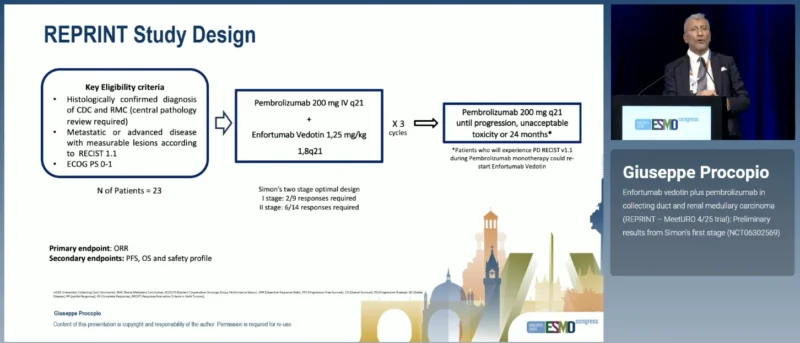
The primary endpoint was objective response rate (ORR), while secondary endpoints included progression-free survival (PFS), overall survival (OS), and safety. Between May 2025 and April 2026, 13 patients were enrolled. Following central pathological review, four were excluded, leaving nine evaluable patients: seven with CDC and two with renal cell carcinoma unclassified with medullary phenotype (RCCU-MP), a subtype of RMC not associated with sickle haemoglobinopathies.
Metastatic sites included lymph nodes in 88% of patients, lungs in 77%, and bones in 33%. All nine evaluable patients received three cycles of pembrolizumab plus enfortumab vedotin.
Key Findings
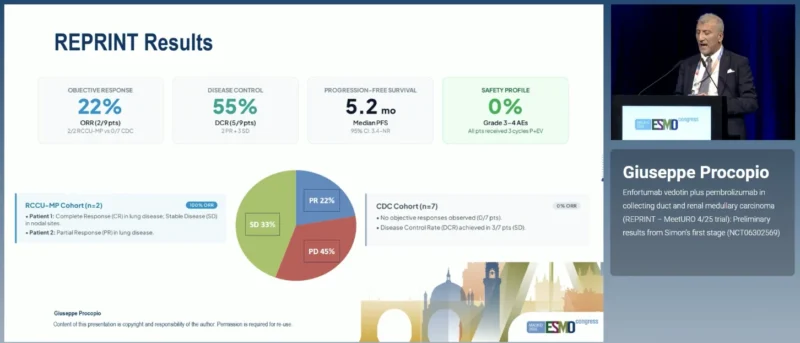
The objective response rate was 22% (2/9), with both responses occurring in the two patients with RCCU-MP. No objective responses were observed among the seven patients with CDC. The disease control rate was 55% (5/9), comprising two partial responses and three cases of stable disease. Median PFS was 5.2 months (95% CI 3.4–not reached).
Among the two RCCU-MP patients, one experienced complete disappearance of lung lesions with stable disease in nodal sites, while the other achieved a partial response in lung disease. Both were classified as partial responders in the overall analysis. These preliminary findings met the prespecified response criterion required to proceed beyond the first stage of Simon’s two-stage design.
Biomarkers: Responses Without Membranous NECTIN-4
Both responding patients had SMARCB1-deficient RCCU-MP, with negative membranous NECTIN-4 expression. Their biomarker profiles showed PD-L1 combined positive scores of 10 and 20, respectively, and tumour mutational burdens of 1.6 and 3.8 mutations per megabase.
The observation of responses in two patients with negative membranous NECTIN-4 expression warrants further investigation. However, the small number of patients does not allow conclusions about the predictive value of NECTIN-4 expression or other biomarkers.
Safety
No grade 3 or 4 adverse events were reported in the first-stage analysis. The small cohort and preliminary nature of these findings limit conclusions about uncommon or delayed toxicities.
Takeaway
The first-stage results of the Phase II REPRINT trial demonstrated preliminary antitumour activity with pembrolizumab plus enfortumab vedotin in patients with rare, aggressive renal malignancies.
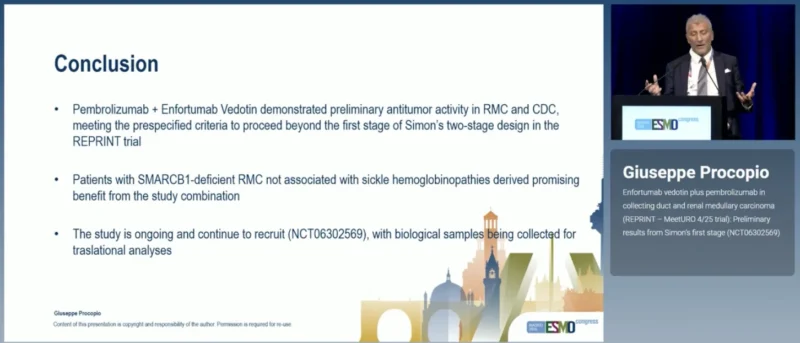
Both objective responses occurred in patients with SMARCB1-deficient RCCU-MP, while no objective responses were observed among seven patients with CDC. The combination met the prespecified criteria to proceed beyond the first stage of Simon’s two-stage design.
Both responding tumours were negative for membranous NECTIN-4 expression, supporting further investigation of potential response biomarkers.
The study remains ongoing, with continued recruitment and collection of biological samples for translational analyses. Additional patients and follow-up are needed to better characterize efficacy and safety.
KEYNOTE-B15/EV-304 at ESMO 2026: HRQoL With Enfortumab Vedotin Plus Pembrolizumab in MIBC