At the ESMO Congress 2026, Daniel Y. Heng (Calgary, Canada) presented the final analysis of the Phase III LITESPARK-011 trial (NCT04586231), evaluating belzutifan plus lenvatinib compared with cabozantinib in patients with advanced clear cell renal cell carcinoma (ccRCC) following anti–PD-(L)1 therapy.
The analysis, presented in the Proffered Paper session (3587O), reported final overall survival (OS) findings alongside updated progression-free survival (PFS), objective response rate (ORR), duration of response (DOR), and safety outcomes.
Why Was LITESPARK-011 Conducted?
The Phase III LITESPARK-011 trial evaluated belzutifan plus lenvatinib as a treatment option for patients with advanced clear cell renal cell carcinoma whose disease had progressed following anti–PD-(L)1 therapy.
Earlier analyses demonstrated statistically significant improvements in PFS and ORR with belzutifan plus lenvatinib compared with cabozantinib. However, although overall survival had been evaluated, the previous analyses did not demonstrate a statistically significant OS benefit. The final analysis assessed overall survival with longer follow-up and evaluated whether the previously observed PFS and ORR benefits were maintained.
LITESPARK-011 Study Design and Methods
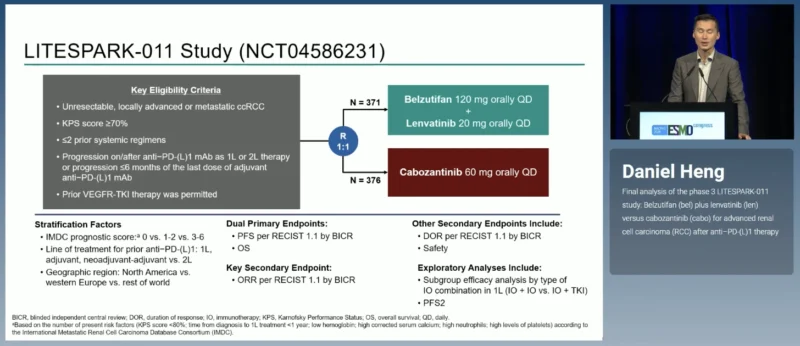
LITESPARK-011 was a randomized Phase III trial enrolling adults with advanced clear cell renal cell carcinoma who experienced disease progression on or after first- or second-line anti–PD-(L)1 therapy, or within six months of the last dose of adjuvant anti–PD-(L)1 therapy.
Patients were randomized in a 1:1 ratio to receive:
- Belzutifan plus lenvatinib: Belzutifan 120 mg once daily combined with lenvatinib 20 mg once daily.
- Cabozantinib: Cabozantinib 60 mg once daily.
The dual primary endpoints were PFS, assessed by blinded independent central review (BICR) according to RECIST 1.1, and overall survival. Objective response rate assessed by BICR was a key secondary endpoint, while duration of response and safety were additional secondary endpoints. PFS and ORR had met their respective statistical significance criteria at earlier interim analyses and were not formally tested at the final analysis.
Key Findings from LITESPARK-011
A total of 747 patients were randomized, including 371 patients assigned to belzutifan plus lenvatinib and 376 assigned to cabozantinib. At the February 2, 2026 data cutoff, median follow-up was 38.8 months (range 29.1–59.0).
Progression-Free Survival
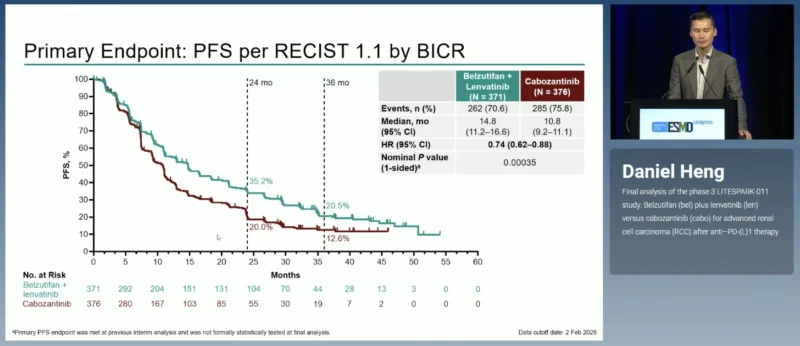
The previously demonstrated PFS benefit with belzutifan plus lenvatinib was maintained at the final analysis. Median PFS was 14.8 months with belzutifan plus lenvatinib compared with 10.8 months with cabozantinib (HR 0.74; 95% CI 0.62–0.88). The estimated 36-month PFS rate was 20.5% with belzutifan plus lenvatinib versus 12.6% with cabozantinib. These updated findings were consistent with the PFS benefit established at earlier interim analyses. PFS was not formally retested for statistical significance at the final analysis.
Overall Survival
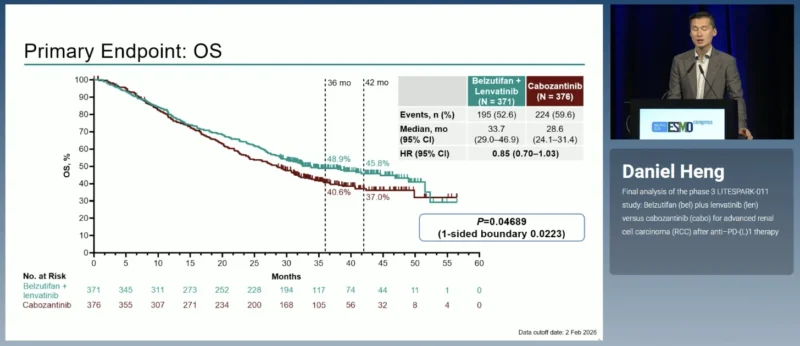
At the final analysis, overall survival numerically favoured belzutifan plus lenvatinib, although the difference did not meet the prespecified threshold for statistical significance. Median OS was 33.7 months with belzutifan plus lenvatinib compared with 28.6 months with cabozantinib, representing a numerical difference of 5.1 months. The OS hazard ratio was 0.85 (95% CI 0.70–1.03), with a one-sided p value of 0.04689.
However, the prespecified statistical significance boundary was 0.0223. Therefore, the OS comparison did not demonstrate a statistically significant improvement. At 36 months, the estimated OS rate was 48.9% with belzutifan plus lenvatinib compared with 40.6% with cabozantinib.
Objective Response Rate and Duration of Response
The objective response rate remained consistent with findings from previous analyses. ORR was 53.1% with belzutifan plus lenvatinib compared with 40.2% with cabozantinib. Median duration of response was 22.0 months with belzutifan plus lenvatinib versus 11.9 months with cabozantinib.
These updated findings supported the durability of the previously reported response outcomes. ORR was not formally retested for statistical significance at the final analysis.
Safety Outcomes
Grade 3 or higher treatment-emergent adverse events (TEAEs) occurred in 85.4% of patients receiving belzutifan plus lenvatinib and 83.0% receiving cabozantinib. Among patients who discontinued study treatment, subsequent therapy was received by 173 of 273 patients (63.4%) in the belzutifan plus lenvatinib group and 203 of 324 patients (62.7%) in the cabozantinib group. The investigators reported a similar frequency of Grade 3 or higher treatment-emergent adverse events between the two treatment groups.
Conclusions
The final analysis of the Phase III LITESPARK-011 trial demonstrated that the previously established PFS and ORR benefits with belzutifan plus lenvatinib compared with cabozantinib were maintained in patients with advanced clear cell renal cell carcinoma following anti–PD-(L)1 therapy. Median PFS was 14.8 months with belzutifan plus lenvatinib versus 10.8 months with cabozantinib (HR 0.74; 95% CI 0.62–0.88). Objective response rates were 53.1% versus 40.2%, while median duration of response was 22.0 versus 11.9 months.
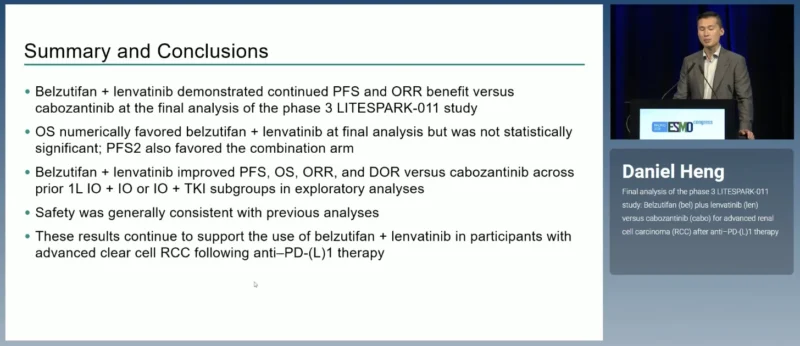
Overall survival numerically favoured belzutifan plus lenvatinib, with median OS of 33.7 versus 28.6 months (HR 0.85; 95% CI 0.70–1.03). However, the one-sided p value of 0.04689 did not meet the prespecified significance boundary of 0.0223, and a statistically significant OS benefit was not established. Grade 3 or higher treatment-emergent adverse events occurred in 85.4% and 83.0% of patients, respectively.
The investigators concluded that the final analysis continued to support the use of belzutifan plus lenvatinib in patients with advanced clear cell renal cell carcinoma following anti–PD-(L)1 therapy, based on the maintained PFS and ORR benefits, despite the absence of a statistically significant overall survival improvement.
Source: ESMO Congress 2026 – Abstract 3587O, Phase III LITESPARK-011
Read more about LITESPARK-012 at ESMO 2026 on OncoDaily.