At the ESMO Congress 2026, Toni K. Choueiri (Boston, USA) presented results from the Phase III LITESPARK-012 trial (NCT04736706), evaluating pembrolizumab plus lenvatinib combined with either belzutifan or quavonlimab in patients with previously untreated advanced clear cell renal cell carcinoma (ccRCC).
The analysis, presented in the Proffered Paper session (3586O), assessed progression-free survival (PFS), overall survival (OS), objective response rate (ORR), and safety compared with standard-of-care pembrolizumab plus lenvatinib.
Why Was LITESPARK-012 Conducted?
Pembrolizumab plus lenvatinib is an established first-line treatment option for patients with advanced renal cell carcinoma. The Phase III LITESPARK-012 trial investigated whether incorporating additional therapeutic agents into this regimen could improve treatment outcomes.
The study evaluated two investigational combinations: pembrolizumab plus lenvatinib and belzutifan, a hypoxia-inducible factor-2α (HIF-2α) inhibitor, and MK-1308A, a coformulation of quavonlimab (an anti-CTLA-4 antibody) and pembrolizumab, combined with lenvatinib.
The trial compared both investigational regimens with pembrolizumab plus lenvatinib to assess whether adding HIF-2α inhibition or CTLA-4 blockade could improve efficacy in the first-line setting.
LITESPARK-012 Study Design and Methods
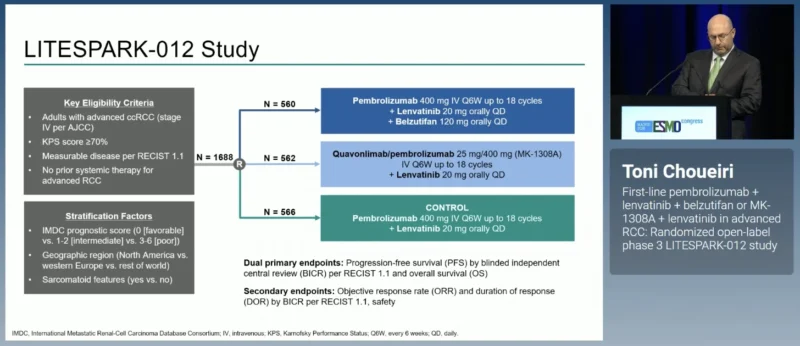
LITESPARK-012 was a randomized, open-label Phase III trial enrolling adults with previously untreated advanced clear cell renal cell carcinoma. Patients were randomized in a 1:1:1 ratio to receive one of three treatment regimens:
- Arm A: Pembrolizumab 400 mg every six weeks for up to 18 cycles, lenvatinib 20 mg once daily, and belzutifan 120 mg once daily.
- Arm B: MK-1308A, consisting of quavonlimab 25 mg and pembrolizumab 400 mg every six weeks for up to 18 cycles, combined with lenvatinib.
- Control: Standard-of-care pembrolizumab plus lenvatinib.
Treatment continued until disease progression, unacceptable toxicity, or study withdrawal. Pembrolizumab and MK-1308A were administered for a maximum of approximately two years.
The dual primary endpoints were PFS, assessed by blinded independent central review (BICR) according to RECIST 1.1, and OS. Arm A was compared with control in the overall randomized population. For Arm B, a prespecified hierarchical testing strategy evaluated endpoints in the IMDC intermediate- or poor-risk population and the overall population. Because the preceding hypothesis was not statistically significant, the overall-population analyses for Arm B were reported with nominal p values. Secondary endpoints included ORR and duration of response assessed by BICR, and safety.
Key Findings from LITESPARK-012
A total of 1,688 patients were randomized, including 560 patients in Arm A, 562 in Arm B, and 566 in the control group. At the February 4, 2026 data cutoff, median follow-up was 43.6 months (range 31.8–57.4). Neither investigational regimen demonstrated improved efficacy compared with pembrolizumab plus lenvatinib alone.
Progression-Free Survival
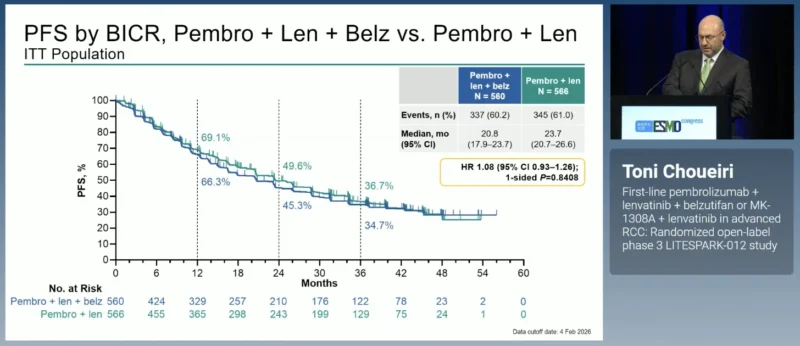
In the overall population, median PFS was 20.8 months with pembrolizumab, lenvatinib, and belzutifan (Arm A), compared with 23.7 months in the control group (HR 1.08; 95% CI 0.93–1.26; p=0.84). For patients receiving MK-1308A plus lenvatinib (Arm B), median PFS was 20.7 months versus 23.7 months with pembrolizumab plus lenvatinib (HR 1.07; 95% CI 0.92–1.25; p=0.82).
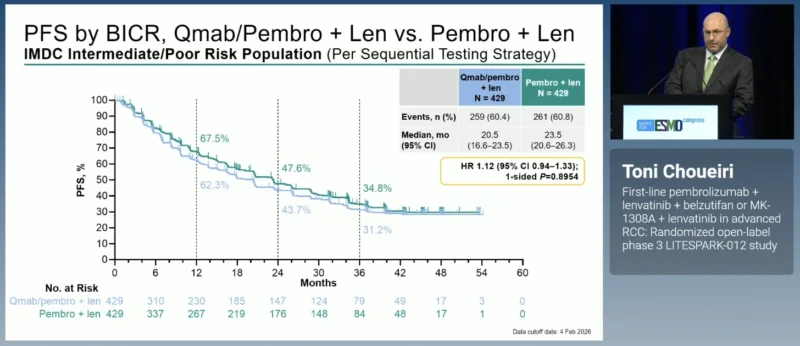
Among patients with IMDC intermediate- or poor-risk disease, median PFS was 20.5 months with MK-1308A plus lenvatinib (n=429), compared with 23.5 months in the corresponding control population (n=429; HR 1.12; 95% CI 0.94–1.33; p=0.90). Neither investigational combination demonstrated a PFS improvement over the control regimen.
Overall Survival
Median OS was 52.0 months with pembrolizumab plus lenvatinib and belzutifan, while median OS was not reached in the control group (HR 1.04; 95% CI 0.87–1.25; p=0.66). In the MK-1308A plus lenvatinib group, median OS was not reached, as was the case in the control group (HR 1.12; 95% CI 0.94–1.35; p=0.90).
In patients with IMDC intermediate- or poor-risk disease, median OS was 39.1 months with MK-1308A plus lenvatinib compared with 46.2 months with pembrolizumab plus lenvatinib (HR 1.17; 95% CI 0.96–1.42; p=0.94). Neither investigational regimen demonstrated an OS benefit compared with the control treatment.
Objective Response Rate
Objective response rates were numerically higher in the standard-of-care group than in either investigational arm. In the overall population, ORR was 69.1% (95% CI 65.1–72.9%) with pembrolizumab plus lenvatinib and belzutifan, compared with 76.3% (95% CI 72.6–79.8%) in the control group.
Among patients receiving MK-1308A plus lenvatinib, ORR was 69.0% (95% CI 65.0–72.8%). In the IMDC intermediate- or poor-risk subgroup, ORR was 66.9% (95% CI 62.2–71.3%) with MK-1308A plus lenvatinib compared with 75.5% (95% CI 71.2–79.5%) in the control group. These response findings were consistent with the absence of improved efficacy in the investigational arms.
Treatment Exposure and Safety
Median treatment duration differed across the three treatment groups. In Arm A, median treatment duration was 14.1 months for pembrolizumab, 18.1 months for lenvatinib, and 18.6 months for belzutifan.
In Arm B, median treatment duration was 11.8 months for MK-1308A and 15.2 months for lenvatinib. In the control group, median treatment duration was 21.2 months for pembrolizumab and 22.2 months for lenvatinib. All-cause adverse events led to discontinuation of at least one study drug in 51.6% of patients receiving pembrolizumab plus lenvatinib and belzutifan, 51.4% receiving MK-1308A plus lenvatinib, and 36.2% receiving pembrolizumab plus lenvatinib.
Grade 3 or higher all-cause adverse events occurred in 87.2%, 88.7%, and 84.8% of patients, respectively. The investigators noted that higher adverse-event-related discontinuation rates in the investigational arms may have limited treatment exposure and partly contributed to the observed efficacy outcomes.
Conclusions
The Phase III LITESPARK-012 trial did not demonstrate improved efficacy with the addition of either belzutifan or quavonlimab to pembrolizumab plus lenvatinib as first-line treatment for advanced clear cell renal cell carcinoma.
In the overall population, median PFS was 20.8 months with pembrolizumab plus lenvatinib and belzutifan, 20.7 months with MK-1308A plus lenvatinib, and 23.7 months with pembrolizumab plus lenvatinib alone. Neither investigational regimen demonstrated an improvement in overall survival. Objective response rates were also numerically lower in both investigational groups compared with control.
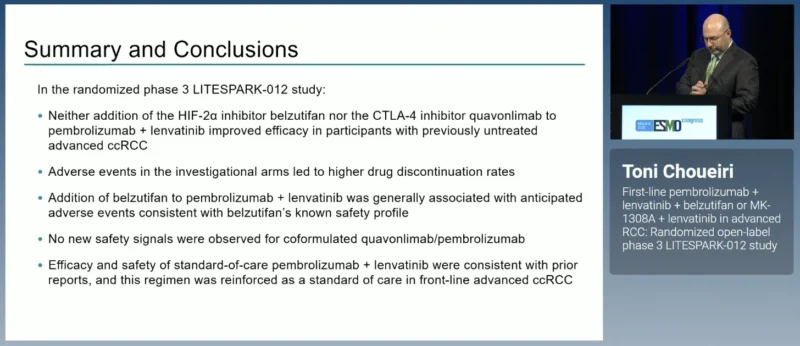
The addition of belzutifan or quavonlimab was associated with higher rates of adverse-event-related treatment discontinuation. The investigators suggested that reduced treatment exposure in the investigational arms may have partly affected efficacy.
These findings indicate that adding HIF-2α inhibition or CTLA-4 blockade to pembrolizumab plus lenvatinib did not provide additional efficacy benefit in this study. Pembrolizumab plus lenvatinib remains a first-line standard-of-care treatment option for patients with advanced clear cell renal cell carcinoma.