At the ESMO Congress 2026, Daniel Y. Heng (Calgary, Canada) presented a post hoc analysis of the Phase III LITESPARK-011 trial (NCT04586231), evaluating the relationship between health-related quality of life (HRQoL) and clinical outcomes in patients with advanced clear cell renal cell carcinoma (ccRCC) following anti–PD-(L)1 therapy.
The analysis, presented in the Rapid Oral session (3595RO), assessed associations between baseline HRQoL, changes during treatment, progression-free survival (PFS), and overall survival (OS) among patients receiving belzutifan plus lenvatinib or cabozantinib.
Why Was This Analysis Conducted?
The Phase III LITESPARK-011 trial previously demonstrated statistically significant improvements in PFS and objective response rate (ORR) with belzutifan plus lenvatinib compared with cabozantinib in patients with previously treated advanced ccRCC.
Patient-reported outcomes, assessed using the Functional Assessment of Cancer Therapy–Kidney Symptom Index Disease-Related Symptoms (FKSI-DRS) and EORTC QLQ-C30 global health status/quality of life (GHS/QoL), were similar between treatment groups.
This post hoc analysis investigated whether baseline HRQoL scores and changes during treatment were associated with clinical outcomes.

Study Design and Methods
LITESPARK-011 enrolled adults with advanced ccRCC whose disease had progressed on or after anti–PD-(L)1 therapy received as the immediately preceding treatment, either in the first-line or second-line setting or within six months of the last dose of adjuvant therapy. Patients were randomized 1:1 to belzutifan plus lenvatinib or cabozantinib.
The post hoc analysis pooled treated patients from both groups who had at least one HRQoL assessment using FKSI-DRS or EORTC QLQ-C30 GHS/QoL. Associations between baseline and longitudinal HRQoL scores and PFS or OS were evaluated using Cox proportional hazards models. For baseline and longitudinal analyses, hazard ratios were calculated per 3-point increase in FKSI-DRS or 10-point increase in QLQ-C30 GHS/QoL scores. Additional landmark analyses examined outcomes according to stable or improved versus deteriorated HRQoL at Weeks 13, 25, and 53.
Clinically meaningful score changes were defined using thresholds of 3 points for FKSI-DRS and 10 points for QLQ-C30 GHS/QoL. In the landmark analyses, stable or improved scores were distinguished from deteriorated scores using changes of >−3 versus ≤−3 points for FKSI-DRS and >−10 versus ≤−10 points for QLQ-C30 GHS/QoL. Patients who experienced a PFS or OS event before the corresponding landmark were excluded from that landmark analysis. No formal hypothesis testing was performed.
Key Findings from LITESPARK-011
A total of 741 treated patients with at least one patient-reported outcome assessment were included in the analysis. The ESMO abstract reported a median follow-up of 29.0 months (range 19.3–49.2). The presentation used an April 9, 2025 data cutoff for PFS analyses and a February 2, 2026 cutoff for OS analyses.
Baseline HRQoL and Clinical Outcomes
Higher baseline HRQoL scores were associated with better clinical outcomes. For FKSI-DRS, higher baseline scores were associated with more favourable PFS (HR 0.86; 95% CI 0.81–0.91) and OS (HR 0.81; 95% CI 0.77–0.86) compared with lower baseline scores. Similarly, higher baseline EORTC QLQ-C30 GHS/QoL scores were associated with more favourable PFS (HR 0.90; 95% CI 0.86–0.94) and OS (HR 0.88; 95% CI 0.83–0.92).
Longitudinal HRQoL Analysis
The longitudinal analysis evaluated associations between HRQoL scores over time and clinical outcomes. Higher FKSI-DRS scores were associated with more favourable PFS (HR 0.82; 95% CI 0.76–0.89) and OS (HR 0.57; 95% CI 0.52–0.62). Similarly, higher QLQ-C30 GHS/QoL scores were associated with more favourable PFS (HR 0.92; 95% CI 0.86–0.99) and OS (HR 0.68; 95% CI 0.62–0.74). The investigators reported a stronger association between longitudinal HRQoL scores and OS than with PFS.
HRQoL Changes During Treatment
Landmark analyses evaluated PFS and OS among patients with stable or improved HRQoL compared with those whose scores deteriorated.
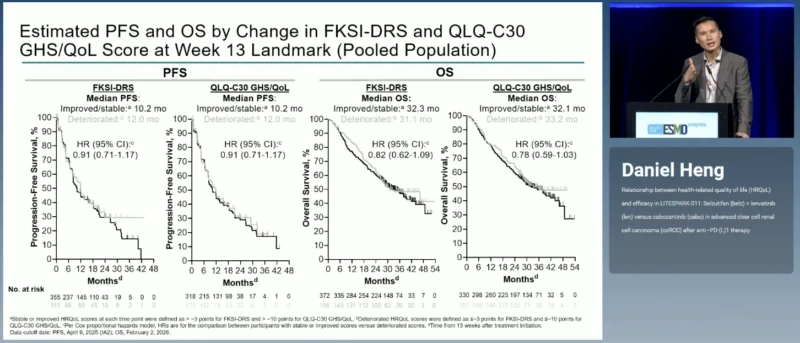
Week 13
For FKSI-DRS, the PFS hazard ratio was 0.91 (95% CI 0.71–1.17), while the OS hazard ratio was 0.82 (95% CI 0.62–1.09). For QLQ-C30 GHS/QoL, the PFS hazard ratio was 0.91 (95% CI 0.71–1.17), and the OS hazard ratio was 0.78 (95% CI 0.59–1.03).
Week 25
For FKSI-DRS, the PFS hazard ratio was 1.19 (95% CI 0.87–1.62), while the OS hazard ratio was 0.79 (95% CI 0.57–1.10). For QLQ-C30 GHS/QoL, the PFS hazard ratio was 0.83 (95% CI 0.61–1.12), and the OS hazard ratio was 0.83 (95% CI 0.60–1.16).
Week 53
For FKSI-DRS, the PFS hazard ratio was 0.80 (95% CI 0.49–1.28), while the OS hazard ratio was 0.57 (95% CI 0.36–0.90). For QLQ-C30 GHS/QoL, the PFS hazard ratio was 1.04 (95% CI 0.67–1.62), and the OS hazard ratio was 0.86 (95% CI 0.56–1.32).
Across the landmark analyses, estimates generally favoured stable or improved HRQoL for overall survival, although most confidence intervals included 1.0. Associations with PFS were less consistent across assessments. These results were exploratory, and no formal hypothesis testing was conducted.
Conclusions
The post hoc analysis of Phase III LITESPARK-011 found that higher baseline HRQoL scores were associated with more favourable PFS and OS outcomes in patients with advanced clear cell renal cell carcinoma following anti–PD-(L)1 therapy.
Higher baseline FKSI-DRS scores were associated with PFS and OS hazard ratios of 0.86 and 0.81, respectively, while higher baseline QLQ-C30 GHS/QoL scores were associated with corresponding hazard ratios of 0.90 and 0.88. Landmark analyses suggested that stable or improved HRQoL during treatment was generally associated with more favourable outcomes, particularly OS, although the associations varied across assessment time points.
The investigators concluded that higher baseline HRQoL scores and improvements during treatment were generally associated with improved clinical outcomes in this population. As a post hoc exploratory analysis pooling patients from both treatment groups, these findings demonstrate associations rather than establishing that improvements in quality of life directly lead to better survival outcomes.