At the ESMO Congress 2026, Jens Bedke (Stuttgart, Germany) presented results from the Phase III KEYNOTE-866 trial (NCT03924856), evaluating perioperative pembrolizumab versus placebo added to neoadjuvant cisplatin and gemcitabine, followed by radical cystectomy and pelvic lymph node dissection, in patients with muscle-invasive bladder cancer (MIBC).
The second prespecified interim analysis, representing the final event-free survival (EFS) analysis, showed that adding pembrolizumab did not confer a statistically significant EFS benefit.
Why Was KEYNOTE-866 Conducted?
New systemic regimens have improved the standard of care for patients with MIBC, including perioperative durvalumab combined with neoadjuvant cisplatin-based chemotherapy, perioperative enfortumab vedotin plus pembrolizumab, and adjuvant nivolumab. KEYNOTE-866 was designed to evaluate perioperative pembrolizumab added to neoadjuvant cisplatin and gemcitabine, followed by radical cystectomy with pelvic lymph node dissection (RC + PLND), in patients eligible for cisplatin-based chemotherapy and curative-intent surgery.
KEYNOTE-866 Study Design and Methods
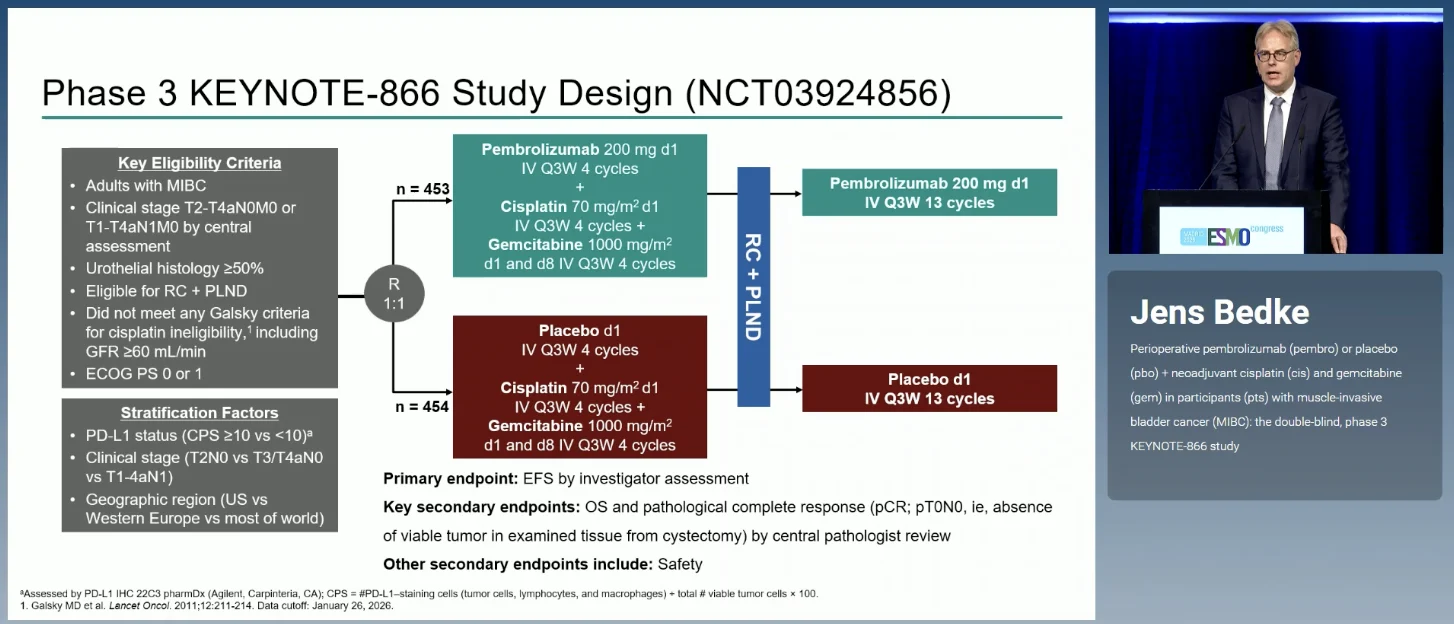
KEYNOTE-866 was a double-blind, randomized Phase III trial involving patients with clinical stage T2–T4aN0M0 or T1–T4aN1M0 MIBC, at least 50% urothelial histology, and ECOG performance status 0–1.
Patients were randomized 1:1 to receive pembrolizumab 200 mg or placebo every three weeks, combined with cisplatin 70 mg/m² on day 1 and gemcitabine 1000 mg/m² on days 1 and 8 for four neoadjuvant cycles. Following RC + PLND, patients were scheduled to receive 13 cycles of adjuvant pembrolizumab or placebo every three weeks, according to their original randomization.
The primary endpoint was investigator-assessed EFS. Key secondary endpoints included overall survival (OS) and pathological complete response (pCR) by central pathology review. The second interim analysis represented the final EFS analysis.

Key Findings from KEYNOTE-866
Between July 2019 and September 2022, 907 patients were randomized to pembrolizumab (n=453) or placebo (n=454). At the January 26, 2026 data cutoff, the median time from randomization to data cutoff was 60.9 months (range 40.7–78.7). A total of 415 patients in the pembrolizumab arm and 399 in the placebo arm underwent cystectomy, while 318 and 315 patients, respectively, started adjuvant treatment.
Event-Free Survival
EFS events occurred in 157 patients (34.7%) receiving pembrolizumab and 168 (37.0%) receiving placebo. Median EFS was 74.1 months (95% CI 72.4–not reached) with pembrolizumab versus not reached (95% CI 67.7–not reached) with placebo (HR 0.88; 95% CI 0.71–1.10; one-sided p=0.1366). The difference was not statistically significant. Estimated 24-month EFS rates were 76.7% versus 70.0%, while 60-month rates were 63.5% versus 61.9%, respectively. EFS outcomes were generally consistent across key subgroups.
Pathological Complete Response
The pCR rate was 44.4% (200/450; 95% CI 39.8–49.2) with pembrolizumab versus 35.8% (162/453; 95% CI 31.3–40.4) with placebo. The estimated difference was 8.9 percentage points (95% CI 2.5–15.1). However, pCR was not formally tested for statistical significance according to the trial’s statistical design.
Overall Survival
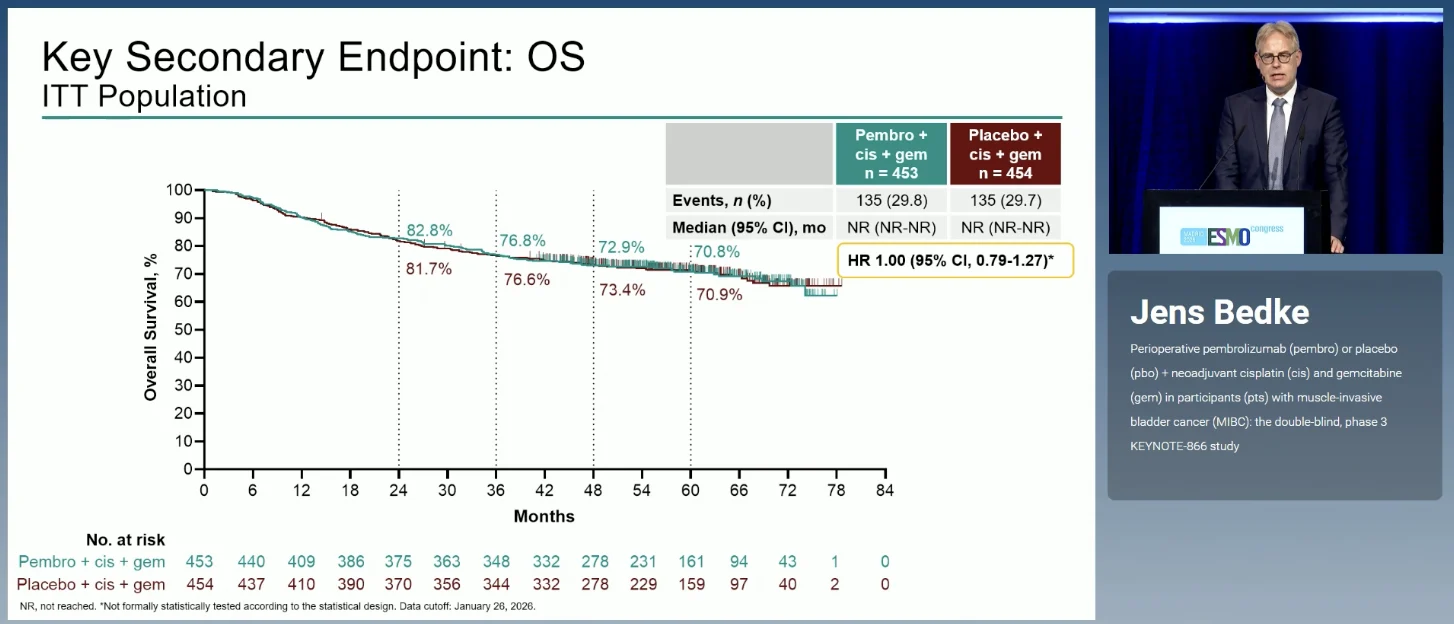
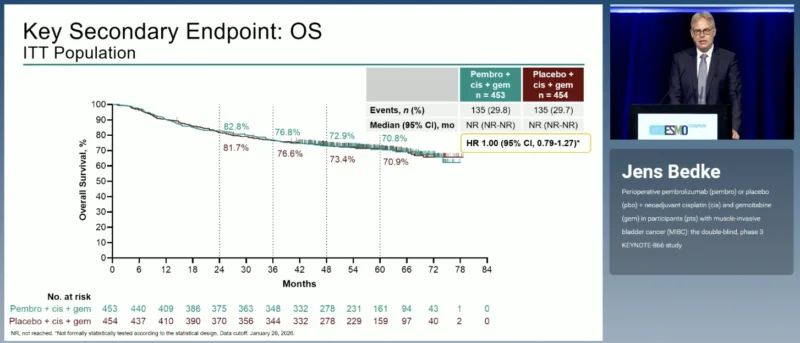
Median OS was not reached in either arm, with 135 deaths reported in each group (29.8% versus 29.7%). The OS HR was 1.00 (95% CI 0.79–1.27). Estimated 60-month OS rates were 70.8% with pembrolizumab versus 70.9% with placebo. OS was similar between treatment groups but was not formally tested for statistical significance.
Safety Outcomes
Treatment-emergent adverse events (TEAEs) occurred in 99.8% of patients receiving pembrolizumab and 98.7% receiving placebo. Grade 3–5 TEAEs occurred in 80.2% versus 75.1%, while serious TEAEs occurred in 61.8% versus 55.2%. Events leading to discontinuation of any study drug occurred in 36.7% versus 26.7%.
TEAEs leading to death occurred in 3.8% versus 4.5%, while treatment-related adverse events leading to death occurred in one patient (0.2%) in each arm. Immune-mediated adverse events and infusion reactions occurred in 28.9% versus 9.4%, including grade 3–5 events in 8.9% versus 1.8%. The most frequently reported immune-mediated adverse event in the pembrolizumab arm was hypothyroidism (10.4%), followed by hyperthyroidism (5.1%) and pneumonitis (4.0%).
Conclusions
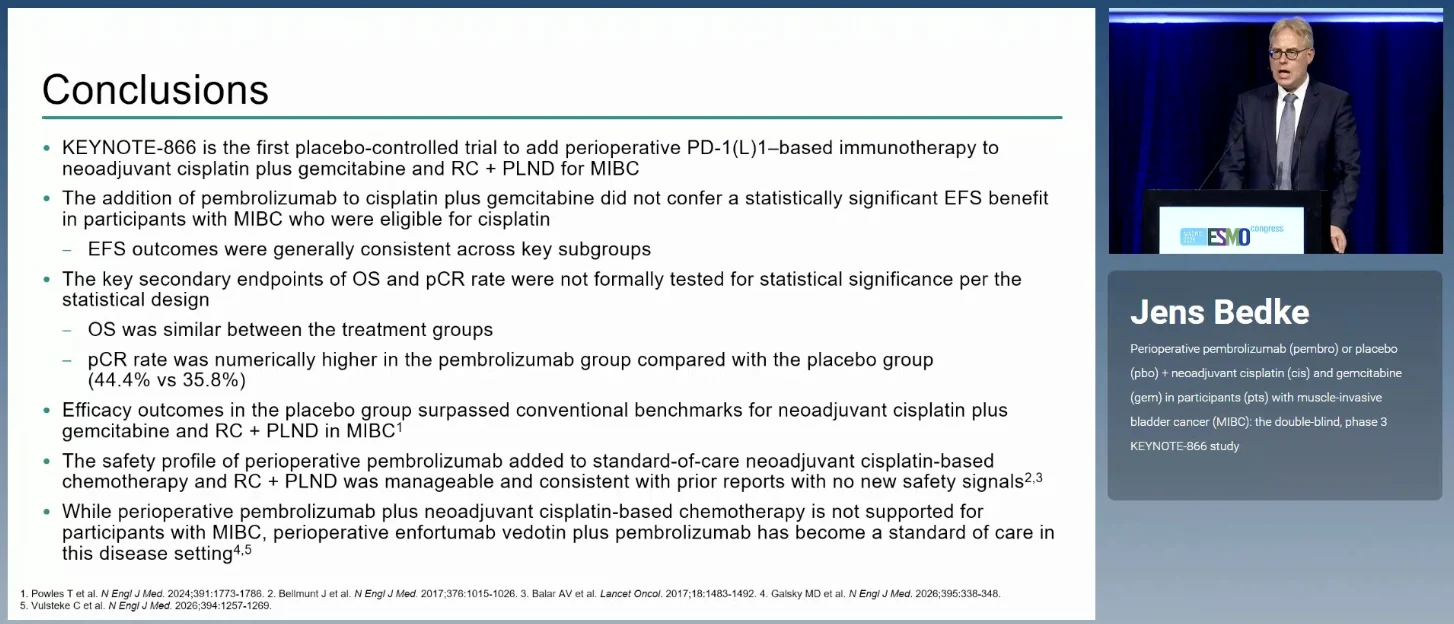
The Phase III KEYNOTE-866 trial demonstrated that adding perioperative pembrolizumab to neoadjuvant cisplatin and gemcitabine, followed by radical cystectomy and pelvic lymph node dissection, did not confer a statistically significant EFS benefit in cisplatin-eligible patients with MIBC.
EFS outcomes were generally consistent across key subgroups. OS was similar between treatment groups, while pCR rates were numerically higher with pembrolizumab. Neither OS nor pCR was formally tested for statistical significance. The investigators reported that the safety profile was manageable and consistent with prior reports, with no new safety signals.
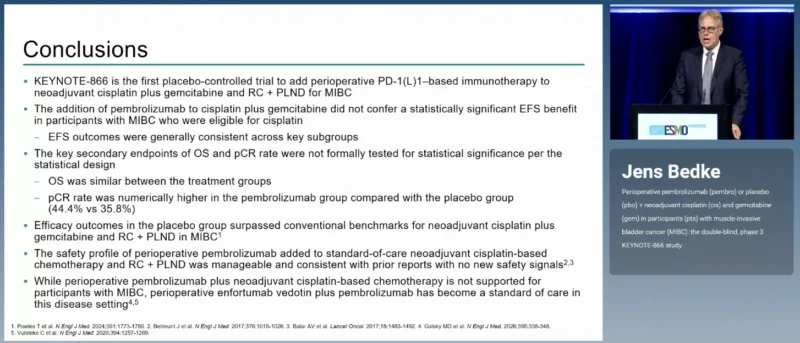
The presentation concluded that perioperative pembrolizumab plus neoadjuvant cisplatin-based chemotherapy is not supported in this setting, while perioperative enfortumab vedotin plus pembrolizumab has become a standard of care for MIBC.