From September 28 to October 4, GU oncology discussions highlighted important updates across prostate cancer, renal cell carcinoma, bladder cancer, penile cancer, and testicular tumors.
This week’s selection includes updates on protocol differences across BCG-unresponsive CIS trials, PSA kinetics and functional cure after curative-intent radiotherapy for localized prostate cancer, rapid recruitment in DEPECA penile cancer trials, uRARE-Seq for detection and monitoring of bladder cancers, and patterns of progression with upfront apalutamide in metastatic castration-sensitive prostate cancer.
Other posts highlight an indirect comparison of PURE01 and KEYNOTE-905 in muscle-invasive bladder cancer, final KEYNOTE-427 data with pembrolizumab monotherapy in advanced ccRCC and nccRCC, the TroFuse055 bladder-preservation phase 3 trial in MIBC, rethinking the 3-cm rule in sporadic bilateral multifocal papillary RCC, and the prognostic impact of metabolic and muscular profile assessment in patients with testicular tumors.
Together, these posts reflect the continued evolution of GU oncology across trial design, biomarker development, liquid biopsy, treatment sequencing, bladder preservation, surgical decision-making, rare tumor research, and more individualized risk assessment.
Alberto Martini — Assistant Professor & Director of Research | Inventor | Robotic Surgery and Urologic Oncology Specialist | United States
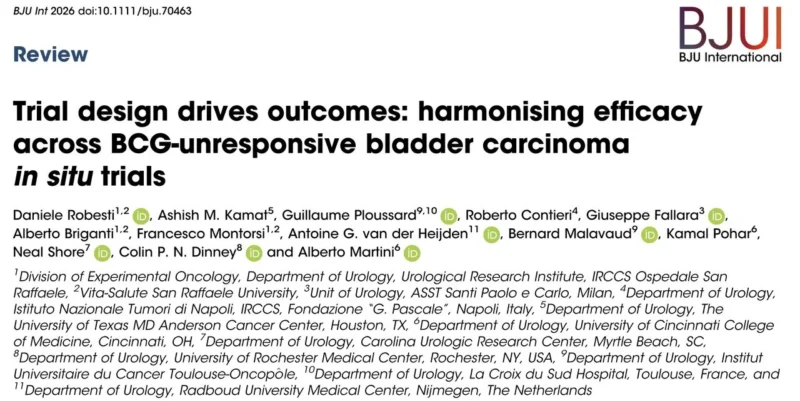
“BCG-unresponsive NMI bladder cancer: Are we really comparing drugs, or are we comparing trial designs?
Check out our newest article on BJUi, where we explored how protocol differences across BCG-unresponsive CIS trials can substantially affect reported outcomes.
By harmonizing factors such as biopsy timing, complete response assessment, and management of re-induction, we demonstrated that trial design itself can meaningfully influence efficacy estimates. Specifically, reinduction can introduce immortal time bias. Different biopsy timing can affect results and not accounting for false negatives (in case of discordant office cystoscopy and biopsy findings) can affect how results are read.
As more bladder-sparing therapies become available, the field needs to move beyond simply reporting response rates and toward standardizing how those responses are measured.
Without methodological consistency, direct cross-trial comparisons may be difficult, and should be avoided, unless accounting for the aforementioned factors.”
Soumyajit Roy, MBBS, MD, MSc. — Physician Scientist, Assistant Professor at UH Seidman Cancer Center, Case Western Reserve University | United States
“Two papers in localized prostate cancer in the same week, asking two sides of the same question: what does PSA actually tell us after curative-intent radiotherapy for prostate cancer?
In our new Red Journal IJROBP The Red Journal paper, we examined PSA kinetics after testosterone recovery following radiotherapy + ADT. The central finding was that faster PSA kinetics were directionally associated with progression, but their relationship with distant metastasis was inconsistent and imprecise.
The implication is important: a rising PSA trajectory after testosterone recovery should not automatically be interpreted as equivalent to metastatic potential.
Our RAPTOR study, now published in European Urology Oncology, approached the question from the other end of the timeline: if a patient remains free of biochemical recurrence for years after radiotherapy, when can we begin to think about “functional cure”?
Using individual-patient data from 3,120 men across 11 randomized trials, we found that among men with intermediate-risk prostate cancer treated with high-dose radiotherapy alone, remaining BCR-free at 5 years was associated with an 8-year distant metastasis risk of 6.6% and 10-year prostate cancer–specific mortality of just 2.5%. In the higher-risk cohorts treated with short- or long-term ADT, however, residual metastatic risk remained above 10% despite being BCR-free at 5 years.
Taken together, these two studies reinforce a concept that I think will become increasingly important: PSA is not simply “recurrent versus not recurrent.” Its prognostic meaning is dynamic and context-dependent and shaped by timing, testosterone recovery, baseline disease risk, treatment intensity, and, critically, the clinical outcome we are trying to predict.
The next step is to move beyond isolated PSA thresholds toward dynamic, individualized risk assessment, integrating longitudinal PSA behavior with clinical, molecular, imaging, and other biomarkers.
Very grateful to all of our collaborators, statisticians, trial investigators, and, most importantly, the patients whose participation made these studies possible.
And somehow, these are two of three papers published this week. Quite a week for our prostate cancer biomarker work!”
Igor Tsaur — Director and Chairman, Department of Urology, University Hospital Tübingen; University Competence Center for Precision Surgery and Robotic-Assisted Urology | Germany
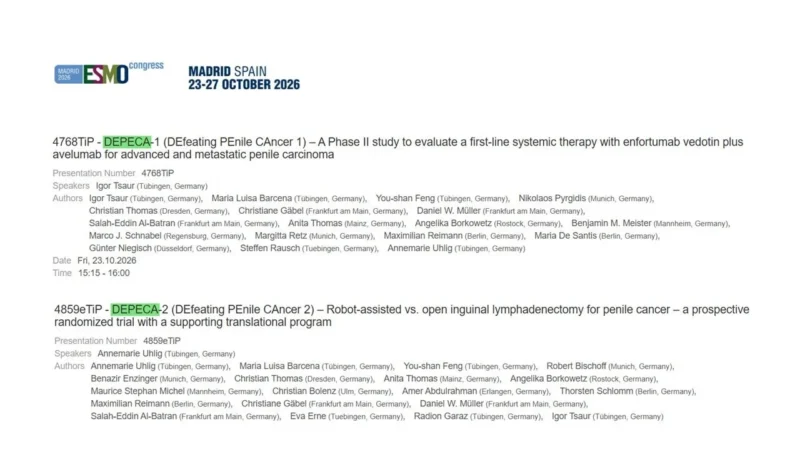
“Making the Impossible Possible: Incredible Recruitment Speed in Penile Cancer Trials!
Clinical trials in the field of this rare tumor entity are notoriously challenging – many pharma partners have shied away in the past due to concerns over supposedly unfeasible recruitment rates. Yet with an unprecedented recruitment momentum across our DEPECA trials, we have proven everyone wrong. No one would have thought this possible!
This breakthrough was made achievable thanks to our dedicated study sites and the DEPECA platform, which provides a reliable foundation for successful penile cancer trials. A massive thank you to everyone involved!
Here is a quick look at our current progress:
DEPECA-1: Over 70% of patients have been enrolled within just 10 months of active recruitment – running twice as fast as originally planned! With more candidates currently in screening, we are now just 7 patients away from reaching our recruitment target.
DEPECA-2: We are seeing fantastic momentum here as well: 14 out of the planned 80 patients are already enrolled, and the 20% milestone is just around the corner.
This achievement reflects the power of outstanding collaboration and unwavering commitment.
See you at the ESMO Congress by our Trials in Progress posters! We look forward to the next steps on our path toward successfully completing both trials!”
Ash Alizadeh — Professor of Medicine, Stanford University School of Medicine |United States
“Excited to introduce uRARE-Seq for detection and monitoring of bladder cancers and beyond.
Eager to see how this new liquid biopsy tool can change the course of these diseases and overcome the unmet needs of patients with these challenging genitourinary cancers.”
Katy Beckermann — GU Medical Oncologist; RCC, Bladder and Prostate Cancer; Clinical Trials and Drug Development; AI in Medicine | United States
“Upfront apalutamide changes how men progress in mCSPC, not only when.
24-month PSA-first CRPC 19% vs 52% on placebo
Radiographic-first CRPC essentially unchanged, 13% vs 14%
Baseline visceral metastasis was associated with the radiographic route in both arms
Limtations: Post hoc of TITAN
With variation in practice on imaging, how closely are you imaging visceral-metastatic patients on an ARPI?”
Andrea Necchi, MD, FASCO — Associate Professor, Vita-Salute San Raffaele University; Director of Genitourinary Medical Oncology, San Raffaele Hospital; Vice President, GU Tumors; Associate Editor, Journal of Clinical Oncology | Italy
“What is the performance of neoadjuvant pembro in PURE01 vs periop EVP KEYNOTE905 in pts with MIBC? Are this data replicable in a multicentric setting? Waiting for a post-hoc analysis of KN905 to be presented at ESMO26 myESMO
Indirect comparison of reconstructed individual patient data from KEYNOTE905 and PURE01”
Enrique Grande — Medical Oncologist | One Oncology Madrid Program Director at Quironsalud | Global Leader in GU Oncology & Bladder Cancer | AI & Digital Oncology | Spain
“KEYNOTE-427 final results (61 months follow-up): pembrolizumab monotherapy in first-line advanced ccRCC and nccRCC — ORR 36.4% and 26.7%, respectively.
PD-L1 CPS and T-cell-inflamed GEP associated with outcomes in both cohorts. Baseline ctDNA positivity linked to shorter OS (30.5 vs 53.7 months).”

Guru Sonpavde, MD — Phase I and GU Oncology Director AdventHealth Cancer Institute; Professor, UCF | United States
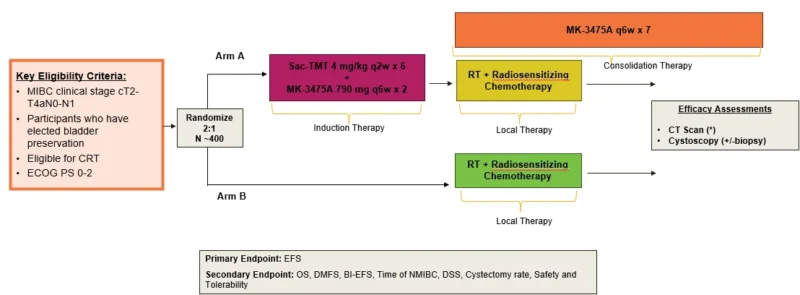
“New bladder cancer clinical trial opening now: Bladder-preservation for muscle-invasive bladder cancer (MIBC) – TroFuse055 is a Phase III clinical trial that evaluates the value of neoadjuvant sacituzumab tirumotecan (Sac-TMT) + MK3475A followed by consolidation MK3475A when combined with conventional chemoradiotherapy – this trial builds upon the value that chemoradiation brings to patients with MIBC who have elected to avoid radical cystectomy surgery – 1) Sac-TMT is a Trop2 binding antibody drug conjugate (ADC) conjugated to a potent topoisomerase-1 inhibitor payload (belotecan) and 2) MK3475A is subcutaneous pembrolizumab. Trial is opening globally and sponsored by Merck.”
Chiara Re — MD; Research Fellow, University of Cambridge; Senior Kidney Cancer Fellow, Cambridge University Hospitals NHS; Resident in Urology San Raffaele Hospital; Associate Member EAU YAU Renal Cancer Working Group
“New editorial out in Eur Urol Oncol!
Rethinking the 3-cm rule in RCC: is size enough? Long-term evidence in sporadic bilateral multifocal pRCC suggests that when we intervene may be as important as how.”

Oscar Arrieta — Director General | National Cancer Institute of Mexico (INCan) | Medical Oncologist | Lung Cancer Research | Cancer Research & Global Oncology | national system of researchers level III | Professor of Medicine at UNAM | Mexico
“Benefits of evaluating the metabolic and muscular profile in patients with testicular tumors.
A study that assesses the prognostic impact of these variables in underexplored populations. Valuable collaboration from researchers at INCanMx: Dr. Miguel Santibañez Andrade, Dr. Miguel A. Jiménez Ríos, Dra. Nora Sobrevilla Moreno, and colleagues.”

Find out 10 Must-Read Posts in GI Oncology from the last week of September on OncoDaily.