
The last week of September brought together important updates across GU oncology, with expert posts covering prostate cancer, renal cell carcinoma, urothelial cancer, and non–muscle-invasive bladder cancer.
This week’s selection includes updates on PSMA PET/CT kinetics during systemic therapy and radiotherapy in hormone-sensitive prostate cancer, the role of empiric triplet therapy in metastatic clear-cell renal cell carcinoma, drug–drug interactions in prostate cancer care, belzutifan plus lenvatinib after PD-1/PD-L1 therapy in advanced renal cell carcinoma, and adjuvant pembrolizumab after surgery for clear cell renal cell carcinoma.
Other posts highlight enfortumab vedotin monotherapy according to age, the prognostic value of baseline PSMA PET/CT in synchronous metastatic hormone-sensitive prostate cancer, micro-ultrasound in prostate cancer, NECTIN4 RNA expression as a potential biomarker for enfortumab vedotin plus pembrolizumab in metastatic urothelial cancer, and a risk model for predicting BCG-unresponsive disease or progression in high-grade Ta/T1 non–muscle-invasive bladder cancer.
Together, these posts reflect the continued evolution of GU oncology across precision imaging, biomarker-driven treatment, treatment escalation and de-escalation, toxicity management, real-world outcomes, risk prediction, and multidisciplinary decision-making.
Juan Gómez Rivas – Urologist, Hospital Clínico San Carlos; Director, ICUA La Milagrosa; Associate Professor, Complutense University of Madrid; ESU/ESOU Board Member; Chair of Scientific Activities, AEU; Assistant Editor, IJS and Actas Urológicas | Spain
“PSMA PET/CT kinetics during systemic therapy and radiotherapy in hormone-sensitive prostate cancer.
We reviewed 11 studies exploring how PSMA expression changes during treatment. Key messages:
ADT generally reduces PSMA expression across prostate, nodal and bone lesions.
An early PSMA “flare” can occur, particularly in bone metastases, highlighting the importance of timing when interpreting PET/CT.
Changes in PSMA PET parameters may eventually provide an imaging biomarker of treatment response and help guide treatment escalation or de-escalation.
However, current evidence remains heterogeneous, and prospective validation linked to oncological outcomes is still needed.”
Javier Molina Cerrillo – Medical Oncologist focused in GU and endocrine tumors at Ramón Y Cajal University Hospital in Madrid, Spain
“Is “more” always “better” in metastatic clear-cell renal cell carcinoma?
Our new Editorial in European Urology Oncology asks a deliberately provocative question:
Triplet therapy in metastatic ccRCC: is it time to move beyond empiric, biomarker-unselected intensification?
The evolution of immunotherapy combinations has transformed RCC treatment. It is therefore tempting to assume that adding a third active drug to an already effective doublet will inevitably deliver additional clinical benefit.
But the most mature evidence tells a more nuanced story.
COSMIC-313: adding cabozantinib to nivolumab + ipilimumab improved PFS, but did not improve OS, while substantially increasing grade 3–4 treatment-related toxicity.
LITESPARK-012: another biologically compelling triplet strategy has so far failed to demonstrate a clear survival advantage, although the available phase III data remain preliminary and not yet peer-reviewed.
So perhaps the question is not simply:
“How can we add another drug?”
but rather:
“Which patients actually need escalation and which biological mechanism should we target?”
Exploratory data from COSMIC-313, including the signal associated with M2-like macrophage infiltration, raise an important possibility: triplet therapy may still have a role in biologically defined populations, rather than being applied empirically to everyone.
The next generation of RCC trials should therefore move from empirical intensification → biological diversification + precision selection.
CAIX-targeted theranostics, HIF-2α strategies, bispecific antibodies, ADCs, cellular therapies and approaches targeting the tumor microenvironment may ultimately be more transformative than simply layering additional agents onto the same immunotherapy backbone.
The goal should not be more treatment.
It should be the right treatment for the right biology, in the right patient.
What do you think? Are we reaching a ceiling with empiric triplet strategies in ccRCC or have we simply not yet identified the patients who truly benefit from them?”
Giuseppe Procopio — Chief of Genitourinary Oncology; Director, Prostate Program; Full Professor Qualified; FICOG and Meet-URO President
“Managing drug-drug interactions in prostate cancer: what happens in real-world clinical practice?
Patients with prostate cancer frequently receive multiple medications for age-related comorbidities, making drug–drug interactions (DDIs) an increasingly important consideration when selecting and managing anticancer therapies, particularly androgen receptor-targeted agents.
A new international survey by the Meet-URO group and ONCOassist, recently published in The Oncologist, provides valuable insights into how healthcare professionals assess and manage DDIs in everyday clinical practice. The study collected responses from 69 Italian oncologists and 1,064 healthcare professionals worldwide, exploring current practices, available resources, barriers and unmet needs.
What did the survey show?
DDIs are widely recognized as clinically relevant in prostate cancer care, with 77.1% of international respondents rating their relevance highly. Digital resources, particularly online databases and smartphone applications, are already central to DDI assessment, while the use of AI-based tools remains relatively limited.
The survey also identified important gaps in clinical practice. Access to pharmacological expertise varied substantially: only 29% of Italian respondents reported having an on-site pharmacologist, compared with approximately 76% of international respondents. Lack of time, uncertainty about the reliability of available sources, and limited access to reliable tools and training were among the main barriers reported.
When DDI checkers provided conflicting information, pharmacologist consultation emerged as a key strategy. Italian clinicians particularly emphasized the need for greater access to pharmacological support, while international respondents highlighted institutional training and educational initiatives.
These findings reinforce the importance of integrating DDI assessment into treatment decision-making and strengthening multidisciplinary collaboration. More standardized and validated tools, routine medication reconciliation, pharmacological expertise and dedicated education could contribute to safer and more effective prostate cancer care.”
Sara Coca Membribes – Medical Oncologist; GU Oncology Clinical Research Fellow, Barts Cancer Institute, Queen Mary University of London, London, United Kingdom
“The FDA has approved belzutifan + lenvatinib for advanced RCC with a clear cell component after PD-1/PD-L1 therapy.
Based on LITESPARK-011 (PFS HR 0.74; ORR 53% vs 40%; OS HR 0.85 not significant), the first positive phase 3 vs TKI post-ICI.”
Federica Sordelli – Department of Biomedical Sciences, Humanitas University, Pieve Emanuele, Milan; Department of Urology, IRCCS Humanitas Research Hospital, Milan; Specialist Centre for Kidney Cancer, Urology Department, Royal Free Hospital, London | Italy
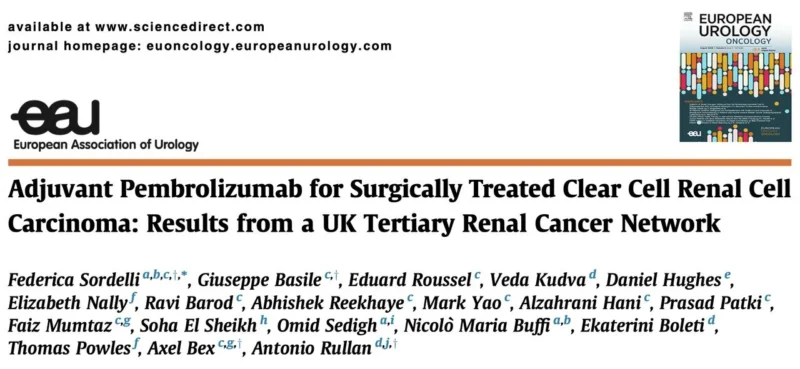
“I’m pleased to share our study, now published in European Urology Oncology, on the use of adjuvant pembrolizumab after surgery for clear cell renal cell carcinoma.
In a UK renal cancer network, we looked at MDT assessment, treatment decisions, outcomes and toxicity.
Of 154 eligible patients, 129 were considered medically fit for treatment. After counselling, 50% chose surveillance.
Among patients who received pembrolizumab, estimated 24-month disease-free survival was 69% and overall survival was 95%.
19% experienced grade 3 treatment-related adverse events, and 23% discontinued treatment because of toxicity.
Overall, the oncological and safety outcomes observed in patients receiving pembrolizumab were consistent with those reported in KEYNOTE-564.
Treatment eligibility is only the starting point. MDT discussion helps assess recurrence risk and fitness; conversations with patients bring in potential toxicity, other health conditions and personal priorities. Both are essential to shared decision-making.”
Maxime Frélaut – Oncologue médical, Gustave Roussy, France
“Happy to share our new publication in Clinical Genitourinary Cancer: a multicenter retrospective study on the efficacy and safety of enfortumab vedotin monotherapy according to age.
The efficacy data are reassuring across age groups, but clinicians should stay vigilant: the risk of severe toxicity increases after 70 years.
Congratulations to Ilgin Akbyyik, and many thanks to all participating centers for their commitment and collaboration.”
Fleur Kleiburg — AIOS Radiotherapie, Amsterdam UMC, Netherlands
“New publication in European Radiology!
Our study on the prognostic value of baseline PSMA PET/CT in synchronous metastatic hormone-sensitive prostate cancer (mHSPC) is now available online.
Since 2017, PSMA PET/CT has replaced conventional imaging for staging high-risk prostate cancer patients at the Leiden University Medical Centre and Alrijne Hospital Leiderdorp. As part of standard clinical practice, patients have been prospectively classified as having low- or high-volume disease by multidisciplinary team (MDT) consensus and were treated accordingly.
In a retrospective analysis of 204 patients with synchronous mHSPC (median follow-up 50 months), we found that:
PSMA PET/CT-derived total tumour volume (PSMA-TV) was a robust predictor of overall survival (HR = 1.39 per doubling, 95% CI 1.22-1.57), independent of WHO performance status and treatment.
A model combining PSMA-TV and WHO performance status achieved a C-index of 0.71 (95% CI 0.66-0.77) after internal validation.
In an exploratory post hoc analysis, the optimal threshold for PSMA-TV-based high-volume disease was PSMA-TV ≥ 150 mL or any visceral metastasis, which performed similarly to MDT-based classification of low- and high-volume disease (HR = 3.01 vs. HR = 2.68).
While MDT-based stratification of mHSPC patients performed well, incorporating PSMA-TV can further improve risk assessment. Instead of dichotomising, we propose using a prognostic model with PSMA-TV as a continuous variable to guide treatment decisions. Multicentre validation is needed before clinical implementation.”
Darius Ashrafi — SUO Uro-oncology Fellow, FRACS (Urol), University of Sydney | Australia
“Our comprehensive review on micro-ultrasound in prostate cancer is out in Diagnostics, written with Professor Laurence Klotz in Toronto – the birthplace of the micro-ultrasound and the PRI-MUS scoring system.
We discuss all the current evidence of this emerging technology in one place, from detection and biopsy targeting through to active surveillance, including the trials still to report.”
Tamás Fazekas — MD, PhD, FEBU, Semmelweis University, Hungary
“Can we predict who benefits most from EV + pembrolizumab?
New European Urology data show that higher pretreatment tumor NECTIN4 RNA expression is associated with better efficacy of first-line EV+pembrolizumab in metastatic urothelial cancer.”
Enrique Grande — Medical Oncology Department Director at Quironsalud Madrid, Spain
“Risk model to predict BCG-unresponsive disease or progression in HG Ta/T1 NMIBC (n=2,211; 13 centers).
Five independent predictors: T1 stage, residual HG/T1 at re-TURBT, multifocality, concomitant CIS, and WHO grade 3.
Outperforms EORTC and EAU 2021 stratification — with a free web calculator available.”

Find out 10 Must-Read Posts in GU Oncology from the third week of September on OncoDaily.