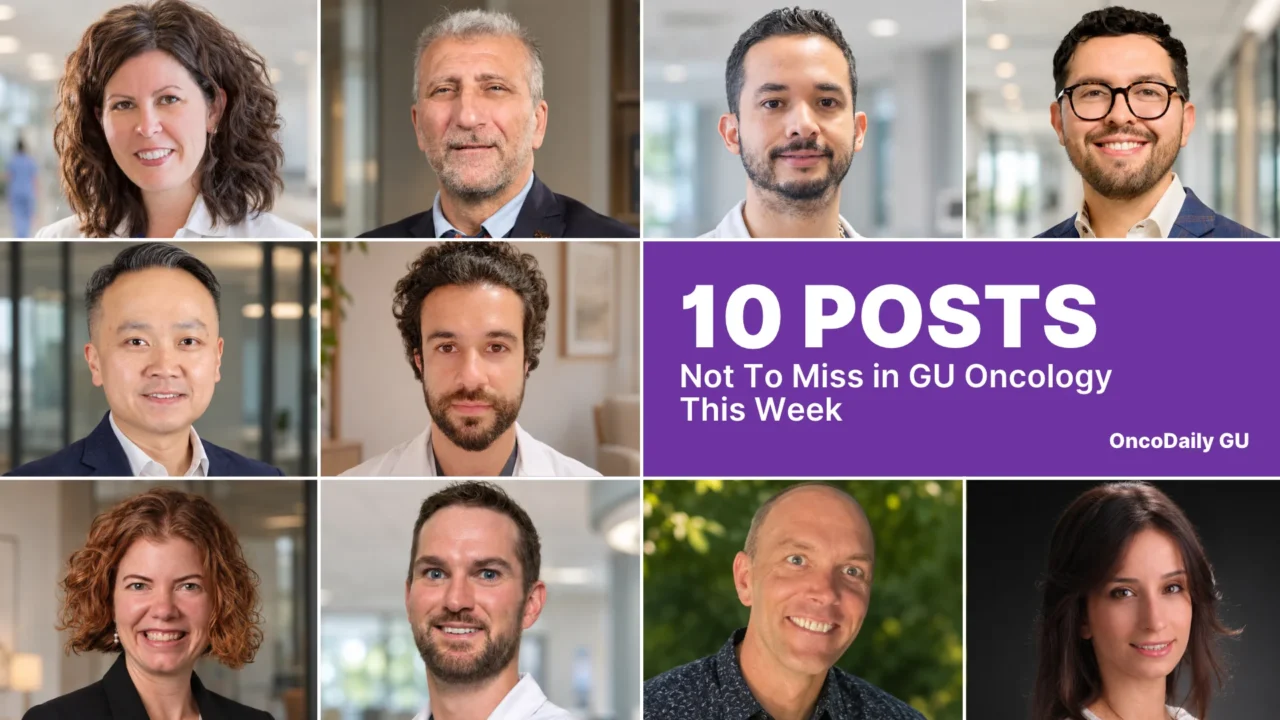
The third week of November 2026 brought new research findings and expert perspectives across GU oncology, with updates spanning prostate, bladder, and renal cell cancers. Recent publications addressed treatment strategies, radiotherapy, emerging therapeutic approaches, diagnostic imaging, and tumor biology.
This week’s selection begins with a review exploring systemic-first, response-adapted management of the primary renal tumor in metastatic clear-cell renal cell carcinoma. In prostate cancer, the randomized phase II SRAM trial compared five-fraction prostate and pelvic SBRT with conventional IMRT, while phase I and II findings with bavdegalutamide examined androgen receptor degradation in metastatic castration-resistant disease. Another post highlights early clinical findings with intravesical CD40 agonist 2141-V11 in BCG-unresponsive non-muscle-invasive bladder cancer.
Further discussions cover the PRIMARY2 trial evaluating PSMA PET to guide prostate biopsy decisions and long-term outcomes of single- versus two-fraction HDR brachytherapy boosts in high-risk prostate cancer. Other updates examine gaps in sex-specific efficacy and safety reporting in perioperative muscle-invasive bladder cancer trials and the publication of the PACE-NODES trial investigating stereotactic radiotherapy in high-risk localized prostate cancer.
The selection also includes preclinical research investigating STF-62247-induced cell death in clear-cell renal cell carcinoma and a multicenter pathological study of microcystic pigmented chromophobe RCC. Together, these 10 posts highlight developments in GU oncology, from treatment selection and radiation approaches to molecular research, diagnostic strategies, and tumor classification.
Giuseppe Procopio — Chief, Genitourinary Oncology Unit, Fondazione IRCCS Istituto Nazionale dei Tumori di Milano | Italy
“New publication in Cancer Treatment Reviews
Managing the renal primary in metastatic clear-cell RCC in the IO–TKI era: a systemic-first, response-adapted strategy
How should we manage the primary renal tumour in metastatic clear-cell RCC in the era of modern immunotherapy?
Our narrative review explores how IO-based combinations are reshaping treatment sequencing and the role of local therapies, moving beyond routine upfront cytoreductive nephrectomy.
Key insights:
Systemic therapy first: IO–IO and IO–TKI combinations can shrink the primary renal tumour, allowing response to guide subsequent decisions.
Deferred nephrectomy: After 3–6 months of treatment, selected patients with sustained disease control may be considered for multidisciplinary surgical reassessment.
SABR and ablation: Potential options for local control, symptom relief and renal preservation in selected cases; evidence of survival benefit remains limited.
Key message: A systemic-first, response-adapted strategy supports individualized decisions based on disease burden, response, symptoms and surgical risk. Prospective trials such as PROBE, NORDIC-SUN and SAMURAI will help address remaining uncertainties.”
Darren Poon — Associate Director, Comprehensive Oncology Center, Hong Kong Sanatorium & Hospital; Honorary Clinical Associate Professor, The Chinese University of Hong Kong; Consultant Clinical Oncologist | Hong Kong
“Excited to share our newly published SRAM trial results in Radiotherapy and Oncology (Green Journal)!
Our SRAM randomized phase II trial (NCT03938649) compared once-weekly, 5-fraction prostate and pelvic SBRT with conventional IMRT in patients with node-negative, high-risk prostate cancer.
Key findings (121 patients):
No significant difference in grade ≥2 GI and GU toxicity at 6–12 months.
Comparable urinary quality of life.
Greater deterioration in patient-reported bowel quality of life following SBRT at 9–12 months.
Clinical Takeaway:Five-fraction pelvic SBRT offers a promising, substantially shorter treatment approach, but convenience must not come at the expense of bowel quality of life.
Physician-graded toxicity alone may miss clinically meaningful symptoms. Optimizing rectal dose constraints and incorporating patient-reported outcomes are essential as we refine pelvic SBRT protocols.”
Katy Beckermann, MD — Medical Director, GU Clinical Research, Tennessee Oncology; Chair, OneOncology GU Disease Group; Physician-Scientist | United States
“Bavdegalutamide an oral PROTAC that degrades the androgen receptor rather than blocking it. First-in-human phase 1 and 2, in mCRPC after an androgen receptor pathway inhibitor.
Phase 1 enrolled 95 patients and set the recommended dose at 420 mg once daily.
In the 144-patient phase 2, PSA50 was 60.0% in tumors with AR T878 or H875 mutations.
PSA50 was 4.3% in AR wild-type or other AR alterations, and 3.1% with AR L702H or AR-V7.
Median radiographic progression-free survival was 11.1 months in the T878/H875 group against 4.2 months in the wild-type group.
Grade 3 treatment-related events occurred in 17.4%, with no grade 4 or higher events.
PROTAC degradation looks real but selective, and the next question is whether AR T878/H875 can be found reliably enough in practice to select for it.Will AR mutation testing decide which of these we use, or will drugs that only need AR as an address make the selector matter less?”
Juan C. Osorio — Medical Oncologist, Assistant Member, Immuno-Oncology Program, Memorial Sloan Kettering Cancer Center | United States
“Excited to share our new study in AACR Journals Clinical Cancer Research!
Can we harness CD40 agonism to treat bladder cancer? And can the spatial organization of immune cells help explain who responds?
CD40 agonism is a powerful strategy to activate dendritic cells (DCs) and initiate antitumor immunity, but clinical translation has been limited by systemic toxicity and suboptimal agonistic activity.
To overcome these challenges, we developed 2141-V11, an Fc-engineered CD40 agonist optimized for engagement of FcγRIIB, the inhibitory Fc receptor required for optimal CD40 agonism.
Building on our first-in-human trial in metastatic cancer, we evaluated intravesical 2141-V11 in patients with BCG-unresponsive non-muscle-invasive bladder cancer (NMIBC), where bladder-preserving options remain limited.
In a fantastic collaboration with clinical investigators in the urologic oncology/GU oncology service led by Bernie Bochner at Memorial Sloan Kettering Cancer Center and outstanding immunologist Lucas Blanchard from the Ravetch lab at The Rockefeller University, we conducted a phase I trial involving 25 patients.
Key findings:
Favorable safety profile, with a recommended phase II dose of 70 mg.
Preliminary clinical responses in 40% of patients.
Perhaps most intriguing: Not all tertiary lymphoid structures (TLS) are created equal!
Although TLS were frequently present, their abundance and maturity were not associated with response. Instead, responders showed enrichment of spatially organized DC–CXCL13⁺ CD4⁺ T cell–CD8⁺ T cell triads, whereas nonresponders exhibited increased DC–Treg proximity following treatment.These findings suggest that how immune cells are organized and interact within tumors may matter more than simply how many are present. They also raise exciting questions about how regulatory interactions may constrain CD40 agonism.
Our findings support further evaluation of intravesical 2141-V11, now advancing into a phase II trial!
It takes a village to move a therapy from antibody engineering to clinical testing. Immensely grateful to our outstanding collaborators including Jonathan Rosenberg, Benjamin Greenbaum and many others, and especially the patients who made this work possible.
Excited to see where our CD40 program takes us next, in bladder cancer and beyond!”
J. Travis Mendel — Radiation Oncologist, Rio Grande Cancer Specialists; Prostate SBRT, Theranostics, Fusion Biopsy and AI Solutions | United States
“PSMA PET may help us do more than stage prostate cancer. It may help us decide when tissue sampling is necessary.
For men with an abnormal PSA and an equivocal or non-suspicious MRI, the next step is not always clear. Clinical concern remains, but proceeding to biopsy means some men undergo an invasive procedure without finding clinically significant cancer.
PRIMARY2 tested a more selective approach in men with PI-RADS 3 MRI findings, or PI-RADS 2 findings with additional clinical risk factors. In the PSMA PET pathway, 49% avoided biopsy within six months, while detection of clinically significant prostate cancer met the trial’s prespecified non-inferiority criterion.
That supports using additional imaging to help decide who needs a biopsy. It does not mean a negative scan excludes cancer or that biopsy can be deferred indefinitely.
Telix’s Phase 3 BiPASS study builds on this evidence, evaluating PSMA PET combined with MRI in the pre-biopsy diagnostic setting.
A particularly useful future application could be active surveillance.
Men with known, lower-risk prostate cancer may undergo repeated biopsies over years of monitoring. If PSMA PET, combined with MRI and PSA trends, could help identify who needs repeat tissue sampling and who can reasonably wait, we could reduce that burden while keeping surveillance focused on detecting meaningful progression.
As someone who personally performed 700-800 prostate biopsies last year, I think this would be GREAT!!!
That is an extension of the clinical question, not a finding from PRIMARY2, which studied men without a prior prostate cancer diagnosis. We would need evidence that an imaging-guided surveillance strategy reduces biopsies without missing clinically significant upgrading.
The practical questions matter: whom to scan, when to repeat imaging, what should trigger biopsy, and whether the benefit justifies the added cost.
The goal is not to eliminate biopsy. It is to use it more selectively, both after an abnormal PSA screen and, potentially, during active surveillance.”
Alai Goñi Ramirez, PhD — Radiation Oncology; Prostate Cancer and Brachytherapy, Hospital Universitario Donostia, UGC Oncología Gipuzkoa – Onkologikoa | Spain
“I’m excited to share that our latest work has just been published in Practical Radiation Oncology: American Society for Radiation Oncology (ASTRO).
Single- Versus Two-Fraction HDR Brachytherapy Boost for Prostate Cancer: Long-Term Oncologic and Toxicity Outcomes
We compared single-fraction (15 Gy) and two-fraction (9–10 Gy) HDR brachytherapy boosts combined with EBRT in 378 patients with high-risk prostate cancer. Median follow-up was nearly 11 years.
Key findings:
There was no significant difference in 10-year oncologic control (bRFS 79.6% vs. 82.6%; CSS 95.3% vs. 95.4%).
Grade ≥3 GU toxicity was lower with a single fraction (10.4% vs. 22.9%).
A single 15 Gy fraction appears to be an adequate boost combined with EBRT. Because this was a non-randomized comparison, prospective studies are needed to confirm it.”
Juan Gómez Rivas — Urologist, Hospital Clínico San Carlos; Director, ICUA La Milagrosa; Associate Professor, Complutense University of Madrid (UCM); ESU/ESOU Board Member; Chair of Scientific Activities, Spanish Association of Urology (AEU); Assistant Editor, International Journal of Surgery and Actas Urológicas | Spain
“Women and men may differ in bladder cancer biology, disease presentation, treatment response, and toxicity. Yet, without sex-specific data, important differences in efficacy and safety may go unnoticed, limiting our ability to deliver truly personalised cancer care.
The following paper highlights a critical gap in perioperative treatment trials for muscle-invasive bladder cancer (MIBC).
Key findings:
27 prospective trials involving 6,376 patients
18% of participants were women
17% of reports provided sex-specific efficacy outcomes
None reported adverse events separately for women and men
The take-home message: Precision oncology cannot be truly precise if we do not understand how treatments perform in both women and men.Improving female representation and systematically reporting sex-specific efficacy and safety outcomes should become priorities in future bladder cancer trials.”
Paul Kelly — Radiation Oncologist, Bon Secours Hospital Cork | Ireland
“Wonderful to see PACE-NODES published in Lancet Oncology this weekend. An incredibly large trial of SABR in high-risk localised Prostate Cancer. Great, as always, to see Irish centres and Cancer Trials Ireland making a contribution to this important trial. Congratulations to the PIs Angela Pathmanathan and Queen’s University Belfast’s own Prof Suneil Jain.
Thanks to my own hard working trials team Bon Secours Hospital Cork, UPMC Ireland: Erica Bennett, Karen Molan, Caoimhe Buckley, Mohd Syafawi Mat.”
Sandra Turcotte — Full Professor, Université de Moncton | Canada
“Our new paper is now available as an Early Access article in Cell Death Discovery.
In this study, we investigated how STF-62247 induces cell death across different genetic models of clear cell renal cell carcinoma (ccRCC). Our findings provide further evidence that STF-62247 triggers a non-canonical, caspase-independent cell death program associated with autophagic and lysosomal dysfunction. While several classical cell death markers are activated, they appear to be secondary rather than essential drivers of STF-62247 cytotoxicity.
The study also raises interesting questions regarding how cells respond to impaired degradative pathways. Our results suggest that alterations in autophagic trafficking, potentially involving secretory autophagy-like mechanisms, may contribute to the distinct cellular responses observed in VHL- and SETD2-deficient models.
More broadly, this work highlights the complexity of cell death mechanisms and the importance of tumor genetics in shaping therapeutic vulnerabilities.
Congratulations to all co-authors, former students of my lab whose dedication and hard work drove this project forward.”
Busra Yaprak Bayrak — Associate Professor, Department of Pathology, Faculty of Medicine, Kocaeli University | Turkey
“Excited to share our newly published multicenter study in Virchows Archiv!
Microcystic Pigmented Chromophobe RCC
117 tumors | 17 institutions
Key finding: Our study provides new insights into the clinicopathological and immunohistochemical features of this renal tumor variant, highlighting important diagnostic considerations.
Grateful to all our collaborators!”
Find out 10 Must-Read Posts in GU Oncology from the second week of November on OncoDaily.