





The third week of July brought together important updates across GU oncology, with expert posts covering prostate cancer, bladder cancer, kidney cancer, testicular cancer and penile cancer.
This week’s selection includes updates on the real-world impact of PSMA-PET/CT in metastatic castration-sensitive prostate cancer, precision medicine in testicular cancer, ALLO-316 allogeneic CAR T-cell therapy in advanced clear cell renal cell carcinoma, artificial intelligence for prognostic biomarkers in metastatic RCC, and outcomes in intermediate- and poor-risk metastatic nonseminomatous germ cell tumors.
Other posts highlight SBRT with or without ADT for aggressive localized prostate cancer in elderly patients, enzalutamide in biochemically recurrent prostate cancer, morphology-based recognition of FGFR3-altered bladder cancer, ESTRO consensus recommendations on focal boost in prostate cancer radiotherapy, and microRNAs as potential biomarkers in penile cancer.
Together, these posts reflect the continued evolution of GU oncology across advanced imaging, precision medicine, cellular therapy, artificial intelligence, biomarker development, radiation oncology, real-world evidence, and risk-adapted treatment strategies.
Kim van der Velden — MD; PhD Candidate in Urology | Netherlands
“We are happy to share our latest work: ‘Real-world impact of PSMA-PET/CT in mCSPC: Insights from the CAPRI-3 registry,’ recently published in EJNMMI.
PSMA-PET/CT has rapidly become the standard for staging high-risk prostate cancer. But how has this shift impacted our patient population and outcomes in daily clinical practice?
In our latest study, we analyzed 3,644 patients with mCSPC from the Dutch CAPRI-3 registry between 2016 and 2021 to evaluate the transition from conventional imaging to PSMA-PET/CT.
Key findings:
• PSMA-PET/CT utilization rose from 8% in 2016 to 62% in 2021
• Patients staged with PSMA-PET were younger, had a lower tumor burden, and showed a significantly more favorable prognosis, with median OS of 78.3 vs 40.0 months
• These results highlight significant stage migration, known as the Will Rogers phenomenon, and selection bias, as PSMA-PET identifies a fitter cohort that may previously have been classified differently
Our findings suggest that comparing survival outcomes between the conventional imaging and PSMA-PET eras requires careful consideration of lead-time and selection bias.
Moving forward, we must determine how this increased precision can lead to optimized, evidence-based treatment strategies.”
João Lobo — MD, PhD. Pathologist, Department of Pathology, IPO Porto. Assistant Professor, Department of Pathology and Molecular Immunology, ICBAS-UP. Junior Researcher, Cancer Biology & Epigenetics Group | Portugal
“Check our latest review article about bridging the gap in precision medicine for patients with testicular cancer.”
Jad Chahoud, MD, MPH-MHA — Chief Scientific and Innovation Officer | Orlando Health Cancer Institute | United States
“Excited to share our new publication in the Journal of Clinical Oncology, reporting the Phase I TRAVERSE-1 trial of ALLO-316 in advanced clear cell renal cell carcinoma.
This study provides the first clinical proof-of-concept that allogeneic, off-the-shelf CAR T-cell therapy can be active in a solid tumor.
Key findings:
• 51 heavily pretreated patients, with a median of 4 prior lines of therapy
• One-time, off-the-shelf CD70-directed CAR T-cell therapy with ALLO-316
• 25.0% ORR in the recommended Phase Ib regimen
• 31.3% ORR in patients with CD70 TPS ≥50%
Perhaps the most exciting observation is the durability of responses, supporting the potential of cellular therapy beyond hematologic malignancies.
Even more rewarding personally, after the data cutoff, one of my patients who was in a partial response has now achieved a complete response and remains off all therapy.
Moments like these remind us why we continue to push the boundaries of cancer research for our patients.
The journey of CAR T-cell therapy in solid tumors is just beginning.”

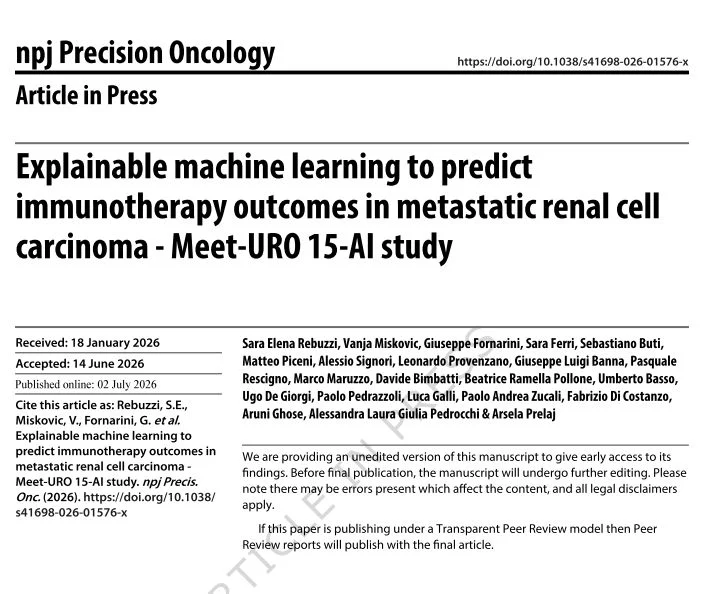
Sara Elena Rebuzzi — Medical Oncologist, PhD in Translational Oncology | Italy
“Great collaboration on the use of artificial intelligence for assessing prognostic biomarkers in patients with metastatic renal cell carcinoma receiving immunotherapy.
This work provides a solid foundation for our upcoming research in the first-line setting.
Looking forward to the next steps.”
Kunal Jobanputra — Medical Oncologist | Delivering evidence-based cutting edge therapies | India
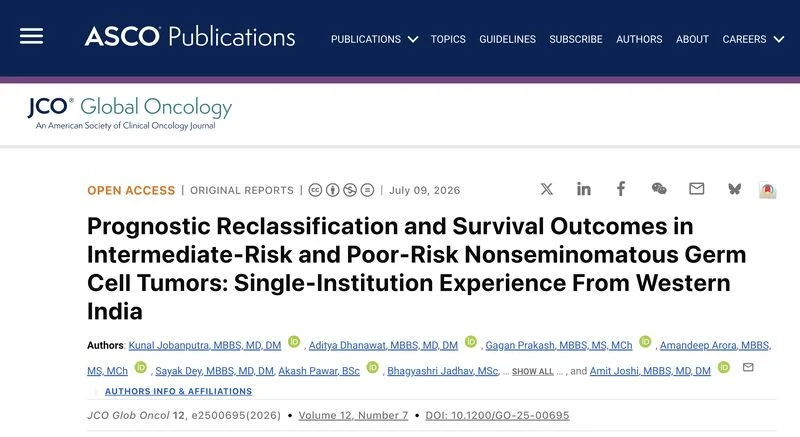
“Happy to share our work from Tata Memorial Hospital, now published in JCO Global Oncology.
In this retrospective single-centre study, we analyzed 400 patients with intermediate- and poor-risk metastatic nonseminomatous germ cell tumors treated between 2015 and 2021 and compared our outcomes with the global benchmark reported in the IGCCCG 2021 update.
Key findings:
Intermediate-risk disease: outcomes were largely comparable to the IGCCCG update.
• 5-year RFS: 77.0% vs 78%
• 5-year OS: 84.6% vs 89%
Poor-risk disease: outcomes remained substantially inferior.
• 5-year RFS: 45.6% vs 54%
• 5-year OS: 52.6% vs 67%
These findings likely reflect the advanced disease burden we frequently encounter in our setting and underscore the need to improve outcomes for this high-risk population.
We also developed a simple six-factor clinical risk model that adds greater granularity to the current risk classification by identifying a distinct poorest-risk subgroup with a 5-year overall survival of only 27.1%.
We hope this provides a framework for selecting patients for future studies evaluating treatment intensification and novel therapeutic strategies.
A heartfelt thank you to Dr Amit Joshi for conceptualizing this study and for his mentorship and guidance, and to the entire Genitourinary DMG at Tata Memorial Hospital and ACTREC for their support, encouragement, and teamwork throughout this project.”
Felipe Couñago, MD, PhD — Medical Director at GenesisCare Spain; Radiation Oncologist; Clinical Researcher; Professor | Spain
“New publication in Clinical and Translational Radiation Oncology.
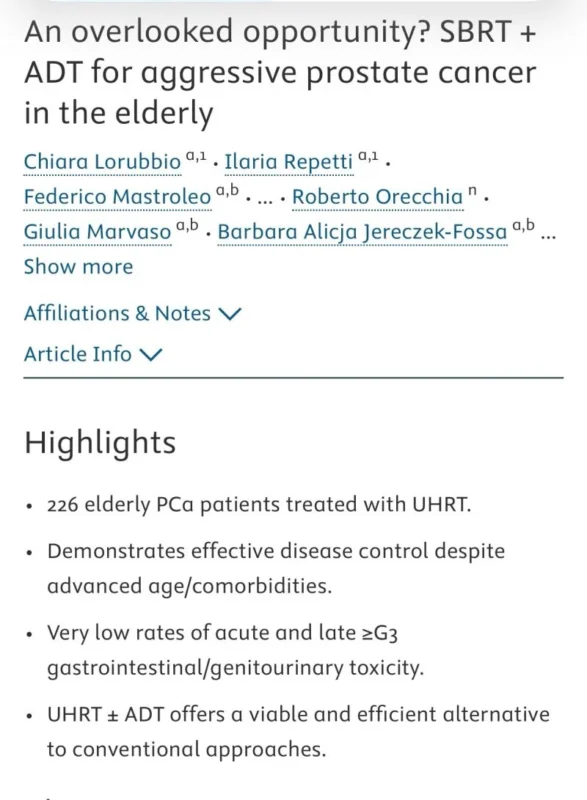
Congratulations to Dr. Chiara Lorubbio, Dr. Giulia Marvaso, Prof. Barbara Jereczek-Fossa, and all co-authors on this important study: ‘An Overlooked Opportunity? SBRT + ADT for Aggressive Prostate Cancer in the Elderly.’
This multicenter study, including 226 patients aged ≥75 years, demonstrates that personalized ultra-hypofractionated radiotherapy in 5 fractions, with or without ADT, provides encouraging disease control while maintaining a very favorable adverse event profile in a frail population with predominantly unfavorable intermediate- and high-risk localized prostate cancer.
The work highlights that chronological age alone should not preclude curative-intent treatment.
It was a real pleasure to contribute as a co-author. I am especially grateful to Dr. Chiara Lorubbio for leading this outstanding work, and to Dr. Giulia Marvaso and Prof. Barbara Jereczek-Fossa for their scientific leadership and for kindly inviting me to participate in this collaboration.
Looking forward to many more international projects together.”
Neal Shore — Medical Director, CPI – Carolina Urologic Research Center; Director, START GU Oncology Center of Excellence | United States
“Enzalutamide in biochemically recurrent prostate cancer: clinical implications from EMBARK for real-world practice.”
Liang Cheng, MD — Vice Chair, Professor of Pathology & Surgery (Urology), Director of Anatomic Pathology & Molecular Pathology, Warren Alpert Medical School of Brown University; Associate Director, Legorreta Cancer Center | United States
“Can you predict FGFR3 mutations in bladder cancer based on morphology?
I am pleased to share this article by Dr. Katrina Collins, which will appear in the August 2026 issue of Laboratory Investigation.
In this study, we found FGFR3 alterations in 17% of urothelial carcinomas, with S249C and Y373C accounting for most mutations.
Remarkably, 76% of FGFR3-altered tumors exhibited variant histology, most commonly micropapillary histology at 39% and squamous differentiation at 21%.
Both morphologic patterns were exclusively associated with the canonical S249C or Y373C hotspot mutations.
Although morphology cannot replace molecular testing, recognizing these histologic patterns may help identify patients most likely to benefit from FGFR3 testing and targeted therapy, particularly in advanced urothelial carcinoma.”
Luis Moreno Sánchez — Radiation Oncologist and Nuclear Medicine Physician; Director of Radiotherapy at Hospital Metropolitano de Santiago (HOMS) | Dominican Republic
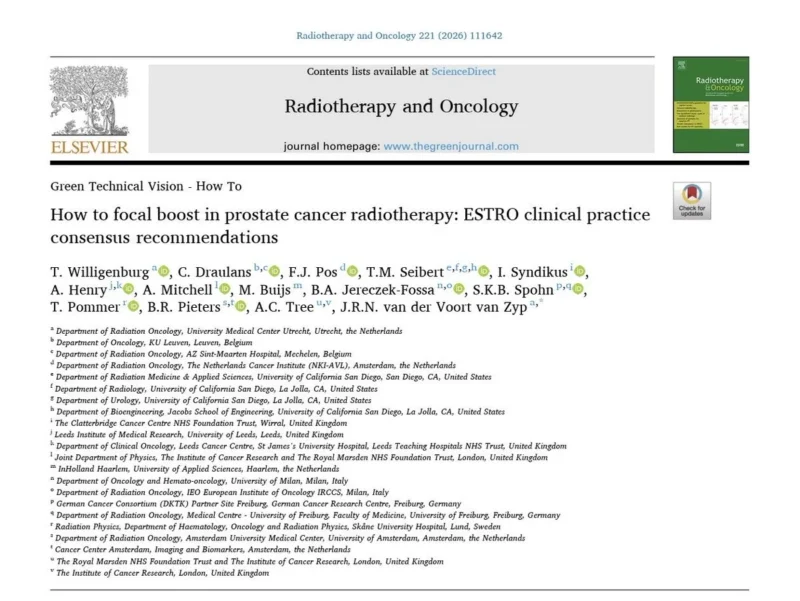
“How to focal boost in prostate cancer radiotherapy: ESTRO clinical practice consensus recommendations.”
Karl Pang — NHS Consultant Urological Surgeon | United Kingdom
“Great to share that our latest systematic review has now been published in European Urology Focus.
MicroRNAs may one day help better detect and predict the behaviour of penile cancer.
Good to get back into some science research.”
Find out 10 Must-Read Posts in GU Oncology from the second week of July on OncoDaily.