At the ESMO Congress 2026, Karim Fizazi (Lille, France) presented updated overall survival findings from the phase III CAPItello-281 trial (NCT04493853), evaluating capivasertib plus abiraterone in patients with PTEN-deficient de novometastatic hormone-sensitive prostate cancer (mHSPC).
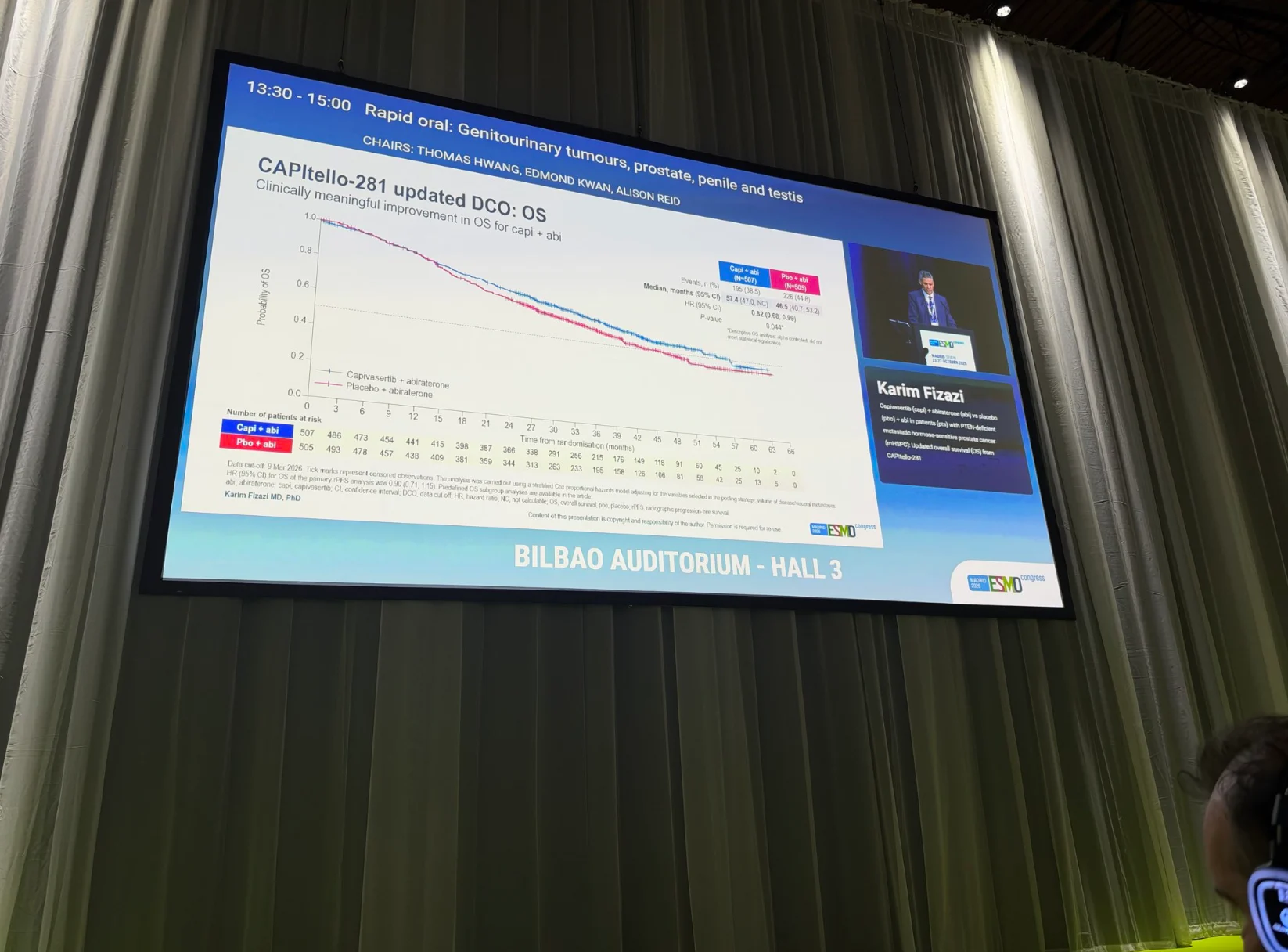
The updated analysis showed a median overall survival (OS) of 57.4 months with capivasertib plus abiraterone versus 46.5 months with placebo plus abiraterone. Although the results favored the capivasertib combination, the descriptive OS analysis did not meet the prespecified threshold for statistical significance.
Methods
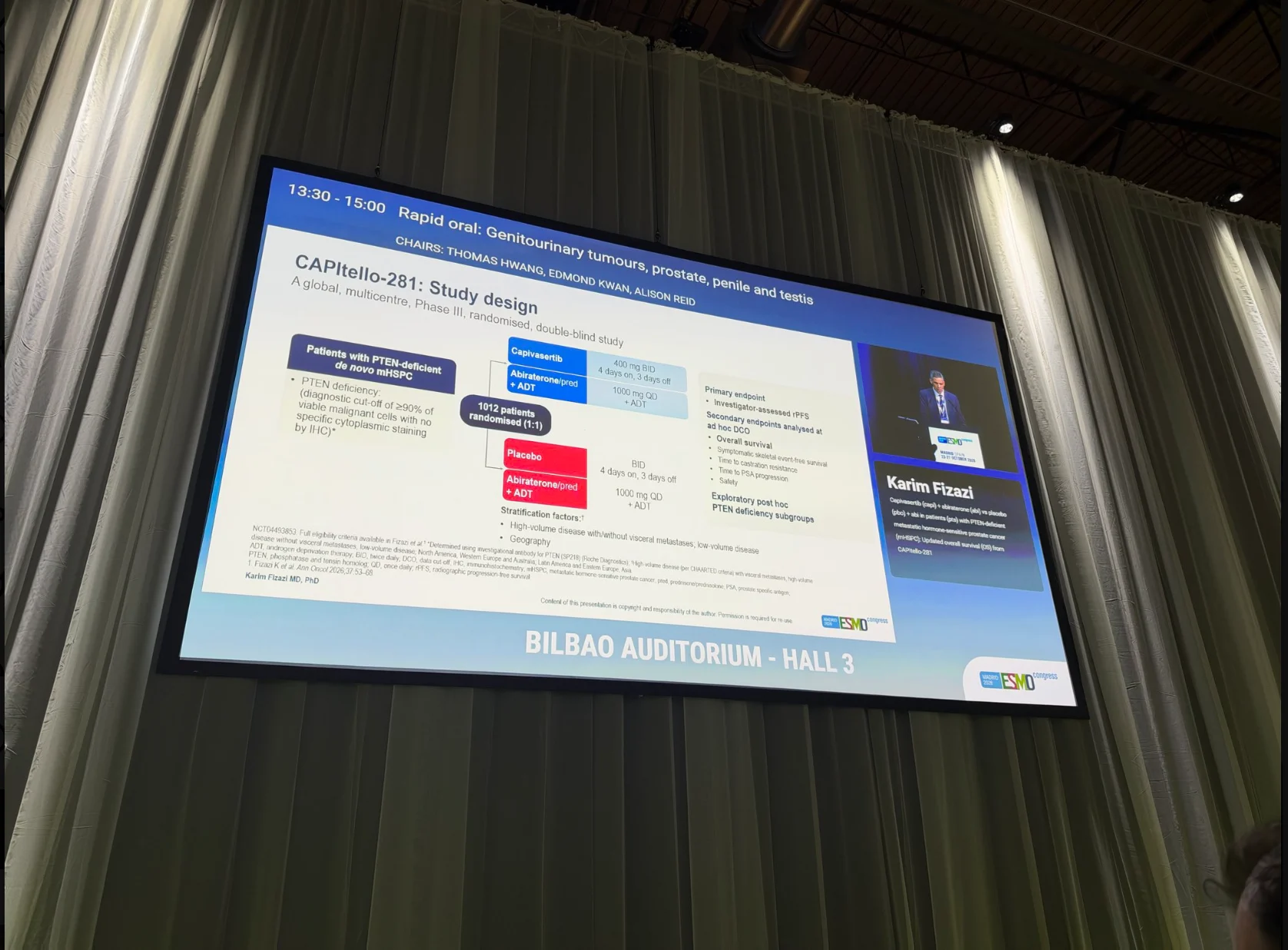
CAPItello-281 is a randomized phase III trial evaluating capivasertib, an AKT inhibitor, in combination with abiraterone, prednisone, and androgen deprivation therapy (ADT) in patients with PTEN-deficient de novo mHSPC.
PTEN deficiency was defined by immunohistochemistry (IHC) as the absence of specific cytoplasmic staining in at least 90% of viable malignant cells.
A total of 1,012 patients were randomized 1:1 to receive capivasertib plus abiraterone (n=507) or placebo plus abiraterone (n=505), alongside prednisone and ADT. Capivasertib was administered at 400 mg twice daily on a four-days-on, three-days-off schedule, while abiraterone was given at 1,000 mg once daily.
The updated analysis assessed overall survival, radiographic progression-free survival (rPFS), exploratory PTEN-deficiency subgroups, and safety.

Key Takeaways
At the March 9, 2026, data cutoff, the analysis included approximately 17 months of additional follow-up.
Median overall survival: 57.4 months with capivasertib plus abiraterone versus 46.5 months with placebo plus abiraterone.
- Overall survival hazard ratio: 0.82 (95% CI, 0.68–0.99), representing an estimated 18% reduction in the hazard of death. The analysis did not meet the prespecified statistical significance threshold (P=0.044).
- Median radiographic progression-free survival: 35.5 months versus 26.0 months, respectively.
- rPFS hazard ratio: 0.83 (95% CI, 0.70–0.99; nominal P=0.033). The updated rPFS analysis was descriptive and not formally tested.
- PTEN-deficiency subgroups: OS hazard ratios ranged from 0.76 to 0.74 across increasingly stringent PTEN-deficiency thresholds of ≥95% to 100%.
- Safety: With 17 months of additional follow-up, the safety profile remained consistent with the primary analysis, with no new safety signals reported.
The updated OS hazard ratio improved from 0.90 at the primary analysis to 0.82, while the radiographic progression-free survival findings remained consistent with the previously demonstrated benefit.
Conclusion
The updated CAPItello-281 analysis showed a favorable overall survival trend and sustained radiographic progression-free survival benefit with capivasertib plus abiraterone in patients with PTEN-deficient de novo metastatic hormone-sensitive prostate cancer.
Although median OS was 10.9 months longer in the capivasertib group, the difference did not meet the prespecified statistical significance threshold and should not be interpreted as a confirmed overall survival benefit.
These findings reinforce the clinical relevance of targeting the AKT pathway in PTEN-deficient prostate cancer, while highlighting the importance of continued evaluation of long-term survival outcomes.
Source: ESMO Congress 2026, Abstract LBA56; CAPItello-281 (NCT04493853).
Martin Ignacio Zapata Laguado, Clinical Oncologist at Instituto Nacional de Cancerología in Bogotá, shared on X.
“CAPItello-281 update: Capivasertib + abiraterone improves OS in PTEN-deficient mHSPC (HR 0.82; 57.4 vs 46.5 months), with sustained rPFS benefit.
A promising first-line strategy!”.