
Presented at ASCO 2026 by Ronald C. Chen, MD, MPH, FASCO, this analysis from the randomized AMBASSADOR trial evaluated health-related quality of life in patients with high-risk muscle-invasive urothelial carcinoma after radical surgery. This ASCO 2026 analysis focused on whether pembrolizumab affected patient-reported quality of life compared with observation.
Previous Results from the AMBASSADOR Trial
The AMBASSADOR trial enrolled 702 patients with high-risk muscle-invasive urothelial carcinoma after radical surgery, randomly assigned in a 1:1 ratio to receive pembrolizumab 200 mg every 3 weeks for up to one year or observation. Randomization was stratified by pathological stage, PD-L1 status, and prior neoadjuvant chemotherapy.
Published in the New England Journal of Medicine in 2025, the primary efficacy results showed that adjuvant pembrolizumab significantly improved disease-free survival compared with observation, with a median of 29.6 months versus 14.2 months, representing a 27% reduction in the risk of disease progression or death (HR 0.73; 95% CI, 0.59–0.90; P=0.003) at a median follow-up of 44.8 months. The benefit was observed regardless of PD-L1 status, pathological stage, or prior neoadjuvant chemotherapy receipt.
Overall survival data remained immature at the time of publication. Grade 3 or higher adverse events occurred in 50.6% of patients receiving pembrolizumab compared with 31.6% in the observation group, consistent with the known safety profile of pembrolizumab.
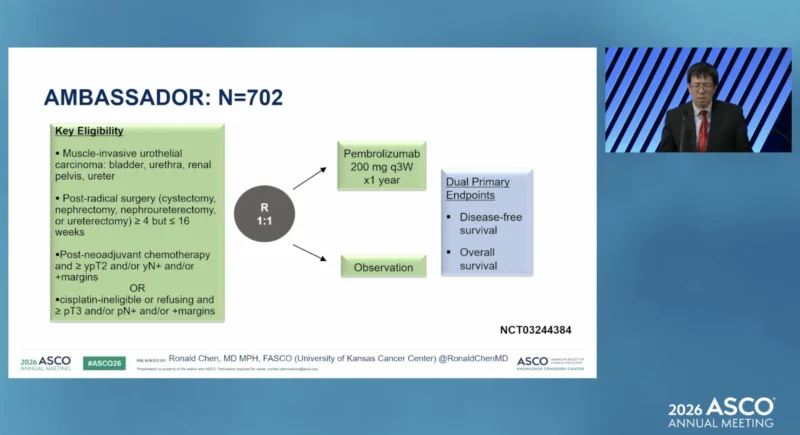
AMBASSADOR Trial Design and HRQOL Assessment
Health-related quality of life was completed by 560 randomized patients. The assessment included the EORTC QLQ-C30 with its bladder cancer supplement BLM30, and the EQ-5D-5L, which evaluates overall quality of life or health state.
The EORTC QLQ-C30 assessed specific symptoms including fatigue, dyspnea, and nausea, as well as physical functioning, role functioning, and global health. The BLM30 supplement assessed urinary symptoms and sexual functioning. The EQ-5D-5L was used to evaluate overall HRQOL and health status and will also be used for quality-adjusted survival analyses.
Published minimally important difference thresholds were 0.06 for EQ-5D-5L and 5–10 points for EORTC instruments. For functional and global health measures, higher scores indicated better outcomes, while for symptom scales such as fatigue, dyspnea, and urinary symptoms, higher scores indicated worse symptoms.
Results of the AMBASSADOR HRQOL Analysis
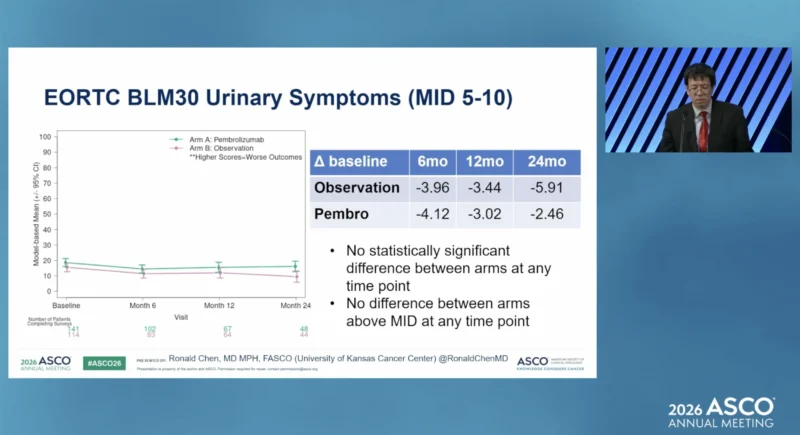
Mean changes from baseline to 12 months, corresponding to the end of treatment, showed no statistically significant differences between observation and pembrolizumab across the reported HRQOL measures.
For EQ-5D-5L index value, mean change was –0.029 with observation and –0.012 with pembrolizumab, with a between-arm difference of –0.02 and a P value of .45. For QLQ-C30 global health, mean change was 0.07 with observation and 1.45 with pembrolizumab, with a between-arm difference of –1.38 and a P value of .55.
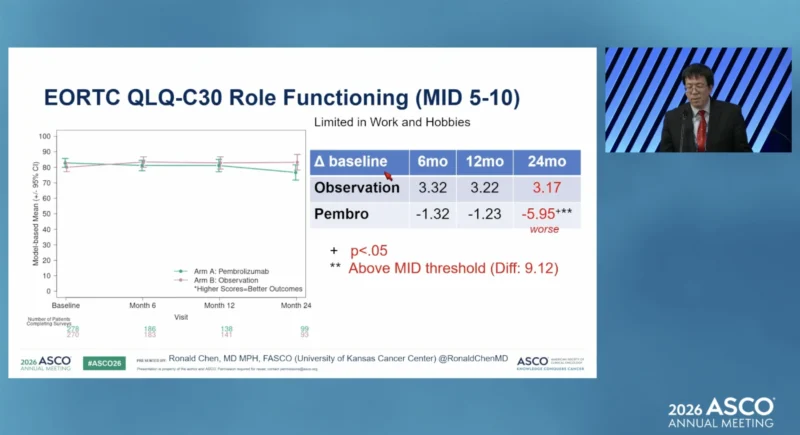
For QLQ-C30 physical functioning, mean change was –0.089 with observation and –0.069 with pembrolizumab, with a between-arm difference of –0.02 and a P value of .99. For QLQ-C30 role functioning, mean change was 3.22 with observation and –1.23 with pembrolizumab, with a between-arm difference of 4.45 and a P value of .15. For BLM30 urinary symptoms, mean change was –3.44 with observation and –3.02 with pembrolizumab, with a between-arm difference of –0.42 and a P value of .87.
For BLM30 sexual functioning, mean change was –0.53 with observation and 4.15 with pembrolizumab, with a between-arm difference of –4.68 and a P value of .07.
In the presentation, additional 24-month data were reported. For QLQ-C30 fatigue, mean change at 24 months was –0.77 with observation and 4.57 with pembrolizumab, with the between-arm difference exceeding the MID threshold, although no statistically significant difference was observed between arms. For QLQ-C30 dyspnea, mean change at 24 months was 0.48 with observation and 7.57 with pembrolizumab, with the between-arm difference exceeding the MID threshold and a statistically significant difference observed between arms (p<.05).
For QLQ-C30 physical functioning, mean change at 24 months was –0.81 with observation and –5.97 with pembrolizumab, with the between-arm difference exceeding the MID threshold, although no statistically significant difference was observed between arms. For QLQ-C30 role functioning, mean change at 24 months was 3.17 with observation and –5.95 with pembrolizumab, with the between-arm difference exceeding the MID threshold and a statistically significant difference observed between arms (p<.05).
Limitations
The authors noted that smaller sample sizes at longer time points reduced statistical power to detect differences between the two arms, which may have been partly attributable to disease progression.
Key Takeaways
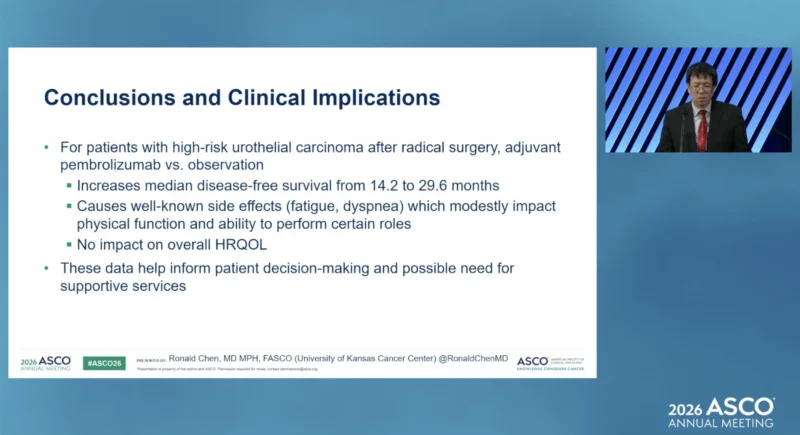
For patients with high-risk muscle-invasive urothelial carcinoma after radical surgery, adjuvant pembrolizumab compared with observation increased median disease-free survival from 14.2 to 29.6 months and was associated with increased fatigue and dyspnea, which modestly affected physical function and the ability to perform certain roles.
However, there was no difference in patient assessment of global health or overall HRQOL. These data help inform patient decision-making and the possible need for supportive services.
The full abstract is available on the official ASCO website.
Find more videos on OncoDaily Youtube TV.