 Algeria
Key takeaways
- Stratify, don't just stage. Resectable, borderline, locally advanced and metastatic is the framework that drives the 2026 pathway.
- Adjuvant chemotherapy follows resection in everyone, regardless of T, N and R status: 6 months, with modified FOLFIRINOX the preferred regimen.
- Check DPD before fluoropyrimidines. Complete deficiency is a contraindication to 5-FU and capecitabine.
- A very high CA 19-9 or a frail, malnourished patient can justify neoadjuvant therapy even when the tumor looks resectable.
- Drain the bile duct when it matters: cholangitis, bilirubin above 250 µmol/L, planned neoadjuvant treatment or delayed surgery.
- Supportive care is part of first-line management, not a fallback after progression.
Pancreatic cancer is the digestive cancer with the least forgiving prognosis, and it is the one where timing, sequencing and supportive care matter as much as the choice of regimen. The 2026 Algerian National Therapeutic Guidelines lay out a stratified pathway, from resectable to metastatic disease, that is worth revisiting as World Pancreatic Cancer Day (19 November) approaches.
Why this cancer demands a different mindset
According to the 2026 guidelines, pancreatic cancer ranked 12th worldwide for incidence in 2022 (510,992 new cases) but 6th for mortality (467,409 deaths), citing GLOBOCAN 2022. Adenocarcinoma accounts for about 90% of pancreatic tumors and is projected to become the second leading cause of cancer death in Europe and the United States by 2030. Net 5-year survival across all stages is 11%, the worst of any digestive cancer.
The guideline’s opening message is procedural rather than numerical: every exocrine pancreatic tumor should be discussed at a multidisciplinary tumor board (RCP). The rest of the chapter explains why.
Before treatment: the work-up that shapes everything
The pre-treatment assessment goes beyond staging imaging.
- Patient status first. Performance status (ECOG), symptoms, nutritional state and comorbidities must be assessed before any decision.
- DPD deficiency testing. The guidelines recommend phenotyping by uracilemia before fluoropyrimidines. Partial deficiency means 5-FU and capecitabine dose adjustment; complete deficiency is a contraindication. DPYD genotyping is an option when the phenotype is abnormal.
- Imaging. A thoraco-abdomino-pelvic CT, dated within 3 weeks of surgery for operable, resectable patients. MRI with diffusion sequences is added for any potentially operable tumor to exclude small liver metastases, provided it does not delay surgery. PET is described as debated: it cannot distinguish chronic pancreatitis from cancer, but may help exclude peritoneal carcinomatosis or doubtful retroperitoneal nodes, and is reserved for patients without hyperglycemia (<2 g/L).
- CA 19-9. Not recommended as a standalone diagnostic test but has prognostic value and may help identify biologically high-risk disease. The 2026 Algerian guidelines propose a threshold of 200 U/mL in the preoperative assessment.
- Biopsy. For resectable tumors, endoscopic ultrasound (EUS)-guided biopsy is only indicated if the diagnosis is doubtful or neoadjuvant therapy is planned. For unresectable disease, a biopsy of the most accessible site is needed before treatment decisions.
Stratification beats TNM
The guidelines state plainly that sorting tumors as resectable, borderline, locally advanced or metastatic is more useful in practice than TNM classification. The pathway follows from that.
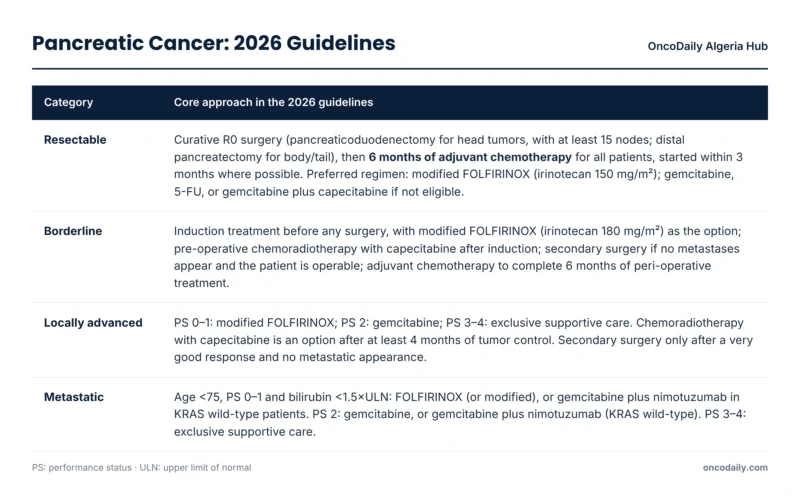
Two details in the chapter are easy to miss:
- A resectable tumor can still call for neoadjuvant chemotherapy when biological criteria (CA 19-9 above 500) and/or clinical criteria (frailty, malnutrition) are unfavorable. These are the “ABC” criteria.
- A resectable tumor in an inoperable patient is managed like a locally advanced one.
Second line and beyond
For metastatic disease, second-line chemotherapy is for patients with PS 0–1 and depends on first-line exposure:
- 5-FU plus oxaliplatin after gemcitabine-based first line (including gemcitabine plus nimotuzumab).
- Gemcitabine after FOLFIRINOX.
- Gemcitabine plus paclitaxel after progression on FOLFIRINOX, when a tumor response is needed or the patient is symptomatic.
- A taxane alone in third line if not previously received.
Supportive care is the treatment, not an add-on
The 2026 chapter calls supportive care “central” to management. Its stated aim is to improve quality of life, tolerance and adherence to anticancer therapy. For locally advanced and metastatic disease the guidelines list supportive care from diagnosis: biliary drainage for jaundice (ERCP with a metallic stent, or EUS-guided drainage with a LAMS stent if ERCP fails), duodenal stenting for symptomatic stenosis, pain management and nutritional support.
The chapter’s scope of supportive care also includes:
- treatment of anxiety and depression;
- treatment of malnutrition and sarcopenia;
- prevention of thromboembolism. Primary prophylaxis with low-molecular-weight heparin is an option in metastatic or locally advanced disease treated with chemotherapy.
The 2026 Algerian guidelines do not specify a routine imaging surveillance schedule after treatment. Clinical follow-up may be conducted by the primary care physician, with additional imaging performed when symptoms arise, particularly unexplained weight loss or new pain.
The Algerian Context: What the Documents Show
The therapeutic guidelines state that their indications were set according to international recommendations and on the basis of treatments registered in Algeria. Beyond that, the national documents give no pancreas-specific epidemiology, so what follows draws on the broader capacity picture and should be read as context, not as pancreas data.
Palliative and supportive care capacity. The Cancer Dashboard 2025–2035 reports that as of 2022 Algeria had two units specialized in palliative care for cancer patients, in Blida and in Algiers, and describes the number of palliative care beds in oncology and hematology centers as insufficient. The European Association for Palliative Care recommends 2 specialized services per 100,000 inhabitants. The Dashboard also notes the stated 2021 intention to form specialized home palliative care teams. The 2025 National Strategy’s supportive care committee recommends creating pain units in cancer centers and university hospitals, making different galenic forms of morphine available throughout the country, and widening who may prescribe specific analgesics. For a disease where pain control is part of the standard of care from diagnosis, these are the access points that matter most.
Surgical expertise. The Strategy recommends creating regional expert hubs in hepato-bilio-pancreatic surgery, within a pyramidal care system based on complexity and expertise. The guideline’s demand that pancreatic resections be done with adequate lymph-node clearance and that every case go to RCP is consistent with that direction.
Access to newer drugs. Of 60 new cancer medicines approved by the European Medicines Agency between 2015 and 2020, 16 (27%) had been approved in Algeria as of March 2025. The 2026 chapter lists the regimens above and does not include some options that appear in other international guidelines; it is not possible to say from these documents which of the listed agents are reliably available at a given center.
Tobacco. The Dashboard lists pancreatic cancer among the cancers linked to smoking and reports that 32% of men and 0.4% of women in Algeria smoke, with tobacco taxation at 44% against a WHO benchmark of 75%.
Endoscopy infrastructure. Biliary drainage by ERCP and EUS-guided biopsy or drainage depend on endoscopy capacity and expertise. The documents do not quantify it, so how far these steps are available outside the major centers is a question for local data.
Clinical Perspective
The pancreatic chapter reads as a plea for sequencing. Surgery alone does not cure most patients, and chemotherapy alone does not help if the patient cannot receive it. The guidelines therefore build in three safeguards: an RCP discussion for every case, upfront stratification by resectability and by biological and clinical risk, and supportive care from the first visit, so that jaundice, pain and malnutrition do not remove patients from treatment before it starts.
For Algerian clinicians, the practical questions are as much logistical as pharmacological. Is uracilemia testing reachable before the first FOLFIRINOX cycle? Can biliary drainage be arranged quickly enough to avoid delaying chemotherapy? Does the patient have access to an experienced pancreatic surgeon, and to a pain unit? These are the steps that decide whether the algorithm can be applied as written.
FAQ
Is there pancreatic cancer data specific to Algeria in the national documents?
Not in the documents used here. The guidelines cite global GLOBOCAN 2022 figures, and the Dashboard mentions pancreatic cancer only as one of the smoking-related cancers. National incidence, stage at diagnosis and resection rates are not reported there.
Why is DPD testing recommended before treatment?
Fluoropyrimidines (5-FU, capecitabine) can cause severe or fatal toxicity in patients with DPD deficiency. The guidelines recommend measuring uracilemia, adjusting doses in partial deficiency, and avoiding these drugs in complete deficiency, with DPYD genotyping if the phenotype is abnormal.
Does every resectable pancreatic cancer go straight to surgery?
No. Surgery first is the standard for resectable tumors, but neoadjuvant chemotherapy should be discussed when CA 19-9 exceeds 500 or the patient is frail or malnourished. Borderline tumors receive induction treatment before any surgery.
When is gemcitabine plus nimotuzumab an option?
In metastatic disease, for patients with KRAS wild-type tumors (PS 0–2). The locally advanced algorithm also lists it, alongside gemcitabine alone, for patients not eligible for modified FOLFIRINOX. This is a feature of the Algerian guideline; whether it is reimbursed or reliably supplied locally is not addressed in the national documents.
Is routine imaging surveillance recommended after treatment?
No. The guidelines recommend no particular surveillance modality; clinical follow-up can be carried out by the primary care physician, with additional tests prompted by symptoms, especially weight loss or pain.
Is supportive care only for patients who are no longer receiving treatment?
No. The guidelines place supportive care at the center of management and list it from diagnosis in advanced disease, to relieve biliary or duodenal obstruction, control pain, support nutrition and improve tolerance of chemotherapy.