At the ESMO Congress 2026, Josep M. Llovet (Barcelona, Spain) presented long-term overall survival results from the Phase III LEAP-012 trial (NCT04246177), evaluating lenvatinib plus pembrolizumab and transarterial chemoembolization (TACE) versus dual placebo plus TACE in patients with unresectable, non-metastatic hepatocellular carcinoma (HCC).
The results, presented during the Rapid Oral session (1678RO), included updated overall survival (OS), progression-free survival (PFS), tumour response, and safety outcomes.
Why Was LEAP-012 Conducted?
The Phase III LEAP-012 trial investigated whether adding lenvatinib and pembrolizumab to TACE could improve clinical outcomes in patients with unresectable, non-metastatic HCC who were not candidates for curative treatment. At the first interim analysis (IA1), the combination significantly improved PFS assessed by blinded independent central review (BICR) according to RECIST v1.1 compared with dual placebo plus TACE (HR 0.66; 95% CI 0.51–0.84; one-sided p=0.0002). The analysis presented at ESMO 2026 evaluated long-term OS outcomes from the third interim analysis (IA3), with a data cutoff of August 19, 2025.
LEAP-012 Study Design and Methods
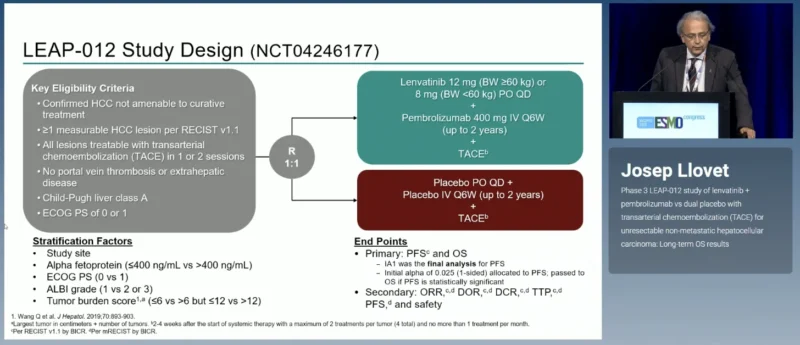
LEAP-012 was a global, randomized Phase III trial enrolling patients with non-metastatic HCC not amenable to curative treatment. Eligible patients had liver-only disease without portal vein invasion, Child-Pugh class A liver function, and an ECOG performance status of 0 or 1. Patients were randomized in a 1:1 ratio to receive TACE combined with either lenvatinib plus pembrolizumab or dual placebo.
Pembrolizumab was administered at 400 mg intravenously every six weeks. Lenvatinib was administered orally once daily at 12 mg for patients weighing at least 60 kg or 8 mg for those weighing less than 60 kg. The control group received TACE plus matching oral and intravenous placebos. Study drug treatment was administered for up to two years.
The primary endpoints were PFS assessed by BICR according to RECIST v1.1 and OS. Secondary endpoints included objective response rate (ORR), duration of response (DOR), time to progression (TTP), and safety.
Key Findings from LEAP-012
A total of 480 patients were randomized, including 237 assigned to lenvatinib plus pembrolizumab and TACE and 243 to dual placebo plus TACE. All 237 patients in the experimental group and 241 in the control group received treatment. At the August 19, 2025 data cutoff, the median time from randomization to data cutoff was 44.2 months (range 31.3–62.1).
Overall Survival
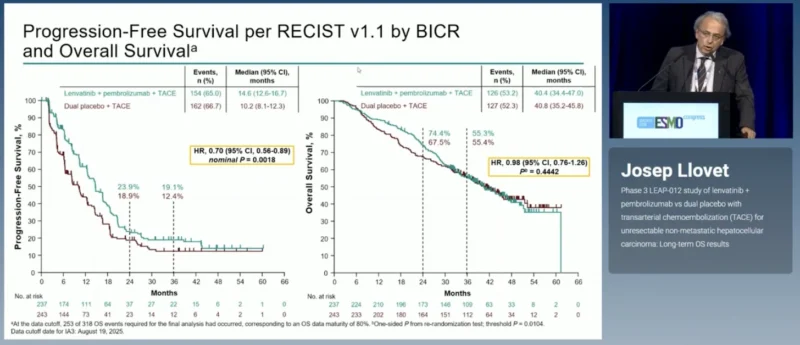
At the third interim analysis, 253 OS events had occurred. Median OS was 40.4 months (95% CI 34.4–47.0) with lenvatinib plus pembrolizumab and TACE compared with 40.8 months (95% CI 35.2–45.8) with dual placebo plus TACE.
The OS hazard ratio was 0.98 (95% CI 0.76–1.26), indicating no demonstrated overall survival benefit with the addition of lenvatinib and pembrolizumab. The estimated 24-month OS rates were 74.4% versus 67.5%, respectively. At 36 months, OS rates were 55.3% and 55.4%. Despite the previously demonstrated PFS benefit, the long-term analysis did not show an improvement in OS.
Progression-Free Survival
LEAP-012 previously met its primary endpoint for PFS at the first interim analysis (IA1), which was also the prespecified final PFS analysis. At the January 30, 2024 cutoff, BICR-assessed PFS according to RECIST v1.1 significantly favoured lenvatinib plus pembrolizumab and TACE over dual placebo plus TACE (HR 0.66; 95% CI 0.51–0.84; one-sided p=0.0002).
In the descriptive PFS analysis presented at IA3, median PFS was 14.6 months (95% CI 12.6–16.7) with lenvatinib plus pembrolizumab and TACE compared with 10.2 months (95% CI 8.1–12.3) with dual placebo plus TACE (HR 0.70; 95% CI 0.56–0.89; nominal p=0.0018). The estimated 24-month PFS rates were 23.9% versus 18.9%, while the corresponding 36-month rates were 19.1% versus 12.4%. The updated descriptive analysis remained consistent with the previously demonstrated PFS benefit.
Objective Response Rate and Duration of Response
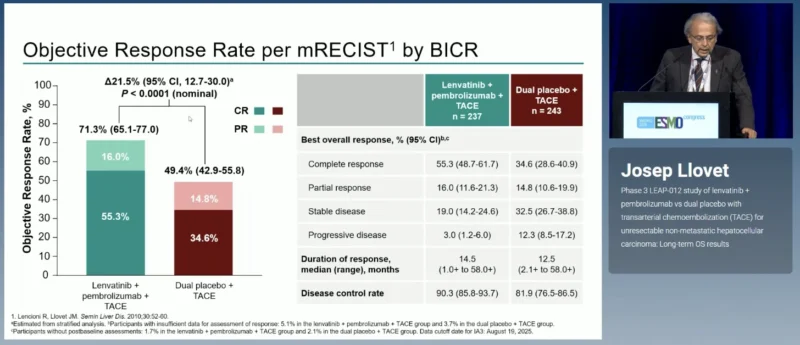
According to RECIST v1.1, the ORR was 48.1% (95% CI 41.6–54.7) with lenvatinib plus pembrolizumab and TACE compared with 33.7% (95% CI 27.8–40.1) with dual placebo plus TACE. Using modified RECIST (mRECIST), response rates were 71.3% (95% CI 65.1–77.0) and 49.4% (95% CI 42.9–55.8), respectively.
Median DOR was 14.3 months (range 1.3+ to 58.0+) with lenvatinib plus pembrolizumab and TACE compared with 12.6 months (range 2.0+ to 51.8+) in the control group.
Time to Progression
Median TTP was 16.6 months (95% CI 14.6–18.5) in the lenvatinib plus pembrolizumab and TACE group compared with 10.4 months (95% CI 8.2–12.5) in the dual placebo plus TACE group. These findings showed numerically more favourable tumour response and disease progression outcomes with the addition of systemic therapy, without a corresponding demonstrated improvement in overall survival.
Safety Outcomes
Grade 3 or higher treatment-related adverse events (TRAEs) occurred in 72.2% of patients receiving lenvatinib plus pembrolizumab and TACE compared with 32.0% receiving dual placebo plus TACE. TRAEs leading to discontinuation of both study drugs occurred in 21 patients (8.9%) in the lenvatinib plus pembrolizumab group and four patients (1.7%) in the control group.
Treatment-related deaths were reported in four patients (1.7%) receiving lenvatinib plus pembrolizumab and TACE and two patients (0.8%) receiving dual placebo plus TACE.
The investigators reported that the safety profile of lenvatinib plus pembrolizumab was consistent with previous reports and earlier analyses of LEAP-012. However, Grade 3 or higher TRAEs and treatment discontinuations were more frequent in the experimental group.
Conclusions
The long-term results of the Phase III LEAP-012 trial demonstrated that adding lenvatinib and pembrolizumab to TACE improved progression-free survival but did not result in an overall survival benefit in patients with unresectable, non-metastatic hepatocellular carcinoma.
At the third interim analysis, median OS was 40.4 months with lenvatinib plus pembrolizumab and TACE versus 40.8 months with dual placebo plus TACE (HR 0.98; 95% CI 0.76–1.26). The earlier PFS analysis had demonstrated a statistically significant benefit, while objective response rates and time to progression also numerically favoured the combination regimen. Grade 3 or higher TRAEs occurred in 72.2% versus 32.0% of patients, and treatment-related deaths were reported in both groups.
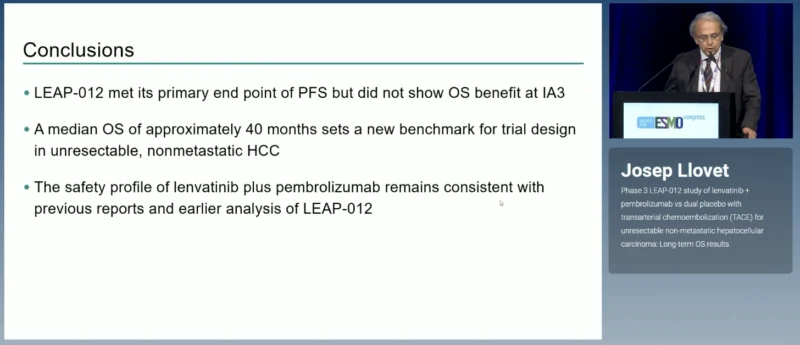
The investigators concluded that LEAP-012 met its primary endpoint for PFS but did not demonstrate an OS benefit. The approximately 40-month median OS observed in both treatment groups was identified as a potential new benchmark for the design of future clinical trials in unresectable, non-metastatic HCC.
These findings highlight the distinction between improvements in progression-related endpoints and overall survival, alongside the increased treatment-related toxicity observed with the addition of lenvatinib and pembrolizumab.
Source: ESMO Congress 2026 – Abstract 1678RO, Phase III LEAP-012
Read more about C-CAR031 at ESMO 2026 on OncoDaily.