At the ESMO Congress 2026, Qi Zhang (Hangzhou, China) presented updated results from a Phase I study (NCT06590246) evaluating C-CAR031 (AZD7003), a glypican-3 (GPC3)-targeted armored autologous chimeric antigen receptor T-cell (CAR-T) therapy, in patients with previously treated advanced hepatocellular carcinoma (HCC).
The results, presented during the Rapid Oral session (1680RO), included updated safety, objective response rate (ORR), disease control rate (DCR), progression-free survival (PFS), duration of response (DOR), and overall survival (OS) outcomes.
Why Was C-CAR031 Investigated?
C-CAR031 is an autologous CAR-T cell therapy targeting GPC3 and engineered to express a dominant-negative transforming growth factor-beta receptor II (TGFβRIIDN). This modification is designed to counteract TGF-β-mediated immunosuppression within the tumour microenvironment, which may limit the activity of CAR-T cells against solid tumours.
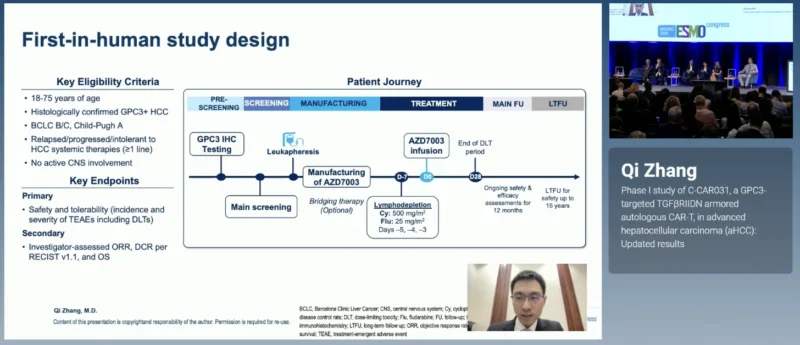
The Phase I study investigated the safety, tolerability, and preliminary antitumour activity of C-CAR031 in patients with GPC3-positive advanced HCC who had experienced treatment failure following at least one prior line of systemic therapy.
C-CAR031 Study Design and Methods
This first-in-human, open-label Phase I dose-escalation study used an accelerated titration approach combined with an i3+3 design. Eligible patients had GPC3-positive advanced HCC and had failed at least one prior line of systemic treatment. Following standard lymphodepleting chemotherapy, patients received an intravenous infusion of C-CAR031. Four dose levels were evaluated. The primary endpoints were safety and tolerability, while additional assessments included pharmacokinetics and preliminary antitumour efficacy.
Key Findings from C-CAR031
A total of 36 patients received C-CAR031 across four dose levels. The updated efficacy and survival analyses used an August 15, 2026 data cutoff. The study population was heavily pretreated. Overall, 94.4% of patients had Barcelona Clinic Liver Cancer (BCLC) stage C disease, and 83.3% had extrahepatic metastases.
Patients had received a median of four prior lines of systemic therapy (range 1–8), and 91.7% had previously received both immune checkpoint inhibitors and VEGF(R) inhibitors. The median observed follow-up in the updated analysis was 14.9 months.
Objective Response Rate and Disease Control
C-CAR031 demonstrated preliminary antitumour activity in patients with previously treated advanced HCC. Tumour shrinkage was observed in 89% of patients, with a median reduction of 42% (range 3%–94%), as reported in the original abstract.
The objective response rate (ORR) according to RECIST v1.1 was 44.4% (16/36), with 16 partial responses. The disease control rate (DCR) was 91.7% (33/36), comprising 16 partial responses and 17 cases of stable disease. Two patients experienced progressive disease, while one patient was not evaluable because no post-baseline tumour assessment was available.
- Dose level 1 (0.75 × 10⁶ cells/kg; n=1): ORR 0%; DCR 100%.
- Dose level 2 (1.5 × 10⁶ cells/kg; n=6): ORR 50.0% (3/6); DCR 83.3% (5/6).
- Dose level 3 (2.5 × 10⁶ cells/kg; n=18): ORR 38.9% (7/18); DCR 100% (18/18).
- Dose level 4 (4.0 × 10⁶ cells/kg; n=11): ORR 54.5% (6/11); DCR 81.8% (9/11).
The dose of 2.5 × 10⁶ cells/kg was selected as the recommended Phase II dose (RP2D), based on combined cellular kinetics, safety, and efficacy data. These results demonstrated preliminary antitumour activity across several dose levels, although the small numbers of patients in individual groups limit comparisons between doses.
Duration of Response and Progression-Free Survival
In the original ESMO abstract, median DOR was 4.4 months (95% CI 2.9–7.4), and median PFS was 4.2 months (95% CI 2.9–4.8) in the overall population. Across dose levels 2, 3, and 4, median DOR was 7.4, 3.4, and 4.4 months, respectively. Corresponding median PFS was 4.3, 4.2, and 4.3 months. These outcomes provide preliminary information on the duration of disease control following C-CAR031 treatment.
Overall Survival
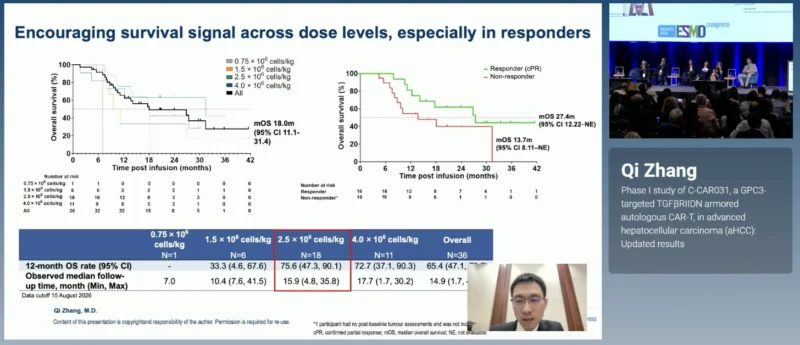
In the updated survival analysis, median overall survival (OS) was 18.0 months (95% CI 11.1–31.4) in the overall population. The estimated 12-month OS rate was 65.4% (95% CI 47.1–78.7). Across dose levels 2, 3, and 4, the 12-month OS rates were 33.3%, 75.6%, and 72.7%, respectively.
Median OS was 27.4 months (95% CI 12.22–not estimable) among patients who achieved a confirmed partial response, compared with 13.7 months (95% CI 8.11–not estimable) among non-responders. These descriptive survival results suggested more favourable outcomes among responders, although the early-phase study design, small sample size, and absence of a control group limit their interpretation.
Safety Outcomes
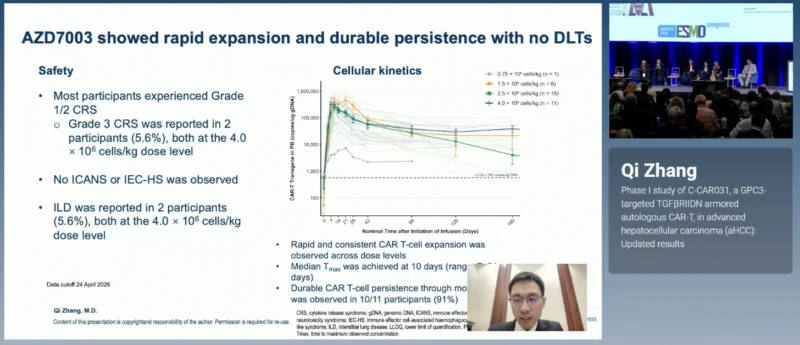
Cytokine release syndrome (CRS), assessed according to ASTCT 2019 criteria, occurred in 94% of patients. Grade 3 CRS occurred in two patients (5.6%), both treated at the 4.0 × 10⁶ cells/kg dose level. No immune effector cell-associated neurotoxicity syndrome (ICANS) or dose-limiting toxicities were observed. According to CTCAE v5.0, the most common Grade 3 or higher treatment-emergent adverse events were lymphopenia (100%), leukopenia (81%), and neutropenia (72%).
The most common Grade 3 or higher adverse events attributed to C-CAR031 were transaminase elevation (14%) and thrombocytopenia (11%). Two patients (5.6%), both treated at the 4.0 × 10⁶ cells/kg dose level, developed C-CAR031-related interstitial lung disease.
One patient developed renal dysfunction secondary to C-CAR031-related tumour lysis syndrome and subsequently died after declining dialysis. Although the investigators described the overall safety profile as manageable, these findings included clinically significant toxicities, including a fatal complication.
Conclusions
The updated results of the Phase I C-CAR031 (AZD7003) study demonstrated preliminary antitumour activity in heavily pretreated patients with GPC3-positive advanced hepatocellular carcinoma. The ORR was 44.4%, and the DCR was 91.7%. Median DOR was 4.4 months, and median PFS was 4.2 months. In the updated survival analysis, median OS was 18.0 months (95% CI 11.1–31.4), with an estimated 12-month OS rate of 65.4% (95% CI 47.1–78.7).
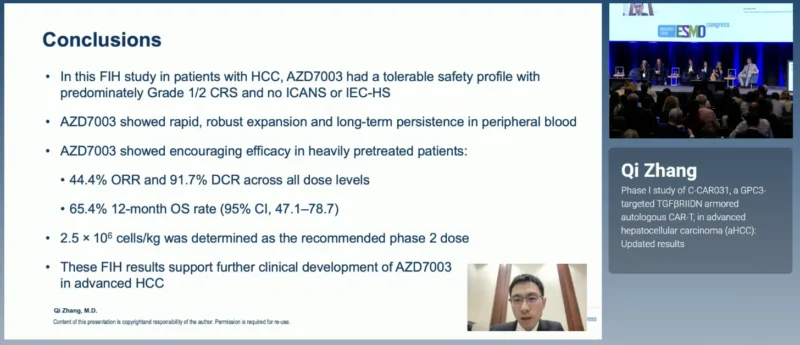
Grade 3 cytokine release syndrome occurred in two patients (5.6%), both at the 4.0 × 10⁶ cells/kg dose level. No ICANS or dose-limiting toxicities were observed. Interstitial lung disease was reported in two patients (5.6%). The original abstract also reported one death following renal dysfunction secondary to C-CAR031-related tumour lysis syndrome, after the patient declined dialysis.
The investigators described a tolerable safety profile and encouraging antitumour activity. The dose of 2.5 × 10⁶ cells/kg was selected as the recommended Phase II dose, supporting further clinical development of C-CAR031 in advanced HCC. Further studies are needed to confirm efficacy and characterize long-term safety.
Source: ESMO Congress 2026 – Abstract 1680RO, Phase I C-CAR031
Read more about HRS-4642 Plus Chemotherapy With or Without Adebrelimab in KRAS G12D-Mutant Pancreatic Cancer presented at ESMO 2026 on OncoDaily.