At the ESMO Congress 2026, Chenlei Wen (Shanghai, China) presented preliminary results from a Phase II study evaluating HRS-4642 plus gemcitabine and nab-paclitaxel (GnP), with or without adebrelimab, as perioperative treatment for patients with KRAS G12D-mutant pancreatic cancer.
The results, presented during the Rapid Oral session as Late-Breaking Abstract LBA85, included objective response rate (ORR), surgical and pathological outcomes, event-free survival (EFS), and safety.
Why Was This Study Conducted?
Despite progress in KRAS G12D-directed therapies for advanced pancreatic ductal adenocarcinoma (PDAC), perioperative treatment continues to rely on chemotherapy-based regimens, including gemcitabine and nab-paclitaxel.
HRS-4642 is a KRAS G12D inhibitor being investigated in combination with chemotherapy. This Phase II study evaluated the efficacy and safety of HRS-4642 plus GnP, with or without adebrelimab, in patients with treatment-naive KRAS G12D-mutant pancreatic cancer.
Study Design and Methods
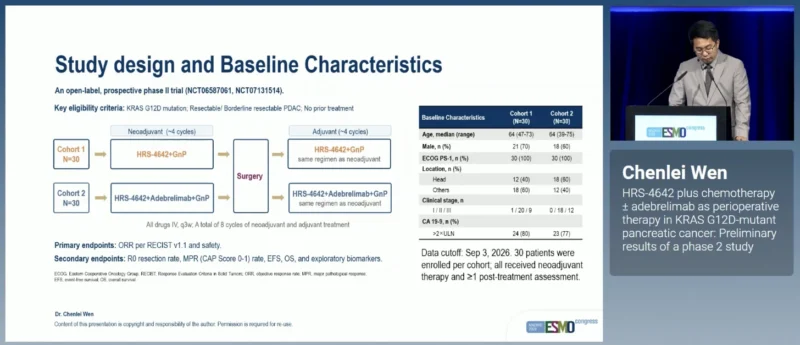
This prospective, open-label Phase II study enrolled patients with treatment-naive, resectable or borderline resectable KRAS G12D-mutant pancreatic cancer. The study used a Bayesian optimal Phase II (BOP2) design and included two treatment cohorts.
The treatment plan consisted of eight three-week perioperative cycles, with approximately four neoadjuvant cycles followed by surgery and approximately four adjuvant cycles. Patients received HRS-4642 plus GnP without adebrelimab (Cohort 1) or with adebrelimab (Cohort 2). HRS-4642 was administered at 500 mg on Day 1 and 1,200 mg on Day 8. Nab-paclitaxel was given at 125 mg/m² and gemcitabine at 1,000 mg/m² on Days 1 and 8 of each cycle. Patients in Cohort 2 additionally received adebrelimab 1,200 mg on Day 1.
The primary endpoints were ORR according to RECIST v1.1 and safety. Secondary endpoints included R0 resection rate, major pathological response (MPR; College of American Pathologists score 0–1), EFS, overall survival (OS), and exploratory biomarker assessments. The study was registered under NCT06587061 and NCT07131514.
Key Findings
As of September 3, 2026, a total of 60 patients had been enrolled, with 30 patients in each cohort. Median age was 64 years in both cohorts, and all patients had an ECOG performance status of 1. All patients received neoadjuvant therapy and underwent at least one post-treatment assessment.
Objective Response Rate
Tumour shrinkage was observed in all patients. The ORR was 63% in Cohort 1, with 19 partial responses among 30 patients receiving HRS-4642 plus GnP. In Cohort 2, the ORR was 87%, with 26 partial responses among 30 patients receiving HRS-4642 plus GnP and adebrelimab. The numerical response rate was higher in Cohort 2, although the preliminary findings do not establish the independent contribution of adebrelimab.
Surgical Outcomes and Pathological Response
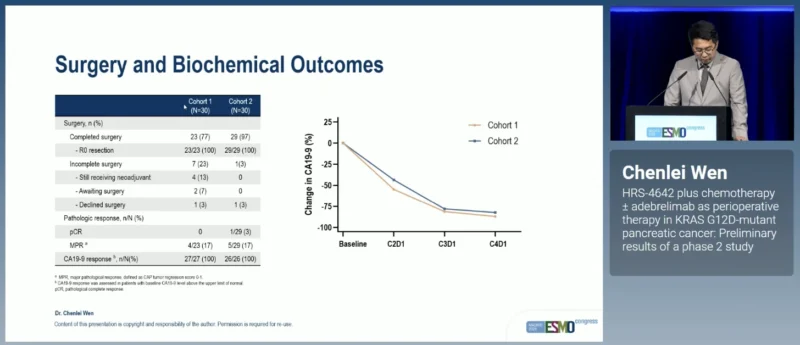
Surgery was performed in 23 patients (77%) in Cohort 1 and 29 patients (97%) in Cohort 2. In Cohort 1, four patients were still receiving neoadjuvant treatment, two were awaiting surgery, and one declined surgery. One patient in Cohort 2 also declined surgery.
Among patients who underwent resection, the R0 resection rate was 100% in both cohorts (23/23 and 29/29, respectively). The MPR rate, defined as a CAP score of 0–1, was 17% in each cohort (4/23 and 5/29, respectively).
Event-Free Survival
At six months, the estimated EFS rate was 87% in Cohort 1 and 96% in Cohort 2. Although the six-month EFS estimate was numerically higher in Cohort 2, survival data remained immature. Among patients with baseline CA19-9 levels above the upper limit of normal, all experienced a reduction of at least 50%.
Safety Outcomes
All patients experienced treatment-related adverse events (TRAEs). Grade 3 or higher TRAEs occurred in 47% of patients receiving HRS-4642 plus GnP and 53% receiving HRS-4642 plus GnP and adebrelimab. The most common Grade 3 or higher TRAEs were neutropenia and leukopenia. No treatment-related adverse events were fatal or prevented patients from undergoing surgery.
Conclusions
The preliminary results of this Phase II study demonstrated antitumour activity with HRS-4642 plus gemcitabine and nab-paclitaxel, with or without adebrelimab, as perioperative treatment for KRAS G12D-mutant pancreatic cancer. Objective response rates were 63% with HRS-4642 plus GnP and 87% with the addition of adebrelimab. Among patients who underwent resection, the R0 resection rate was 100% in both cohorts, while the MPR rate was 17% in each cohort.
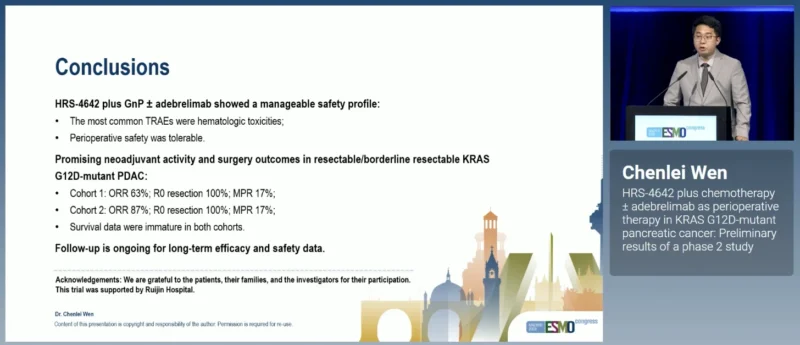
Six-month EFS rates were 87% and 96%, respectively, although survival data remained immature. Grade 3 or higher TRAEs occurred in 47% and 53% of patients, with no treatment-related deaths or adverse events that prevented surgery.
The investigators concluded that HRS-4642 plus GnP showed promising neoadjuvant activity with a manageable safety profile, while the addition of adebrelimab showed potential for enhanced efficacy. However, these preliminary results do not establish a comparative benefit from adding adebrelimab, and longer follow-up is needed to assess survival outcomes.
Source: ESMO Congress 2026 – LBA85, Phase II HRS-4642 Plus Chemotherapy ± Adebrelimab
Read more about RASolute 302 at ESMO 2026 on OncoDaily.