The ESMO Congress 2026 will feature several important readouts across hepatobiliary cancers, including hepatocellular carcinoma (HCC) and biliary tract cancers (BTC). The program spans TACE-based treatment strategies, adjuvant therapy, first-line immunotherapy, biomarker-selected maintenance treatment, bispecific antibodies, and CAR-T cell therapy.
In HCC, updated phase III data from EMERALD-3 and LEAP-012 will further evaluate systemic therapy combined with transarterial chemoembolization (TACE), while BGB-B2033 and C-CAR031 will provide new data on GPC3-directed approaches. In biliary tract cancer, the program includes phase III first-line studies, the ACTICCA-1 adjuvant trial, a DDR-selected maintenance strategy, and randomized data in previously treated disease.
This overview highlights 9 HCC and biliary tract cancer trials to watch at ESMO 2026.
EMERALD-3: Liver Function and Post-Progression Outcomes With STRIDE ± Lenvatinib + TACE
Abstract: LBA48
Presenter: Masatoshi Kudo (Osaka, Japan)
Trial Type: Phase III
Session: Proffered Paper session
EMERALD-3 (NCT05301842) is a global, randomized, open-label, sponsor-blinded phase III study evaluating the STRIDE regimen—single tremelimumab plus regular-interval durvalumab—with or without lenvatinib in combination with TACE versus TACE alone in patients with embolization-eligible HCC. The study enrolled 760 patients across three treatment groups.
The primary results were presented at ASCO 2026 and subsequently published in The Lancet Oncology in September 2026. In the primary comparison, STRIDE plus lenvatinib and TACE improved median progression-free survival to 13.0 months versus 9.8 months with TACE alone (HR 0.70; 95% CI, 0.57–0.86; P=0.0007). At the interim overall survival analysis, median OS was 39.5 versus 34.7 months (HR 0.84; 95% CI, 0.65–1.09; P=0.1814).
At ESMO 2026, EMERALD-3 will report liver function trajectories and post-progression outcomes.
BGB-B2033: GPC3 × 4-1BB Bispecific Antibody in Advanced HCC
Abstract: 1679O
Presenter: Hong Jae Chon (Seongnam, Republic of Korea)
Trial Type: Phase I
Session: Proffered Paper session
BGB-B2033 is an IgG-based GPC3 × 4-1BB bispecific antibody designed to activate 4-1BB signaling in the presence of GPC3-expressing tumor cells. It is being evaluated in a first-in-human phase I study (NCT06427941) as monotherapy and in combination strategies in advanced GPC3-expressing solid tumors.
Initial monotherapy data were presented at ASCO 2026. Among 61 patients enrolled in the dose-escalation and safety-expansion portion, 60 had HCC. In 59 efficacy-evaluable patients with HCC, the confirmed objective response rate was 20.3% (95% CI, 11.0–32.8). At doses above the predicted target efficacious dose, confirmed ORR was 28.9% (11/38). Grade ≥3 treatment-related adverse events occurred in 8.2% of patients.
At ESMO 2026, investigators will provide the first disclosure of dose-optimization data together with an updated dose-escalation analysis of BGB-B2033 monotherapy in advanced HCC.
LEAP-012: Long-Term OS With Lenvatinib + Pembrolizumab + TACE
Abstract: 1678RO
Presenter: Josep M. Llovet (Barcelona, Spain)
Trial Type: Phase III
Session: Rapid Oral session
LEAP-012 (NCT04246177) is a randomized, double-blind phase III study comparing lenvatinib plus pembrolizumab and TACE with dual placebo plus TACE in patients with unresectable, non-metastatic HCC.
The primary analysis was published in The Lancet in January 2025. Median progression-free survival was 14.6 months with lenvatinib plus pembrolizumab and TACE versus 10.0 months with TACE plus placebo (HR 0.66; 95% CI, 0.51–0.84; one-sided P=0.0002). At the first interim OS analysis, the 24-month OS rate was 75% versus 69% (HR 0.80; 95% CI, 0.57–1.11), and the prespecified threshold for statistical significance had not been reached.
At ESMO 2026, LEAP-012 will report long-term overall survival results.
C-CAR031: GPC3-Targeted Armored CAR-T in Advanced HCC
Abstract: 1680RO
Presenter: Qi Zhang (Hangzhou, China)
Trial Type: Phase I
Session: Rapid Oral session
C-CAR031 is an autologous GPC3-targeted CAR-T cell therapy engineered with a dominant-negative TGF-β receptor II (TGFβRIIDN) to counter TGF-β-mediated immunosuppression in the HCC tumor microenvironment. The first-in-human study is registered as NCT05155189.
Results from 36 patients with advanced, treatment-refractory HCC were published in Nature on July 15, 2026. The objective response rate was 44.4%, with a median duration of response of 4.4 months. Median progression-free survival was 4.2 months, and median overall survival was 14.2 months.
At ESMO 2026, investigators will present updated phase I results with C-CAR031 in advanced HCC.

HARMONi-GI1: Ivonescimab + Chemotherapy Versus Durvalumab + Chemotherapy
Abstract: LBA8
Presenter: Jian Zhou (Shanghai, China)
Trial Type: Phase III, Randomized, Double-Blind
Session: Proffered Paper session
HARMONi-GI1 (NCT06591520; AK112-309) is a randomized phase III study conducted in China comparing first-line ivonescimab plus gemcitabine-cisplatin with durvalumab plus gemcitabine-cisplatin in patients with unresectable locally advanced or metastatic biliary tract cancer. Overall survival is the primary endpoint.
Ivonescimab is a bispecific antibody targeting PD-1 and VEGF-A. On August 25, 2026, Akeso reported that HARMONi-GI1 met its primary endpoint at a prespecified interim analysis, with a statistically significant improvement in overall survival for ivonescimab plus chemotherapy compared with durvalumab plus chemotherapy. The study also met its key secondary endpoints of progression-free survival and objective response rate. Detailed efficacy and safety results were not included in the topline announcement.
ESMO 2026 will present the phase III HARMONi-GI1 results comparing the two first-line immunotherapy-plus-chemotherapy strategies.
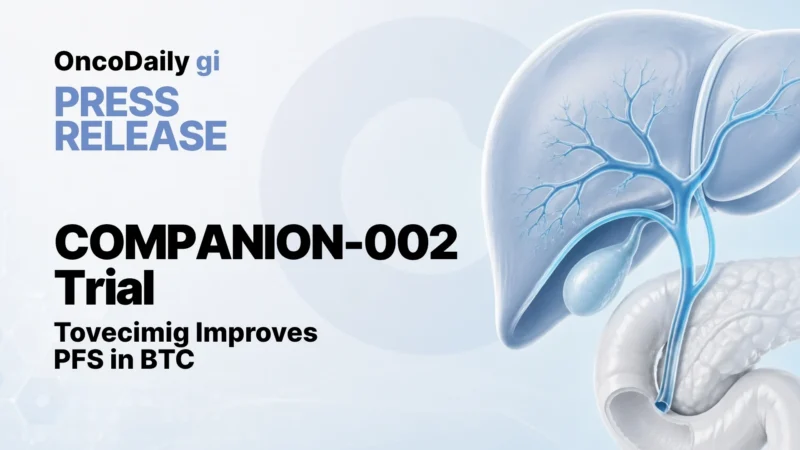
COMPANION-002: Paclitaxel ± Tovecimig in Previously Treated BTC
Abstract: 459O
Presenter: Nilofer S. Azad (Baltimore, United States of America)
Trial Type: Randomized Phase II/III
Session: Proffered Paper session
COMPANION-002 (NCT05506943) is a randomized phase II/III study evaluating paclitaxel with or without tovecimig, a DLL4 × VEGF-A bispecific antibody, in patients with unresectable advanced, metastatic, or recurrent biliary tract cancer after one prior systemic chemotherapy regimen. Patients were randomized 2:1 to tovecimig plus paclitaxel or paclitaxel alone, with crossover permitted after centrally confirmed progression.
Company-reported results showed that the study met its primary endpoint of objective response rate. In the subsequently updated analysis, ORR was 18.0% with tovecimig plus paclitaxel versus 5.3% with paclitaxel alone (P=0.0228). Median PFS was 4.7 versus 2.6 months (HR 0.44; P<0.0001). The overall survival analysis did not show a statistically significant difference and was affected by substantial crossover from the control arm.
At ESMO 2026, investigators will present the randomized paclitaxel ± tovecimig analysis in previously treated advanced biliary tract cancer.
ACTICCA-1: Adjuvant Gemcitabine + Cisplatin After Resection of BTC
Abstract: LBA21
Presenter: Henning Wege (Hamburg, Germany)
Trial Type: Phase III
Session: Proffered Paper session
ACTICCA-1 (NCT02170090) is a multinational randomized phase III study evaluating adjuvant gemcitabine plus cisplatin after curative-intent resection of cholangiocarcinoma or muscle-invasive gallbladder carcinoma.
The trial was initially designed with observation as the control strategy. Following the emergence of BILCAP data, the protocol was amended, and capecitabine became the standard-of-care comparator for the subsequent stage of the study. The current registry lists disease-free survival as the primary endpoint, with overall survival, recurrence-free survival, safety, and quality of life among the secondary outcomes.
At ESMO 2026, ACTICCA-1 will report the phase III comparison of adjuvant gemcitabine-cisplatin with standard of care after curative-intent resection of cholangiocarcinoma and gallbladder carcinoma.
OPTIMUM: Maintenance Olaparib ± Durvalumab in DDR-Mutated Advanced BTC
Abstract: LBA22
Presenter: Changhoon Yoo (Seoul, Republic of Korea, Songpa-gu)
Trial Type: Phase II, Randomized
Session: Rapid Oral session
OPTIMUM (NCT05222971) is a randomized, open-label phase II study evaluating maintenance olaparib alone versus olaparib plus durvalumab in patients with advanced biliary tract cancer harboring DNA damage repair (DDR) gene mutations following platinum-based chemotherapy.
Eligible patients have unresectable or metastatic BTC, a DDR alteration identified by tumor and circulating tumor DNA sequencing, and no disease progression after at least 16 weeks of first-line platinum-based chemotherapy. Patients are randomized 1:1 to olaparib alone or olaparib plus durvalumab. The 6-month progression-free survival rate is the primary endpoint.
ESMO 2026 will present results from the randomized phase II OPTIMUM study.
Envafolimab + GEMOX Versus GEMOX in First-Line Advanced BTC
Abstract: 473RO
Presenter: Shukui Qin (Nanjing, China)
Trial Type: Phase III, Randomized, Open-Label
Session: Rapid Oral session
NCT03478488 is a randomized, multicenter phase III study conducted in China evaluating subcutaneous envafolimab, an anti-PD-L1 monoclonal antibody, plus gemcitabine and oxaliplatin (GEMOX) versus GEMOX alone in previously untreated unresectable locally advanced or metastatic biliary tract cancer. Overall survival is the primary endpoint.
The final analysis was presented at ASCO 2026. Among 472 randomized patients, median OS was 10.9 months with envafolimab plus GEMOX versus 8.6 months with GEMOX alone (HR 0.723; 95% CI, 0.585–0.880; P=0.0016). Median PFS was 4.8 versus 4.6 months (HR 0.899; 95% CI, 0.713–1.132), and ORR was 27.6% versus 20.9%.
At ESMO 2026, the phase III comparison of first-line envafolimab plus GEMOX versus GEMOX alone will be presented in a Rapid Oral session.
The Bottom Line
The HCC program at ESMO 2026 spans both locoregional and systemic approaches. EMERALD-3 will provide additional information on liver function and outcomes after progression following STRIDE-based TACE strategies, while LEAP-012 will deliver longer-term overall survival follow-up of lenvatinib, pembrolizumab, and TACE. BGB-B2033 and C-CAR031 extend the program into two distinct GPC3-directed approaches: bispecific immune activation and armored CAR-T cell therapy.
In biliary tract cancer, HARMONi-GI1 will provide phase III results from an active-comparator first-line immunotherapy study, while ACTICCA-1 addresses adjuvant chemotherapy after curative-intent resection. OPTIMUM evaluates DDR-selected maintenance therapy, envafolimab plus GEMOX adds randomized first-line data from China, and COMPANION-002 examines tovecimig plus paclitaxel after prior systemic treatment.
Together, these nine presentations will provide new data across locoregional and advanced HCC, as well as adjuvant, maintenance, first-line, and previously treated biliary tract cancer settings.
Full abstract details are available in the official ESMO programme.

Join the OncoDaily Ambassadors Team
Interested in contributing to global oncology coverage and joining the OncoDaily Ambassadors Team?