At the ESMO Congress 2026, Mark A. Hull (Leeds, United Kingdom) presented results from the Phase III EMT2 trial (NCT03428477), evaluating high-dose eicosapentaenoic acid (EPA), an omega-3 polyunsaturated fatty acid, compared with placebo in patients undergoing surgical resection of colorectal cancer liver metastases (CRLM).
The analysis, presented as Late-Breaking Abstract LBA30 in the Proffered Paper session, assessed progression-free survival (PFS), overall survival (OS), safety, and quality of life following EPA treatment initiated before surgery and continued postoperatively.
Why Was EMT2 Conducted?
Preclinical and human observational studies have suggested that eicosapentaenoic acid, an omega-3 polyunsaturated fatty acid, may have activity against colorectal cancer.
A previous randomized Phase II trial evaluating preoperative EPA supplementation in patients undergoing surgery for colorectal cancer liver metastases showed a possible overall survival benefit, which was assessed as an exploratory endpoint.
These findings provided the rationale for the Phase III EMT2 trial, which investigated whether EPA treatment initiated before surgery and continued after resection could improve outcomes in patients undergoing colorectal cancer liver metastasis surgery with curative intent.
EMT2 Study Design and Methods
EMT2 was a multicentre, double-blind, randomized Phase III trial enrolling adults aged 18 years or older who were undergoing surgical resection of colorectal cancer liver metastases with curative intent. Participants were randomized in a 1:1 ratio to receive one of two treatments:
- EPA arm: 4 g of pure eicosapentaenoic acid ethyl ester (Vascepa) daily.
- Placebo arm: Mineral oil placebo capsules.
Treatment was initiated at least one day before surgery and was planned to continue for a minimum of two years and a maximum of four years, including after colorectal cancer progression.
Randomization was conducted using minimisation, accounting for neoadjuvant chemotherapy use, the presence of extrahepatic metastases, the interval between randomization and surgery (less than two weeks versus at least two weeks), aspirin use, and recruitment centre. The primary endpoint was PFS, while OS was the key secondary endpoint. Efficacy and quality-of-life analyses were conducted in the intention-to-treat population.
Key Findings from EMT2
A total of 418 participants were randomized, with 209 assigned to EPA and 209 to placebo. The median age was 64 years (interquartile range 56–70), 61.5% of participants were male, and 83.5% had an American Society of Anesthesiologists (ASA) grade of 2 or lower.
Progression-Free Survival
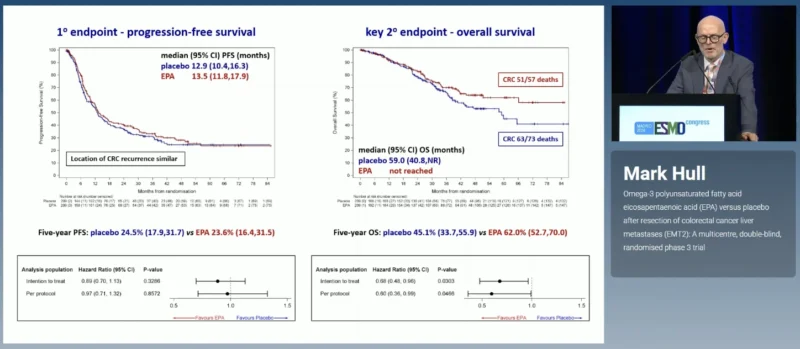
EPA treatment did not demonstrate a statistically significant improvement in progression-free survival compared with placebo. Median PFS was 13.5 months with EPA (95% CI 11.8–17.9) compared with 12.9 months with placebo (95% CI 10.4–16.3). The PFS hazard ratio was 0.89 (95% CI 0.70–1.13; p=0.33). These findings indicated that high-dose EPA did not significantly reduce the risk of disease progression or death compared with placebo, and the trial did not meet its primary endpoint.
Overall Survival
Although no significant improvement in PFS was observed, the overall survival analysis showed a difference favouring EPA. At five years, the estimated OS rate was 62.0% (95% CI 52.7–70.0) in the EPA group compared with 45.1% (95% CI 33.7–55.9) in the placebo group. The OS hazard ratio was 0.68 (95% CI 0.48–0.96; p=0.030), corresponding to an approximately 32% lower observed hazard of death with EPA compared with placebo.
These results suggested an overall survival benefit with EPA despite the absence of a statistically significant improvement in the primary PFS endpoint. The OS findings should be interpreted in the context of OS being a secondary endpoint and the negative primary endpoint.
Safety Outcomes
Safety was evaluated in 411 participants. The investigators reported no excess of total adverse events, bleeding, or atrial fibrillation among participants receiving EPA compared with placebo. The results indicated that high-dose EPA was generally safe and well tolerated in this study population.
Quality of Life
Quality-of-life outcomes were similar between the EPA and placebo groups. The investigators reported no detrimental effect of EPA treatment on quality of life during the study.
Conclusions
The Phase III EMT2 trial demonstrated that high-dose eicosapentaenoic acid did not significantly improve progression-free survival compared with placebo in patients undergoing surgical resection of colorectal cancer liver metastases.
Median PFS was 13.5 months with EPA versus 12.9 months with placebo (HR 0.89; 95% CI 0.70–1.13; p=0.33), and the study did not meet its primary endpoint. However, five-year overall survival was 62.0% with EPA compared with 45.1% with placebo (HR 0.68; 95% CI 0.48–0.96; p=0.030), suggesting a potential survival benefit despite the absence of improved PFS.
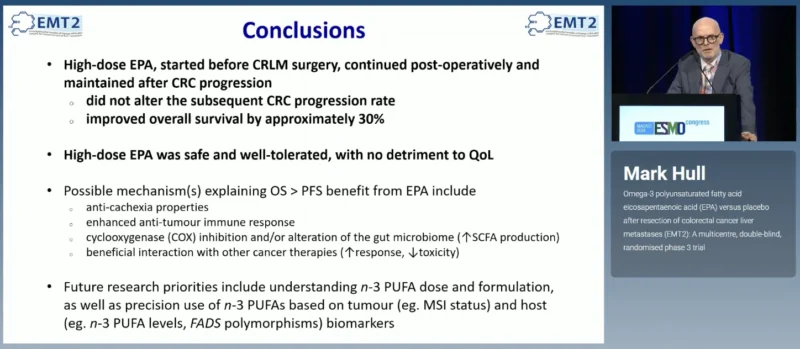
EPA was well tolerated, with no excess of overall adverse events, bleeding, or atrial fibrillation and no detrimental effect on quality of life. The investigators concluded that high-dose EPA did not alter subsequent colorectal cancer progression but was associated with an approximately 30% reduction in the hazard of death compared with placebo following colorectal cancer liver metastasis resection.
While the trial did not meet its primary PFS endpoint, the prespecified, powered secondary OS analysis favoured EPA, highlighting the difference between the progression-free and overall survival findings.
Source: ESMO Congress 2026 – LBA30, Phase III EMT2
Read more about IROCAS at ESMO 2026 on OncoDaily.