At the ESMO Congress 2026, Jaafar Bennouna (Suresnes, France) presented results from the Phase III IROCAS trial (NCT02967289), evaluating adjuvant chemotherapy intensification with modified FOLFIRINOX (mFOLFIRINOX) compared with modified FOLFOX6 (mFOLFOX6) in patients with high-risk stage III colon cancer.
The analysis, presented as Late-Breaking Abstract LBA29 in the Proffered Paper session, assessed whether mFOLFIRINOX could improve disease-free survival (DFS) compared with mFOLFOX6 in patients with T4 and/or N2 disease following curative surgery.
Why Was IROCAS Conducted?
Patients with high-risk stage III colon cancer, defined by T4 and/or N2 disease, have an estimated three-year disease-free survival rate of approximately 65%, highlighting the need for more effective adjuvant treatment strategies.
The IDEA collaboration established six months of oxaliplatin-containing doublet chemotherapy as a standard treatment approach for this high-risk population. However, disease recurrence remains a clinical concern.
The Phase III IROCAS trial investigated whether adjuvant chemotherapy intensification with mFOLFIRINOX could improve outcomes compared with mFOLFOX6 in patients with high-risk stage III colon cancer.
IROCAS Study Design and Methods
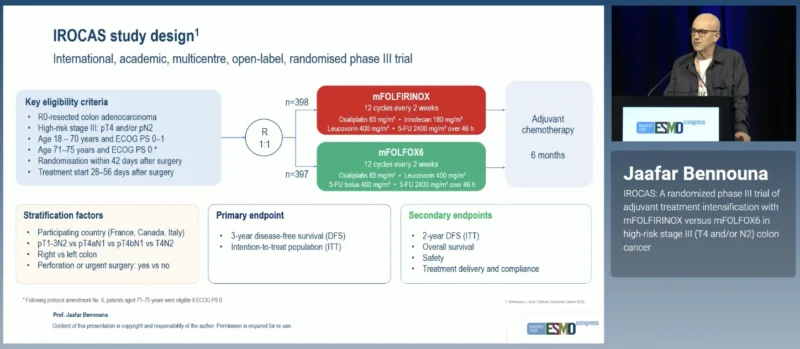
IROCAS was an academic, randomized Phase III trial conducted through the PRODIGE group in France, the Canadian Cancer Trials Group (CCTG) in Canada, and the GONO group in Italy. Between May 2017 and June 2023, the study enrolled 795 patients with R0-resected colon adenocarcinoma classified as pT4 and/or pN2. Patients were randomized in a 1:1 ratio to receive one of two adjuvant chemotherapy regimens.
The mFOLFIRINOX arm received oxaliplatin 85 mg/m², leucovorin 400 mg/m², irinotecan 180 mg/m², and fluorouracil (5-FU) 2,400 mg/m² administered over 46 hours. The mFOLFOX6 arm received oxaliplatin 85 mg/m², leucovorin 400 mg/m², a 5-FU bolus of 400 mg/m², followed by 5-FU 2,400 mg/m² administered over 46 hours.
Both regimens were administered every two weeks for 12 cycles. Patients were planned to be followed for five years after completing adjuvant chemotherapy. The primary endpoint was three-year DFS, assessed in the intention-to-treat population. The analysis also reported overall survival (OS) and adverse-event outcomes.
Key Findings from IROCAS
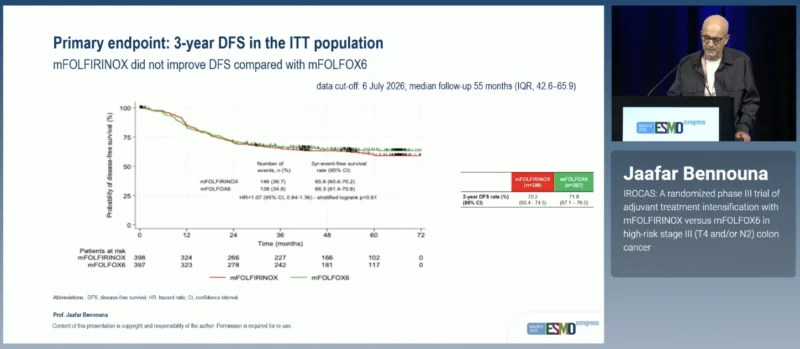
A total of 795 patients were randomized, including 398 assigned to mFOLFIRINOX and 397 to mFOLFOX6. The median patient age was 59 years (range 19–75), and 39.7% were female. Overall, 52.8% had pT4 disease, 72.2% had pN2 disease, and 25.3% had both pT4 and pN2 disease. At a median follow-up of 55 months (interquartile range 42.6–65.9), 284 DFS events had occurred, including 146 in the mFOLFIRINOX arm and 138 in the mFOLFOX6 arm.
Disease-Free Survival
Adjuvant mFOLFIRINOX did not demonstrate a statistically significant improvement in disease-free survival compared with mFOLFOX6. The three-year DFS rates were 65.6% with mFOLFIRINOX and 66.3% with mFOLFOX6 (HR 1.07; 95% CI 0.84–1.36; p=0.61).
The primary endpoint was not met, indicating that chemotherapy intensification with mFOLFIRINOX did not improve DFS in this high-risk stage III colon cancer population. No statistically significant treatment-by-subgroup interaction was observed across the prespecified subgroups.
Overall Survival
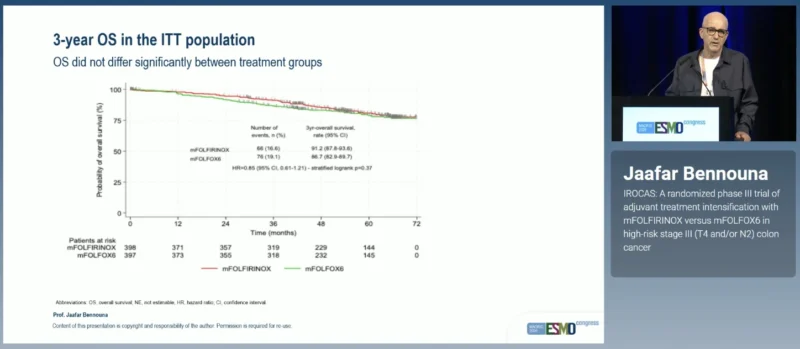
At three years, the estimated overall survival rate was 91.2% with mFOLFIRINOX compared with 86.7% with mFOLFOX6. The OS hazard ratio was 0.85 (95% CI 0.61–1.21; p=0.37), and the difference between treatment groups was not statistically significant.
Although the three-year OS rate was numerically higher with mFOLFIRINOX, the investigators reported that overall survival data remained immature, and a survival benefit was not established.
Safety Outcomes
The overall incidence of Grade 3 or higher adverse events was similar between the treatment groups, occurring in 62.2% of patients receiving mFOLFIRINOX and 62.1% receiving mFOLFOX6. However, differences were observed in specific adverse events. Grade 3 or higher diarrhoea occurred more frequently with mFOLFIRINOX than with mFOLFOX6 (15.6% vs 3.8%). Grade 3 or higher fatigue was also more common with mFOLFIRINOX (7.3% vs 1.8%).
Conversely, Grade 3 or higher neutropenia occurred less frequently with mFOLFIRINOX (18.0% vs 23.9%). Granulocyte colony-stimulating factor (G-CSF) use was reported in 37.8% of patients receiving mFOLFIRINOX compared with 19.1% receiving mFOLFOX6. These findings demonstrated a similar overall frequency of Grade 3 or higher adverse events between the regimens, but with differences in specific toxicities and supportive treatment use.
Conclusions
The Phase III IROCAS trial demonstrated that intensifying adjuvant chemotherapy with mFOLFIRINOX did not improve disease-free survival compared with mFOLFOX6 in patients with R0-resected, high-risk stage III colon cancer. At three years, DFS rates were 65.6% with mFOLFIRINOX and 66.3% with mFOLFOX6 (HR 1.07; 95% CI 0.84–1.36; p=0.61), indicating that the trial did not meet its primary endpoint.
Although the three-year OS rate was numerically higher with mFOLFIRINOX (91.2% vs 86.7%), the difference was not statistically significant (HR 0.85; p=0.37), and overall survival data remained immature. Grade 3 or higher adverse events occurred at similar overall rates in both groups, although mFOLFIRINOX was associated with higher rates of severe diarrhoea and fatigue.
The investigators concluded that adjuvant chemotherapy intensification with mFOLFIRINOX did not improve DFS compared with mFOLFOX6 in high-risk stage III colon cancer. These findings highlight the need to investigate novel adjuvant strategies beyond empirical chemotherapy intensification based on TNM stage alone.