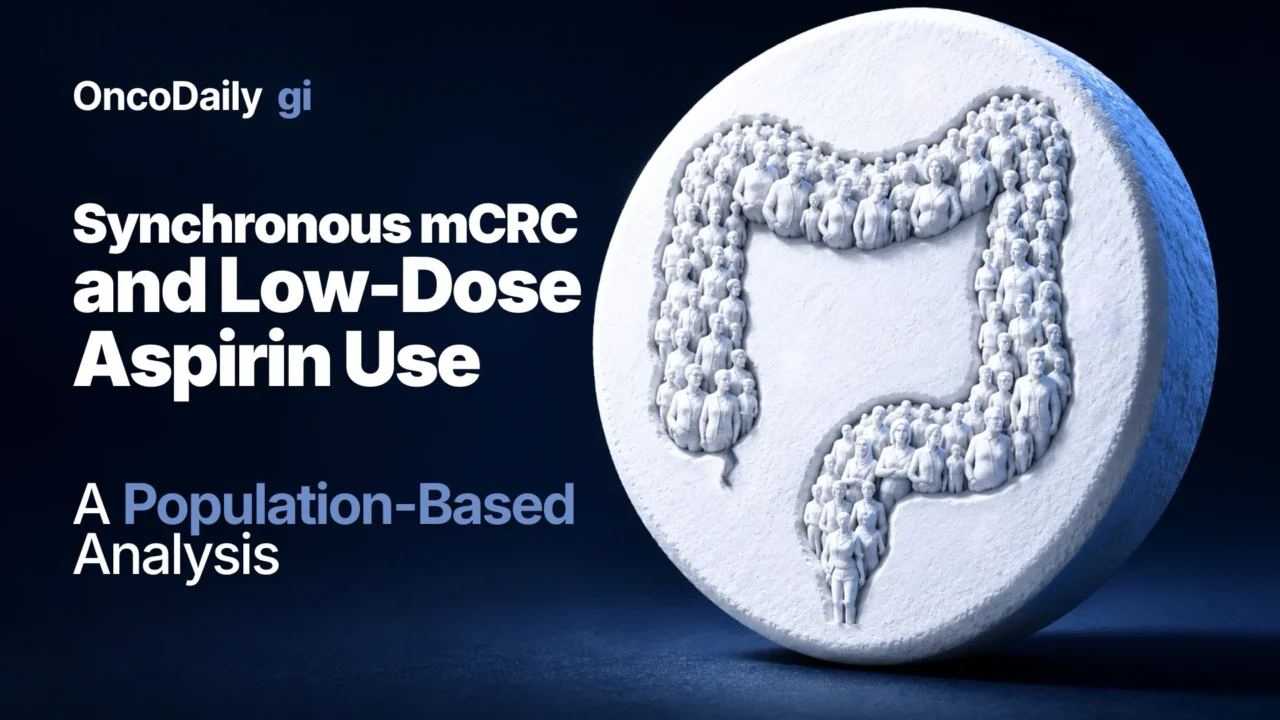
Aspirin has been widely investigated for its potential role in colorectal cancer (CRC) prevention and treatment. While previous studies have linked long-term aspirin use to a lower incidence of CRC, its association with the presence of distant metastases at diagnosis remains less well understood. Previous observational studies have suggested an association between aspirin use and a lower risk of metastatic CRC at diagnosis, while findings from randomized cardiovascular prevention trials have been inconsistent.
On November 21, 2026, a large population-based study was published in the British Journal of Cancer under the title “Low-dose aspirin use and the risk of synchronous metastatic colorectal cancer: results from a population-based study.”
The study was conducted by Mehrnoosh Shahrivar, Caroline E. Dietrich, Bengt Glimelius, Anna Martling, and Caroline Nordenvall, who investigated the association between low-dose aspirin use and the presence of synchronous distant metastases and stage III disease at CRC diagnosis, with analyses stratified by primary tumor location and duration of aspirin use.
Study Design and Patient Population
The investigators used data from the Colorectal Cancer Database Sweden (CRCBaSe), which links the Swedish Colorectal Cancer Registry with nationwide health and demographic registers. The study included patients aged 18 years or older diagnosed with primary stage I–IV CRC between 2008 and 2021, without another cancer diagnosis within the preceding five years.
Low-dose aspirin use (75 or 160 mg tablets) was defined as dispensation of at least 365 tablets before CRC diagnosis, corresponding to an estimated minimum of 12 months of use.
Patients were categorized as non-users, current users, or past users. Current users were defined as patients dispensed at least 365 tablets within the two years preceding CRC diagnosis, while past users had met the overall exposure criteria but had not reached this threshold within the same two-year period.
The primary outcome was the presence of synchronous distant metastases (stage IV CRC), while the secondary outcome was stage III disease, reflecting regional lymph node involvement or tumor deposits among patients without distant metastases. Logistic regression analyses were adjusted for age, sex, year of diagnosis, education level, diabetes, hypertension, cardiovascular disease, inflammatory bowel disease, and gastrointestinal bleeding.
A total of 81,269 patients were included in the final analysis. Among them, 15,424 (19%) were current low-dose aspirin users, 5,044 (6%) were past users, and 18,943 (23%) had synchronous distant metastases at diagnosis. Compared with non-users, current aspirin users were older (median age, 78 vs 71 years), more frequently male (60% vs 50%), and had a higher prevalence of cardiovascular disease (69% vs 22%) and diabetes (25% vs 8%).

Low-Dose Aspirin Use and Synchronous Distant Metastases
Both current and past low-dose aspirin use were associated with lower odds of synchronous distant metastases compared with non-use:
- Current aspirin users: Adjusted odds ratio (OR) 0.86 (95% CI, 0.82–0.90).
- Past aspirin users: Adjusted OR 0.87 (95% CI, 0.81–0.94).
Liver metastases (13% vs 18%) and metastases involving multiple distant organs (10% vs 14%) were also less frequent among current aspirin users than among non-users. When stratified by primary tumor location, current aspirin use was associated with lower odds of synchronous distant metastases in both colon cancer (adjusted OR 0.84; 95% CI, 0.79–0.89) and rectal cancer (adjusted OR 0.90; 95% CI, 0.82–0.98).
Further stratification by colon subsite showed lower odds of synchronous distant metastases among current aspirin users with both right- and left-sided colon cancer, with the strongest association observed in right-sided colon cancer (adjusted OR 0.79; 95% CI, 0.74–0.86). Among past aspirin users, lower odds of synchronous distant metastases were observed in colon cancer overall (adjusted OR 0.84; 95% CI, 0.77–0.92). In the subsite-specific analysis, this association was confined to right-sided colon cancer.
Does the Duration of Aspirin Use Matter?
Duration-dependent analyses included 65,177 patients diagnosed from 2011 onward, ensuring at least five years of available prescription data before CRC diagnosis. Among current aspirin users, lower odds of synchronous distant metastases were observed in patients with less than three years of aspirin use (adjusted OR 0.81; 95% CI, 0.71–0.93) and those with at least five years of use (adjusted OR 0.85; 95% CI, 0.79–0.90). No statistically significant association was observed among patients with three to less than five years of aspirin use.
Among past aspirin users, lower odds of synchronous distant metastases in the overall CRC population were observed only in patients with at least five years of aspirin exposure (adjusted OR 0.85; 95% CI, 0.77–0.95). In right-sided colon cancer, the association remained evident across all evaluated duration categories among both current and past aspirin users. In contrast, no association was observed in left-sided colon cancer in the duration-dependent analyses. In rectal cancer, lower odds of synchronous distant metastases were observed among current aspirin users in some duration categories.
Additional sensitivity analyses based on the cumulative number of aspirin tablets dispensed, an alternative minimum exposure definition of six months, and restriction of the cohort to patients diagnosed from 2011 onward generally supported the main findings.

Association Between Aspirin Use and Stage III Colorectal Cancer
Unlike the findings for distant metastases, current aspirin use was not associated with stage III CRC in the main analysis. Past aspirin users had lower odds of stage III disease (adjusted OR 0.91; 95% CI, 0.85–0.99), with the association confined to patients with colon cancer (adjusted OR 0.90; 95% CI, 0.83–0.98). However, this association was no longer evident after further stratification by colon subsite.
In the duration-dependent analysis, lower odds of stage III CRC among past aspirin users were observed only in those with at least five years of use (adjusted OR 0.87; 95% CI, 0.78–0.96).
Both current and past aspirin users with at least five years of exposure had lower odds of stage III colon cancer, while no association was observed in rectal cancer. In right-sided colon cancer, lower odds of stage III disease were observed among current users with at least five years of aspirin use (adjusted OR 0.91; 95% CI, 0.83–0.99) and past users with at least three years of use. However, the finding among current long-term users was not reproduced in the cumulative-dose analysis. No association was observed in left-sided colon cancer in either group.
Overall, the associations between aspirin use and stage III disease were weaker and less consistent than those observed for synchronous distant metastases.
Why Right-Sided Colon Cancer?
The authors discussed several potential explanations for the more consistent association observed in right-sided colon cancer, including differences in molecular characteristics, intestinal microbiota, and mechanisms of metastatic dissemination.
Right-sided colon cancers more frequently exhibit microsatellite instability-high (MSI-H) status and harbor BRAF V600E and PIK3CA mutations. The authors referred to the CAPP2 trial in patients with Lynch syndrome and the ALASCCA trial in patients with PI3K pathway-altered CRC when discussing whether certain molecular subtypes may be particularly responsive to aspirin.
Differences in the intestinal microbiome were also considered, particularly the greater abundance of Fusobacterium nucleatum in the proximal colon and previous experimental evidence of aspirin’s antibacterial activity against this bacterium in vitro. Another potential mechanism involves platelet inhibition. Even at low doses, aspirin irreversibly inhibits platelet cyclooxygenase-1 (COX-1). Platelets may facilitate metastatic dissemination by promoting tumor cell migration and protecting circulating tumor cells from immune recognition.
Experimental evidence linking platelet-derived thromboxane A2 signaling to the suppression of T-cell immunity provides a possible biological explanation for the observed association between aspirin use and distant metastatic disease. However, these mechanisms were not directly investigated in the present study.
Study Strengths and Limitations
The nationwide coverage, large patient population, and availability of detailed registry data were among the main strengths of the study. The authors acknowledged several limitations, including the lack of direct information on medication adherence, lifestyle factors, family history of CRC, and the use of other antiplatelet or anticoagulant medications. High-dose aspirin was not included in the exposure assessment, and data on comorbidities from primary care were unavailable.
Detection bias was also considered a possible explanation, as aspirin users with more comorbidities may have been diagnosed earlier because of more frequent healthcare contact or bleeding. However, the authors noted that detection bias alone was unlikely to explain the tumor-location-specific findings and the associations observed among past aspirin users.
Takeaway
In this large Swedish population-based study of 81,269 patients with colorectal cancer, both current and past low-dose aspirin use were associated with lower odds of synchronous distant metastases at diagnosis. The association was particularly evident in right-sided colon cancer, regardless of the evaluated duration of aspirin use, while associations with stage III disease were less consistent.
Given the observational nature of the study, these findings do not establish a causal relationship between aspirin use and metastatic dissemination. Further research is needed to better understand the mechanisms through which aspirin may influence CRC progression.
The full article is available in the British Journal of Cancer.