





Key takeaways
- mRNA-4359 is an investigational, non-personalized mRNA cancer antigen therapy targeting PD-L1 and IDO1.
- It is administered by intramuscular injection, usually every three weeks, and has mainly been studied with pembrolizumab.
- Investigational doses include 400 micrograms and 1,000 micrograms, with up to nine injections in selected study cohorts.
- Early melanoma cohorts showed encouraging response rates and evidence of PD-L1- and IDO1-specific T-cell activation.
- The reported patient groups were small and nonrandomized, so larger studies are needed to confirm efficacy.
- Common reported effects include injection-site pain, fatigue, fever, chills, nausea, muscle aches, and headache.
- mRNA-4359 remains investigational and is not approved by major regulatory authorities.
mRNA-4359 is an investigational cancer antigen therapy developed by Moderna. It is designed to generate T-cell responses against PD-L1 and IDO1, two targets involved in tumor immune escape.
The therapy is being studied alone and with immune-checkpoint inhibitors, particularly pembrolizumab, in melanoma and other advanced solid tumors. It is not approved by the FDA or EMA. Moderna currently lists mRNA-4359 as a Phase 2 oncology program.
What Is mRNA-4359?
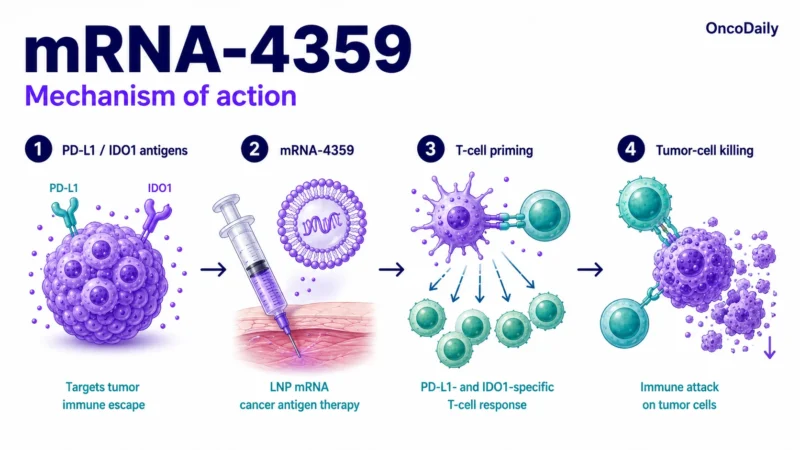
mRNA-4359 is a lipid nanoparticle–encapsulated mRNA cancer antigen therapy administered by intramuscular injection.
The mRNA provides instructions for cells to produce selected antigen sequences derived from:
- Programmed death-ligand 1, or PD-L1
- Indoleamine 2,3-dioxygenase 1, or IDO1
These antigens are intended to prime and expand PD-L1- and IDO1-specific T cells. The activated T cells may then attack tumor cells expressing these targets and reduce immunosuppressive cells within the tumor microenvironment.
Unlike individualized neoantigen vaccines, mRNA-4359 is a fixed, non-personalized cancer antigen therapy targeting immune-evasion pathways shared across multiple tumors.
What Is the Dose of mRNA-4359?
Doses evaluated in the Phase 1/2 melanoma program include:
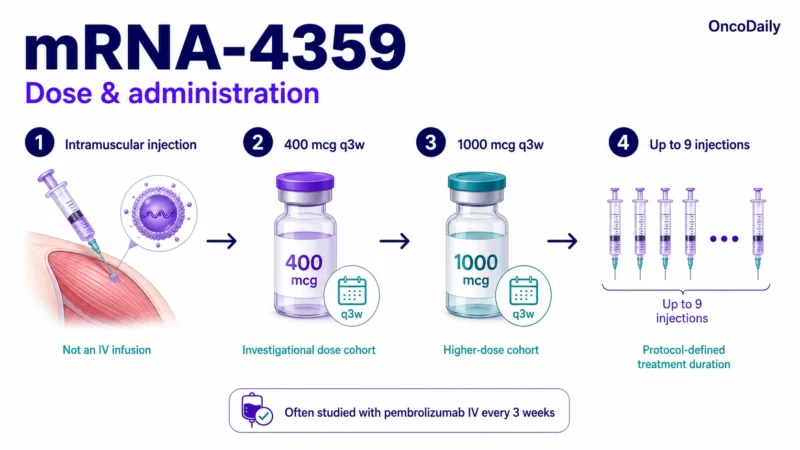
mRNA-4359 400 micrograms or 1,000 micrograms administered intramuscularly every three weeks.
Patients could receive up to nine injections, depending on the study arm, continued eligibility, and protocol-defined treatment duration.
Pembrolizumab is administered intravenously according to the study protocol. The exact mRNA-4359 dose used may depend on the trial cohort and disease setting.
These are investigational clinical-trial doses, not approved prescribing recommendations.
How Is mRNA-4359 Administered?
mRNA-4359 is administered as an intramuscular injection. It is not given as an intravenous infusion.
The lipid nanoparticle formulation delivers the mRNA into cells at the injection site, allowing temporary production of the encoded PD-L1 and IDO1 antigen sequences.
In the principal combination studies:
- mRNA-4359 is given by intramuscular injection.
- Pembrolizumab is given separately by intravenous infusion.
- Treatment is commonly repeated every three weeks.
- Up to nine mRNA-4359 injections may be administered.
Public sources do not provide complete commercial instructions concerning the preferred injection muscle, needle gauge, injection volume, storage after preparation, or post-injection observation. These details remain protocol-specific.
Does mRNA-4359 Require an In-Line Filter?
No. mRNA-4359 does not require an in-line infusion filter because it is administered intramuscularly.
No intravenous tubing or infusion bag is used for mRNA-4359 itself.
Pembrolizumab is a separate intravenous medicine and should be prepared and administered with the filtration requirements specified in its prescribing information.
Is Premedication Required?
No standard mRNA-4359-specific premedication regimen has been publicly established.
Patients may receive supportive treatment for symptoms such as fever, injection-site discomfort, chills, or fatigue. Premedication for pembrolizumab is generally not routine unless the patient previously experienced an infusion-related reaction.
Are Dose Reductions Used?
Public reports do not describe a standardized dose-reduction schedule for mRNA-4359.
Clinical-trial management may include:
- Delaying an injection
- Withholding one or more doses
- Discontinuing treatment
- Providing symptomatic supportive care
Treatment decisions depend on the severity and duration of adverse events, immune-related toxicity from combination therapy, and study-specific criteria.
What Is Known About mRNA-4359 Pharmacokinetics?
Traditional pharmacokinetic measures used for oral or intravenous small molecules are less informative for an mRNA therapy.
After intramuscular administration, the lipid nanoparticle delivers mRNA into cells. The mRNA is translated temporarily and is subsequently degraded through normal cellular processes.
Clinical development has focused more strongly on pharmacodynamic and immunologic markers, including:
- PD-L1- and IDO1-specific T-cell responses
- Expansion of new T-cell receptor clones
- Changes in tumor immune-cell populations
- Evidence of immune activation in blood and tumor samples
Antigen-specific T-cell responses and new T-cell receptor clonal expansion were observed in evaluable patients in the first-line melanoma cohort.
Are Renal or Hepatic Dose Adjustments Required?
No validated renal- or hepatic-impairment dose adjustments have been established.
Participants in clinical studies generally require adequate kidney, liver, blood-cell, and overall organ function. These eligibility requirements should not be interpreted as formal prescribing recommendations.
What Did mRNA-4359 Clinical Trials Show?
The ongoing Phase 1/2 mRNA-4359-P101 trial, NCT05533697 is evaluating mRNA-4359 alone and with pembrolizumab or other immune-checkpoint blockade in advanced solid tumors.
Previously Treated Melanoma
In 29 evaluable patients with checkpoint inhibitor-resistant or refractory melanoma, mRNA-4359 plus pembrolizumab produced:
- Objective response rate: 24%
- Disease-control rate: 60%
- Objective response rate in evaluable PD-L1-positive disease: 67%
Patients received 400-microgram or 1,000-microgram intramuscular doses every three weeks for up to nine injections. These findings were encouraging but came from a small, nonrandomized cohort.
First-Line Advanced Melanoma
At AACR 2026, results were reported for 12 patients receiving first-line mRNA-4359 plus pembrolizumab:
- Objective response rate: 83%
- Complete responses: 2
- Partial responses: 8
- Disease-control rate: 92%
- Median time to response: six weeks
Responses occurred in both PD-L1-positive and PD-L1-negative tumors. The median duration of response had not been reached at the reported analysis. However, the cohort was extremely small, so these findings require confirmation in larger randomized studies.
Watch more: Explore emerging melanoma treatments, including therapeutic cancer vaccines, in What’s Next in Melanoma Therapy with Dr. Marco Donia by OncoDaily.
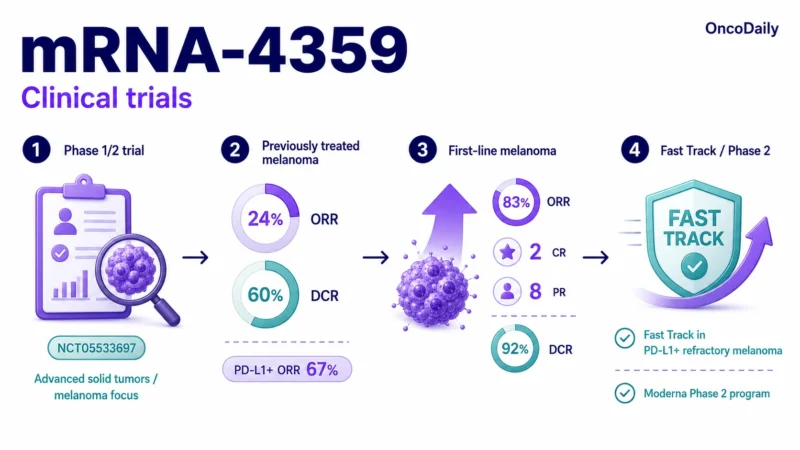
The FDA has granted Fast Track designation to mRNA-4359 plus pembrolizumab for checkpoint inhibitor-refractory, unresectable or metastatic melanoma with PD-L1-positive disease. Fast Track designation supports development and regulatory communication but is not an approval.
Read more about mRNA-4359 plus pembrolizumab and other emerging immunotherapy studies presented at ESMO 2025 on OncoDaily.
What Are the Side Effects of mRNA-4359?
Reported adverse effects have generally included:
- Injection-site pain
- Fatigue
- Fever
- Chills
- Nausea
- Muscle aches
- Headache
- Immune-related adverse events associated with pembrolizumab
Early monotherapy dose-escalation findings described treatment as generally well tolerated, with fatigue, injection-site pain, and fever among the reported events.
In the small first-line melanoma cohort, most mRNA-4359-related adverse events were low grade. Pembrolizumab-related grade 3 or 4 adverse events occurred in some patients and led to pembrolizumab discontinuation in a minority of the cohort.
Mirna Antabian, MD
FAQ
Is mRNA-4359 approved?
No. mRNA-4359 remains investigational and is not approved by the FDA, European Commission, or other major regulatory authorities.
Is mRNA-4359 a personalized cancer vaccine?
No. mRNA-4359 is a fixed, non-personalized cancer antigen therapy targeting PD-L1 and IDO1.
How is mRNA-4359 administered?
mRNA-4359 is administered by intramuscular injection, usually every three weeks in clinical trials.
What dose of mRNA-4359 has been studied?
Clinical studies have evaluated 400-microgram and 1,000-microgram intramuscular doses, with up to nine injections in selected cohorts.
Does mRNA-4359 require an in-line filter?
No. It is administered intramuscularly, so an intravenous in-line filter is not used.
Is premedication required before mRNA-4359?
No standard mRNA-4359-specific premedication regimen has been publicly established. Supportive treatment may be used for fever, chills, injection-site discomfort, or other symptoms.
How does mRNA-4359 work?
It delivers mRNA instructions that help cells produce PD-L1- and IDO1-derived antigens. These antigens are intended to activate T cells that recognize tumor cells and immune-suppressive cells expressing those targets.
What cancers is mRNA-4359 being studied in?
Its most advanced research has focused on advanced melanoma, including checkpoint inhibitor-resistant disease and previously untreated metastatic melanoma. It is also being studied in other advanced solid tumors.
What are the common side effects of mRNA-4359?
Reported effects include injection-site pain, fatigue, fever, chills, nausea, muscle aches, and headache. Additional immune-related adverse events may occur when mRNA-4359 is combined with pembrolizumab.
Did mRNA-4359 show activity in melanoma?
Early nonrandomized studies reported encouraging response rates in both previously treated and first-line melanoma cohorts. However, the patient numbers were small, so larger studies are needed to confirm benefit.