





Key takeaways
- DKN-01, now known as sirexatamab, is an investigational monoclonal antibody targeting DKK1.
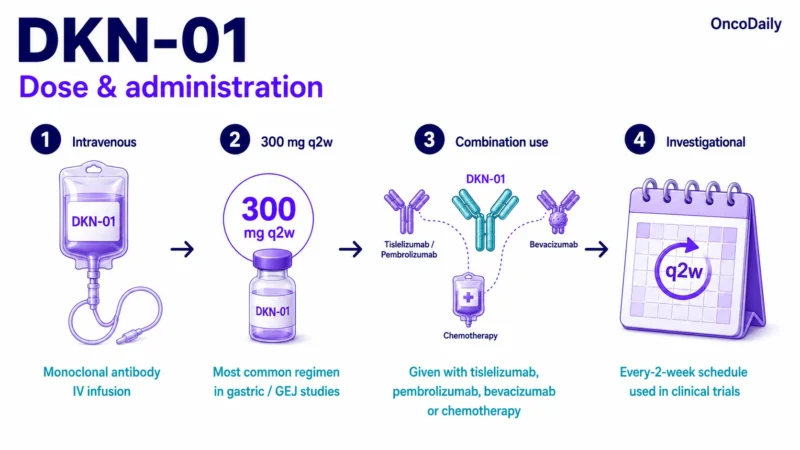
- It is administered by intravenous infusion, most commonly at 300 mg every two weeks in gastric and gastroesophageal junction cancer studies.
- DKK1 inhibition may reduce tumor-promoting signaling and help create a more active antitumor immune environment.
- Early DisTinGuish results showed encouraging response rates, particularly in patients with DKK1-high tumors, but the cohorts were small and nonrandomized.
- The DeFianCe trial also suggested that patients with DKK1-high colorectal cancer may receive greater benefit from sirexatamab-based treatment.
- Reported adverse effects include fatigue, nausea, diarrhea, reduced appetite, cytopenias, liver-enzyme abnormalities, and occasional infusion reactions.
- DKN-01 remains investigational and is not approved by major regulatory authorities.
DKN-01, now known as sirexatamab, is an investigational monoclonal antibody designed to neutralize Dickkopf-1, or DKK1. It is being developed mainly for DKK1-expressing colorectal, gastric, gastroesophageal junction, and endometrial cancers.
DKN-01 is not approved by the FDA or EMA. It has received FDA Fast Track designation for selected patients with DKK1-high gastric or gastroesophageal junction adenocarcinoma and orphan drug designation for gastric and gastroesophageal junction cancer.
What Is DKN-01?
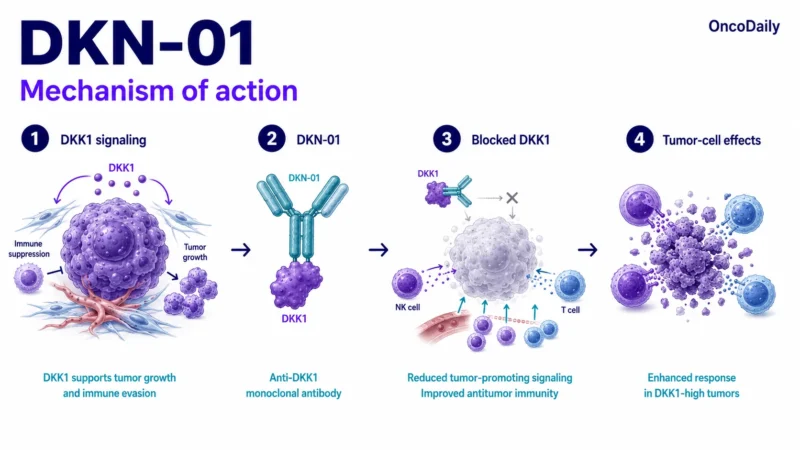
DKN-01 is a humanized IgG4 monoclonal antibody that binds to and neutralizes circulating DKK1.
DKK1 can promote tumor growth, angiogenesis, metastasis, and an immunosuppressive tumor microenvironment through effects on Wnt/β-catenin, CKAP4–PI3K–AKT signaling, natural killer cells, macrophages, and myeloid-derived suppressor cells.
Blocking DKK1 may:
- Reduce tumor-promoting signaling
- Increase natural killer-cell activity
- Promote tumor-attacking macrophages
- Increase T-cell infiltration
- Improve sensitivity to immunotherapy and antiangiogenic treatment
The drug was previously called DKN-01 and is now referred to as sirexatamab.
What Is the Dose of DKN-01?
The most frequently studied regimen in gastric and gastroesophageal junction cancer is:
DKN-01 300 mg administered intravenously once every two weeks.
Earlier trials also evaluated:
- 150 mg intravenously every two weeks
- 300 mg intravenously every two weeks
- 600 mg intravenously every two weeks
- Weekly doses ranging from 75 to 300 mg
The 300 mg every-two-week regimen was used with tislelizumab and chemotherapy in the DisTinGuish study.
These are investigational clinical-trial doses rather than approved prescribing recommendations.
How Is DKN-01 Administered?
DKN-01 is administered by intravenous infusion.
Depending on the clinical-trial protocol, it may be given with:
- Tislelizumab
- Pembrolizumab
- Bevacizumab
- Capecitabine and oxaliplatin
- Modified FOLFOX6
- Other protocol-defined chemotherapy
In an earlier gastroesophageal cancer study, DKN-01 was administered on Days 1 and 15, while pembrolizumab was given on Day 1 of a 21-day cycle.
Publicly available sources do not consistently specify:
- Infusion duration
- Dilution solution
- Final concentration
- Administration sequence
- Line-flushing procedure
- Prepared-solution stability
These details remain defined by the applicable pharmacy manual.
Does DKN-01 Require an In-Line Filter?
A universal in-line filter requirement has not been publicly established for DKN-01.
Published trial reports do not consistently state a required filter type or pore size. Clinical-trial sites must follow the investigational-product preparation and administration instructions.
Separate filter requirements may apply to tislelizumab, pembrolizumab, bevacizumab, or chemotherapy administered with DKN-01.
Is Premedication Required?
No standardized DKN-01-specific premedication regimen has been publicly established.
Infusion-related reactions have occurred, but they appear to have been uncommon in published studies. Antihistamines, corticosteroids, antipyretics, or slower infusion rates may be used according to previous reactions and protocol requirements.
Premedication may also be required for accompanying chemotherapy or antibody therapy.
Are Dose Reductions Used?
Monoclonal-antibody trials generally manage clinically important toxicity through:
- Temporary treatment interruption
- Delayed dosing
- Infusion-rate modification
- Supportive treatment
- Permanent discontinuation
Traditional stepwise dose reductions have not been consistently described for DKN-01. Decisions depend on whether an adverse event is related to DKN-01, immunotherapy, bevacizumab, chemotherapy, or the underlying cancer.
What Is Known About DKN-01 Pharmacokinetics?
DKN-01 has been evaluated using weekly and every-two-week intravenous schedules.
Early dose-escalation studies tested doses up to 600 mg every two weeks, and the 300 mg every-two-week regimen was selected for several later combination programs. Publicly available data on terminal half-life, clearance, distribution, accumulation, and exposure–response relationships remain limited.
Are Renal or Hepatic Dose Adjustments Required?
No validated renal- or hepatic-impairment dose adjustments have been established.
Clinical trials generally require adequate:
- Kidney function
- Liver function
- Bone-marrow function
- Cardiovascular status
Because DKN-01 remains investigational, formal dosing recommendations for severe organ impairment are unavailable.
What Did DKN-01 Clinical Trials Show?
Gastric and Gastroesophageal Junction Cancer
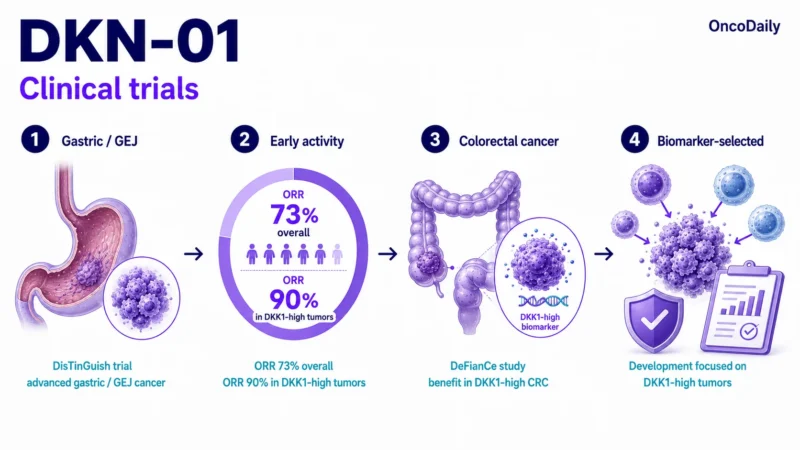
The Phase 2 DisTinGuish trial, NCT04363801, evaluated DKN-01 with tislelizumab, with or without chemotherapy, in advanced gastric and gastroesophageal junction adenocarcinoma.
In the first-line early cohort, DKN-01 plus tislelizumab and chemotherapy produced:
Objective response rate of 73% overall
Objective response rate of 90% in DKK1-high tumors
The cohort was small and nonrandomized, so the findings required confirmation in the randomized Part C study.
A separate second-line analysis examined DKN-01 plus tislelizumab specifically in patients with DKK1-high gastroesophageal adenocarcinoma. The combination demonstrated clinical activity and a manageable safety profile, although it was not directly compared with standard treatment in that part of the study.
Colorectal Cancer
The randomized Phase 2 DeFianCe study evaluated sirexatamab with bevacizumab and chemotherapy as second-line treatment for advanced colorectal cancer.
Initial results showed:
Objective response rate of 35% with sirexatamab
Objective response rate of 23% in the control group
The strongest benefit appeared among patients with high DKK1 levels.
Final data presented at ESMO 2025 reported statistically significant progression-free and overall-survival improvements in the DKK1-high subgroup, with greater treatment benefit as DKK1 levels increased. Leap Therapeutics stated that it planned to continue supporting development in biomarker-selected DKK1-high colorectal cancer.
Watch more: Explore key developments across gastrointestinal cancers in OncoDaily Grand Rounds at ESMO 2025: GI Edition.
Other Tumor Types
DKN-01 has also been evaluated in:
- Endometrial cancer
- Prostate cancer
- Non-small cell lung cancer
- Hepatobiliary cancers
- Other advanced solid tumors
A Phase 1/2 prostate cancer study found that 600 mg was generally tolerable but produced only modest monotherapy activity in metastatic castration-resistant prostate cancer.
What Are the Side Effects of DKN-01?
Reported adverse effects include:
- Fatigue
- Nausea
- Diarrhea
- Reduced appetite
- Anemia
- Neutropenia
- Thrombocytopenia
- Infusion-related reactions
- Elevated liver enzymes
In combination studies, many toxicities were also attributable to chemotherapy, anti-PD-1 therapy, or bevacizumab. DKN-01 has generally been considered feasible to combine with checkpoint inhibition and standard chemotherapy in early and Phase 2 trials.
Read more about DKN-01 with tislelizumab and chemotherapy in advanced gastric or gastroesophageal junction adenocarcinoma on OncoDaily.
Mirna Antabian, MD
FAQ
Is DKN-01 Approved?
No. DKN-01, or sirexatamab, remains investigational.
Is DKN-01 Chemotherapy?
No. It is a targeted monoclonal antibody against DKK1.
Is DKN-01 an Infusion or Injection?
DKN-01 is administered by intravenous infusion.
What Is the Main DKN-01 Dose?
The most frequently studied regimen is 300 mg intravenously every two weeks.
Does DKN-01 Require an In-Line Filter?
Public sources do not establish a universal filtration requirement. Trial-specific pharmacy instructions determine whether a filter is used.
What Cancers Is DKN-01 Being Studied In?
Its most advanced programs involve DKK1-high colorectal cancer and gastric or gastroesophageal junction adenocarcinoma.