





Vinorelbine: Understanding Its Mechanism, Dosing, and Clinical Role in Cancer
Key takeaways
- Vinorelbine is a semisynthetic vinca alkaloid chemotherapy.
- It inhibits microtubule assembly and produces metaphase arrest.
- Its principal FDA-approved role is in advanced NSCLC.
- The single-agent FDA-recommended dose is 30 mg/m² IV once weekly.
- When combined with cisplatin, common labeled doses are 25–30 mg/m² IV weekly.
- Administration is typically performed over 6–10 minutes.
- Neutropenia is the principal dose-limiting toxicity.
- CBC should be checked before every dose.
- Significant constipation, neuropathy, hepatic toxicity, extravasation, and pulmonary toxicity can occur.
- JBR.10 and ANITA established the importance of cisplatin-vinorelbine as adjuvant chemotherapy following NSCLC surgery.
- - Vinorelbine remains clinically relevant despite the increasing use of targeted therapy and immunotherapy in lung cancer.
Vinorelbine (Navelbine) is a semisynthetic vinca alkaloid chemotherapy that inhibits microtubule assembly and prevents malignant cells from completing mitosis. Its principal FDA-approved role is in non-small cell lung cancer (NSCLC), where it may be administered alone or in combination with cisplatin.
Vinorelbine belongs to the same drug family as vincristine and vinblastine but has a somewhat different toxicity profile. Neutropenia is its major dose-limiting toxicity, while clinically significant neurotoxicity is generally less prominent than with vincristine.
This article focuses primarily on intravenous vinorelbine.
Key Facts
- Generic name: Vinorelbine
- Historical brand name: Navelbine
- Drug class: Semisynthetic vinca alkaloid
- Route: Intravenous
- Initial US approval: 1994
- FDA-approved indication: Locally advanced or metastatic NSCLC
- Single-agent dose: 30 mg/m² IV once weekly
- Combination dose: 25–30 mg/m² IV weekly with cisplatin, depending on regimen
- Administration time: 6–10 minutes
- Available concentration: 10 mg/mL
- Major mechanism: Inhibition of microtubule assembly
- Cell-cycle effect: Metaphase arrest
- Major dose-limiting toxicity: Neutropenia
- Important toxicities: Myelosuppression, constipation, peripheral neuropathy, hepatic toxicity, extravasation, and pulmonary toxicity
- Premedication: No routine corticosteroid or antihistamine premedication required
- Major monitoring: CBC before every dose and periodic liver-function assessment.
What Is Vinorelbine?
Vinorelbine is a semisynthetic derivative of the vinca alkaloid family.
Like vincristine and vinblastine, it targets tubulin and interferes with the microtubule network required for successful cell division.
One pharmacologic characteristic of vinorelbine is its relative preference for mitotic microtubules compared with axonal microtubules. This may partly explain why severe neurotoxicity is generally less prominent than with vincristine, although peripheral and autonomic neuropathy can still occur.
What Is the Mechanism of Action of Vinorelbine?
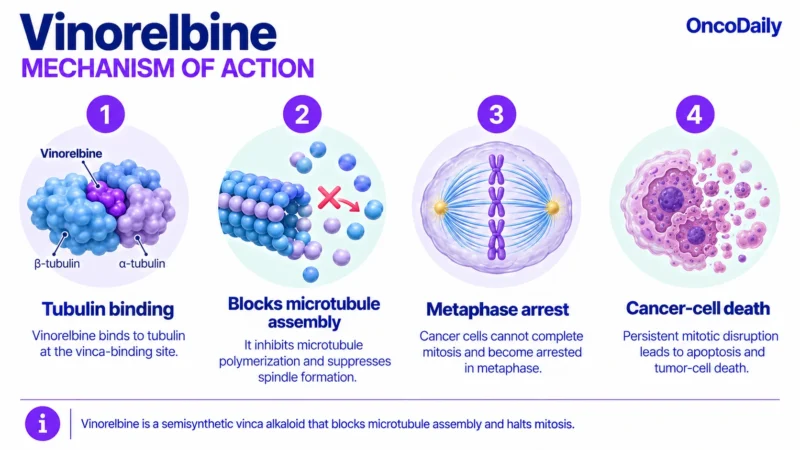
1. Binding to Tubulin
Vinorelbine interacts with tubulin, particularly at the vinca-binding region of β-tubulin.
2. Inhibition of Microtubule Assembly
Tubulin molecules normally polymerize to form microtubules.
Vinorelbine interferes with this process and suppresses normal microtubule dynamics.
3. Mitotic Spindle Disruption
Functional microtubules are necessary for formation of the mitotic spindle.
When microtubule assembly is impaired, chromosomes cannot be properly separated during cell division.
4. Metaphase Arrest
Vinorelbine primarily inhibits mitosis at:
Metaphase.
Cells remain unable to progress normally through mitosis.
5. Cancer-Cell Death
Persistent mitotic disruption produces cellular stress and eventually promotes cancer-cell death.
The mechanism can be summarized as:
Vinorelbine → tubulin binding → inhibition of microtubule assembly → mitotic spindle dysfunction → metaphase arrest → cancer-cell death.
What Is the Dose of Vinorelbine?
Vinorelbine dosing depends on whether it is administered alone or with cisplatin.
Vinorelbine With Cisplatin 100 mg/m²
The FDA-labeled regimen is:
Vinorelbine 25 mg/m² IV over 6–10 minutes on Days 1, 8, 15, and 22 of each 28-day cycle
combined with:
Cisplatin 100 mg/m² IV on Day 1.
Vinorelbine With Cisplatin 120 mg/m²
An alternative labeled regimen uses:
Vinorelbine 30 mg/m² IV over 6–10 minutes once weekly
with:
Cisplatin 120 mg/m² on Days 1 and 29, then every 6 weeks.
Single-Agent Vinorelbine
The recommended dose is:
30 mg/m² IV over 6–10 minutes once weekly.
Are Dose Reductions Used?
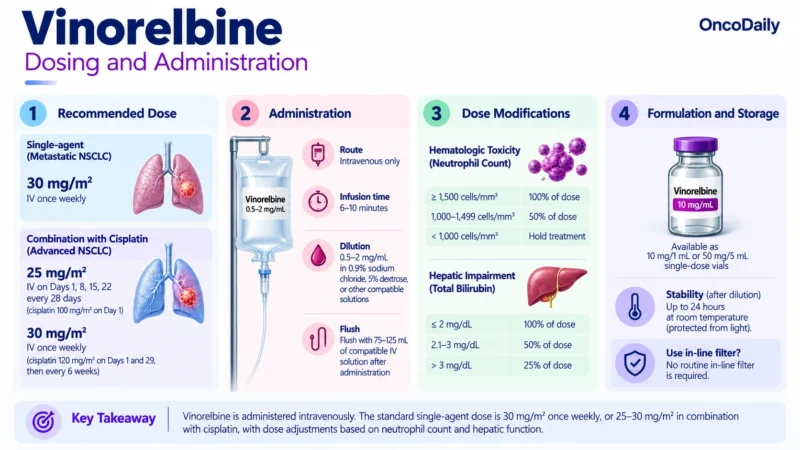
Yes. Vinorelbine dosing is closely linked to the patient’s neutrophil count.
Neutrophil-Based Modification
When the neutrophil count on the day of treatment is:
≥1,500 cells/mm³:
Give 100% of the planned dose.
1,000–1,499 cells/mm³:
Give 50% of the planned dose.
<1,000 cells/mm³:
Do not administer vinorelbine.
The neutrophil count should be reassessed approximately one week later.
Patients who develop febrile neutropenia, sepsis during neutropenia, or recurrent treatment delays may require additional dose reduction.
Peripheral Neuropathy
Vinorelbine should be discontinued for:
Grade 2 or greater peripheral neuropathy
or clinically significant autonomic neuropathy associated with constipation.
How Is Vinorelbine Administered?
Vinorelbine is administered:
Intravenously only.
The commercial IV formulation contains:
10 mg/mL
and commonly comes as:
- 10 mg/1 mL
- 50 mg/5 mL single-dose vials.
Preparation and Dilution
Vinorelbine should be diluted to a final concentration of:
0.5–2 mg/mL.
Compatible solutions include:
- 0.9% sodium chloride
- 0.45% sodium chloride
- 5% dextrose
- 5% dextrose with 0.45% sodium chloride
- Ringer’s solution
- Lactated Ringer’s solution.
Administration
The diluted drug should be administered over:
6–10 minutes
through the side port of a freely flowing IV line.
After administration, the IV line should be flushed with approximately:
75–125 mL of compatible IV solution.
This helps reduce local venous irritation and ensures delivery of the complete dose.
What Is the Stability of Vinorelbine?
Diluted vinorelbine may be stored for up to:
24 hours
under normal room light when maintained between approximately 5°C and 30°C in compatible IV bags.
Product-specific institutional preparation policies should always be followed.
Does Vinorelbine Require an In-Line Filter?
No routine in-line filter requirement is specified in the current US prescribing information.
The prepared solution should nevertheless be inspected visually before administration.
Does Vinorelbine Require Premedication?
Routine corticosteroid or antihistamine premedication is not required.
Antiemetics may be administered according to the treatment regimen and individual patient risk.
Because constipation and paralytic ileus can occur, the current prescribing information also recommends consideration of a prophylactic bowel regimen, adequate hydration, dietary fiber, and stool-softening measures. DailyMed
Is Vinorelbine a Vesicant?
Vinorelbine can cause significant local tissue injury following extravasation.
Possible consequences include:
- Severe irritation
- Pain
- Thrombophlebitis
- Local tissue necrosis.
If extravasation is suspected, the infusion should be stopped immediately and managed according to institutional extravasation protocols.
Does Vinorelbine Require Renal or Hepatic Dose Adjustment
Renal Impairment
Vinorelbine undergoes predominantly hepatic metabolism and fecal elimination.
The current US label does not provide a routine creatinine-clearance-based dose-reduction schedule.
Renal function nevertheless remains clinically important, particularly when vinorelbine is combined with cisplatin.
Hepatic Impairment
Vinorelbine exposure and toxicity may increase in patients with impaired hepatic function.
The US prescribing information recommends:
Total bilirubin ≤2 mg/dL:
Give 100% of the starting dose.
Total bilirubin 2.1–3 mg/dL:
Give 50% of the starting dose.
Total bilirubin >3 mg/dL:
Give 25% of the starting dose.
If both hepatic dysfunction and myelosuppression are present, the lower dose determined by the two modification schemes should be used.
What Is the Pharmacokinetic Profile of Vinorelbine?
Distribution
Vinorelbine distributes extensively into tissues.
Its steady-state volume of distribution is approximately:
25.4–40.1 L/kg.
Approximately 80–91% is bound to plasma constituents, with additional substantial binding to platelets and lymphocytes.
Metabolism
Vinorelbine undergoes extensive hepatic metabolism.
The major enzyme involved is:
CYP3A.
The principal identified metabolite is deacetylvinorelbine, which retains antitumor activity.
Elimination
Vinorelbine is eliminated predominantly through hepatic and fecal pathways.
After radiolabeled administration, approximately:
- 46% of radioactivity was recovered in feces
- 18% was recovered in urine.
Only a relatively small proportion is excreted unchanged in urine.
Half-Life
The terminal elimination half-life averages approximately:
27.7–43.6 hours.
What Are the Important Drug Interactions?
CYP3A Inhibitors
Vinorelbine is metabolized by CYP3A.
Concomitant CYP3A inhibitors may cause:
- Earlier onset of toxicity
- Greater severity of adverse reactions
- Increased neurologic or hematologic toxicity.
Medication review is therefore important before starting treatment.
What Are the Clinical Uses of Vinorelbine?
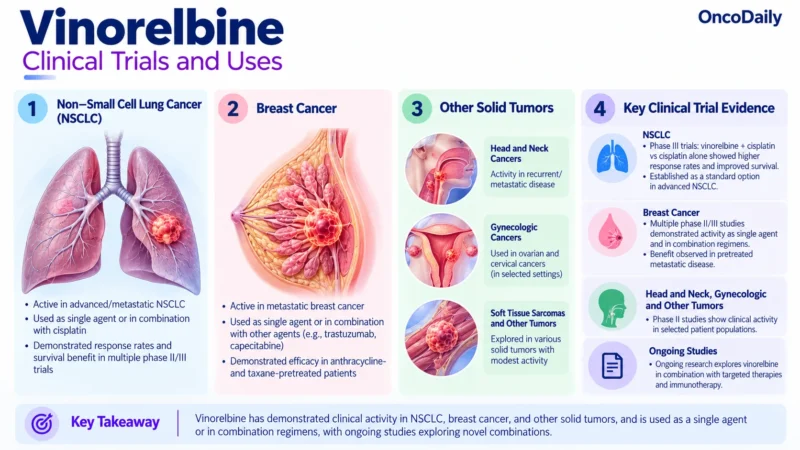
Advanced Non-Small Cell Lung Cancer
NSCLC is the principal FDA-approved indication for vinorelbine.
Vinorelbine is approved:
- In combination with cisplatin as first-line treatment for locally advanced or metastatic NSCLC
- As single-agent therapy for metastatic NSCLC.
Resected Non-Small Cell Lung Cancer
Vinorelbine plus cisplatin has also generated important evidence as adjuvant chemotherapy following complete surgical resection.
Trials such as JBR.10 and ANITA established a survival benefit from cisplatin-vinorelbine in selected patients with resected NSCLC.
These studies contributed substantially to the development of platinum-based adjuvant chemotherapy in early-stage lung cancer.
Vinorelbine is frequently administered with cisplatin in NSCLC. Learn more about cisplatin, its mechanism, dosing, and clinical role on OncoDaily.
Breast Cancer
Vinorelbine has demonstrated activity in advanced and metastatic breast cancer and has been evaluated both as monotherapy and in combinations such as vinorelbine plus gemcitabine.
However, breast cancer is not an FDA-approved indication for vinorelbine in the United States.
Its use in this setting is therefore dependent on clinical context, previous therapy, regional guidelines, and institutional practice.
What Did Vinorelbine Clinical Trials Show?
Vinorelbine + Cisplatin Versus Cisplatin Alone in Advanced NSCLC
A randomized multicenter trial enrolled 432 patients with stage IIIB or IV NSCLC.
Patients received either vinorelbine plus cisplatin or cisplatin alone.
Median overall survival:
- Vinorelbine + cisplatin: 7.8 months
- Cisplatin alone: 6.2 months
Overall response rate:
Vinorelbine + cisplatin: 19%
Cisplatin alone: 8%
The combination significantly improved both response rate and overall survival, supporting the use of vinorelbine plus cisplatin in advanced NSCLC.
European Phase III Trial: Vinorelbine + Cisplatin
A landmark European randomized trial enrolled 612 patients with advanced NSCLC.
Patients received:
- Vinorelbine + cisplatin
- Vindesine + cisplatin
- Vinorelbine alone.
Objective response rate:
Vinorelbine + cisplatin: 30%
Vindesine + cisplatin: 19%
Vinorelbine alone: 14%
Median survival:
- Vinorelbine + cisplatin: approximately 40 weeks
- Vindesine + cisplatin: 32 weeks
- Vinorelbine alone: 31 weeks
The vinorelbine-cisplatin combination produced superior response and survival compared with the other two treatment approaches.
JBR.10: Adjuvant Vinorelbine + Cisplatin
The JBR.10 trial randomized 482 patients with completely resected stage IB or II NSCLC to:
Vinorelbine + cisplatin
or:
Observation.
Long-term follow-up demonstrated a persistent survival benefit from adjuvant chemotherapy.
The hazard ratio for overall survival was approximately:
0.78
and the benefit was most evident in patients with stage II disease.
Earlier analyses reported an approximately 15% improvement in 5-year overall survival with adjuvant chemotherapy. Open the
ANITA: Adjuvant Vinorelbine + Cisplatin
The ANITA trial enrolled 840 patients with completely resected stage IB–IIIA NSCLC.
Patients were randomized to vinorelbine plus cisplatin or observation.
Median overall survival:
- Vinorelbine + cisplatin: 65.7 months
- Observation: 43.7 months
Adjuvant chemotherapy improved 5-year overall survival by approximately:
8.6%.
The survival benefit remained evident at seven years.
The trial further established cisplatin-vinorelbine as an important adjuvant chemotherapy regimen following NSCLC surgery.
Is Vinorelbine FDA Approved?
Yes.
Vinorelbine received its initial US approval in:
1994.
The current FDA-approved indications include:
- First-line treatment of locally advanced or metastatic NSCLC in combination with cisplatin
- Single-agent treatment of metastatic NSCLC.
Watch more: Gefitinib versus Vinorelbine-Cisplatin as Adjuvant Treatment in NSCLC — a discussion of the phase III ADJUVANT/CTONG1104 study in resected EGFR-mutant NSCLC, where vinorelbine + cisplatin served as the chemotherapy comparator.
What Is the Current Clinical Role of Vinorelbine?
Vinorelbine remains an established vinca alkaloid with its strongest evidence base in NSCLC.
Historically, cisplatin-vinorelbine was one of the most important chemotherapy doublets for advanced NSCLC and became particularly influential in the development of adjuvant chemotherapy following lung-cancer surgery.
Modern NSCLC treatment increasingly incorporates:
- Immunotherapy
- Molecularly targeted therapies
- Biomarker-directed treatment
- Newer chemotherapy combinations.
As a result, vinorelbine is no longer used as broadly as it was before the precision-oncology era.
Nevertheless, it remains a clinically relevant chemotherapy option in selected patients with lung cancer and in specific treatment settings where vinorelbine-containing regimens remain appropriate.
What Are the Major Side Effects of Vinorelbine?
Myelosuppression
Neutropenia is the principal dose-limiting toxicity of vinorelbine.
With single-agent weekly vinorelbine, Grade 3–4 neutropenia occurred in approximately:
53% of patients in clinical studies summarized in the US label.
The neutrophil nadir generally occurs:
7–10 days after treatment
with recovery usually during the following:
7–14 days.
Severe neutropenia can lead to:
- Febrile neutropenia
- Serious infection
- Sepsis
- Hospitalization
- Treatment-related death.
CBC should be assessed before every dose.
Anemia and Thrombocytopenia
Vinorelbine can also produce:
- Anemia
- Thrombocytopenia
although severe thrombocytopenia is generally less frequent than severe neutropenia.
Constipation and Paralytic Ileus
Vinorelbine can cause significant autonomic gastrointestinal toxicity.
Reported complications include:
- Severe constipation
- Paralytic ileus
- Intestinal obstruction
- Bowel necrosis
- Gastrointestinal perforation.
A prophylactic bowel-management strategy should therefore be considered.
Peripheral Neuropathy
Possible neurologic effects include:
- Paresthesia
- Hyperesthesia
- Reduced reflexes
- Muscle weakness
- Motor neuropathy.
Severe neuropathy is less frequent than with vincristine, but treatment should be discontinued for Grade 2 or greater neurologic toxicity according to the current label.
Injection-Site Reactions
Vinorelbine can cause:
- Injection-site pain
- Erythema
- Vein discoloration
- Chemical phlebitis
- Extravasation injury.
In historical single-agent studies, injection-site reactions occurred in approximately 28% of patients.
Nausea and Vomiting
Gastrointestinal adverse effects may include:
- Nausea
- Vomiting
- Diarrhea
- Reduced appetite.
Antiemetic prophylaxis may be considered based on the treatment regimen and patient-specific risk.
Hepatotoxicity
Elevations in:
- AST
- Bilirubin
- Other liver enzymes
may occur during therapy.
Liver function should be assessed before treatment and periodically thereafter.
Pulmonary Toxicity
Rare but serious pulmonary toxicity has been reported, including:
- Acute bronchospasm
- Interstitial pneumonitis
- Acute respiratory distress syndrome.
Confirmed pneumonitis or ARDS requires permanent discontinuation.
Alopecia
Hair loss can occur but is generally less prominent than with several other cytotoxic chemotherapy agents.
Pregnancy and Reproductive Toxicity
Vinorelbine can cause fetal harm.
Effective contraception is recommended during treatment and for an appropriate period after the final dose according to prescribing information.
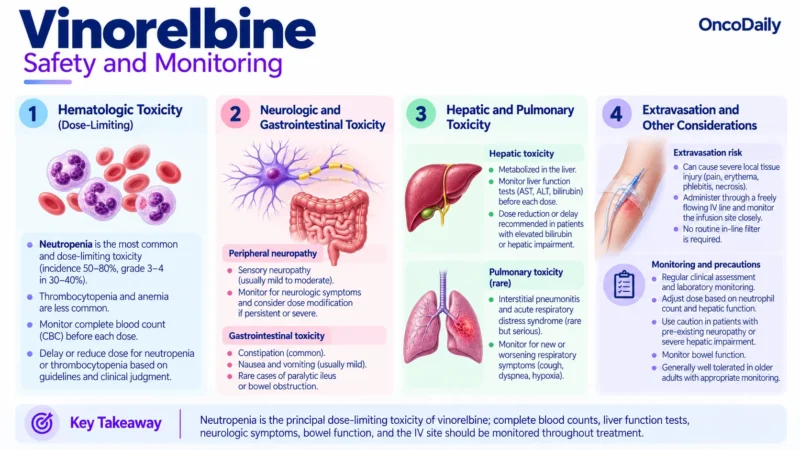
What Monitoring Is Required?
Monitoring should include:
- CBC with differential before every dose
- Absolute neutrophil count
- Hemoglobin and platelet count
- Liver function and bilirubin
- Bowel function
- Peripheral neuropathy assessment
- Signs of infection
- Respiratory symptoms
- IV infusion site
- Concomitant CYP3A-interacting medications.
Particular attention should be given to neutropenia, constipation, and extravasation risk.