





Vinblastine: Understanding Its Mechanism, Dosing, and Clinical Role in Cancer
Key takeaways
- Vinblastine is a vinca alkaloid that inhibits microtubule polymerization.
- It disrupts the mitotic spindle and produces metaphase arrest.
- Its most important current role is in Hodgkin lymphoma.
- A common Hodgkin lymphoma dose is 6 mg/m² IV on Days 1 and 15 every 28 days.
- Vinblastine remains part of the AVD backbone used with modern targeted and immunotherapy agents.
- Leukopenia is the major dose-limiting toxicity.
- Vinblastine generally causes more myelosuppression but less neurotoxicity than vincristine.
- It must be given intravenously only.
- Extravasation can cause significant tissue injury.
- A 50% dose reduction is recommended when direct bilirubin exceeds 3 mg/dL.
- - Historical PVB chemotherapy helped establish curative treatment for metastatic testicular cancer, although modern treatment generally uses etoposide instead.
Vinblastine is a vinca alkaloid chemotherapy that inhibits microtubule formation and prevents malignant cells from completing mitosis. It has played a major role in oncology for more than six decades and remains particularly important in Hodgkin lymphoma, where it forms part of the AVD chemotherapy backbone used in several contemporary treatment regimens.
Vinblastine is closely related to vincristine, but the two drugs have clinically important differences. Vinblastine causes substantially more myelosuppression, particularly leukopenia, whereas vincristine is generally more neurotoxic.
Vinblastine is also used in selected patients with Langerhans cell histiocytosis and has historical roles in germ-cell tumors, Kaposi sarcoma, and several other malignancies. The current US label includes Hodgkin disease, several lymphoma categories, advanced testicular carcinoma, Kaposi sarcoma, advanced mycosis fungoides, histiocytosis X, resistant choriocarcinoma, and selected breast cancer among its indications.
Key Facts
- Generic name: Vinblastine sulfate
- Historical brand name: Velban
- Drug class: Vinca alkaloid; antimicrotubule chemotherapy
- Route: Intravenous only
- Initial FDA approval: 1961
- Available concentration: 1 mg/mL
- Major mechanism: Inhibition of microtubule polymerization
- Cell-cycle effect: Metaphase arrest
- Common Hodgkin lymphoma dose: 6 mg/m² IV on Days 1 and 15 of a 28-day cycle
- Major dose-limiting toxicity: Leukopenia/neutropenia
- Other important toxicities: Peripheral neuropathy, constipation, alopecia, mucositis, and extravasation injury
- Premedication: Not routinely required
- In-line filter: No routine filter requirement specified in the current US label
- Major safety warning: For intravenous use only — fatal if given by other routes
- Important interaction: CYP3A inhibitors may increase vinblastine toxicity.
What Is Vinblastine?
Vinblastine is a naturally derived vinca alkaloid originally isolated from the Madagascar periwinkle, Catharanthus roseus.
It belongs to the same drug family as:
- Vincristine
- Vinorelbine
- Vindesine
Vinblastine entered clinical oncology during the early development of combination chemotherapy and received FDA approval in the early 1960s.
Its greatest continuing importance is in Hodgkin lymphoma, where it is one of the three cytotoxic agents in the AVD backbone:
Doxorubicin + vinblastine + dacarbazine.
AVD is incorporated into several modern regimens, including combinations with brentuximab vedotin or nivolumab.
For more about the unusual history of both vinca alkaloids, read The Flower Behind Vincristine and Vinblastine on OncoDaily.
What Is the Mechanism of Action of Vinblastine?
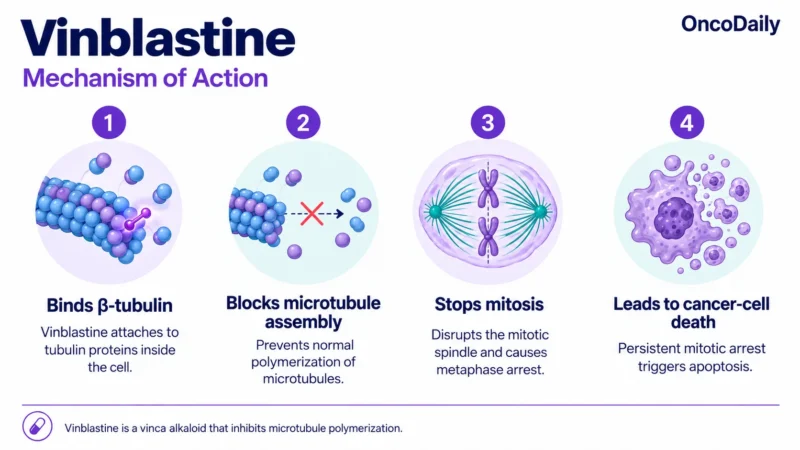
1. Binding to β-Tubulin
Vinblastine binds to β-tubulin, one of the principal structural components of microtubules.
2. Inhibition of Microtubule Polymerization
Tubulin normally assembles into microtubules.
Vinblastine interferes with this polymerization process and prevents normal microtubule formation.
3. Mitotic Spindle Disruption
Microtubules are essential components of the mitotic spindle.
Without functional spindle microtubules, chromosomes cannot be properly organized and separated during mitosis.
4. Metaphase Arrest
Cells exposed to vinblastine become arrested primarily in metaphase.
5. Cancer-Cell Death
Persistent mitotic dysfunction ultimately triggers cellular stress and programmed cell-death pathways.
The mechanism can therefore be summarized as:
Vinblastine → β-tubulin binding → inhibition of microtubule assembly → mitotic spindle disruption → metaphase arrest → cancer-cell death.
This mechanism is essentially opposite to that of taxanes such as paclitaxel and docetaxel, which stabilize microtubules and prevent their disassembly.
Watch more: Vincristine Vinblastine: Mechanism of Action
What Is the Dose of Vinblastine?
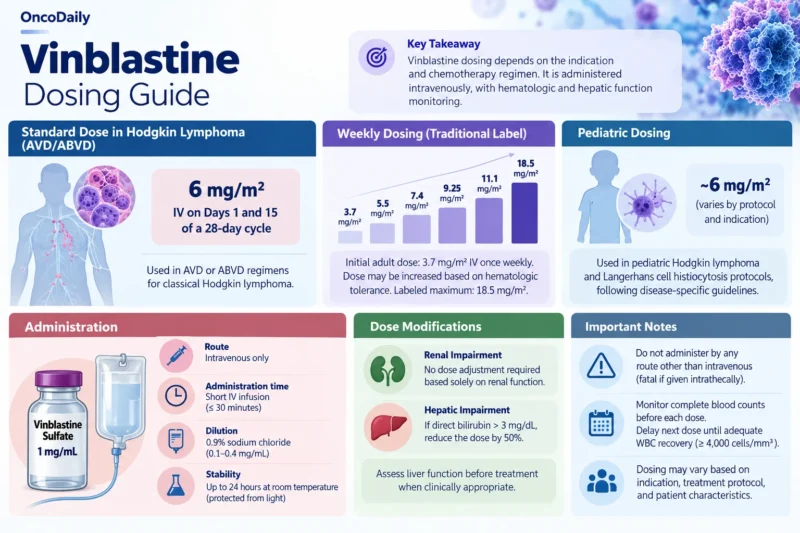
Vinblastine dosing is strongly dependent on the indication and chemotherapy protocol.
Hodgkin Lymphoma
A standard dose within AVD- or ABVD-based treatment is:
Vinblastine 6 mg/m² IV on Days 1 and 15
of each:
28-day cycle.
For example, the AVD backbone contains:
Doxorubicin 25 mg/m² + vinblastine 6 mg/m² + dacarbazine 375 mg/m²
on Days 1 and 15.
US Label Weekly Dosing
The traditional US prescribing information uses an individualized weekly dose-escalation approach.
The initial adult dose is:
3.7 mg/m² IV once weekly.
Depending on hematologic tolerance, subsequent weekly doses may be increased to:
5.5 mg/m² → 7.4 mg/m² → 9.25 mg/m² → 11.1 mg/m².
The labeled maximum is:
18.5 mg/m².
However, contemporary oncology generally uses disease-specific protocol doses rather than this historical dose-escalation scheme.
The next dose should not be administered until the white blood cell count has adequately recovered; the label specifies recovery to at least 4,000 cells/mm³.
Pediatric Patients
Pediatric dosing varies according to disease and treatment protocol.
The label describes historical starting doses including:
6 mg/m² when vinblastine is incorporated into combination treatment for Hodgkin lymphoma.
For histiocytosis X/Langerhans cell histiocytosis, vinblastine-containing protocols commonly use approximately 6 mg/m², although the exact schedule must follow the treatment protocol.
How Is Vinblastine Administered?
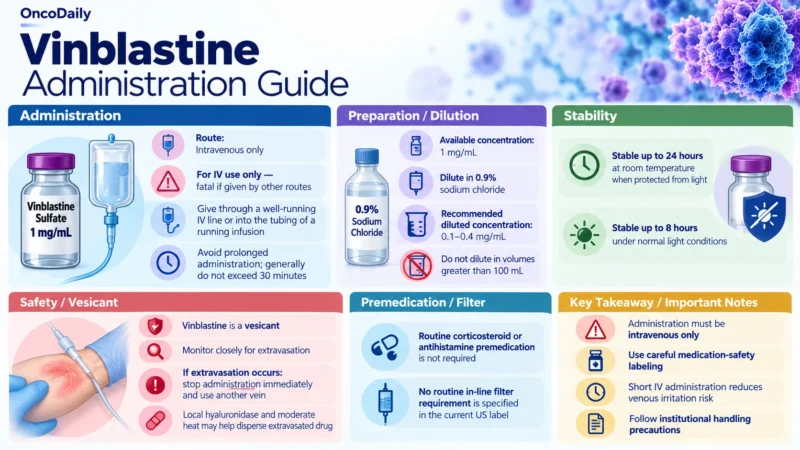
Vinblastine must be administered intravenously only.
The most important safety statement is:
FOR INTRAVENOUS USE ONLY — FATAL IF GIVEN BY OTHER ROUTES.
Medication-safety procedures are therefore especially important.
The current US label recommends that vinblastine be prepared in a flexible plastic IV container with a prominent warning identifying it as intravenous-only medication.
Available Formulation
Vinblastine sulfate injection is available at:
1 mg/mL.
One current presentation contains:
10 mg in 10 mL.
Preparation
Vinblastine may be diluted in:
0.9% sodium chloride.
The recommended diluted concentration described in the US label is:
0.1–0.4 mg/mL.
When prepared within this range, the solution is stable for up to:
24 hours at room temperature when protected from light
or:
8 hours under normal light conditions.
Infusion
The calculated dose may be administered into an IV catheter or through a running IV infusion.
The label advises against:
- Diluting in volumes greater than 100 mL
- Prolonged IV administration exceeding 30 minutes.
Both can increase venous irritation and the risk of extravasation.
Does Vinblastine Require an In-Line Filter?
No routine in-line filter is specified in the current US prescribing information.
Institutional policies and the specific product formulation should still be followed.
Does Vinblastine Require Premedication?
No routine corticosteroid or antihistamine premedication is required.
Antiemetic treatment may be administered according to the chemotherapy regimen and individual patient risk.
Is Vinblastine a Vesicant?
Yes. Vinblastine can cause significant local tissue injury after extravasation.
Potential consequences include:
- Pain
- Erythema
- Phlebitis
- Cellulitis
- Tissue sloughing.
If extravasation occurs, administration should be stopped immediately.
The US label describes local hyaluronidase and moderate heat as measures that may help disperse extravasated vinblastine.
Does Vinblastine Require Renal or Hepatic Dose Adjustment?
Renal Impairment
Vinblastine is predominantly metabolized and eliminated through hepatic and biliary pathways.
The current US label states that:
No dose modification is required solely for impaired renal function.
Clinical judgment remains important in patients receiving other nephrotoxic or renally cleared chemotherapy agents.
Hepatic Impairment
Hepatic dysfunction can substantially increase vinblastine exposure and toxicity.
The US prescribing information recommends:
Direct bilirubin >3 mg/dL → reduce the vinblastine dose by 50%.
Liver function should therefore be assessed before treatment when clinically appropriate.
What Is the Pharmacokinetic Profile of Vinblastine?
Vinblastine demonstrates rapid tissue distribution and prolonged terminal elimination.
Distribution
After intravenous administration, the drug rapidly leaves the circulation and binds extensively and reversibly to tissues.
Half-Life
Serum concentrations decline in a triphasic pattern.
Reported half-lives are approximately:
Initial phase: 3.7 minutes
Intermediate phase: 1.6 hours
Terminal phase: 24.8 hours.
Metabolism
Vinblastine is metabolized primarily through hepatic:
CYP3A enzymes.
Strong inhibitors of CYP3A metabolism can increase vinblastine exposure and toxicity.
Elimination
The major route of elimination is believed to be hepatobiliary.
Consequently, hepatic dysfunction is considerably more relevant to vinblastine dosing than renal dysfunction.
What Are the Important Drug Interactions?
CYP3A Inhibitors
Drugs that inhibit CYP3A metabolism may increase vinblastine toxicity.
Examples include selected:
- Macrolide antibiotics
- Azole antifungals
- Protease inhibitors
- Other strong CYP3A inhibitors.
Enhanced toxicity has historically been reported with concomitant erythromycin.
Phenytoin
Combination chemotherapy containing vinblastine has been associated with reduced phenytoin concentrations and loss of seizure control.
Therapeutic drug monitoring may therefore be necessary.
Mitomycin-C
Severe dyspnea and bronchospasm have been reported when vinca alkaloids are administered with mitomycin-C.
Pulmonary symptoms may occur shortly after treatment or be delayed for several days.
What Are the Clinical Uses of Vinblastine?
Hodgkin Lymphoma
Hodgkin lymphoma is the most important contemporary oncologic use of vinblastine.
Vinblastine is a component of the classic:
ABVD regimen
consisting of:
Doxorubicin + bleomycin + vinblastine + dacarbazine.
It is also retained in the AVD chemotherapy backbone incorporated into newer regimens such as:
- Brentuximab vedotin + AVD
- Nivolumab + AVD.
Thus, even as treatment has evolved toward targeted therapy and immune checkpoint inhibition, vinblastine remains part of the cytotoxic backbone of several highly effective Hodgkin lymphoma regimens.
Langerhans Cell Histiocytosis
Vinblastine combined with corticosteroids has long been used in treatment of Langerhans cell histiocytosis, particularly in pediatric disease.
Its exact role now depends on disease extent, organ involvement, molecular alterations, prior therapy, and treatment protocol.
Germ-Cell Tumors
Vinblastine historically formed part of PVB chemotherapy:
Cisplatin + vinblastine + bleomycin.
PVB was one of the early curative chemotherapy regimens for metastatic testicular germ-cell tumors.
In contemporary practice, vinblastine has largely been replaced by etoposide-containing regimens such as BEP, but its historical contribution to the development of curative germ-cell chemotherapy remains important.
Other Labelled or Historical Uses
The US label also includes selected use in:
- Non-Hodgkin lymphoma
- Mycosis fungoides
- Kaposi sarcoma
- Advanced testicular carcinoma
- Resistant choriocarcinoma
- Histiocytosis X
- Selected treatment-refractory breast cancer.
Several of these indications reflect older oncology practice and are no longer major contemporary uses of vinblastine.
What Did Vinblastine Clinical Trials Show?
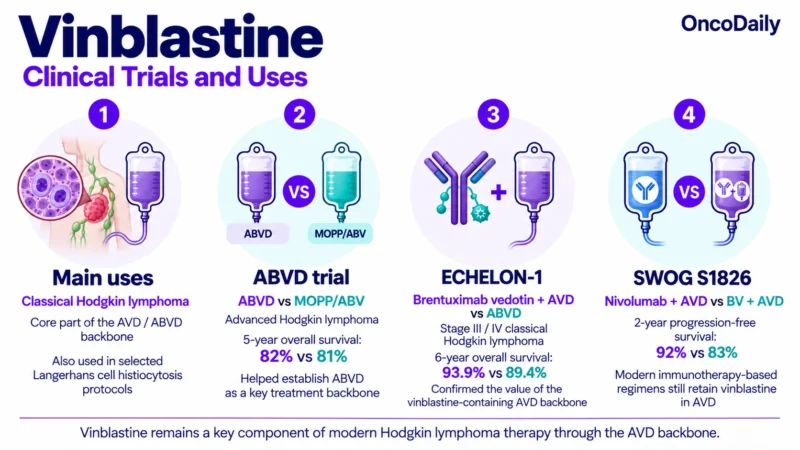
ABVD in Advanced Hodgkin Lymphoma
A major randomized intergroup trial evaluated ABVD versus MOPP/ABV in 856 patients with advanced Hodgkin lymphoma.
Both regimens contained vinblastine.
At five years:
Failure-free survival:
- ABVD: 63%
- MOPP/ABV: 66%
Overall survival:
- ABVD: 82%
- MOPP/ABV: 81%
Complete remission rates were 76% and 80%, respectively.
The comparable efficacy with a more favorable long-term treatment profile helped establish ABVD as a major Hodgkin lymphoma chemotherapy backbone.
ECHELON-1: Brentuximab Vedotin + AVD
ECHELON-1 randomized 1,334 patients with previously untreated stage III or IV classical Hodgkin lymphoma to:
Brentuximab vedotin + AVD
or:
ABVD.
Vinblastine was administered at:
6 mg/m² on Days 1 and 15.
At approximately six years:
Overall survival:
- A+AVD: 93.9%
- ABVD: 89.4%.
The hazard ratio for death was 0.59.
Progression-free survival also favored A+AVD.
The study demonstrated that vinblastine-containing AVD could serve as the chemotherapy backbone for targeted CD30-directed treatment.
SWOG S1826: Nivolumab + AVD
The phase III S1826 trial compared:
Nivolumab + AVD
with:
Brentuximab vedotin + AVD
in adolescents and adults with newly diagnosed stage III or IV classical Hodgkin lymphoma.
Both regimens retained vinblastine as part of the AVD backbone.
Among 970 patients included in the efficacy population:
2-year progression-free survival:
- Nivolumab + AVD: 92%
- Brentuximab vedotin + AVD: 83%.
The trial demonstrates how the vinblastine-containing AVD backbone continues to be incorporated into modern immunotherapy-based Hodgkin lymphoma strategies.
Historical PVB in Testicular Cancer
Vinblastine also played an important historical role in metastatic germ-cell tumors.
In a randomized Southwest Oncology Group study comparing cisplatin + vinblastine + bleomycin (PVB) with a vinblastine/cisplatin/etoposide regimen:
Disease-free status was achieved in:
- PVB: 77%
- Comparator regimen: 73%.
These early platinum-based studies contributed to the development of curative chemotherapy for advanced testicular cancer, although modern therapy subsequently moved toward etoposide-containing regimens.
Is Vinblastine FDA Approved?
Yes.
Vinblastine was among the earliest cytotoxic chemotherapy drugs approved in the United States, receiving FDA approval in 1961.
Its original regulatory indications span several hematologic and solid malignancies, although current clinical practice is considerably more focused than the historical label.
What Is the Current Clinical Role of Vinblastine?
Vinblastine remains most clinically relevant in classical Hodgkin lymphoma.
An important feature of its history is that it has survived multiple generations of treatment evolution.
It was present in ABVD, remained in AVD when bleomycin was removed, and continues to form part of contemporary combinations incorporating agents such as brentuximab vedotin and nivolumab.
Vinblastine also remains relevant in selected Langerhans cell histiocytosis protocols.
By contrast, its former role in metastatic germ-cell cancer has largely been replaced by etoposide-containing chemotherapy.
What Are the Major Side Effects of Vinblastine?
Vinblastine differs clinically from vincristine because its major dose-limiting toxicity is bone-marrow suppression rather than neurotoxicity.
Leukopenia and Neutropenia
Leukopenia is the most important dose-limiting toxicity of vinblastine.
The white blood cell nadir usually occurs approximately:
5–10 days after administration.
Recovery generally occurs over the following:
7–14 days.
CBC assessment before subsequent doses is therefore essential.
Anemia and Thrombocytopenia
Vinblastine may also cause:
- Anemia
- Thrombocytopenia.
These effects may be more pronounced in patients with previous chemotherapy, radiation therapy, or bone-marrow involvement.
Peripheral Neuropathy
Neurologic toxicity can occur and may include:
- Paresthesias
- Reduced deep tendon reflexes
- Peripheral neuritis
- Weakness.
However, neurotoxicity is generally less prominent than with vincristine.
Constipation and Ileus
Autonomic effects can cause:
- Constipation
- Abdominal discomfort
- Ileus.
Patients should be monitored for bowel dysfunction during treatment.
Alopecia
Hair loss is common but is not always complete.
Hair may begin to regrow even while maintenance treatment continues.
Gastrointestinal Toxicity
Possible gastrointestinal effects include:
- Nausea
- Vomiting
- Reduced appetite
- Diarrhea
- Stomatitis
- Abdominal pain.
Extravasation
Vinblastine is a vesicant and may cause significant local tissue damage.
Careful verification of IV access before and during treatment is essential.
Ototoxicity
Rare vestibular and auditory toxicity has been reported, including:
- Hearing loss
- Vertigo
- Nystagmus
- Balance disturbances.
Particular caution may be appropriate when vinblastine is combined with other ototoxic agents such as platinum chemotherapy.
Pulmonary Toxicity
Acute dyspnea and severe bronchospasm have been reported, particularly when vinca alkaloids are combined with mitomycin-C.
SIADH
Inappropriate secretion of antidiuretic hormone has been reported, particularly after higher-than-recommended doses.
Fertility
Vinblastine can impair reproductive function.
Reported effects include:
- Aspermia
- Azoospermia in multidrug regimens
- Amenorrhea in selected combination treatments.
Fertility preservation should therefore be discussed when appropriate.
What Monitoring Is Required?
Monitoring should include:
- CBC with differential before treatment
- Neutrophil and white blood cell counts
- Platelet count
- Liver function and bilirubin
- Neurologic symptoms
- Bowel function
- Signs of infection
- Oral mucosa
- IV infusion site
- Concomitant CYP3A-interacting drugs.
The white blood cell count is particularly important because leukopenia is the principal dose-limiting toxicity.