


Vemurafenib (Zelboraf): Understanding Its Mechanism, Dosing, Clinical Uses, and Role in BRAF V600–Mutated Cancer
Key takeaways
- Vemurafenib is a selective inhibitor of BRAF V600-mutant kinase.
- Standard dosing is 960 mg orally twice daily.
- It is FDA approved for BRAF V600E-positive unresectable/metastatic melanoma and BRAF V600-mutant Erdheim-Chester disease.
- BRIM-3 demonstrated median PFS of 6.9 vs 1.6 months and median OS of 13.6 vs 9.7 months compared with dacarbazine.
- coBRIM showed that adding cobimetinib significantly improved outcomes compared with vemurafenib alone.
- In BRAF V600-mutant ECD, VE-BASKET demonstrated an ORR of 54.5% in the ECD cohort.
- Important toxicities include cutaneous SCC, photosensitivity, QT prolongation, hepatotoxicity, ocular toxicity, and renal injury.
- In 2026, single-agent vemurafenib has a more limited role in melanoma because BRAF/MEK combinations and immunotherapy-based strategies are generally preferred, while vemurafenib remains particularly relevant in BRAF V600-mutated ECD.
Vemurafenib (Zelboraf) is an oral small-molecule inhibitor of mutant BRAF, developed specifically for cancers driven by activating BRAF V600 mutations. It was the first BRAF inhibitor to demonstrate a major survival advantage in metastatic melanoma, establishing BRAF-directed therapy as a key precision-oncology strategy.
Vemurafenib remains FDA approved for unresectable or metastatic melanoma with BRAF V600E mutation and for Erdheim-Chester disease (ECD) with a BRAF V600 mutation. In contemporary melanoma practice, however, BRAF/MEK combination therapy is generally preferred over BRAF inhibitor monotherapy because it provides more durable disease control and reduces paradoxical MAPK-driven skin toxicities.
Key Facts
- Generic name: Vemurafenib
- Brand name: Zelboraf
- Drug class: BRAF kinase inhibitor
- Route: Oral
- Initial US approval: 2011
- Primary target: Mutant BRAF, especially BRAF V600E
- Standard dose: 960 mg orally twice daily
- Administration: Approximately 12 hours apart, with or without food
- Tablet strength: 240 mg
- FDA indications: BRAF V600E-mutant unresectable/metastatic melanoma; BRAF V600-mutant Erdheim-Chester disease
- Not indicated for: Wild-type BRAF melanoma
- Major toxicities: Arthralgia, rash, photosensitivity, fatigue, alopecia, nausea
- Important serious toxicities: Cutaneous squamous-cell carcinoma, new primary melanoma, QT prolongation, hepatotoxicity, severe skin reactions, uveitis, renal toxicity
- Current US status: FDA approved.
What Is Vemurafenib?
Vemurafenib is a selective inhibitor of mutant BRAF kinase.
The BRAF protein is a key component of the:
RAS–RAF–MEK–ERK pathway
which regulates:
- Cell proliferation
- Cell differentiation
- Cell survival
In cancers carrying a BRAF V600 mutation, most commonly:
BRAF V600E
the kinase becomes constitutively active.
This drives continuous downstream MAPK signaling independently of normal upstream growth-factor regulation.
Vemurafenib preferentially inhibits the mutant BRAF kinase and suppresses this oncogenic signaling.
What Is the Mechanism of Action of Vemurafenib?
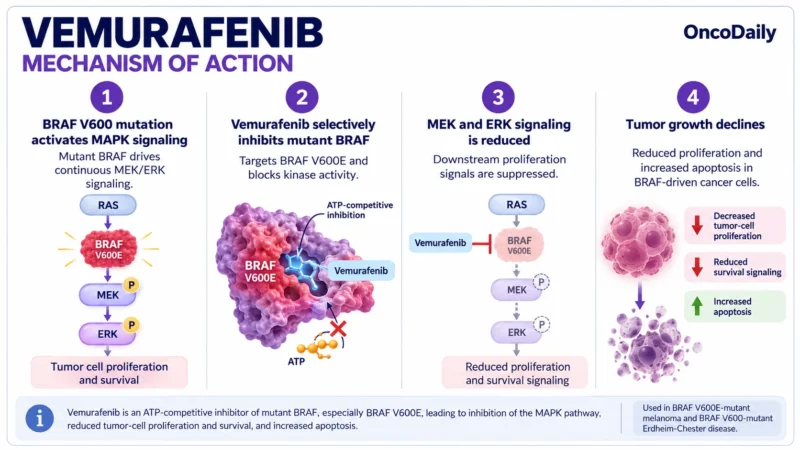
1. BRAF V600 Mutation Causes Constitutive Kinase Activation
The most common alteration is:
BRAF V600E
in which valine is replaced by glutamic acid at codon 600.
This mutation causes persistent activation of the BRAF kinase.
2. MAPK Signaling Becomes Continuously Active
Mutant BRAF constitutively activates:
MEK1/2
which activates:
ERK1/2.
This promotes:
- Tumor-cell proliferation
- Survival
- Growth
- Invasion
3. Vemurafenib Binds Mutant BRAF
Vemurafenib is an:
ATP-competitive BRAF kinase inhibitor.
It binds to the kinase domain and inhibits BRAF V600 signaling.
4. MEK and ERK Phosphorylation Falls
Inhibition of mutant BRAF reduces:
- MEK phosphorylation
- ERK phosphorylation
thereby suppressing the downstream MAPK pathway.
5. Tumor Growth Is Reduced
The result is:
- Reduced proliferation
- Reduced survival
- Increased apoptosis
- Tumor regression in BRAF-dependent cancers
The mechanism can be summarized as:
Vemurafenib → mutant BRAF inhibition → reduced MEK/ERK signaling → decreased tumor-cell proliferation and survival.
Why Can Vemurafenib Cause Secondary Skin Tumors?
This is an important feature of BRAF inhibitor biology.
In cells with wild-type BRAF, vemurafenib can paradoxically activate MAPK signaling in the presence of upstream RAS activation.
This may stimulate growth of pre-existing RAS-mutant keratinocytes and contribute to:
- Cutaneous squamous-cell carcinoma
- Keratoacanthoma
- Other secondary skin lesions
This paradoxical effect is one reason why combining a BRAF inhibitor with a MEK inhibitor improves both efficacy and some aspects of safety.
What Is the Dose of Vemurafenib?
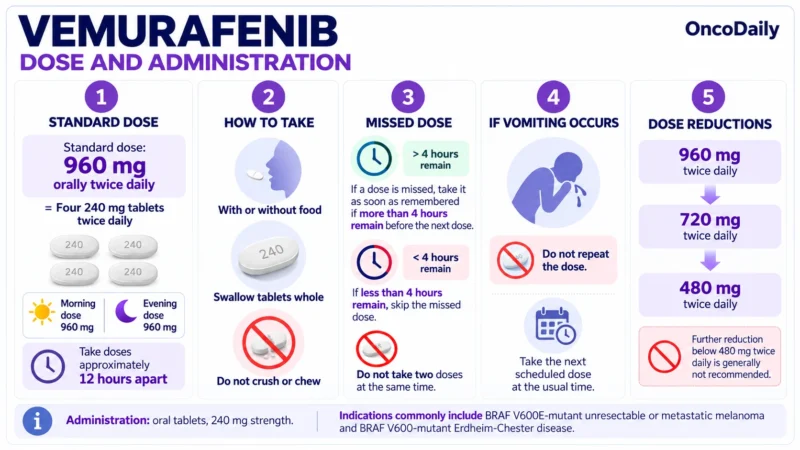
The recommended dose is:
960 mg orally twice daily.
That corresponds to:
Four 240 mg tablets twice daily.
Doses should be taken approximately:
12 hours apart.
Vemurafenib may be taken:
With or without food.
Treatment continues until:
- Disease progression
- Unacceptable toxicity
What If a Dose Is Missed?
If a dose is missed:
Take it as soon as remembered if there are:
More than 4 hours before the next scheduled dose.
If the next dose is due within 4 hours:
Skip the missed dose.
Do not take two doses at the same time.
If vomiting occurs after vemurafenib:
Do not repeat the dose.
Take the next scheduled dose at the usual time.
How Are Vemurafenib Dose Reductions Made?
The standard dose is:
960 mg twice daily.
Dose reductions may be made stepwise depending on toxicity.
Typical reduction levels include:
- 720 mg twice daily
- 480 mg twice daily
Further reduction below:
480 mg twice daily
is generally not recommended.
Dose interruption or reduction may be needed for:
- QT prolongation
- Severe skin toxicity
- Hepatotoxicity
- Photosensitivity
- Arthralgia
- Renal toxicity
- Other Grade ≥3 adverse reactions
How Is Vemurafenib Administered?
Vemurafenib is available as:
240 mg tablets.
Patients should:
- Swallow tablets whole
- Take doses approximately 12 hours apart
- Maintain a consistent schedule
Tablets should not be:
- Crushed
- Chewed
It may be taken:
With or without food.
What Are the Important Drug Interactions With Vemurafenib?
Vemurafenib can interact with several CYP enzymes and transport systems.
It may increase exposure to some:
CYP1A2 substrates
and alter exposure to:
CYP3A4 substrates.
Clinically relevant concomitant medications should therefore be reviewed carefully.
Particular caution is warranted with:
- Warfarin
- CYP1A2-sensitive drugs
- QT-prolonging drugs
QT-Prolonging Drugs
Vemurafenib can prolong the:
QT interval.
Concomitant use with other drugs that significantly prolong QT should be minimized when possible.
Patients at increased risk should have:
- ECG monitoring
- Potassium
- Magnesium
- Calcium
checked before and during treatment.
Does Vemurafenib Require Renal or Hepatic Dose Adjustment?
Renal Impairment
No routine starting dose adjustment is generally required for:
Mild-to-moderate renal impairment.
Data are more limited in:
Severe renal impairment.
Because renal injury has been reported with vemurafenib, renal function should be monitored during therapy.
Hepatic Impairment
No routine dose adjustment is generally required for:
Mild or moderate hepatic impairment.
Data are limited in:
Severe hepatic impairment.
Liver function should be monitored carefully during treatment.
What Is the Pharmacokinetic Profile of Vemurafenib?
Absorption
Vemurafenib is orally absorbed and reaches systemic circulation after repeated twice-daily administration.
Protein Binding
Vemurafenib is:
Highly protein bound.
Metabolism
Metabolism involves:
CYP3A4
among other pathways.
Elimination
Elimination occurs predominantly through:
Fecal excretion.
The drug has a relatively long terminal half-life, supporting twice-daily dosing.
What Are the Clinical Uses of Vemurafenib?
BRAF V600E-Mutated Unresectable or Metastatic Melanoma
Vemurafenib is FDA approved for:
Patients with unresectable or metastatic melanoma with BRAF V600E mutation detected by an FDA-approved test.
It should not be used for:
Wild-type BRAF melanoma.
Erdheim-Chester Disease
Vemurafenib is also FDA approved for:
Patients with Erdheim-Chester disease harboring a BRAF V600 mutation.
This was an important milestone because ECD is a rare histiocytic neoplasm highly enriched for BRAF pathway alterations.
What Did Vemurafenib Clinical Trials Show?
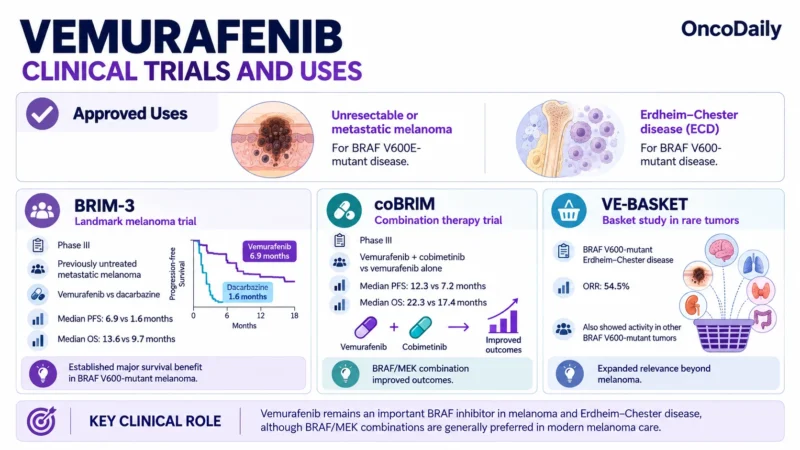
BRIM-3 — Vemurafenib Versus Dacarbazine
The pivotal BRIM-3 phase III trial compared vemurafenib with dacarbazine in previously untreated patients with metastatic melanoma harboring a BRAF V600 mutation.
A total of:
675 patients
were randomized:
- Vemurafenib: 337
- Dacarbazine: 338.
Median Progression-Free Survival
With extended follow-up:
- Vemurafenib: 6.9 months
- Dacarbazine: 1.6 months
Hazard ratio:
0.38
P < 0.0001.
Median Overall Survival
- Vemurafenib: 13.6 months
- Dacarbazine: 9.7 months
Hazard ratio:
0.70.
Final long-term analysis continued to show a survival advantage, with median OS around:
- 13.6 months with vemurafenib
- 9.7–10.3 months with dacarbazine, depending on crossover handling.
coBRIM — Vemurafenib Plus Cobimetinib
The phase III coBRIM trial asked whether adding the MEK inhibitor cobimetinib to vemurafenib could improve outcomes.
A total of:
495 patients
with previously untreated BRAF V600-mutant advanced melanoma were randomized to:
- Vemurafenib + cobimetinib
- Vemurafenib + placebo.
Progression-Free Survival
Initial analysis:
- Combination: 9.9 months
- Vemurafenib alone: 6.2 months
Hazard ratio:
0.51.
With longer follow-up:
- Combination: 12.3 months
- Vemurafenib alone: 7.2 months
Hazard ratio:
0.58.
Median OS was:
- 22.3 months with combination therapy
- 17.4 months with vemurafenib alone
Hazard ratio:
0.70.
- OS: 31% vs 26%
- PFS: 14% vs 10%
favoring vemurafenib plus cobimetinib.
VE-BASKET — Erdheim-Chester Disease
The histology-independent VE-BASKET phase II study evaluated vemurafenib in nonmelanoma tumors carrying BRAF V600 mutations.
Among:
22 patients with Erdheim-Chester disease
the confirmed ORR was:
54.5%.
In the combined ECD/LCH analysis of 26 patients:
- ORR: 61.5%
- 2-year PFS: 86%
- 2-year OS: 96%
All evaluable patients achieved at least stable disease, and 80% of FDG-PET-evaluable patients achieved a complete metabolic response.
What About Other BRAF V600-Mutated Tumors?
Vemurafenib has shown activity in several additional BRAF V600-mutated tumor types in basket studies.
Examples include:
- NSCLC
- Glioma
- Hairy cell leukemia
- Cholangiocarcinoma
- Ovarian cancer
- Sarcoma
However, these are not all FDA-approved vemurafenib indications.
Vemurafenib in BRAF V600-Mutant NSCLC
In the VE-BASKET NSCLC cohort:
62 patients
with BRAF V600-mutant NSCLC received vemurafenib.
Objective Response Rate
ORR was:
37.1%.
Median Progression-Free Survival
6.5 months.
Median Overall Survival
15.4 months.
This demonstrated meaningful activity but vemurafenib monotherapy is not the dominant contemporary approach for BRAF V600E-positive NSCLC, where BRAF/MEK combinations are generally favored.
Vemurafenib in BRAF V600-Mutant Glioma
In VE-BASKET:
24 patients
with BRAF V600-mutant gliomas were treated.
Objective Response Rate
25%.
Median Progression-Free Survival
5.5 months.
Activity varied substantially by histologic subtype, with particularly notable responses in some patients with:
- Pleomorphic xanthoastrocytoma
- Ganglioglioma
- Pilocytic astrocytoma.
Is Vemurafenib FDA Approved?
Yes.
Current FDA-approved indications include:
1. Melanoma
Unresectable or metastatic melanoma with BRAF V600E mutation.
2. Erdheim-Chester Disease
BRAF V600 mutation-positive ECD.
What Is the Current Clinical Role of Vemurafenib?
Melanoma
Vemurafenib remains an active BRAF inhibitor, but single-agent vemurafenib is no longer the preferred targeted approach for most patients with advanced BRAF V600-mutant melanoma.
Combination BRAF/MEK inhibition has demonstrated:
- Longer PFS
- Longer OS
- Higher response rates
- Lower rates of paradoxical cutaneous neoplasms
than BRAF monotherapy.
An established combination is:
Vemurafenib + cobimetinib.
In broader contemporary melanoma sequencing, immune checkpoint blockade also plays a major role, and treatment order depends on disease burden, symptoms, mutation status, CNS disease, LDH, and need for rapid tumor control.
Read more: OncoDaily’s overview of how targeted therapy and immunotherapy have reshaped melanoma treatment, including BRAF and MEK inhibition.
Watch more: Explore OncoDaily’s discussion on melanoma treatment and the evolving role of targeted therapies, including BRAF/MEK-directed strategies.
Erdheim-Chester Disease
In BRAF V600-mutant ECD, vemurafenib remains highly clinically relevant and is FDA approved.
This is one setting where vemurafenib retains a particularly distinctive role because responses can be:
- Deep
- Durable
- Metabolically complete in some patients.
What Are the Major Side Effects of Vemurafenib?
Common adverse effects include:
- Arthralgia
- Rash
- Photosensitivity
- Fatigue
- Alopecia
- Nausea
- Pruritus
- Hyperkeratosis
- Headache
Cutaneous Squamous-Cell Carcinoma and Keratoacanthoma
Vemurafenib can cause:
- Cutaneous squamous-cell carcinoma
- Keratoacanthoma
- Other secondary cutaneous lesions
Patients should undergo:
Dermatologic evaluation before treatment and periodically during therapy.
Suspicious lesions should be excised and managed appropriately.
New Primary Melanoma
New primary melanomas have also been reported.
Patients should receive:
- Baseline skin examination
- Regular dermatologic surveillance
during treatment.
Photosensitivity
Photosensitivity is one of the most characteristic vemurafenib toxicities.
Patients should:
- Avoid excessive sun exposure
- Use broad-spectrum sunscreen
- Wear protective clothing
- Use sunglasses when appropriate
Severe Dermatologic Reactions
Rare but serious reactions can include:
- Stevens-Johnson syndrome
- Toxic epidermal necrolysis
- DRESS
Severe or life-threatening skin reactions require:
Permanent discontinuation.
QT Prolongation
Vemurafenib can prolong the QT interval.
Monitoring should include:
- ECG
- Potassium
- Magnesium
- Calcium
in patients at risk.
Clinically significant QT prolongation may require:
- Treatment interruption
- Dose reduction
- Permanent discontinuation
Hepatotoxicity
Vemurafenib can cause abnormalities in:
- ALT
- AST
- Alkaline phosphatase
- Bilirubin
Liver function should be checked:
- Before treatment
- Periodically during therapy
Ocular Toxicity
Vemurafenib can cause:
- Uveitis
- Iritis
- Retinal vein occlusion
Patients with visual symptoms should undergo prompt:
Ophthalmologic evaluation.
Renal Toxicity
Renal injury has been reported.
Monitoring should include:
- Serum creatinine
- Renal function
particularly in patients with pre-existing renal impairment or other risk factors.
Embryo-Fetal Toxicity
Vemurafenib can cause fetal harm.
Patients of reproductive potential should receive counseling regarding:
- Pregnancy risk
- Effective contraception
Breastfeeding is not recommended during therapy.
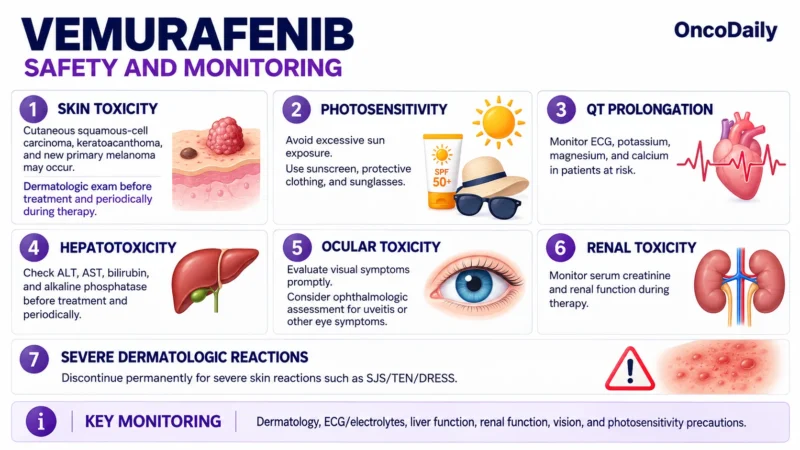
What Monitoring Is Required?
Before and during vemurafenib therapy, monitor:
- BRAF mutation status before treatment
- Dermatologic examination
- ECG
- Potassium
- Magnesium
- Calcium
- ALT
- AST
- Bilirubin
- Alkaline phosphatase
- Renal function
- Serum creatinine
- Visual symptoms
- Photosensitivity
- New skin lesions
- Arthralgia
- Concomitant QT-prolonging medications
Particular attention should be given to:
Skin toxicity, QT interval, hepatic function, renal function, and ocular symptoms.
FAQ
What Is Vemurafenib Used For?
What Is the Standard Dose?
Can Vemurafenib Be Taken With Food?
It may be taken:
With or without food.
How Does Vemurafenib Work?
What Did BRIM-3 Show?
- 6.9 months with vemurafenib
- 1.6 months with dacarbazine
and median OS was:
- 13.6 months
- 9.7 months, respectively.