


Tucatinib (Tukysa): Understanding Its Mechanism, Dosing, Clinical Uses, and Role in HER2-Positive Breast Cancer and Colorectal Cancer
Key takeaways
- Tucatinib is an oral, relatively selective HER2 tyrosine kinase inhibitor.
- Standard dosing is 300 mg twice daily approximately 12 hours apart.
- Dose reductions proceed 300 → 250 → 200 → 150 mg twice daily.
- HER2CLIMB established tucatinib + trastuzumab + capecitabine as an effective regimen in previously treated HER2-positive metastatic breast cancer.
- In HER2CLIMB, median OS ultimately reached 24.7 vs 19.2 months, HR 0.73.
- Tucatinib has particularly important evidence in HER2-positive brain metastases.
- HER2CLIMB-05 showed median PFS 24.9 vs 16.3 months, HR 0.641, leading to a new FDA maintenance approval in October 2026.
- MOUNTAINEER established tucatinib + trastuzumab in RAS wild-type HER2-positive metastatic colorectal cancer.
- Final MOUNTAINEER results showed ORR 39.3%, median DoR 15.2 months, PFS 8.1 months, and OS 23.9 months.
- Major monitoring priorities are hepatotoxicity, diarrhea, serum creatinine, and drug interactions.
- Tucatinib can increase creatinine without necessarily reducing true renal function.
Tucatinib (Tukysa) is an oral, highly selective HER2-directed tyrosine kinase inhibitor. Unlike broader pan-HER TKIs, tucatinib has relatively little inhibition of EGFR, which helps distinguish its toxicity profile from agents such as lapatinib and neratinib. Tucatinib inhibits HER2 phosphorylation, reduces HER2/HER3 signaling, and suppresses downstream MAPK and AKT pathways, leading to reduced tumor-cell proliferation.
As of October 2026, tucatinib has several important FDA-approved roles: with trastuzumab + capecitabine for previously treated advanced HER2-positive breast cancer, including patients with brain metastases; with trastuzumab for chemotherapy-refractory, RAS wild-type HER2-positive metastatic colorectal cancer; and, newly as of October 7, 2026, with trastuzumab + pertuzumab as maintenance treatment after induction therapy for unresectable locally advanced or metastatic HER2-positive breast cancer.
Key Facts
- Generic name: Tucatinib
- Brand name: Tukysa
- Drug class: Selective HER2 tyrosine kinase inhibitor
- Primary target: HER2
- Route: Oral
- Initial US approval: 2020
- Tablet strengths: 50 mg and 150 mg
- Standard dose: 300 mg orally twice daily
- Administration: Approximately 12 hours apart, with or without food
- Major breast cancer combinations: trastuzumab + capecitabine; trastuzumab + pertuzumab
- Colorectal cancer combination: trastuzumab
- Important clinical feature: Strong prospective evidence in HER2-positive breast cancer with brain metastases
- Major safety concerns: Hepatotoxicity, diarrhea, increased serum creatinine, embryo-fetal toxicity
- Important interactions: CYP2C8, CYP3A, and P-gp-related interactions.
What Is Tucatinib?
Tucatinib is a small-molecule HER2 kinase inhibitor designed to preferentially inhibit:
HER2
rather than broadly inhibiting several HER-family receptors.
This relative HER2 selectivity is clinically relevant because inhibition of EGFR is associated with toxicities such as:
- Rash
- Diarrhea
- Other epithelial toxicities
that are often more pronounced with broader HER-family TKIs.
HER2 amplification or overexpression can drive persistent signaling through:
- PI3K–AKT
- RAS–RAF–MEK–ERK
which promotes:
- Cell proliferation
- Survival
- Tumor growth
- Metastatic progression.
Tucatinib interrupts this HER2-dependent signaling.
What Is the Mechanism of Action of Tucatinib?
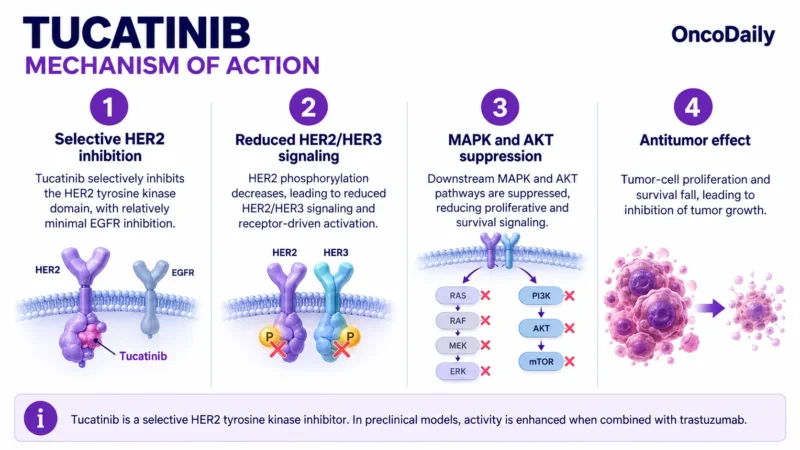
1. HER2 Signaling Drives Tumor Growth
HER2 can form homodimers or heterodimers with other HER-family receptors, particularly:
HER3
which activates powerful intracellular survival pathways.
2. HER2/HER3 Activates Downstream Pathways
HER2 signaling stimulates:
PI3K → AKT
and:
RAS → RAF → MEK → ERK
These pathways promote:
- Proliferation
- Survival
- Growth
- Resistance to apoptosis.
3. Tucatinib Inhibits HER2 Kinase Activity
Tucatinib inhibits:
HER2 tyrosine kinase activity
and reduces phosphorylation of:
- HER2
- HER3.
4. MAPK and AKT Signaling Falls
The reduction in HER2/HER3 signaling suppresses:
- MAPK signaling
- AKT signaling
5. Tumor-Cell Proliferation Is Reduced
The result is:
- Reduced proliferation
- Reduced survival signaling
- Reduced tumor growth
- Increased antitumor activity.
In preclinical models, combining tucatinib with trastuzumab produced greater antitumor activity than either agent alone.
The mechanism can be summarized as:
Tucatinib → selective HER2 kinase inhibition → ↓HER2/HER3 phosphorylation → ↓MAPK and ↓AKT signaling → reduced tumor-cell proliferation and survival.
What Is the Dose of Tucatinib?
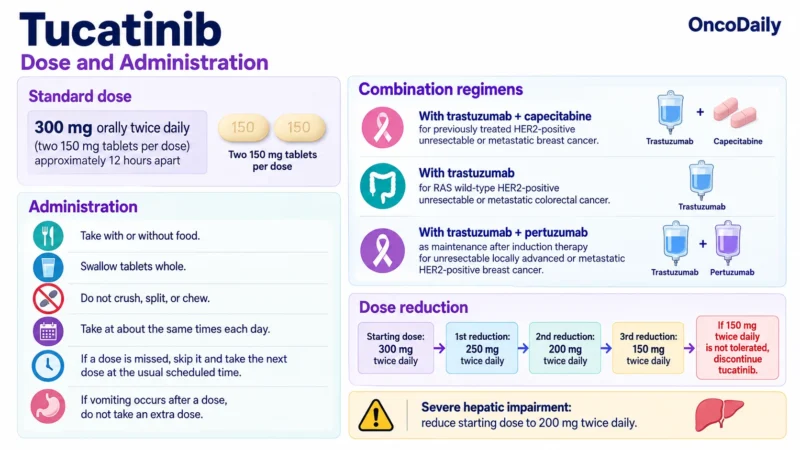
The standard recommended dose is:
300 mg orally twice daily
approximately:
12 hours apart.
Treatment generally continues until:
- Disease progression
- Unacceptable toxicity.
Tucatinib With Trastuzumab and Capecitabine
For previously treated HER2-positive advanced or metastatic breast cancer:
Tucatinib 300 mg orally twice daily
plus:
Trastuzumab
and:
Capecitabine 1,000 mg/m² orally twice daily on Days 1–14 of each 21-day cycle.
Tucatinib and capecitabine may be taken at the same time.
Tucatinib With Trastuzumab in Colorectal Cancer
For:
RAS wild-type, HER2-positive unresectable or metastatic colorectal cancer
the dose is:
Tucatinib 300 mg orally twice daily
in combination with:
Trastuzumab.
Tucatinib With Trastuzumab and Pertuzumab
Following the FDA approval on October 7, 2026, tucatinib may also be used as maintenance treatment after induction therapy in adults with unresectable locally advanced or metastatic HER2-positive breast cancer.
The regimen uses:
Tucatinib 300 mg orally twice daily
with:
- Trastuzumab
- Pertuzumab
after induction treatment with:
4–8 cycles of trastuzumab + pertuzumab + a taxane.
How Should Tucatinib Be Taken?
Tucatinib should be taken:
- Approximately 12 hours apart
- At approximately the same times each day
- With or without food
Tablets should be swallowed:
Whole.
They should not be:
- Chewed
- Crushed
- Split.
Do not take a tablet that is:
- Broken
- Cracked
- Otherwise not intact.
What If a Dose Is Missed?
If a dose is missed:
Do not replace it.
Take the next dose at the:
Usual scheduled time.
If vomiting occurs after a dose:
Do not take an additional replacement dose.
Resume at the next scheduled administration.
How Are Tucatinib Dose Reductions Made?
The recommended dose reductions are:
- Starting dose: 300 mg twice daily
- First reduction: 250 mg twice daily
- Second reduction: 200 mg twice daily
- Third reduction: 150 mg twice daily
If the patient cannot tolerate:
150 mg twice daily
tucatinib should be:
Permanently discontinued.
Dose Modification for Diarrhea
For Grade 3 diarrhea without antidiarrheal treatment:
- Start or intensify antidiarrheal therapy
- Hold tucatinib until recovery to Grade ≤1
- Resume at the same dose level.
For Grade 3 diarrhea despite antidiarrheal treatment:
- Hold tucatinib until recovery to Grade ≤1
- Resume at the next lower dose.
For Grade 4 diarrhea:
Permanently discontinue tucatinib.
Dose Modification for Hepatotoxicity
For Grade 2 bilirubin elevation:
- Hold tucatinib
- Resume at the same dose once toxicity improves to Grade ≤1.
For Grade 3 ALT, AST, or bilirubin elevation:
- Hold tucatinib
- Resume at the next lower dose once toxicity improves.
For Grade 4 hepatic toxicity:
Permanently discontinue tucatinib.
Tucatinib should also be permanently discontinued if:
ALT or AST >3× ULN together with bilirubin >2× ULN.
What Are the Important Drug Interactions With Tucatinib?
Tucatinib has clinically important interactions involving:
- CYP2C8
- CYP3A
- P-glycoprotein.
Strong CYP3A Inducers
Strong CYP3A inducers can lower tucatinib exposure and potentially reduce efficacy.
Examples include:
- Rifampin
- Carbamazepine
- Phenytoin
- St. John’s wort
- These should generally be:
Avoided.
Moderate CYP2C8 Inducers
Moderate CYP2C8 inducers may also decrease tucatinib exposure.
Concomitant use should generally be:
Avoided.
Strong CYP2C8 Inhibitors
Strong CYP2C8 inhibitors may significantly increase tucatinib exposure.
They should generally be:
Avoided.
If unavoidable, the tucatinib dose should be reduced to:
100 mg orally twice daily.
After the CYP2C8 inhibitor has been discontinued for approximately three elimination half-lives, tucatinib can return to the previous dose.
Effect of Tucatinib on CYP3A Substrates
Tucatinib can increase plasma concentrations of:
CYP3A substrates.
Drugs in which even small increases in concentration could lead to serious or life-threatening toxicity should generally be avoided or adjusted appropriately.
P-glycoprotein Substrates
Tucatinib may also increase exposure to:
P-gp substrates.
If minimal concentration increases could produce serious toxicity, dose reduction of the P-gp substrate may be required.
Does Tucatinib Require Renal or Hepatic Dose Adjustment?
Renal Impairment
Mild-to-moderate renal impairment does not generally require tucatinib dose modification.
However, interpretation of serum creatinine requires caution because tucatinib can inhibit renal tubular creatinine transport.
Tucatinib may therefore produce:
An increase in serum creatinine without a true reduction in glomerular filtration.
In clinical studies, mean serum creatinine increased by approximately:
32% within the first 21 days
and was generally reversible after treatment.
Alternative markers of renal function can be considered if persistent creatinine elevation occurs.
Severe Renal Impairment
The combination of tucatinib with capecitabine is generally problematic in severe renal impairment because:
Capecitabine itself is contraindicated or requires significant consideration depending on renal function.
Therefore the complete regimen—not just tucatinib—must be evaluated.
Hepatic Impairment
For:
Severe hepatic impairment, Child-Pugh C
reduce tucatinib to:
200 mg orally twice daily.
No starting adjustment is generally required for mild or moderate hepatic impairment under the established label.
What Is the Pharmacokinetic Profile of Tucatinib?
Absorption
Tucatinib is orally administered and may be taken:
With or without food.
Food does not require a clinically relevant dosing adjustment.
Half-Life
At steady state, the effective half-life is approximately:
11.9 hours in metastatic breast cancer
and approximately:
16.4 hours in metastatic colorectal cancer.
This pharmacokinetic profile supports:
Twice-daily dosing.
Metabolism
Tucatinib is metabolized predominantly through:
CYP2C8
with a lesser contribution from:
CYP3A.
This explains the importance of CYP2C8 inhibitors and CYP3A/CYP2C8 inducers in clinical practice.
Transporter Effects and Creatinine
Tucatinib inhibits transport mediated by:
- OCT2
- MATE1
- MATE2-K
which contributes to increased serum creatinine through reduced tubular secretion rather than impaired glomerular filtration.
What Are the Clinical Uses of Tucatinib?
1. Previously Treated HER2-Positive Advanced or Metastatic Breast Cancer
Tucatinib is FDA approved with:
Trastuzumab + capecitabine
for adults with:
- Advanced unresectable or metastatic HER2-positive breast cancer
- Including patients with brain metastases
- After at least one prior anti-HER2-based regimen in the metastatic setting.
2. First-Line Maintenance for HER2-Positive Metastatic Breast Cancer
As of October 7, 2026, tucatinib is FDA approved with:
Trastuzumab + pertuzumab
for maintenance treatment after induction therapy in:
- HER2-positive
- Unresectable locally advanced or metastatic breast cancer
following induction with:
Trastuzumab + pertuzumab + a taxane.
This is an important expansion of tucatinib from a later-line HER2 therapy into the first-line maintenance setting.
3. RAS Wild-Type HER2-Positive Metastatic Colorectal Cancer
Tucatinib is FDA approved with:
Trastuzumab
for adults with:
- RAS wild-type
- HER2-positive
- Unresectable or metastatic colorectal cancer
after progression following:
- Fluoropyrimidine
- Oxaliplatin
- Irinotecan-based chemotherapy.
The colorectal indication was granted under:
Accelerated approval.
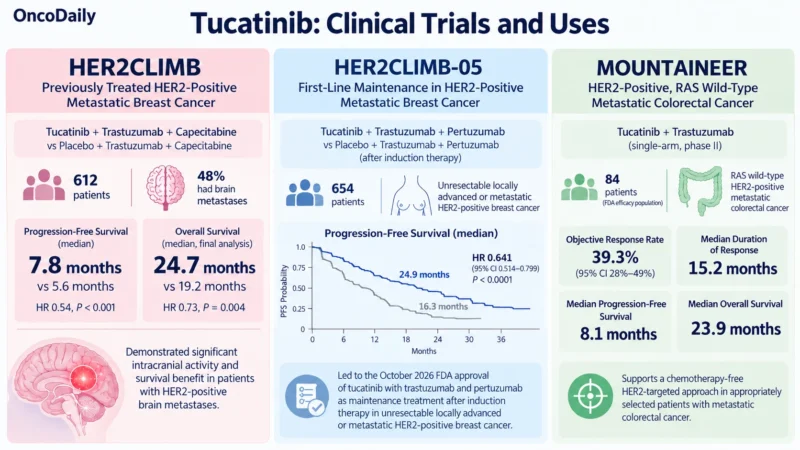
What Did the HER2CLIMB Trial Show?
HER2CLIMB was the pivotal randomized trial establishing tucatinib in previously treated HER2-positive metastatic breast cancer.
A total of:
612 patients
were enrolled.
Patients received:
Tucatinib + trastuzumab + capecitabine
or:
Placebo + trastuzumab + capecitabine.
Importantly, patients with:
- Treated stable brain metastases
- Active brain metastases
were eligible.
Progression-Free Survival
In the primary analysis:
1-Year PFS
- Tucatinib combination: 33.1%
- Control: 12.3%
Hazard ratio:
0.54
P < 0.001.
Median PFS:
- 7.8 months
- 5.6 months.
Overall Survival
At 2 years:
Tucatinib combination: 44.9%
Control: 26.6%
Hazard ratio for death:
0.66
P = 0.005.
Median OS:
- 21.9 months
- 17.4 months.
Final HER2CLIMB Overall Survival Analysis
With longer follow-up:
Median OS was:
- 24.7 months with tucatinib
- 19.2 months with control
Hazard ratio:
0.73
P = 0.004.
Median PFS was:
- 7.6 months
- 4.9 months
Hazard ratio:
0.57.
What About Brain Metastases?
This is one of the most important features of tucatinib.
In HER2CLIMB, approximately:
48%
of patients had brain metastases.
Among patients with brain metastases:
1-Year PFS
- Tucatinib combination: 24.9%
- Control: 0%
Median PFS:
- 7.6 months
- 5.4 months
Hazard ratio:
0.48.
These data were especially important because HER2CLIMB prospectively included patients with:
Active brain metastases, a population often excluded from older breast cancer trials.
Intracranial Activity
HER2CLIMB also demonstrated substantial intracranial activity.
Among patients with measurable brain metastases, the tucatinib-containing regimen produced clinically meaningful:
- Intracranial responses
- CNS progression delay
- Survival benefit
supporting tucatinib as a major CNS-active HER2 therapy.
What Did HER2CLIMB-05 Show?
HER2CLIMB-05 evaluated tucatinib earlier in the treatment pathway.
A total of:
654 patients
with HER2-positive unresectable locally advanced or metastatic breast cancer were randomized after successful induction therapy.
Patients received:
Tucatinib + trastuzumab + pertuzumab
or:
Placebo + trastuzumab + pertuzumab.
Median PFS
- Tucatinib arm: 24.9 months
- Control arm: 16.3 months
Hazard ratio:
0.641
95% CI:
0.514–0.799
P < 0.0001.
The PFS benefit was observed regardless of:
- Hormone receptor status
- Presence or absence of brain metastases.
Overall survival data were still immature at the primary analysis.
These findings led to the October 2026 FDA approval of tucatinib + trastuzumab + pertuzumab as maintenance therapy after induction.
What Did the MOUNTAINEER Trial Show?
MOUNTAINEER evaluated tucatinib + trastuzumab in:
HER2-positive, RAS wild-type metastatic colorectal cancer.
In the FDA efficacy population:
84 patients
received tucatinib + trastuzumab.
Objective Response Rate
38%
95% CI:
28%–49%.
Median Duration of Response
12.4 months
and:
81% of responders
maintained response for more than 6 months.
Final MOUNTAINEER Analysis
With longer follow-up:
Confirmed ORR
39.3%
Median Duration of Response
15.2 months
Median PFS
8.1 months
Median OS
23.9 months.
These results support a chemotherapy-free HER2-targeted approach in appropriately selected metastatic colorectal cancer.
Is Tucatinib FDA Approved?
Yes.
As of October 2026, FDA-approved uses include:
HER2-Positive Metastatic Breast Cancer
Tucatinib + trastuzumab + capecitabine
after at least one prior anti-HER2 regimen in the metastatic setting, including patients with brain metastases.
HER2-Positive Breast Cancer Maintenance
Tucatinib + trastuzumab + pertuzumab
after induction treatment for unresectable locally advanced or metastatic HER2-positive disease. This approval was granted on October 7, 2026.
HER2-Positive Colorectal Cancer
Tucatinib + trastuzumab
for RAS wild-type HER2-positive unresectable or metastatic colorectal cancer after fluoropyrimidine-, oxaliplatin-, and irinotecan-based therapy.
What Is the Current Clinical Role of Tucatinib in 2026?
Tucatinib has become one of the most important selective HER2 TKIs because of its:
- Strong systemic activity
- Prospective CNS efficacy
- HER2 selectivity
- Activity in both breast and colorectal cancer.
HER2-Positive Breast Cancer
Tucatinib historically became established through HER2CLIMB as a later-line regimen with:
trastuzumab + capecitabine
particularly in patients with:
brain metastases.
Its role expanded substantially in October 2026 with approval of:
tucatinib + trastuzumab + pertuzumab
as maintenance treatment after first-line induction.
This places tucatinib in both:
- Earlier maintenance therapy
- Later-line metastatic treatment.
HER2-Positive Colorectal Cancer
For RAS wild-type, HER2-positive metastatic colorectal cancer, tucatinib + trastuzumab provides:
Chemotherapy-free dual HER2 blockade
after standard chemotherapy, with durable responses demonstrated in MOUNTAINEER.
Read more: FDA Approves Tucatinib as Front-Line Maintenance in HER2-Positive Metastatic Breast Cancer — OncoDaily coverage of the October 2026 FDA approval of tucatinib with trastuzumab and pertuzumab after induction therapy
Watch more: OncoDaily discussion on targeted therapies in oncogene-driven cancers, relevant to HER2-directed TKIs such as tucatinib.
What Are the Major Side Effects of Tucatinib?
Common adverse effects depend partly on the combination regimen.
With tucatinib + trastuzumab + capecitabine, important adverse effects include:
- Diarrhea
- Palmar-plantar erythrodysesthesia
- Nausea
- Fatigue
- Vomiting
- Elevated ALT/AST
- Increased bilirubin
- Increased serum creatinine.
With tucatinib + trastuzumab in colorectal cancer, common adverse events include:
- Diarrhea
- Fatigue
- Rash
- Nausea
- Abdominal pain
- Infusion-related reactions
- Pyrexia.
Hepatotoxicity
Tucatinib can cause:
Severe hepatotoxicity.
ALT, AST, and bilirubin should be measured:
- Before treatment
- Every 3 weeks during therapy
- As clinically indicated.
The October 2026 FDA communication for the maintenance regimen notes that current prescribing information includes a:
Boxed warning for hepatotoxicity.
Diarrhea
Tucatinib may cause severe diarrhea.
Complications can include:
- Dehydration
- Hypotension
- Acute kidney injury
- Rare fatal outcomes.
In HER2CLIMB:
81% experienced diarrhea.
Grade 3 diarrhea occurred in:
12%.
The median time to first diarrhea episode was:
12 days.
Antidiarrheal treatment should be initiated as clinically indicated.
Increased Serum Creatinine
Tucatinib commonly increases serum creatinine through:
Inhibition of renal tubular creatinine transport
rather than true impairment of glomerular filtration.
The mean increase was approximately:
32% within 21 days.
If serum creatinine remains persistently elevated, consider another renal-function marker.
Embryo-Fetal Toxicity
Tucatinib can cause fetal harm.
Patients of reproductive potential should be counseled regarding:
- Pregnancy risk
- Effective contraception.
Breastfeeding is not recommended during treatment according to the prescribing information.
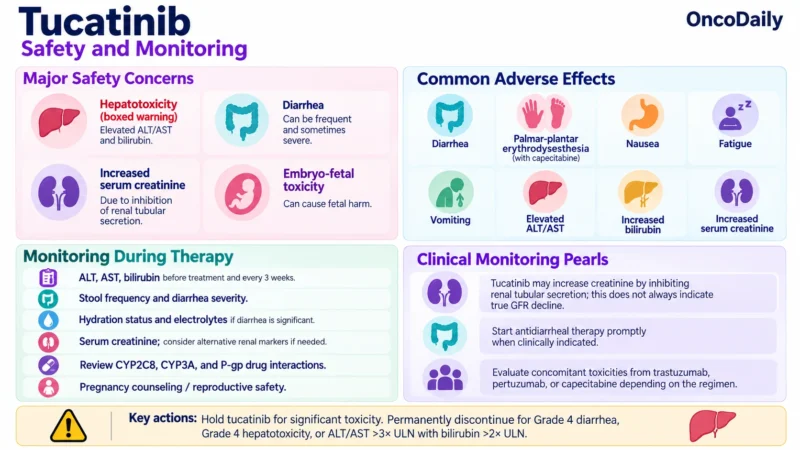
What Monitoring Is Required?
Monitoring during tucatinib treatment should include:
- ALT
- AST
- Bilirubin
- Liver tests before treatment and every 3 weeks
- Stool frequency
- Diarrhea severity
- Hydration status
- Electrolytes when diarrhea is significant
- Serum creatinine
- Alternative renal-function markers when clinically necessary
- CYP2C8 and CYP3A drug interactions
- P-gp substrate interactions
- Pregnancy status when appropriate
- Toxicities related to trastuzumab, pertuzumab, or capecitabine depending on the regimen.
FAQ
What Is Tucatinib Used For?
- HER2-positive locally advanced or metastatic breast cancer
- HER2-positive breast cancer requiring first-line maintenance therapy
- RAS wild-type HER2-positive metastatic colorectal cancer.
What Is the Standard Tucatinib Dose?
Can Tucatinib Be Taken With Food?
It can be taken:
With or without food.
How Does Tucatinib Work?
- HER2/HER3 phosphorylation
- MAPK signaling
- AKT signaling
- Tumor-cell proliferation.
What Did HER2CLIMB Show?
- Progression-free survival
- Overall survival
compared with trastuzumab + capecitabine alone.
Does Tucatinib Work in Brain Metastases?
HER2CLIMB provided strong prospective evidence of systemic and intracranial activity in patients with:
HER2-positive brain metastases, including active brain metastases.
What Did HER2CLIMB-05 Show?
16.3 to 24.9 months
HR 0.641.
What Did MOUNTAINEER Show?
- ORR 39.3%
- Median DoR 15.2 months
- Median PFS 8.1 months
- Median OS 23.9 months.
What Is the Most Important Monitoring Requirement?
Hepatotoxicity.
Why Can Creatinine Increase With Tucatinib?
Without a corresponding reduction in glomerular filtration.