


Trastuzumab (Herceptin): Mechanism of Action, Dosing, Clinical Uses, Trials, and Side Effects
Key takeaways
- Trastuzumab is a humanized HER2-directed monoclonal antibody.
- It inhibits HER2 signaling and promotes antibody-dependent cellular cytotoxicity.
- It received initial FDA approval in 1998.
- It transformed the prognosis of HER2-positive breast cancer.
- Common IV dosing is 8 mg/kg initially followed by 6 mg/kg every 3 weeks.
- HERA and NSABP B-31/N9831 established major adjuvant benefits.
- CLEOPATRA demonstrated improved survival with dual HER2 blockade.
- ToGA established trastuzumab's role in HER2-positive metastatic gastric cancer.
- Cardiomyopathy is a major dose-limiting concern.
- Regular cardiac monitoring is essential.
- Trastuzumab remains important in modern treatment despite the expansion of HER2-directed antibody-drug conjugates.
Trastuzumab (Herceptin) is a humanized monoclonal antibody targeting human epidermal growth factor receptor 2 (HER2/ERBB2), a transmembrane receptor involved in cellular proliferation, differentiation, and survival. By binding the extracellular domain of HER2, trastuzumab inhibits oncogenic signaling and promotes antibody-dependent cellular cytotoxicity, reducing the growth of HER2-positive tumor cells.
First approved by the FDA in 1998, trastuzumab transformed the treatment of HER2-positive breast cancer, a subtype historically associated with aggressive disease and poor outcomes. It subsequently became an established treatment for HER2-positive metastatic gastric and gastroesophageal junction (GEJ) adenocarcinoma.
Trastuzumab is administered intravenously, commonly using an initial dose of 8 mg/kg followed by 6 mg/kg every three weeks, although weekly schedules are also approved. Its clinical importance has been demonstrated in landmark studies including HERA, NSABP B-31/N9831, CLEOPATRA, and ToGA.
Key Facts
- Generic name: Trastuzumab
- Brand name: Herceptin
- Drug class: HER2-directed monoclonal antibody
- Antibody type: Humanized IgG1κ
- Molecular target: HER2/ERBB2
- Mechanism: Inhibition of HER2 signaling and antibody-dependent cellular cytotoxicity
- Initial FDA approval: 1998
- Administration: Intravenous infusion; separate subcutaneous trastuzumab–hyaluronidase formulation available
- Common three-weekly dose: 8 mg/kg loading, then 6 mg/kg every 3 weeks
- Weekly dose: 4 mg/kg loading, then 2 mg/kg weekly
- IV vial strength: 150 mg
- Main indications: HER2-positive early and metastatic breast cancer; HER2-positive metastatic gastric/GEJ adenocarcinoma
- Essential biomarker: HER2 overexpression or amplification
- Major adverse reactions: Infusion reactions, diarrhea, fatigue, nausea, and cardiac dysfunction
- Boxed warnings: Cardiomyopathy, infusion reactions, pulmonary toxicity, embryo-fetal toxicity
- Important monitoring: LVEF, infusion reactions, respiratory symptoms, pregnancy status
- Metabolism: Proteolytic catabolism
- Biosimilars: Multiple FDA-approved trastuzumab biosimilars are available
What Is Trastuzumab?
Trastuzumab is a recombinant humanized monoclonal antibody that selectively binds subdomain IV of the extracellular region of HER2.
HER2 belongs to the ERBB family of receptor tyrosine kinases. HER2 amplification or overexpression promotes tumor growth through activation of signaling pathways, including:
- PI3K–AKT–mTOR
- RAS–RAF–MEK–ERK
These pathways regulate cellular proliferation, survival, and resistance to apoptosis.
HER2-positive breast cancer is typically defined by IHC 3+ or HER2 gene amplification by in situ hybridization (ISH), according to established testing guidelines.
Trastuzumab is a naked monoclonal antibody and should not be confused with HER2-directed antibody-drug conjugates such as trastuzumab emtansine or trastuzumab deruxtecan.
What Is the Mechanism of Action of Trastuzumab?
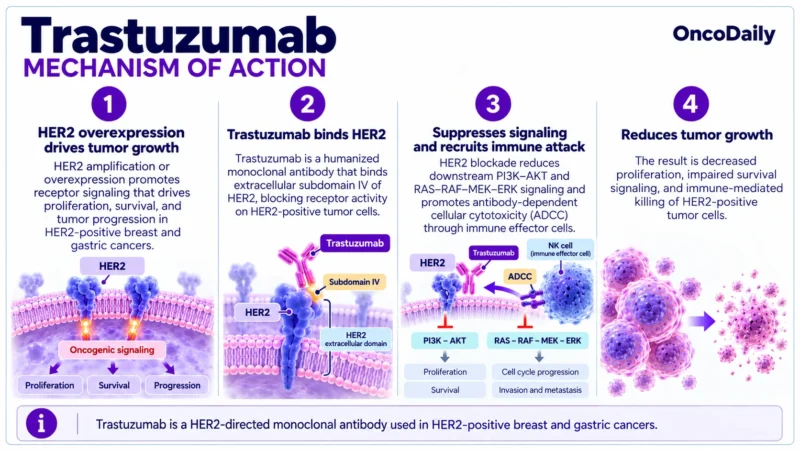
1. HER2 Overexpression Drives Tumor Growth
HER2 amplification increases receptor abundance on the tumor-cell surface.
This promotes HER2-containing receptor dimerization and activation of downstream growth and survival signaling.
2. Trastuzumab Binds HER2
Trastuzumab binds extracellular subdomain IV of HER2.
This interferes with HER2-mediated signaling and reduces tumor-cell proliferative activity.
3. Downstream Signaling Is Suppressed
Trastuzumab can inhibit HER2-dependent activation of intracellular pathways, particularly:
- PI3K–AKT
- RAS–RAF–MEK–ERK
The degree of pathway inhibition depends on tumor biology and resistance mechanisms.
4. Immune-Mediated Tumor-Cell Killing Occurs
The antibody’s Fc region recruits immune effector cells, including natural killer cells.
This promotes:
Antibody-dependent cellular cytotoxicity (ADCC).
5. Tumor Growth Is Reduced
The combined effects inhibit tumor-cell proliferation and promote immune-mediated elimination of HER2-positive malignant cells.
Overall mechanism:
Trastuzumab → HER2 binding → reduced oncogenic signaling + enhanced ADCC → decreased proliferation and tumor-cell survival.
What Is the Recommended Dose of Trastuzumab?
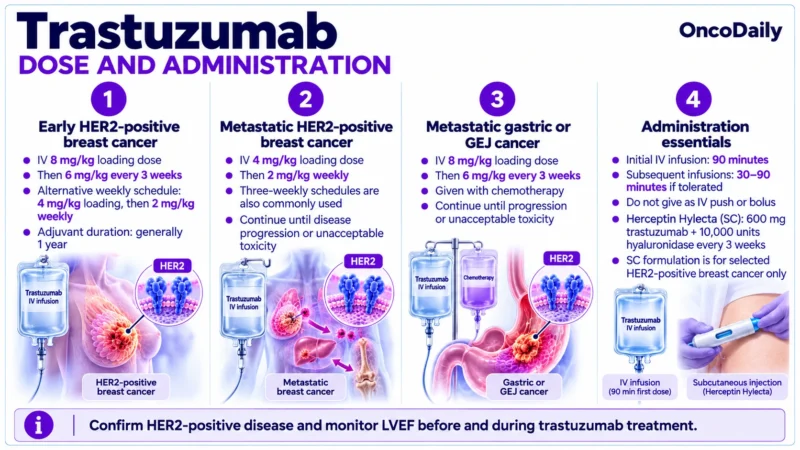
Early HER2-Positive Breast Cancer
Two commonly used intravenous schedules are available.
Three-Weekly Schedule
Loading dose: 8 mg/kg IV
followed by:
6 mg/kg IV every 3 weeks.
Total adjuvant treatment duration is generally:
52 weeks (1 year).
Weekly Schedule
Loading dose: 4 mg/kg IV
followed by:
2 mg/kg IV weekly
during the initial chemotherapy phase.
In the FDA-labeled adjuvant schedule, weekly dosing is administered for 12 weeks with paclitaxel or docetaxel, or 18 weeks with docetaxel/carboplatin, followed by three-weekly maintenance to complete one year.
Metastatic HER2-Positive Breast Cancer
The original FDA-labeled metastatic regimen uses:
4 mg/kg IV loading dose
followed by:
2 mg/kg IV weekly.
Three-weekly trastuzumab dosing is also widely used in contemporary combination regimens.
Treatment generally continues until disease progression or unacceptable toxicity.
Metastatic Gastric or GEJ Cancer
Recommended intravenous dose:
8 mg/kg loading dose
followed by:
6 mg/kg every 3 weeks.
Trastuzumab is administered with an appropriate chemotherapy backbone.
Treatment generally continues until disease progression or unacceptable toxicity.
How Should Trastuzumab Be Administered?
Intravenous Administration
Trastuzumab should be administered as a controlled intravenous infusion.
It must not be administered as an IV push or bolus.
Initial Infusion
Typically administered over:
90 minutes.
Subsequent Infusions
If the initial infusion is well tolerated, subsequent infusions may be administered over:
30–90 minutes.
Subcutaneous Trastuzumab
A separate formulation, Herceptin Hylecta (trastuzumab–hyaluronidase), is approved for selected adults with HER2-positive breast cancer.
Recommended dose:
600 mg trastuzumab + 10,000 units hyaluronidase
subcutaneously every three weeks.
Administration takes approximately:
2–5 minutes.
No loading dose is required.
The subcutaneous formulation is not approved for gastric cancer and must not be confused with intravenous trastuzumab.
Important Administration Precautions
- Confirm HER2-positive disease.
- Assess cardiac function before treatment.
- Monitor for infusion reactions.
- Use the correct formulation and route.
- Do not substitute trastuzumab for trastuzumab emtansine or trastuzumab deruxtecan.
What Should You Do If a Trastuzumab Dose Is Missed?
For intravenous trastuzumab:
Missed by One Week or Less
Administer the usual maintenance dose as soon as possible.
Continue subsequent doses at the recommended weekly or three-weekly interval.
Missed by More Than One Week
A repeat loading dose is generally required:
- Weekly regimen: 4 mg/kg
- Three-weekly regimen: 8 mg/kg
Resume maintenance dosing according to the intended schedule.
These instructions apply to the IV Herceptin label; separate formulations and combination products may have different missed-dose instructions.
How Are Trastuzumab Dose Modifications Managed?
Trastuzumab generally does not require stepwise dose reductions.
Management focuses on treatment interruption or discontinuation.
Cardiac Dysfunction
Withhold trastuzumab for at least four weeks if:
- LVEF decreases by 16 percentage points or more from baseline; or
- LVEF falls below the institutional lower limit of normal with an absolute decrease of 10 percentage points or more from baseline.
Treatment may resume if, within 4–8 weeks, LVEF returns to normal and the absolute decrease from baseline is no more than 15 percentage points.
Permanently discontinue for persistent LVEF decline lasting more than eight weeks or repeated treatment suspensions for cardiomyopathy.
Infusion-Related Reactions
- Mild/moderate: Reduce or temporarily interrupt infusion.
- Clinically significant dyspnea or hypotension: Interrupt infusion.
- Severe or life-threatening: Permanently discontinue.
What Drug Interactions Are Important With Trastuzumab?
Anthracyclines
The most important interaction is increased risk of cardiotoxicity with anthracycline-containing chemotherapy.
Concurrent exposure can substantially increase the risk of left ventricular dysfunction and heart failure.
Other Cardiotoxic Therapies
Additional cardiac monitoring may be necessary when trastuzumab is administered with treatments associated with cardiovascular toxicity.
Cytotoxic Chemotherapy
Combination chemotherapy may increase:
- Neutropenia
- Infection risk
- Gastrointestinal toxicity
- Fatigue
CYP450 Interactions
Trastuzumab is not primarily metabolized by CYP enzymes.
Conventional CYP-mediated drug interactions are therefore not a major concern.
Does Trastuzumab Require Dose Adjustment in Renal or Hepatic Impairment?
Renal Impairment
Trastuzumab is primarily eliminated through protein catabolism.
Routine dose adjustments are not established for mild or moderate renal impairment.
Clinical data in severe renal impairment remain limited.
Hepatic Impairment
Trastuzumab is not primarily cleared through hepatic CYP metabolism.
No standard hepatic dose-reduction algorithm is established.
Dose modifications of concomitant chemotherapy may still be necessary.
What Is the Pharmacokinetic Profile of Trastuzumab?
Half-Life
At steady state, trastuzumab has an elimination half-life of approximately:
28 days
although estimates vary by regimen, disease, and pharmacokinetic model.
Distribution
Distribution occurs primarily within vascular and extracellular compartments.
Metabolism
Trastuzumab undergoes:
Proteolytic catabolism
into peptides and amino acids.
Clearance
Clearance includes nonspecific antibody catabolism and target-related processes.
Persistence After Treatment
Trastuzumab may remain in circulation for several months after discontinuation.
This is relevant when considering subsequent anthracyclines and pregnancy planning.
What Are the Clinical Uses of Trastuzumab?
Early HER2-Positive Breast Cancer
Trastuzumab is a foundational component of adjuvant and neoadjuvant treatment for eligible HER2-positive breast cancer.
It reduces recurrence risk and improves survival when combined with appropriate systemic therapy.
In some settings, treatment includes dual HER2 blockade with pertuzumab.
Metastatic HER2-Positive Breast Cancer
Trastuzumab is used in combination with chemotherapy and other HER2-directed treatments.
Historically, trastuzumab with pertuzumab and a taxane established an important first-line treatment standard.
However, newer antibody-drug conjugate combinations have changed the metastatic treatment landscape.
Metastatic Gastric and GEJ Cancer
Trastuzumab is an established component of first-line treatment for eligible HER2-positive metastatic gastric or GEJ adenocarcinoma.
It may be combined with platinum/fluoropyrimidine chemotherapy.
For tumors expressing PD-L1 CPS ≥1, pembrolizumab with trastuzumab and chemotherapy is also an FDA-approved first-line strategy.
What Molecular Testing Is Required Before Trastuzumab?
HER2 Testing in Breast Cancer
HER2 status is assessed by:
- Immunohistochemistry (IHC)
- In situ hybridization (ISH)
HER2 positivity is generally established by IHC 3+ or gene amplification according to the applicable testing algorithm.
HER2-low disease is not an indication for trastuzumab monotherapy based on IHC 1+ or IHC 2+/ISH-negative status.
HER2 Testing in Gastric Cancer
HER2 testing uses gastric-specific interpretation criteria.
HER2 positivity generally requires IHC 3+ or IHC 2+ with amplification confirmed by ISH.
Additional Testing
For metastatic gastric/GEJ cancer, PD-L1 testing can guide eligibility for pembrolizumab-containing combination treatment.
Cardiac function should also be assessed before trastuzumab initiation.
What Did the Pivotal Clinical Trials Show?
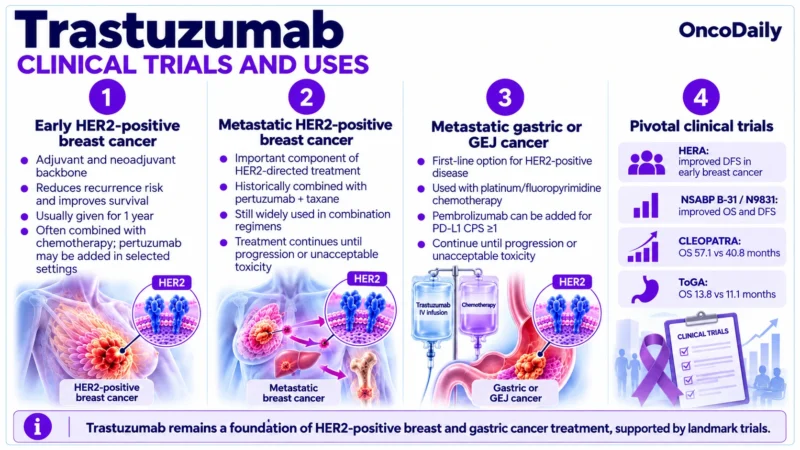
HERA — Adjuvant Trastuzumab in Early Breast Cancer
The phase III HERA trial evaluated trastuzumab following adjuvant chemotherapy in HER2-positive early breast cancer.
Ten-Year Disease-Free Survival
- One year of trastuzumab: 69%
- Observation: 63%
HR: 0.76
One year of trastuzumab significantly improved disease-free survival.
Extending treatment to two years did not provide additional disease-free survival benefit.
NSABP B-31 / NCCTG N9831 — Adjuvant Trastuzumab
The combined analysis evaluated adding trastuzumab to chemotherapy in early HER2-positive breast cancer.
A total of:
4,046 patients
were enrolled.
Ten-Year Overall Survival
- Trastuzumab + chemotherapy: 84.0%
- Chemotherapy alone: 75.2%
HR: 0.63
Ten-Year Disease-Free Survival
- Trastuzumab: 73.7%
- Control: 62.2%
HR: 0.60
These studies established a substantial survival advantage from adjuvant HER2-targeted therapy.
CLEOPATRA — Metastatic HER2-Positive Breast Cancer
CLEOPATRA evaluated:
- Pertuzumab + trastuzumab + docetaxel
- Placebo + trastuzumab + docetaxel
A total of:
808 patients
were randomized.
Final Median Overall Survival
- Pertuzumab combination: 57.1 months
- Control: 40.8 months
HR: 0.69
Eight-Year Overall Survival
- Pertuzumab combination: 37%
- Control: 23%
CLEOPATRA demonstrated the major survival benefit of dual HER2 blockade with trastuzumab and pertuzumab.
ToGA — HER2-Positive Metastatic Gastric Cancer
The phase III ToGA study evaluated trastuzumab plus chemotherapy versus chemotherapy alone in advanced HER2-positive gastric/GEJ cancer.
A total of:
594 patients
were randomized.
Median Overall Survival
- Trastuzumab + chemotherapy: 13.8 months
- Chemotherapy alone: 11.1 months
HR: 0.74
p = 0.0046
ToGA established trastuzumab as an important treatment for HER2-positive metastatic gastric cancer.
Does Trastuzumab Have CNS Activity?
Trastuzumab is a large monoclonal antibody with limited penetration across an intact blood–brain barrier.
Therefore, intravenous trastuzumab alone has limited direct CNS exposure.
In HER2-positive metastatic breast cancer with brain metastases, treatment may include other HER2-directed agents with established intracranial activity.
Examples include:
- Tucatinib-containing regimens
- Trastuzumab deruxtecan
- Appropriate CNS-directed radiotherapy or surgery when indicated
Trastuzumab remains a component of certain CNS-active systemic regimens but should not be considered an effective standalone CNS-directed treatment.
Is Trastuzumab FDA Approved?
Yes.
Trastuzumab was initially approved by the FDA in:
September 1998.
The reference product Herceptin is approved for selected adult patients with:
- HER2-positive adjuvant breast cancer
- HER2-positive metastatic breast cancer
- HER2-positive metastatic gastric or GEJ adenocarcinoma
A separate subcutaneous formulation, Herceptin Hylecta, is approved for selected HER2-positive breast cancer indications.
Multiple trastuzumab biosimilars are available, including:
- Ogivri
- Herzuma
- Ontruzant
- Trazimera
- Kanjinti
Product-specific labeling should be checked.
What Is the Current Clinical Role of Trastuzumab in 2026?
Early Breast Cancer
Trastuzumab remains a foundation of treatment for HER2-positive early breast cancer.
One year of anti-HER2 treatment remains a standard duration in many adjuvant settings.
Patients with residual invasive disease after neoadjuvant treatment may instead receive an appropriate post-neoadjuvant HER2-directed regimen.
Metastatic Breast Cancer
Trastuzumab remains an important treatment component, although antibody-drug conjugates have substantially changed the treatment landscape.
In December 2025, the FDA approved trastuzumab deruxtecan plus pertuzumab as a first-line treatment for unresectable or metastatic HER2-positive breast cancer.
This development means trastuzumab–pertuzumab–taxane should no longer be described as the only modern first-line standard.
Read more: Trastuzumab Deruxtecan Plus Pertuzumab Approved in EU for First-Line HER2-Positive Metastatic Breast Cancer by OncoDaily.
Watch more: Trastuzumab (Herceptin) & Pertuzumab (Perjeta) for HER2+ Breast Cancer: A Complete Guide.
Metastatic Gastric Cancer
Trastuzumab remains a central component of HER2-positive metastatic gastric cancer treatment.
In March 2025, pembrolizumab with trastuzumab and chemotherapy received traditional FDA approval for eligible tumors with PD-L1 CPS ≥1.
These developments demonstrate that HER2 blockade remains important even as immunotherapy and antibody-drug conjugates reshape treatment strategies.
What Are the Major Side Effects of Trastuzumab?
Cardiomyopathy
Cardiac dysfunction is one of the most important toxicities.
It may present as:
- Reduced LVEF
- Asymptomatic ventricular dysfunction
- Symptomatic heart failure
Risk is increased with anthracycline exposure.
Infusion-Related Reactions
Symptoms may include:
- Fever
- Chills
- Hypotension
- Dyspnea
- Rash
- Bronchospasm
Severe reactions, including anaphylaxis, may occur.
Pulmonary Toxicity
Rare but serious pulmonary complications include:
- Interstitial pneumonitis
- Acute respiratory distress syndrome
- Severe respiratory failure
New respiratory symptoms require prompt evaluation.
Gastrointestinal Toxicity
Common symptoms include:
- Diarrhea
- Nausea
- Vomiting
These may be more frequent when trastuzumab is combined with chemotherapy.
Hematologic Toxicity
Trastuzumab can exacerbate chemotherapy-associated neutropenia.
Monitor blood counts according to the combination regimen.
Embryo-Fetal Toxicity
Exposure during pregnancy may cause:
- Oligohydramnios
- Fetal renal complications
- Pulmonary hypoplasia
- Neonatal death
Pregnancy must be avoided during treatment.
Other Adverse Reactions
Additional reactions include:
- Fatigue
- Headache
- Rash
- Fever
- Infections
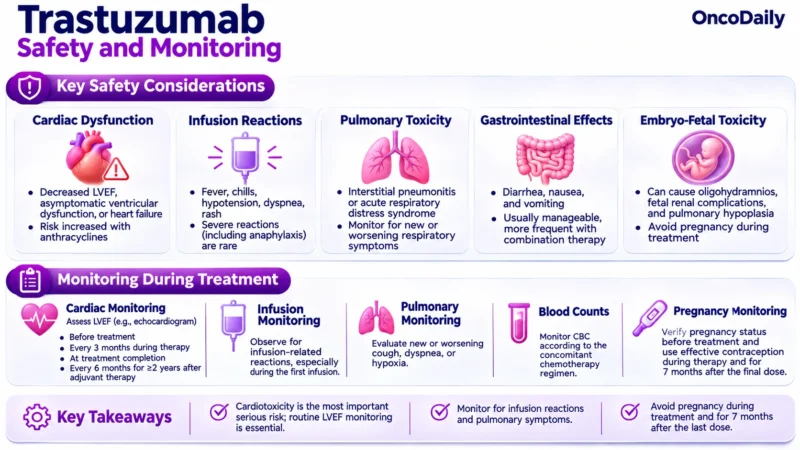
What Monitoring Is Required During Trastuzumab Treatment?
Cardiac Monitoring
Assess LVEF using echocardiography or another appropriate validated method.
Recommended monitoring includes:
- Before treatment
- Every 3 months during treatment
- At treatment completion
- Every 6 months for at least 2 years after completion of adjuvant therapy
The exact schedule may be individualized for metastatic disease and patients with additional cardiac risk factors.
Infusion Monitoring
Monitor for:
- Fever and chills
- Hypotension
- Dyspnea
- Hypersensitivity reactions
Close monitoring is particularly important during the first infusion.
Pulmonary Monitoring
Assess new or worsening:
- Cough
- Dyspnea
- Hypoxia
- Respiratory distress
Complete Blood Count
Monitor CBC according to the chemotherapy regimen, particularly when myelosuppressive agents are used.
Pregnancy Monitoring
Verify pregnancy status before treatment in females of reproductive potential.
Effective contraception is recommended during treatment and for:
7 months after the final dose.
Renal and Hepatic Monitoring
Routine organ-function assessment depends on the underlying disease and combination treatment.