


Trametinib (Mekinist): Understanding Its Mechanism, Dosing, Clinical Uses, and Role in BRAF V600–Mutated Cancers
Key takeaways
- Trametinib is an oral MEK1/MEK2 inhibitor.
- The standard adult dose is 2 mg orally once daily.
- It should be taken at least 1 hour before or 2 hours after food.
- Adult dose reductions generally follow 2 mg → 1.5 mg → 1 mg once daily.
- Trametinib is FDA approved as monotherapy for BRAF-inhibitor–naïve BRAF V600E/K melanoma, but is more commonly used with dabrafenib.
- METRIC demonstrated median PFS of approximately 4.8–4.9 months versus 1.5 months with chemotherapy.
- COMBI-d/COMBI-v showed a 5-year OS of 34% with dabrafenib + trametinib.
- COMBI-AD demonstrated durable relapse-free and distant-metastasis–free benefits after resection of BRAF-mutant stage III melanoma.
- Dabrafenib + trametinib is also approved in BRAF V600E NSCLC, ATC, tumor-agnostic solid tumors, and pediatric LGG.
- Important trametinib toxicities include cardiomyopathy, ocular toxicity, ILD/pneumonitis, hemorrhage, thromboembolism, colitis/perforation, severe skin reactions, and hyperglycemia.
- In 2026, trametinib is primarily understood as a component of dual BRAF/MEK inhibition, rather than as routine MEK-inhibitor monotherapy.
Trametinib (Mekinist) is an oral, selective inhibitor of MEK1 and MEK2, key kinases within the RAS–RAF–MEK–ERK/MAPK signaling pathway. By blocking MEK activation and downstream ERK signaling, trametinib suppresses tumor-cell proliferation and survival in cancers driven by MAPK-pathway activation.
Although trametinib is FDA approved as a single agent for BRAF-inhibitor–naïve patients with unresectable or metastatic BRAF V600E/K-mutated melanoma, its major contemporary role is in combination with dabrafenib. The dabrafenib/trametinib combination is FDA approved across several BRAF V600E-driven malignancies, including melanoma, metastatic NSCLC, anaplastic thyroid cancer, tumor-agnostic solid tumors, and pediatric low-grade glioma.
Key Facts
- Generic name: Trametinib
- Brand name: Mekinist
- Drug class: MEK1/MEK2 inhibitor
- Route: Oral
- Initial US approval: 2013
- Primary targets: MEK1 and MEK2
- Adult dose: 2 mg orally once daily
- Administration: At least 1 hour before or at least 2 hours after a meal
- Tablet strengths: 0.5 mg and 2 mg
- Additional formulation: Powder for oral solution
- Most common partner: Dabrafenib
- Major FDA indications: Melanoma, metastatic NSCLC, anaplastic thyroid cancer, BRAF V600E-positive solid tumors, pediatric low-grade glioma
- Important toxicities: Cardiomyopathy, hemorrhage, venous thromboembolism, ocular toxicity, ILD/pneumonitis, severe febrile reactions, serious skin toxicity, hyperglycemia, and GI perforation/colitis
- Current US status: FDA approved.
What Is Trametinib?
Trametinib is a small-molecule inhibitor of:
MEK1 and MEK2
also known as:
MAP2K1 and MAP2K2.
MEK1/2 are central components of the:
RAS → RAF → MEK → ERK
signaling cascade.
Normally, this pathway helps regulate:
- Cellular proliferation
- Differentiation
- Survival
- Migration
In BRAF V600-mutated tumors, constitutively active BRAF continuously stimulates MEK and ERK.
This persistent signaling contributes to uncontrolled malignant growth.
Trametinib interrupts the pathway downstream of BRAF.
What Is the Mechanism of Action of Trametinib?
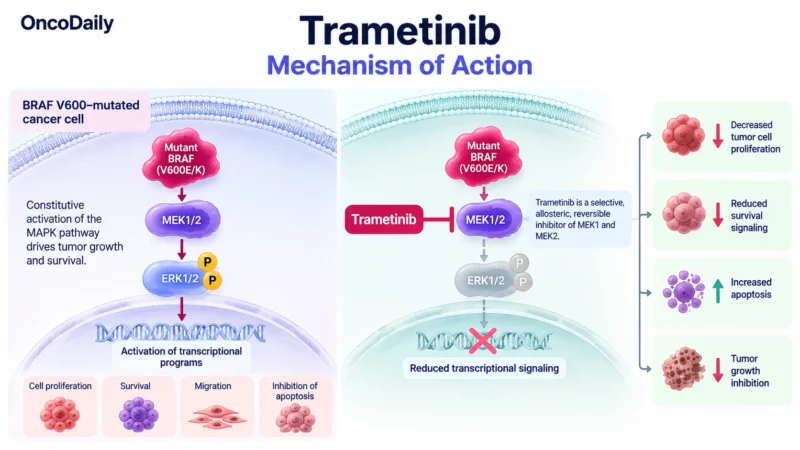
1. MAPK-Pathway Activation Drives Tumor Growth
Activating mutations such as:
BRAF V600E
or:
BRAF V600K
produce constitutive activation of BRAF.
Mutant BRAF continuously stimulates:
MEK1/2.
2. Activated MEK Phosphorylates ERK
MEK1/2 phosphorylate:
ERK1/2
which then regulate multiple transcriptional programs promoting:
- Cell-cycle progression
- Tumor-cell proliferation
- Survival
- Migration
- Resistance to apoptosis
3. Trametinib Selectively Inhibits MEK1 and MEK2
Trametinib is an:
Allosteric, reversible MEK1/2 inhibitor.
Unlike ATP-competitive kinase inhibitors, trametinib binds MEK at a site distinct from the ATP-binding pocket.
It inhibits both:
- MEK activation
- MEK kinase activity
thereby reducing phosphorylation of ERK.
4. ERK Signaling Is Suppressed
Reduced ERK activation decreases downstream transcriptional signaling associated with:
- Proliferation
- Growth
- Survival
5. Tumor Growth Is Reduced
The downstream effects include:
- Reduced tumor-cell proliferation
- Reduced survival signaling
- Increased apoptosis
- Tumor regression in MAPK-dependent cancers
The mechanism can be summarized as:
Trametinib → MEK1/2 inhibition → reduced ERK phosphorylation → MAPK-pathway suppression → decreased tumor-cell proliferation and survival.
Why Is Trametinib Commonly Combined With Dabrafenib?
Dabrafenib inhibits:
Mutant BRAF
while trametinib inhibits:
MEK1/2 downstream of BRAF.
Therefore:
Dabrafenib + trametinib
creates dual MAPK-pathway blockade.
This strategy helps:
- Produce deeper pathway suppression
- Delay MAPK reactivation
- Improve response durability
- Extend progression-free survival
- Improve overall survival
- Reduce some paradoxical BRAF-inhibitor–associated secondary skin tumors
The combination has become more clinically important than trametinib monotherapy in most BRAF V600-driven cancers.
What Is the Dose of Trametinib?
Adults
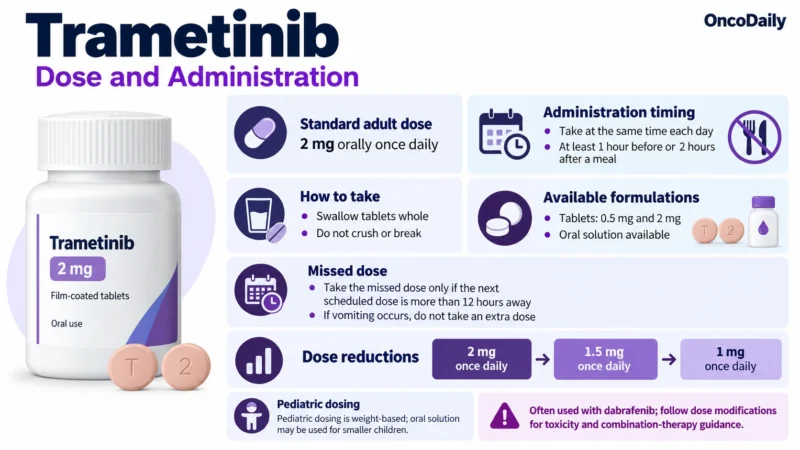
The recommended adult dose is:
2 mg orally once daily.
It should be taken approximately:
24 hours apart
at the same time each day.
Treatment continues until:
- Disease progression
- Unacceptable toxicity
depending on the indication.
How Should Trametinib Be Taken?
Trametinib should be taken:
At least 1 hour before or at least 2 hours after a meal.
Tablets should:
- Be swallowed whole
- Not be crushed
- Not be broken
The once-daily schedule should be maintained consistently.
What If a Dose Is Missed?
Do not take a missed dose if the next scheduled dose is due within:
12 hours.
If more than 12 hours remain, the missed dose may be taken.
If vomiting occurs after taking trametinib:
Do not take an additional dose.
Take the next dose at the scheduled time.
How Are Trametinib Dose Reductions Made?
For adults receiving:
2 mg once daily
the first dose reduction is:
1.5 mg once daily.
The second reduction is:
1 mg once daily.
If trametinib cannot be tolerated after the permitted dose reductions:
Permanently discontinue treatment.
Dose modification may be needed for:
- Cardiomyopathy
- Hemorrhage
- Venous thromboembolism
- Ocular toxicity
- ILD/pneumonitis
- Severe skin toxicity
- Pyrexia when used with dabrafenib
- Other Grade ≥3 adverse events
Pediatric Dosing
Trametinib is approved in selected pediatric BRAF V600E-positive indications beginning at:
1 year of age.
For tablets in patients weighing at least 26 kg:
- 26–37 kg: 1 mg once daily
- 38–50 kg: 1.5 mg once daily
- ≥51 kg: 2 mg once daily.
For smaller children or patients requiring finer weight-based dosing, an:
Oral solution
is available.
The oral solution allows dosing beginning at lower body weights according to the prescribing-information table.
What Formulations Are Available?
Trametinib is available as:
Tablets
- 0.5 mg
- 2 mg
Oral Solution
Mekinist powder for oral solution is reconstituted to provide:
0.05 mg/mL
and can be administered:
- Orally
- Through an appropriate feeding tube
after proper preparation.
Does Trametinib Require Renal or Hepatic Dose Adjustment?
Renal Impairment
No clinically meaningful pharmacokinetic effect has generally been observed in:
- Mild renal impairment
- Moderate renal impairment
Evidence is more limited in:
Severe renal impairment.
Hepatic Impairment
Mild hepatic impairment does not generally require routine dose adjustment.
Patients with moderate or severe hepatic impairment require additional caution because available evidence is limited and exposure may be altered.
What Is the Pharmacokinetic Profile of Trametinib?
Absorption
Trametinib is absorbed orally and reaches maximum plasma concentrations within several hours.
Food decreases trametinib exposure, which explains the recommendation to administer it:
At least 1 hour before or 2 hours after a meal.
Protein Binding
Trametinib is:
Highly protein bound.
Half-Life
Trametinib has a particularly long terminal half-life of approximately:
4–5 days.
This allows:
Once-daily dosing.
Metabolism
Unlike many TKIs, trametinib does not depend predominantly on CYP3A metabolism.
Its metabolism primarily involves:
- Deacetylation
- Oxidation
- Glucuronidation
Therefore, its interaction profile differs from that of dabrafenib.
What Are the Clinical Uses of Trametinib?
1. BRAF V600E/K-Mutated Unresectable or Metastatic Melanoma
Trametinib is FDA approved:
As a single agent
for BRAF-inhibitor–naïve patients with unresectable or metastatic melanoma harboring:
- BRAF V600E
- BRAF V600K
mutations.
It is also approved:
In combination with dabrafenib.
2. Adjuvant BRAF V600E/K-Mutated Melanoma
Trametinib plus dabrafenib is approved as:
Adjuvant therapy after complete resection
for melanoma with:
- BRAF V600E
- BRAF V600K
mutation and lymph-node involvement.
Treatment may continue for up to:
1 year
unless recurrence or unacceptable toxicity occurs.
3. BRAF V600E-Mutated Metastatic NSCLC
Trametinib plus dabrafenib is FDA approved for:
Metastatic NSCLC with BRAF V600E mutation.
4. BRAF V600E-Mutated Anaplastic Thyroid Cancer
The combination is approved for:
Locally advanced or metastatic BRAF V600E-mutated anaplastic thyroid cancer
when no satisfactory locoregional treatment options exist.
5. Tumor-Agnostic BRAF V600E-Positive Solid Tumors
Trametinib plus dabrafenib is approved for:
Adults and pediatric patients ≥1 year with unresectable or metastatic BRAF V600E-positive solid tumors
that:
- Progressed after previous treatment
- Have no satisfactory alternative treatment options
This indication remains:
Accelerated approval.
Important limitation:
The combination is not indicated for colorectal cancer because of intrinsic resistance to isolated BRAF/MEK pathway inhibition in CRC.
6. Pediatric BRAF V600E-Mutated Low-Grade Glioma
Trametinib plus dabrafenib is approved for:
Children aged 1 year and older with BRAF V600E-mutated low-grade glioma requiring systemic therapy.
What Did Trametinib Clinical Trials Show?
METRIC — Trametinib Monotherapy in Metastatic Melanoma
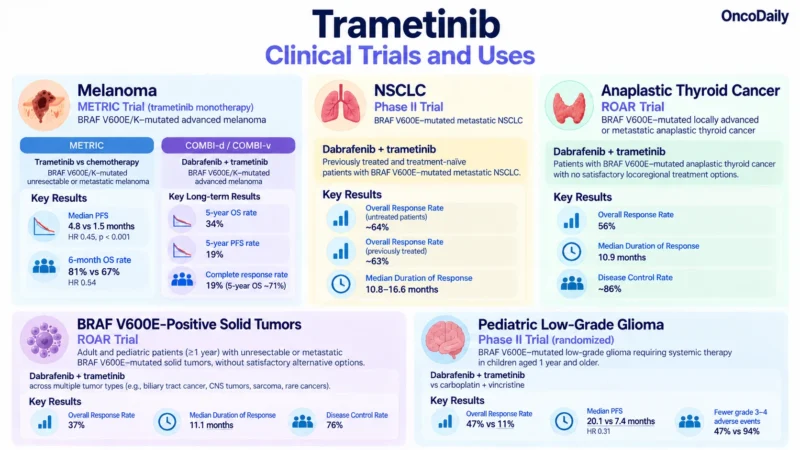
The phase III METRIC trial evaluated trametinib versus chemotherapy in patients with:
BRAF V600E/K-mutated unresectable or metastatic melanoma.
A total of:
322 patients
were randomized:
Trametinib: 214
Chemotherapy: 108.
Median Progression-Free Survival
Initial analysis showed:
- Trametinib: 4.8 months
- Chemotherapy: 1.5 months
Hazard ratio:
0.45
P < 0.001.
Overall Survival
At 6 months:
- Trametinib: 81%
- Chemotherapy: 67%
despite substantial crossover.
Hazard ratio for death:
0.54.
Long-term follow-up confirmed a median PFS of approximately:
- 4.9 months
- 1.5 months, respectively.
COMBI-d and COMBI-v — Dabrafenib + Trametinib
The major modern role of trametinib was established by studies combining it with dabrafenib.
Pooled long-term data from:
- COMBI-d
- COMBI-v
included:
563 patients
who received dabrafenib plus trametinib.
5-Year Progression-Free Survival
19%.
5-Year Overall Survival
34%.
Complete Responses
Complete response occurred in approximately:
19%
of patients.
Among patients achieving complete response:
5-year OS reached approximately 71%.
These results established dual BRAF/MEK inhibition as a major targeted strategy in BRAF V600-mutated advanced melanoma.
COMBI-AD — Adjuvant Melanoma
COMBI-AD evaluated:
Dabrafenib + trametinib for 1 year
versus placebo after complete resection of high-risk:
Stage III BRAF V600E/K-mutated melanoma.
At nearly 10 years of follow-up:
Relapse-Free Survival
Hazard ratio:
0.52.
Distant Metastasis-Free Survival
Hazard ratio:
0.56.
The overall survival analysis showed an approximately:
20% reduction in the risk of death
but did not cross the predefined threshold for statistical significance.
Among patients with:
BRAF V600E
there was a numerically stronger OS benefit.
BRAF V600E-Mutated NSCLC
The phase II study of dabrafenib plus trametinib included both:
- Previously treated
- Previously untreated
patients with metastatic BRAF V600E-mutated NSCLC.
In previously untreated patients:
36 patients
received:
- Dabrafenib 150 mg twice daily
- Trametinib 2 mg once daily.
The study demonstrated a high objective response rate and durable disease control, supporting the FDA-approved use of the combination.
The previously treated cohort likewise demonstrated substantial antitumor activity.
ROAR — Anaplastic Thyroid Cancer and Rare Tumors
The ROAR basket study evaluated dabrafenib plus trametinib across several BRAF V600E-mutated rare cancers.
In anaplastic thyroid cancer, the combination produced clinically meaningful and often rapid responses, establishing BRAF/MEK inhibition as an important treatment for this historically difficult-to-treat cancer. PubMed
Pediatric BRAF V600E-Mutated Low-Grade Glioma
A randomized phase II trial compared:
Dabrafenib + trametinib
with:
Carboplatin + vincristine
as first-line systemic therapy in pediatric BRAF V600-mutated low-grade glioma.
The targeted-therapy combination produced:
- Significantly more objective responses
- Longer progression-free survival
- A more favorable safety profile
than conventional chemotherapy.
Earlier pediatric studies also established weight-based trametinib dosing and showed activity both as monotherapy and in combination with dabrafenib.
Is Trametinib FDA Approved?
Yes.
Trametinib received its initial US approval in:
2013.
Current FDA-approved uses include:
As Single-Agent Therapy
- BRAF-inhibitor–naïve BRAF V600E/K-mutated unresectable or metastatic melanoma
With Dabrafenib
- Unresectable/metastatic BRAF V600E/K melanoma
- Adjuvant BRAF V600E/K melanoma
- BRAF V600E metastatic NSCLC
- BRAF V600E locally advanced/metastatic anaplastic thyroid cancer
- BRAF V600E unresectable/metastatic solid tumors
- Pediatric BRAF V600E low-grade glioma.
What Is the Current Clinical Role of Trametinib?
Melanoma
Trametinib monotherapy remains FDA approved, but modern practice generally favors:
BRAF + MEK combination therapy
when targeted treatment is selected.
Dabrafenib + trametinib provides more durable pathway blockade than either agent alone.
Immune checkpoint therapy also plays a central role in advanced melanoma, so sequencing depends on:
- Disease burden
- Symptoms
- LDH
- CNS involvement
- Prior immunotherapy
- Need for rapid tumor shrinkage
NSCLC
Trametinib is not used as isolated MEK inhibition in BRAF V600E NSCLC.
Its clinically established role is:
Trametinib + dabrafenib
for BRAF V600E-mutated metastatic NSCLC.
Read more: OncoDaily’s review of BRAF V600E-mutated NSCLC, including the role of dabrafenib + trametinib and how targeted therapy compares with immunotherapy in current practice.
Watch more: Explore OncoDaily’s discussion on targeted therapy in BRAF-driven cancers and the evolving role of BRAF/MEK combinations.
Anaplastic Thyroid Cancer
In BRAF V600E-mutated ATC, dabrafenib plus trametinib can produce rapid tumor regression and remains one of the most important targeted options available.
Pediatric Low-Grade Glioma
Trametinib has become particularly important in pediatric neuro-oncology.
For BRAF V600E-mutated LGG requiring systemic treatment:
Dabrafenib + trametinib
is an established molecularly targeted option for children aged:
1 year and older.
What Are the Major Side Effects of Trametinib?
When used as monotherapy, the most common adverse reactions include:
- Rash
- Diarrhea
- Lymphedema.
When combined with dabrafenib, common toxicities include:
- Pyrexia
- Nausea
- Rash
- Chills
- Diarrhea
- Vomiting
- Fatigue
- Headache
- Arthralgia
- Myalgia
- Peripheral edema.
Cardiomyopathy
Trametinib can reduce:
Left ventricular ejection fraction.
LVEF should be assessed:
- Before treatment
- Approximately 1 month after treatment begins
- Every 2–3 months thereafter.
Clinically significant cardiomyopathy may require:
- Treatment interruption
- Dose reduction
- Permanent discontinuation
Ocular Toxicity
Important ocular adverse effects include:
- Retinal vein occlusion
- Retinal pigment epithelial detachment
- Other visual disturbances
Any new visual symptoms require:
Prompt ophthalmologic evaluation.
For confirmed:
Retinal vein occlusion
trametinib should be:
Permanently discontinued.
Interstitial Lung Disease/Pneumonitis
Patients should be monitored for:
- New cough
- Dyspnea
- Hypoxia
- New pulmonary infiltrates
For unexplained new or worsening respiratory symptoms:
Withhold trametinib.
Confirmed treatment-related ILD/pneumonitis requires:
Permanent discontinuation.
Hemorrhage
Major hemorrhagic events can occur.
Patients should be assessed for:
- Gastrointestinal bleeding
- Intracranial hemorrhage
- Other clinically significant bleeding
Grade 4 hemorrhage generally requires:
Permanent discontinuation.
Venous Thromboembolism
Trametinib can increase the risk of:
- Deep-vein thrombosis
- Pulmonary embolism
Patients should be educated to report:
- Leg swelling
- Sudden chest pain
- Dyspnea
- Tachycardia
Life-threatening pulmonary embolism requires permanent discontinuation.
Colitis and Gastrointestinal Perforation
Although uncommon, trametinib can cause:
- Colitis
- Gastrointestinal perforation
Patients with:
- Severe abdominal pain
- Persistent diarrhea
- Peritoneal symptoms
require prompt evaluation.
Serious Febrile Reactions
When combined with dabrafenib:
Pyrexia is particularly characteristic.
Severe febrile reactions may be accompanied by:
- Rigors
- Dehydration
- Hypotension
- Renal impairment
Treatment interruption and supportive care may be necessary.
Serious Skin Toxicity
Trametinib can cause:
- Severe rash
- Secondary skin infection
- Severe cutaneous adverse reactions
Treatment should be permanently discontinued for:
- Severe cutaneous adverse reactions
- Grade 3–4 rash not improving adequately despite interruption.
Hyperglycemia
Trametinib can worsen:
Serum glucose control, particularly when used with dabrafenib.
Patients with:
- Diabetes
- Pre-existing hyperglycemia
should undergo glucose monitoring.
Hemophagocytic Lymphohistiocytosis
A rare but serious risk is:
Hemophagocytic lymphohistiocytosis (HLH).
If HLH is suspected:
Interrupt therapy.
If confirmed:
Discontinue trametinib.
What Monitoring Is Required?
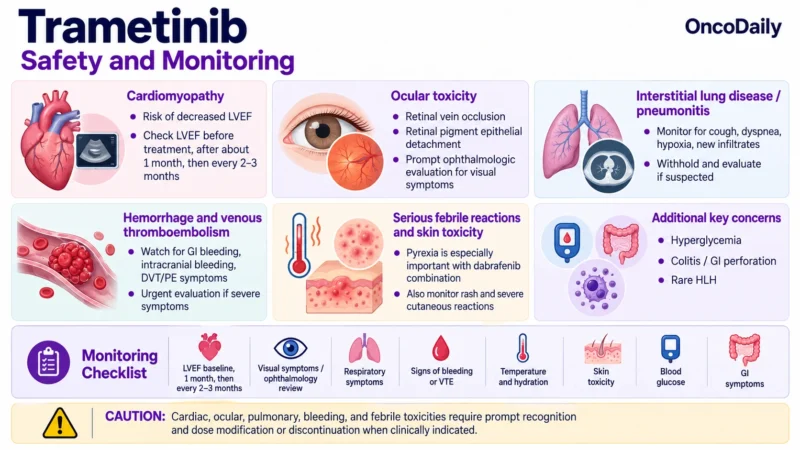
Monitoring during trametinib treatment should include:
- LVEF before treatment
- LVEF after approximately 1 month
- LVEF every 2–3 months thereafter
- Visual symptoms
- Ophthalmologic assessment when indicated
- Respiratory symptoms
- Signs of ILD/pneumonitis
- Signs of hemorrhage
- Signs of DVT/PE
- Skin toxicity
- Temperature when combined with dabrafenib
- Hydration status
- Blood glucose
- Liver tests as clinically appropriate
- GI symptoms suggesting colitis or perforation
- Symptoms suggesting HLH
Particular attention should be given to:
Cardiac function, ocular toxicity, respiratory symptoms, bleeding, thromboembolism, fever, and skin toxicity.
FAQ
What Is Trametinib Used For?
What Is the Standard Adult Dose?
Should Trametinib Be Taken With Food?
Take trametinib at least 1 hour before or at least 2 hours after a meal.
What Are the Adult Dose Reductions?
2 mg → 1.5 mg → 1 mg once daily.
How Does Trametinib Work?
Why Is Trametinib Combined With Dabrafenib?
What Did METRIC Show?
- 4.8 months with trametinib
- 1.5 months with chemotherapy.
Is Trametinib Used in NSCLC?
BRAF V600E-mutated metastatic NSCLC.
Is Trametinib Used in Children?
What Are the Most Important Safety Concerns?
Cardiomyopathy, retinal toxicity, ILD/pneumonitis, hemorrhage, VTE, severe skin reactions, pyrexia, and hyperglycemia.