





Toremifene (Fareston): Mechanism of Action, Dosing, Clinical Uses, Trials, and Side Effects
Key takeaways
- Toremifene is a selective estrogen receptor modulator used for metastatic breast cancer in postmenopausal women.
- The standard FDA-approved dose is 60 mg orally once daily.
- Its mechanism involves competitive estrogen receptor binding and suppression of estrogen-dependent tumor proliferation.
- The North American, Eastern European, and Nordic trials demonstrated efficacy broadly comparable with tamoxifen.
- Toremifene's primary metabolic pathway involves CYP3A4.
- QT prolongation is the major distinguishing safety risk and carries an FDA boxed warning.
- Cardiac risk assessment, electrolyte monitoring, gynecological surveillance, and medication review are essential.
Toremifene (Fareston) is a nonsteroidal selective estrogen receptor modulator (SERM) used in the treatment of metastatic breast cancer in postmenopausal women. It competitively binds estrogen receptors, inhibiting estrogen-dependent tumor-cell proliferation while exerting tissue-specific estrogen agonist or antagonist effects.
Toremifene is structurally related to tamoxifen but contains an additional chlorine atom in its triphenylethylene structure. Both drugs act primarily as estrogen antagonists in breast tissue.
Unlike aromatase inhibitors, which suppress estrogen synthesis, toremifene acts directly at the estrogen receptor. It is metabolized predominantly through CYP3A4 into N-demethyltoremifene and other metabolites.
The FDA first approved toremifene in 1997 for metastatic breast cancer in postmenopausal women with estrogen receptor-positive or estrogen receptor-unknown tumors.
Randomized trials demonstrated broadly comparable efficacy between toremifene and tamoxifen in this population. However, toremifene carries a clinically important boxed warning for QT prolongation, making cardiac risk assessment and medication review essential.
As of November 2026, its FDA-approved use remains limited to metastatic breast cancer in postmenopausal women.
Key Facts
- Generic name: Toremifene citrate
- Brand name: Fareston
- Drug class: Selective estrogen receptor modulator (SERM)
- Drug type: Nonsteroidal endocrine therapy
- Molecular target: Estrogen receptors, primarily ERα
- Mechanism: Competitive estrogen receptor binding and inhibition of estrogen-dependent breast cancer growth
- Initial FDA approval: 1997
- Administration: Oral
- Recommended dose: 60 mg once daily
- Available strength: 60 mg tablet
- Treatment duration: Until disease progression or unacceptable toxicity
- FDA indication: Metastatic breast cancer in postmenopausal women with ER-positive or ER-unknown tumors
- Principal clinical studies: North American, Eastern European, and Nordic randomized trials
- Important metabolic enzyme: CYP3A4
- Major metabolite: N-demethyltoremifene
- Boxed warning: QT prolongation and risk of torsades de pointes
- Major risks: QT prolongation, hepatotoxicity, uterine abnormalities, hypercalcemia, and thromboembolism
- Monitoring: ECG when indicated, potassium, magnesium, liver function, calcium, CBC, and gynecological evaluation
- Elimination half-life: Approximately five days
- Steady state: Approximately four to six weeks
What Is Toremifene?
Toremifene is a triphenylethylene-derived SERM with estrogen antagonist activity in breast tissue.
Estrogen receptor-positive breast cancers rely partly on estrogen-mediated transcriptional signaling to support proliferation and survival.
When estrogen binds ERα, the receptor regulates the transcription of genes involved in cell-cycle progression and tumor growth.
Toremifene competes with estrogen for receptor binding and alters estrogen receptor-mediated transcription.
The resulting reduction in estrogen-dependent signaling may inhibit tumor proliferation and produce disease regression or stabilization.
However, toremifene is not a pure estrogen antagonist.
Like tamoxifen, it may exhibit estrogen-like activity in selected tissues, including the endometrium and bone.
These tissue-dependent effects explain several therapeutic and adverse properties.
How Does Toremifene Differ From Tamoxifen?
Both are SERMs with similar breast-directed antiestrogenic activity.
Important differences include:
- Toremifene: Standard dose 60 mg daily; primarily metabolized through CYP3A4; carries an FDA boxed warning for QT prolongation.
- Tamoxifen: Standard dose 20 mg daily; CYP2D6-mediated endoxifen formation is important; has broader approved applications, including adjuvant treatment and breast cancer risk reduction.
Toremifene and tamoxifen should not be considered automatically interchangeable across all treatment settings.
What Is the Mechanism of Action of Toremifene?
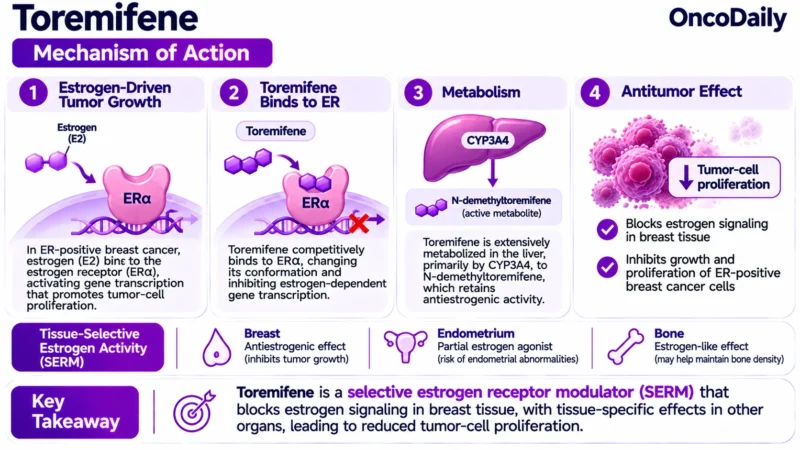
1. Estrogen Receptor Activation
Estradiol binds estrogen receptors in hormone-sensitive breast cancer cells.
Activated estrogen receptors regulate transcription of genes that promote cell proliferation and survival.
2. Competitive Estrogen Receptor Binding
Toremifene competes with estradiol for binding to estrogen receptors, particularly ERα.
3. Inhibition of Estrogen-Dependent Transcription
Binding induces receptor conformational changes and alters interactions with transcriptional coregulators.
In breast tissue, this predominantly suppresses estrogen-dependent gene expression.
4. Reduced Tumor-Cell Proliferation
Inhibition of estrogen receptor signaling reduces the proliferative stimulus in hormone-sensitive malignant cells.
This may lead to tumor regression or disease stabilization.
5. Hepatic Metabolism
Toremifene is extensively metabolized by CYP3A4, principally to N-demethyltoremifene.
This metabolite retains antiestrogenic activity but has relatively weak antitumor activity in vivo.
6. Tissue-Selective Estrogen Activity
Toremifene may demonstrate partial estrogen agonist activity outside breast tissue.
This contributes to its effects on bone and reproductive tissues but may also cause endometrial abnormalities.
7. Endocrine Antitumor Activity
Continued estrogen receptor modulation suppresses hormone-driven tumor growth in responsive metastatic breast cancers.
Overall mechanism:
Toremifene → estrogen receptor binding → inhibition of estrogen-dependent transcription → reduced cell-cycle signaling → decreased tumor proliferation → disease control.
Watch More: SERMs Antineoplastic Drugs for Cancer.
What Is the Recommended Dose of Toremifene?
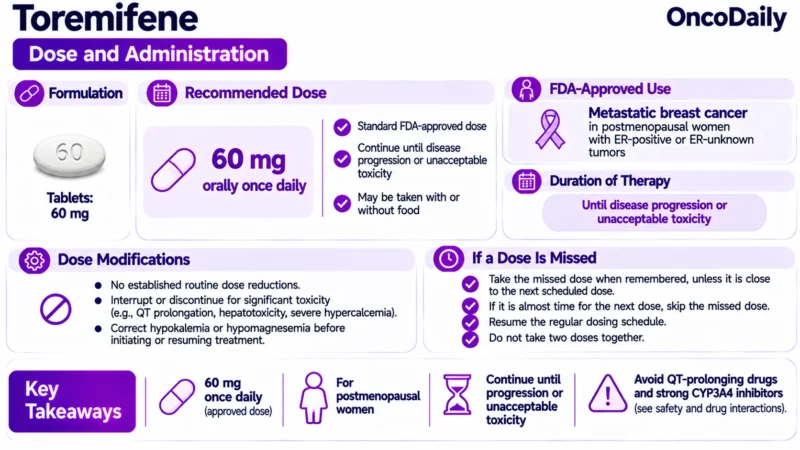
Standard Adult Dose
The FDA-approved dose is:
60 mg orally once daily.
Treatment generally continues until disease progression or unacceptable toxicity.
Postmenopausal Metastatic Breast Cancer
For women with ER-positive or ER-unknown metastatic breast cancer:
Toremifene 60 mg once daily.
The medication can be taken with or without food.
Duration of Treatment
There is no predetermined treatment duration.
Therapy is continued while the patient derives clinical benefit and tolerates treatment.
Higher Doses
Clinical studies evaluated toremifene at 200–240 mg daily.
However, higher doses did not establish a clinically meaningful advantage over standard-dose toremifene.
Doses above 60 mg daily are not recommended as routine FDA-approved treatment.
Higher exposure is also relevant because QT prolongation is dose- and concentration-dependent.
Early-Stage Breast Cancer
Toremifene has been investigated as adjuvant endocrine therapy.
However, it is not FDA-approved for adjuvant treatment of early-stage breast cancer.
Premenopausal Breast Cancer
Toremifene is not FDA-approved for routine treatment of premenopausal breast cancer.
Its labeled indication is restricted to postmenopausal women.
These dosing recommendations follow the U.S. prescribing information.
How Should Toremifene Be Administered?
Oral Administration
Toremifene is taken orally once daily.
It may be administered with or without food.
Patients should take the medication at approximately the same time each day.
Available Formulation
Fareston is supplied as a 60 mg oral tablet.
Each tablet contains 88.5 mg of toremifene citrate, equivalent to 60 mg of toremifene.
Before Starting Treatment
Evaluate:
- Cardiac history and QT-prolongation risk
- Potassium and magnesium
- Concomitant medications
- Hepatic function
- Gynecological history
- Thromboembolic history
Obtain a baseline ECG in patients at increased risk.
Treatment Adherence
Daily adherence is important for maintaining endocrine suppression.
Patients should report adverse effects that interfere with treatment rather than independently discontinuing therapy.
What Should You Do If a Toremifene Dose Is Missed?
If a dose is missed:
- Take it when remembered unless the next scheduled dose is approaching.
- If nearly time for the next dose, skip the missed dose.
- Continue the regular dosing schedule.
- Do not take two doses together.
Repeated missed doses should prompt discussion of adherence and tolerability.
How Are Toremifene Dose Modifications Managed?
Toremifene does not have a standardized toxicity-based dose-reduction algorithm.
Significant adverse reactions generally require treatment interruption, reassessment, or discontinuation rather than routine dose reduction.
QT Prolongation
If clinically significant QT prolongation develops, interrupt treatment and investigate reversible causes.
Evaluate electrolyte abnormalities, interacting medications, and underlying cardiac disease.
Patients with congenital or acquired long QT syndrome should not receive toremifene.
Hypokalemia or Hypomagnesemia
Correct low potassium or magnesium before treatment.
Persistent or severe electrolyte abnormalities require further evaluation before continuing therapy.
Hepatotoxicity
Clinically significant liver dysfunction may require treatment interruption or discontinuation.
Hypercalcemia
Hypercalcemia can occur, particularly in patients with bone metastases.
Severe hypercalcemia requires appropriate treatment and discontinuation of toremifene.
Uterine Abnormalities
Abnormal uterine bleeding or suspected endometrial pathology requires prompt gynecological evaluation.
Venous Thromboembolism
Patients with a history of thromboembolic disease should generally not receive toremifene.
A new thromboembolic event requires urgent assessment and reconsideration of endocrine therapy.
What Drug Interactions Are Important With Toremifene?
QT-Prolonging Medications
Concomitant QT-prolonging drugs should be avoided.
Examples include selected:
- Antiarrhythmics, such as amiodarone and sotalol
- Antibiotics, including macrolides and fluoroquinolones
- Antipsychotics
- Antidepressants
- Antiemetics, including certain 5-HT3 antagonists
The actual risk depends on the specific drug, exposure, electrolyte balance, and cardiac history.
Strong CYP3A4 Inhibitors
Strong CYP3A4 inhibitors can increase toremifene exposure and potentially exacerbate QT prolongation.
Examples include:
- Ketoconazole
- Itraconazole
- Clarithromycin
- Ritonavir-containing regimens
Avoid these combinations whenever possible.
In a pharmacokinetic interaction study, ketoconazole increased toremifene AUC approximately 2.9-fold.
Strong CYP3A4 Inducers
Strong CYP3A4 inducers may reduce toremifene exposure.
Examples include:
- Rifampin
- Carbamazepine
- Phenytoin
- Phenobarbital
Avoid combinations that may substantially reduce treatment exposure.
Warfarin and Phenytoin
Toremifene is a weak CYP2C9 inhibitor.
Concomitant use with narrow-therapeutic-index CYP2C9 substrates, including warfarin and phenytoin, requires careful monitoring.
Thiazide Diuretics
Thiazides may reduce renal calcium excretion and increase hypercalcemia risk.
Grapefruit Products
Grapefruit may inhibit intestinal CYP3A4 and increase toremifene exposure.
Avoid grapefruit products during treatment.
Does Toremifene Require Dose Adjustment in Renal or Hepatic Impairment?
Renal Impairment
Toremifene pharmacokinetics are generally comparable between patients with normal and impaired renal function.
Routine dose adjustment is not generally required.
However, clinical monitoring remains necessary in patients with substantial renal dysfunction or electrolyte abnormalities.
Hepatic Impairment
Toremifene is extensively metabolized in the liver.
In a small pharmacokinetic study, hepatic impairment increased its elimination half-life by less than twofold.
No established hepatic dose-reduction algorithm is available.
Use caution in hepatic impairment, particularly because increased drug exposure may also increase QT-prolongation risk.
What Is the Pharmacokinetic Profile of Toremifene?
Absorption
Toremifene is well absorbed after oral administration.
Peak plasma concentrations occur within approximately three hours.
Food does not meaningfully affect absorption.
Distribution
Toremifene is extensively distributed into tissues.
Its apparent volume of distribution is approximately 580 L.
Protein binding exceeds 99.5%, predominantly to albumin.
Metabolism
Toremifene is extensively metabolized in the liver, primarily through CYP3A4.
Its principal metabolite is N-demethyltoremifene.
Elimination Half-Life
Approximately five days.
N-demethyltoremifene has an elimination half-life of approximately six days.
Steady State
Steady-state concentrations are generally achieved within four to six weeks.
Excretion
Toremifene is eliminated mainly as metabolites through the fecal route.
A smaller proportion is excreted in urine.
Cardiac Electrophysiology
Toremifene prolongs QTc in a concentration-dependent manner.
In a thorough QT study, the placebo-adjusted mean QTc increase was approximately:
- 20 mg: 7 milliseconds
- 80 mg: 26 milliseconds
- 300 mg: 65 milliseconds
These findings support the FDA boxed warning.
What Are the Clinical Uses of Toremifene?
Metastatic ER-Positive Breast Cancer
Toremifene is FDA-approved for metastatic breast cancer in postmenopausal women with ER-positive disease.
Its primary therapeutic effect is suppression of estrogen-dependent tumor proliferation.
Metastatic Breast Cancer With Unknown ER Status
The U.S. label also includes postmenopausal women with ER-unknown tumors.
However, contemporary practice strongly favors obtaining hormone receptor status whenever feasible.
Alternative Endocrine Treatment
Toremifene may be considered in selected patients when established endocrine options are unsuitable.
In modern metastatic HR-positive/HER2-negative breast cancer, preferred initial regimens frequently combine endocrine therapy with targeted agents, particularly CDK4/6 inhibitors.
Toremifene should therefore not be presented as a preferred first-line regimen in contemporary practice.
Adjuvant Breast Cancer — Investigational or Off-Label
Toremifene has been studied following surgery for early-stage breast cancer.
Some randomized studies found outcomes broadly comparable with tamoxifen.
However, adjuvant treatment is not an FDA-approved indication.
Breast Cancer Prevention
Toremifene is not FDA-approved for primary breast cancer risk reduction or DCIS risk reduction.
What Molecular Testing Is Required Before Toremifene?
Estrogen Receptor Testing
ER status should be established using immunohistochemistry whenever tissue is available.
ER-positive tumors are most likely to benefit from endocrine treatment.
Although the label includes ER-unknown disease, routine treatment selection should not bypass accessible biomarker testing.
Progesterone Receptor Testing
PR testing provides additional information about endocrine responsiveness and tumor biology.
HER2 Testing
HER2 status is essential for broader metastatic breast cancer treatment planning.
It helps determine whether HER2-directed treatment is indicated.
Molecular Profiling
Modern metastatic breast cancer evaluation may include:
- ESR1 mutations
- PIK3CA mutations
- AKT1 alterations
- PTEN alterations
- Germline BRCA1/2 testing when appropriate
These biomarkers guide other endocrine-targeted or precision treatment options.
They are not specific prerequisites for toremifene.
Baseline Cardiac Assessment
Assess QT-prolongation risk, including medical history, medication exposure, and electrolyte abnormalities.
An ECG is recommended at baseline for patients at increased risk.
What Did the Pivotal Clinical Trials Show?
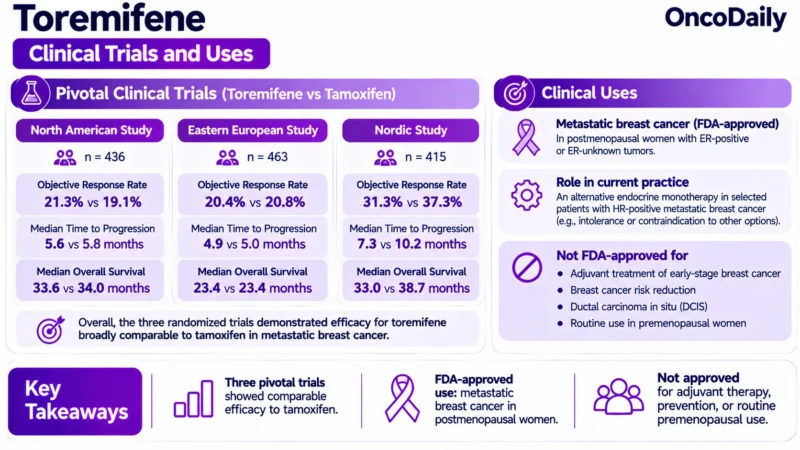
Three major randomized studies formed the principal efficacy evidence supporting toremifene’s approval. The results below reflect the 60 mg approved dose, compared with tamoxifen.
1. North American Randomized Study — Toremifene Versus Tamoxifen
This randomized trial evaluated toremifene 60 mg daily versus tamoxifen 20 mg daily in postmenopausal women with ER-positive or ER-unknown metastatic breast cancer.
The principal comparison included 436 patients.
Objective Response Rate
- Toremifene: 21.3%
- Tamoxifen: 19.1%
Median Time to Progression
- Toremifene: 5.6 months
- Tamoxifen: 5.8 months
Median Overall Survival
- Toremifene: 33.6 months
- Tamoxifen: 34.0 months
The study demonstrated similar antitumor activity and survival outcomes between the treatments, without evidence of clinically meaningful superiority for toremifene.
2. Eastern European Study — Toremifene Dose Comparison Versus Tamoxifen
This randomized phase III study enrolled 463 patients across three arms:
- Toremifene 60 mg daily
- Toremifene 240 mg daily
- Tamoxifen 40 mg daily
The comparison of the approved 60 mg dose against tamoxifen involved 306 patients.
Objective Response Rate
- Toremifene 60 mg: 20.4%
- Tamoxifen 40 mg: 20.8%
Median Time to Progression
- Toremifene: 4.9 months
- Tamoxifen: 5.0 months
Median Overall Survival
- Toremifene: 25.4 months
- Tamoxifen: 23.4 months
The study found comparable efficacy between the standard-dose treatments.
Increasing the toremifene dose did not demonstrate a statistically significant advantage.
3. Nordic Randomized Phase III Study — Toremifene Versus Tamoxifen
This double-blind randomized study enrolled 415 postmenopausal women with advanced breast cancer.
Patients received toremifene 60 mg or tamoxifen 40 mg daily.
Objective Response Rate
- Toremifene: 31.3%
- Tamoxifen: 37.3%
P = 0.215
Median Time to Progression
- Toremifene: 7.3 months
- Tamoxifen: 10.2 months
Median Overall Survival
- Toremifene: 33.0 months
- Tamoxifen: 38.7 months
The Nordic study numerically favored tamoxifen in time to progression, but the overall regulatory evidence from the three studies supported toremifene as an effective endocrine therapy for the approved population.
Overall Interpretation of the Trials
The three pivotal comparisons showed response rates of approximately 20–31% with toremifene 60 mg, broadly comparable to tamoxifen.
A subsequent Cochrane systematic review found no clear overall difference in efficacy between the drugs in advanced breast cancer.
These were historical endocrine monotherapy trials and should not be interpreted as evidence of equivalence to modern endocrine-targeted combinations.
Does Toremifene Have CNS Activity?
Toremifene is not a CNS-directed treatment.
There is insufficient prospective evidence establishing clinically meaningful intracranial efficacy against breast cancer brain metastases.
Patients with CNS metastases should receive individualized treatment based on neurological symptoms, molecular subtype, disease burden, and available local or systemic treatments.
Toremifene is not approved for primary CNS malignancies.
Is Toremifene FDA Approved?
Yes.
Toremifene was initially approved in the United States in 1997.
Its FDA-approved indication is:
Metastatic breast cancer in postmenopausal women with estrogen receptor-positive or estrogen receptor-unknown tumors.
It is not FDA-approved for adjuvant breast cancer treatment, breast cancer prevention, DCIS, or routine premenopausal breast cancer treatment.
What Is the Current Clinical Role of Toremifene in 2026?
Toremifene remains an approved endocrine therapy but has a relatively limited role in modern breast cancer management.
For postmenopausal patients with HR-positive metastatic disease, treatment selection is now strongly influenced by previous endocrine exposure, resistance mechanisms, molecular biomarkers, targeted treatment availability, and comorbidities.
Toremifene may be considered as an alternative endocrine monotherapy in selected circumstances.
However, its boxed QT-prolongation warning may make it unsuitable for patients with cardiovascular risk factors, electrolyte abnormalities, or unavoidable QT-prolonging medications.
Unlike tamoxifen, toremifene does not have broad FDA-approved adjuvant or risk-reduction indications.
Read More: ESMO 2026 Metastatic Breast Cancer Guideline: Biomarker-Driven Therapy Reshapes Treatment Across Subtypes by OncoDaily.
What Are the Major Side Effects of Toremifene?
QT Prolongation and Torsades de Pointes
QT prolongation is the most important distinguishing safety concern of toremifene.
Toremifene prolongs ventricular repolarization in a dose- and concentration-dependent manner.
Severe QT prolongation may result in torsades de pointes, syncope, seizures, or sudden cardiac death.
Risk increases with:
- Congenital or acquired long QT syndrome
- Hypokalemia or hypomagnesemia
- Concurrent QT-prolonging medications
- Strong CYP3A4 inhibitors
- Significant hepatic impairment
- Underlying cardiac disease
Toremifene carries an FDA boxed warning for QT prolongation.
Vasomotor Symptoms
Hot flashes and increased sweating are among the most frequently reported adverse effects.
These symptoms reflect estrogen receptor modulation.
Gastrointestinal Effects
Patients may experience nausea, vomiting, and constipation.
Symptoms are usually manageable but can affect adherence.
Vaginal Discharge and Gynecological Effects
Toremifene may cause vaginal discharge, uterine bleeding, and other gynecological symptoms.
Endometrial Abnormalities
Because of partial estrogen agonist activity in the uterus, toremifene has been associated with:
- Endometrial hyperplasia
- Endometrial polyps
- Endometrial thickening
- Endometrial cancer
Patients require appropriate gynecological surveillance and prompt evaluation of abnormal bleeding.
Hypercalcemia and Tumor Flare
Hypercalcemia may occur, especially in patients with bone metastases during the first weeks of treatment.
Tumor flare can present with increased musculoskeletal pain or transient enlargement of lesions before subsequent improvement.
Severe hypercalcemia requires urgent treatment.
Hepatotoxicity
Toremifene may cause elevated liver enzymes, hyperbilirubinemia, hepatitis, or fatty liver changes.
Clinically significant liver injury requires reassessment.
Venous Thromboembolism
Toremifene may increase thromboembolic risk.
Patients with previous thromboembolic disease should generally not receive the medication.
Hematological Abnormalities
Rare cases of leukopenia and thrombocytopenia have been reported.
Other Adverse Effects
Additional symptoms may include dizziness, fatigue, edema, and visual disturbances.
Embryo-Fetal Toxicity
Toremifene can cause fetal harm.
It is approved only for postmenopausal women.
If prescribed outside this population, effective nonhormonal contraception and appropriate reproductive counseling are essential.
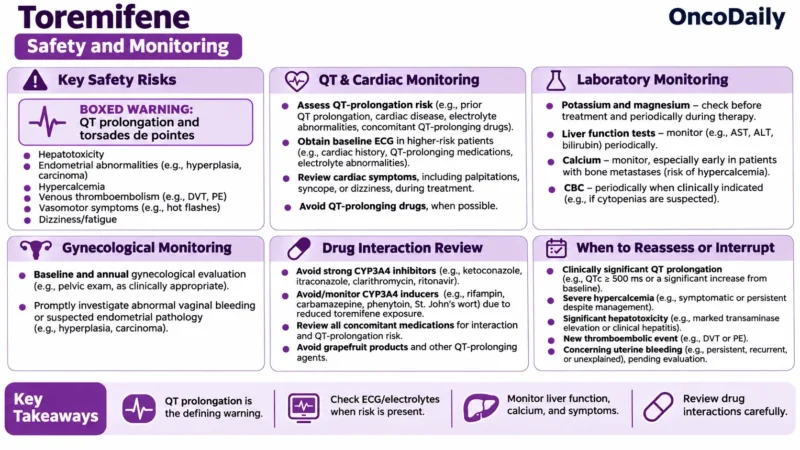
What Monitoring Is Required During Toremifene Treatment?
ECG and QT Interval
Assess cardiac risk before starting treatment.
Obtain a baseline ECG in patients at increased risk, with repeat ECGs as clinically indicated.
Investigate palpitations, syncope, unexplained dizziness, and other symptoms suggestive of arrhythmia.
Potassium and Magnesium
Measure potassium and magnesium before treatment.
Correct abnormalities before starting therapy and monitor periodically.
Liver Function
Monitor AST, ALT, and bilirubin periodically.
More frequent evaluation may be appropriate in patients with hepatic impairment.
Calcium Levels
Monitor calcium, especially during the first weeks in patients with bone metastases.
Gynecological Assessment
The U.S. label recommends baseline and annual gynecological examinations.
Investigate abnormal vaginal bleeding promptly.
Patients with pre-existing endometrial abnormalities may need additional assessment.
Complete Blood Count
Obtain periodic CBCs, particularly in patients with pre-existing leukopenia or thrombocytopenia.
Drug Interaction Review
Review all prescription medications, over-the-counter products, and supplements.
Pay particular attention to QT-prolonging medications and CYP3A4 inhibitors or inducers.
Breast Cancer Response
Assess treatment response using appropriate imaging, symptom evaluation, and disease-specific criteria.