





Tamoxifen (Nolvadex, Soltamox): Mechanism of Action, Dosing, Clinical Uses, Trials, and Side Effects
Key takeaways
- Tamoxifen is a selective estrogen receptor modulator that inhibits estrogen-dependent signaling in breast cancer.
- It is a major endocrine treatment for ER-positive breast cancer, particularly in premenopausal patients.
- The standard dose is 20 mg orally once daily, commonly for five years, with extension to ten years in selected patients.
- ATLAS demonstrated reduced late recurrence and breast cancer mortality with extended treatment.
- SOFT established the additional benefit of ovarian suppression for selected premenopausal patients.
- NSABP B-24 and P-1 established important roles in DCIS and breast cancer risk reduction.
- Venous thromboembolism, endometrial malignancy, and important CYP2D6 interactions are key safety considerations.
Tamoxifen (Nolvadex, Soltamox) is a nonsteroidal selective estrogen receptor modulator (SERM) used primarily in the treatment and prevention of hormone receptor-positive breast cancer. By competitively binding estrogen receptors, tamoxifen inhibits estrogen-dependent tumor-cell proliferation and reduces the risk of breast cancer recurrence.
Unlike aromatase inhibitors, which reduce estrogen synthesis, tamoxifen acts directly at the estrogen receptor (ER). Its effects are tissue-dependent: it has predominantly antiestrogenic activity in breast tissue but can exert estrogen-like effects in the endometrium, bone, and other tissues.
Tamoxifen is a prodrug metabolized in the liver into active metabolites, particularly endoxifen and 4-hydroxytamoxifen. CYP2D6 plays an important role in endoxifen formation, making drug interactions clinically relevant.
First approved in the United States in 1977, tamoxifen remains a cornerstone of endocrine treatment for estrogen receptor-positive (ER-positive) breast cancer, especially in premenopausal women.
It is used in early-stage and metastatic breast cancer, ductal carcinoma in situ (DCIS), and breast cancer risk reduction in selected high-risk women. Its role is supported by decades of randomized evidence demonstrating reductions in recurrence, contralateral breast cancer, and breast cancer mortality.
Key Facts
- Generic name: Tamoxifen citrate
- Brand names: Nolvadex (historical brand), Soltamox (oral solution)
- Drug class: Selective estrogen receptor modulator (SERM)
- Drug type: Nonsteroidal endocrine therapy
- Molecular target: Estrogen receptor alpha (ERα/ESR1)
- Mechanism: Competitive ER binding and inhibition of estrogen-dependent breast cancer growth
- Initial FDA approval: 1977
- Administration: Oral
- Standard dose: 20 mg once daily
- Alternative therapeutic dose: Up to 40 mg/day in selected breast cancer settings
- Available formulations: 10 mg and 20 mg tablets; oral solution
- Treatment duration: Usually 5 years, with extension to 10 years in selected patients
- Clinical uses: ER-positive breast cancer, DCIS, and breast cancer risk reduction
- Major trials: ATLAS, SOFT, NSABP B-24, NSABP P-1, and TAM-01
- Required biomarker: ER testing for therapeutic breast cancer indications
- Important metabolic enzyme: CYP2D6
- Principal active metabolite: Endoxifen
- Boxed warning: Uterine malignancies, stroke, and pulmonary embolism in DCIS/risk-reduction settings
- Major risks: Venous thromboembolism, endometrial cancer, abnormal uterine bleeding, and vasomotor symptoms
- Monitoring: Clinical assessment, gynecological symptoms, thromboembolic symptoms, and treatment adherence
- Elimination half-life: Approximately 5–7 days
What Is Tamoxifen?
Tamoxifen is an orally administered endocrine therapy that modulates estrogen receptor signaling.
Estrogen receptor-positive breast cancers depend partly on estrogen-mediated transcriptional signaling for tumor-cell growth and survival.
When estradiol binds ERα, it promotes receptor activation and regulates genes involved in cell-cycle progression, survival, and proliferation.
Tamoxifen and its active metabolites compete with estradiol for binding to estrogen receptors.
In breast tissue, the resulting receptor conformation reduces estrogen-dependent transcriptional activity, inhibiting malignant-cell proliferation.
However, tamoxifen is not a pure estrogen antagonist.
Its selective activity depends on tissue-specific coregulatory proteins and cellular context.
This explains both its therapeutic effects and characteristic adverse reactions.
How Does Tamoxifen Differ From Aromatase Inhibitors?
Tamoxifen blocks estrogen receptor signaling in breast tissue.
Aromatase inhibitors such as letrozole, anastrozole, and exemestane suppress estrogen biosynthesis.
Tamoxifen can be used in premenopausal women because its activity does not require suppression of ovarian estrogen production.
Aromatase inhibitors generally require confirmed menopause or effective ovarian function suppression when used in premenopausal breast cancer.
What Is the Mechanism of Action of Tamoxifen?
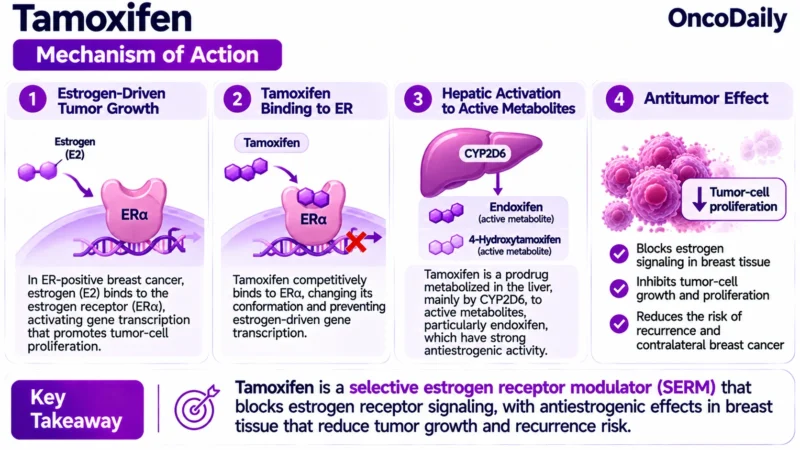
1. Estrogen Receptor Activation
Estrogen binds ERα in hormone receptor-positive breast cancer cells.
Activated ER complexes regulate transcription of genes involved in proliferation and survival.
2. Competitive Estrogen Receptor Binding
Tamoxifen and its active metabolites compete with estradiol for binding to the estrogen receptor ligand-binding domain.
3. Inhibition of Estrogen-Dependent Transcription
Tamoxifen changes estrogen receptor conformation and alters recruitment of transcriptional coregulators.
In breast tissue, this suppresses estrogen-dependent gene expression.
4. Reduction of Tumor-Cell Proliferation
Antiestrogenic signaling reduces cell-cycle progression, including estrogen-dependent cyclin D1 signaling.
Consequently, susceptible breast cancer cells demonstrate reduced proliferation.
5. Hepatic Metabolic Activation
Tamoxifen undergoes hepatic metabolism through CYP enzymes.
Important pathways include:
- CYP3A4/5-mediated formation of N-desmethyltamoxifen
- CYP2D6-mediated formation of endoxifen
- Formation of 4-hydroxytamoxifen
Endoxifen is a major clinically important active metabolite.
6. Tissue-Selective Estrogen Effects
Tamoxifen can exert partial estrogen agonist activity in other tissues.
This may contribute to preservation of bone density in postmenopausal women but also to endometrial proliferation and thromboembolic risk.
7. Sustained Endocrine Suppression
Continued therapy reduces the probability of estrogen-dependent recurrence and contralateral breast cancer.
Overall mechanism:
Tamoxifen → hepatic activation to endoxifen → ERα binding → suppression of estrogen-dependent transcription → reduced breast cancer-cell proliferation → lower recurrence risk.
What Is the Recommended Dose of Tamoxifen?
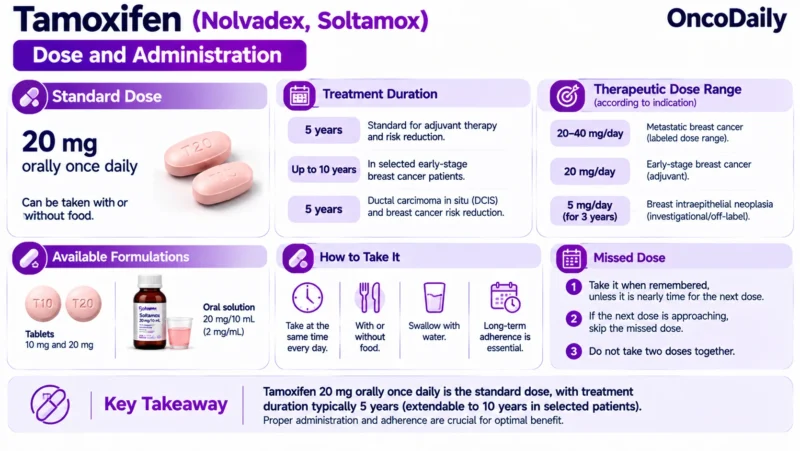
Standard Adult Dose
The most commonly used dose is:
Tamoxifen 20 mg orally once daily.
The medication can generally be taken with or without food.
Early-Stage ER-Positive Breast Cancer
20 mg once daily for five years.
In selected patients, endocrine treatment may be extended to a total of 7–10 years, depending on menopausal status, recurrence risk, previous treatment, and tolerability.
Extended Adjuvant Treatment
For selected patients who complete five years of tamoxifen:
Continue 20 mg once daily to complete 10 years.
Alternatively, postmenopausal patients may transition to an aromatase inhibitor.
Premenopausal Breast Cancer
Possible endocrine approaches include:
- Tamoxifen 20 mg daily alone
- Tamoxifen 20 mg daily with ovarian function suppression
- An aromatase inhibitor with ovarian function suppression
The choice depends on recurrence risk and menopausal status.
Metastatic ER-Positive Breast Cancer
The labeled dosage range is:
20–40 mg/day orally.
Doses above 20 mg/day should be divided into morning and evening administrations.
In contemporary practice, tamoxifen is generally not the preferred initial treatment for endocrine-sensitive metastatic breast cancer when more effective endocrine-targeted combinations are available.
Ductal Carcinoma in Situ
For women with DCIS following breast surgery and radiation:
20 mg orally once daily for five years.
Treatment reduces subsequent breast cancer events, including contralateral breast cancer.
Breast Cancer Risk Reduction
For eligible women at increased risk of breast cancer:
20 mg once daily for five years.
The benefit-risk balance must be individualized because tamoxifen increases the risks of thromboembolism and uterine malignancies.
Low-Dose Tamoxifen
5 mg daily for three years has been studied in women with breast intraepithelial neoplasia, including DCIS, atypical ductal hyperplasia, and lobular carcinoma in situ.
The TAM-01 trial demonstrated reduced breast cancer events.
However, this low-dose regimen is not the standard FDA-approved dosing schedule and should be identified as an evidence-supported, off-label approach where applicable.
How Should Tamoxifen Be Administered?
Oral Administration
Tamoxifen is administered orally, generally once daily.
It may be taken with or without meals.
Patients should aim to take the medication at approximately the same time every day.
Available Tablets
Common tablet strengths are:
- 10 mg
- 20 mg
Tablet strengths refer to the equivalent amount of tamoxifen, rather than the total mass of the citrate salt.
Oral Solution
Soltamox provides an alternative formulation for patients who have difficulty swallowing tablets.
Its concentration is 20 mg/10 mL (2 mg/mL).
Treatment Adherence
Long-term daily adherence is essential.
Hot flashes, fatigue, sexual symptoms, and other adverse effects can contribute to premature treatment discontinuation.
Patients experiencing troublesome symptoms should be assessed for supportive management rather than automatically stopping endocrine therapy.
What Should You Do If a Tamoxifen Dose Is Missed?
If a dose is missed:
- Take it when remembered, unless it is nearly time for the next scheduled dose.
- If the next dose is approaching, skip the missed dose.
- Resume the normal schedule.
- Do not take two doses together.
Repeated missed doses should prompt an adherence assessment and discussion of barriers to treatment.
How Are Tamoxifen Dose Modifications Managed?
Tamoxifen does not have a conventional toxicity-based dose-reduction algorithm comparable to cytotoxic chemotherapy.
Mild Vasomotor Symptoms
Continue treatment when possible.
Consider nonhormonal symptom management and review potential drug interactions.
Severe or Persistent Adverse Effects
Temporarily interrupt treatment if clinically necessary.
Evaluate whether symptoms are related to tamoxifen and consider alternative endocrine treatment.
Venous Thromboembolism
Suspected deep vein thrombosis or pulmonary embolism requires urgent assessment.
Treatment interruption or discontinuation should be individualized according to the clinical event and treatment indication.
Abnormal Uterine Bleeding
Prompt gynecological assessment is required.
Tamoxifen may need to be interrupted while clinically significant pathology is investigated.
Severe Hepatic Toxicity
Clinically important hepatic dysfunction may require treatment interruption or discontinuation.
Low-Dose Strategies
Low-dose tamoxifen should not be treated as an established, universally interchangeable substitute for 20 mg/day adjuvant therapy in invasive breast cancer.
What Drug Interactions Are Important With Tamoxifen?
Strong CYP2D6 Inhibitors
Tamoxifen requires metabolic activation to endoxifen.
Strong CYP2D6 inhibitors may substantially reduce endoxifen exposure.
Important examples include:
- Paroxetine
- Fluoxetine
- Bupropion
- Quinidine
These combinations should generally be avoided when suitable alternatives are available.
The clinical effect on recurrence outcomes remains less certain than the pharmacokinetic interaction itself.
Antidepressant Selection
When antidepressant treatment is required, consider options with less CYP2D6 inhibition, based on the patient’s psychiatric and medical needs.
Venlafaxine is frequently considered for vasomotor symptoms because it has relatively limited CYP2D6 inhibition.
Warfarin
Tamoxifen may enhance anticoagulant effects and increase bleeding risk.
Concomitant use requires particular caution and appropriate INR monitoring.
For breast cancer risk reduction or DCIS, some U.S. tamoxifen labels contraindicate concurrent coumarin-type anticoagulant treatment.
Rifampin
Rifampin can substantially reduce tamoxifen exposure through enzyme induction.
Avoid the combination when possible.
Hormonal Therapies
Concomitant estrogen-containing treatment may counteract tamoxifen’s therapeutic purpose.
Hormonal contraception is not preferred during treatment.
Aromatase Inhibitors
Tamoxifen and aromatase inhibitors are generally used sequentially rather than concurrently in standard adjuvant regimens.
Coadministration with letrozole can lower letrozole exposure.
Does Tamoxifen Require Dose Adjustment in Renal or Hepatic Impairment?
Renal Impairment
Routine renal dose adjustment is generally not required.
Tamoxifen is metabolized predominantly in the liver, with elimination mainly through the fecal route.
However, evidence in severe renal dysfunction is limited.
Hepatic Impairment
Tamoxifen undergoes extensive hepatic metabolism.
A validated dose-adjustment algorithm for hepatic impairment is not established.
Patients with clinically significant liver disease require individualized treatment decisions and appropriate monitoring.
What Is the Pharmacokinetic Profile of Tamoxifen?
Absorption
Tamoxifen is absorbed following oral administration.
Peak plasma concentrations typically occur approximately five hours after a 20 mg dose.
Distribution
Tamoxifen is highly protein-bound and extensively distributed into tissues.
Metabolism
Tamoxifen undergoes hepatic metabolism through several CYP pathways, including CYP3A4, CYP2C9, and CYP2D6.
Its important active metabolites include endoxifen and 4-hydroxytamoxifen.
Elimination Half-Life
Tamoxifen: Approximately 5–7 days.
N-desmethyltamoxifen has a longer estimated half-life of approximately 14 days.
Steady State
Tamoxifen reaches steady state after approximately four weeks.
N-desmethyltamoxifen generally reaches steady state after approximately eight weeks.
Excretion
Tamoxifen and its metabolites are eliminated predominantly through fecal excretion.
Pharmacogenomics
CYP2D6 genotype can influence endoxifen exposure.
However, routine CYP2D6 genotyping and endoxifen therapeutic drug monitoring are not universally recommended for all patients receiving tamoxifen.
What Are the Clinical Uses of Tamoxifen?
Adjuvant Treatment of ER-Positive Breast Cancer
Tamoxifen is used after definitive local treatment to reduce recurrence and breast cancer mortality.
It is particularly important in premenopausal patients, either alone or with ovarian function suppression.
In postmenopausal patients, treatment may involve tamoxifen, an aromatase inhibitor, or a sequence of both.
Extended Adjuvant Endocrine Therapy
Continuing tamoxifen beyond five years can provide additional protection against late recurrence in selected patients.
The decision depends on recurrence risk, menopausal status, competing health risks, and treatment tolerance.
Metastatic Breast Cancer
Tamoxifen has activity in ER-positive metastatic breast cancer, including in men.
Its contemporary use is generally reserved for selected treatment sequences, especially when other endocrine therapies or targeted agents are unsuitable or unavailable.
Ductal Carcinoma in Situ
Tamoxifen can reduce ipsilateral and contralateral breast events following treatment of hormone receptor-positive DCIS.
It is a risk-reduction treatment, not a substitute for indicated surgery or radiotherapy.
Breast Cancer Risk Reduction
Tamoxifen can reduce the incidence of ER-positive breast cancer in appropriately selected high-risk women.
Its use requires careful consideration of age, uterine status, personal thromboembolic risk, and patient preferences.
Male Breast Cancer
Tamoxifen is a standard endocrine treatment for men with hormone receptor-positive breast cancer.
It is commonly used in the adjuvant setting for five years, with possible extension in selected patients.
What Molecular Testing Is Required Before Tamoxifen?
Estrogen Receptor Testing
ER testing is essential when selecting tamoxifen as treatment for invasive breast cancer.
ER expression is evaluated through immunohistochemistry.
Tumors with at least 1% ER-positive invasive tumor-cell nuclei are classified as ER-positive, although ER-low tumors (1–10%) may derive less predictable endocrine benefit.
Progesterone Receptor Testing
PR expression provides additional information about tumor biology and endocrine responsiveness.
PR positivity is not mandatory if ER expression supports endocrine treatment.
HER2 Testing
HER2 status should be determined in invasive breast cancer.
It informs the overall systemic treatment strategy but does not independently exclude tamoxifen use.
Multigene Assays
Tests such as Oncotype DX may help guide chemotherapy decisions in selected early-stage HR-positive/HER2-negative breast cancers.
These assays do not directly determine tamoxifen dosing.
CYP2D6 Genotyping
CYP2D6 testing may identify differences in tamoxifen metabolism, but routine testing is not universally recommended.
Reviewing strong CYP2D6-inhibiting medications is more immediately relevant to most prescribing decisions.
Menopausal Status
Menopausal status is essential when choosing between tamoxifen, ovarian suppression, and aromatase inhibitors.
Amenorrhea during treatment does not necessarily indicate permanent menopause.
What Did the Pivotal Clinical Trials Show?
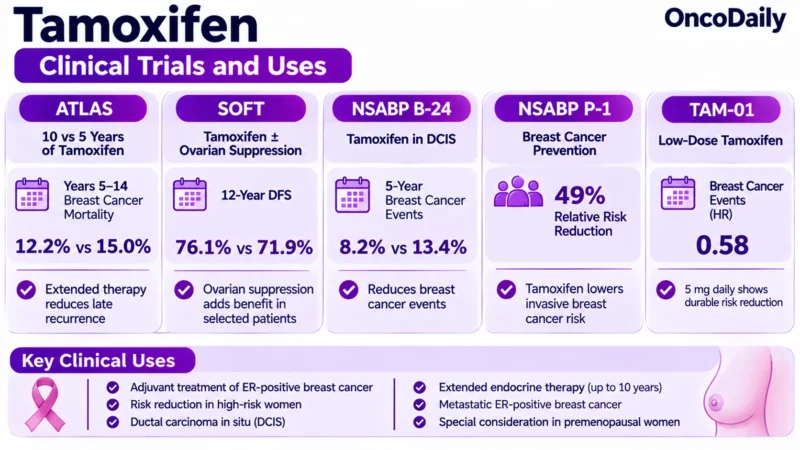
1. ATLAS — Ten Years Versus Five Years of Tamoxifen
ATLAS (NCT00003016) was a randomized trial involving 12,894 women with early breast cancer who had completed approximately five years of tamoxifen.
Patients were assigned to continue tamoxifen to ten years or discontinue after five years.
In the ER-positive population:
Cumulative Recurrence Risk, Years 5–14
- Ten years: 21.4%
- Five years: 25.1%
Breast Cancer Mortality, Years 5–14
- Ten years: 12.2%
- Five years: 15.0%
Absolute Breast Cancer Mortality Reduction
2.8 percentage points
Extended treatment reduced late recurrence and breast cancer mortality, supporting ten years of tamoxifen in selected patients.
2. SOFT — Tamoxifen With or Without Ovarian Suppression
SOFT (NCT00066690) was a randomized phase III trial evaluating endocrine treatment strategies in premenopausal women with hormone receptor-positive early breast cancer.
The study compared tamoxifen alone, tamoxifen plus ovarian function suppression, and exemestane plus ovarian function suppression.
Twelve-Year Disease-Free Survival
- Tamoxifen alone: 71.9%
- Tamoxifen + ovarian suppression: 76.1%
- Exemestane + ovarian suppression: 79.0%
DFS Hazard Ratio — Tamoxifen + Ovarian Suppression vs Tamoxifen Alone
HR: 0.82 (95% CI, 0.69–0.98)
P = 0.03
The trial demonstrated that ovarian suppression provides additional benefit in selected premenopausal patients, particularly those with higher-risk disease.
Read More: Premenopausal Breast Cancer: New Review Challenges One-Size-Fits-All Adjuvant Treatment Strategies by OncoDaily.
Watch More: Ovarian Suppression in Young Women With ER-Positive Breast Cancer — Dr. Francisco J. Esteva.
3. NSABP B-24 — Tamoxifen After Treatment of DCIS
NSABP B-24 evaluated tamoxifen versus placebo in women with DCIS who underwent breast-conserving surgery and radiotherapy.
Five-Year Breast Cancer Events
- Tamoxifen: 8.2%
- Placebo: 13.4%
P = 0.009
Tamoxifen also reduced contralateral breast neoplasms.
The results supported adjuvant tamoxifen as a risk-reduction strategy following local treatment of DCIS.
4. NSABP P-1 — Breast Cancer Prevention
NSABP P-1 randomized 13,388 women at increased breast cancer risk to tamoxifen 20 mg daily or placebo for five years.
Invasive Breast Cancer Cases — Initial Analysis
- Tamoxifen: 89 of 6,576 women
- Placebo: 175 of 6,599 women
Relative Risk Reduction
49%
Relative Risk: 0.51 (95% CI, 0.39–0.66)
The trial established tamoxifen’s ability to reduce invasive breast cancer incidence in appropriately selected high-risk women.
However, this benefit must be weighed against thromboembolic and uterine risks.
5. TAM-01 — Low-Dose Tamoxifen in Breast Intraepithelial Neoplasia
TAM-01 was a randomized trial evaluating tamoxifen 5 mg daily for three years versus placebo following surgery for breast intraepithelial neoplasia.
The population included women with DCIS, atypical ductal hyperplasia, and lobular carcinoma in situ.
At a median follow-up of 9.7 years:
Breast Cancer Events
- Low-dose tamoxifen: 25
- Placebo: 41
Hazard Ratio
HR: 0.58 (95% CI, 0.35–0.95)
P = 0.03
The findings suggest durable risk reduction with low-dose tamoxifen.
However, 5 mg daily remains an off-label regimen in the United States, and these findings should not be extrapolated to standard treatment of invasive breast cancer.
Does Tamoxifen Have CNS Activity?
Tamoxifen is not primarily considered a CNS-directed anticancer agent.
It can cross the blood–brain barrier to some extent, but established clinical evidence does not support its use as a specific treatment for brain metastases.
In patients with ER-positive breast cancer and CNS metastases, systemic endocrine treatment may contribute to extracranial disease management.
However, local CNS-directed treatment and other systemic options with demonstrated intracranial activity should be considered according to tumor biology and clinical circumstances.
Tamoxifen is not an established treatment for primary CNS tumors.
Is Tamoxifen FDA Approved?
Yes.
Tamoxifen was first approved in the United States in 1977.
Its established U.S. indications include:
- Metastatic breast cancer in women and men
- Adjuvant treatment of breast cancer
- Reduction of invasive breast cancer risk after DCIS treatment
- Reduction of breast cancer incidence in selected high-risk women
The precise indication and safety wording depend on the formulation and prescribing label.
What Is the Current Clinical Role of Tamoxifen in 2026?
Tamoxifen remains a foundational endocrine treatment, particularly in premenopausal ER-positive breast cancer.
For lower-risk premenopausal patients, tamoxifen alone may provide an appropriate balance of benefit and toxicity.
For higher-risk premenopausal patients, ovarian function suppression with tamoxifen or an aromatase inhibitor may improve outcomes.
In postmenopausal patients, aromatase inhibitors are frequently preferred when clinically appropriate, although tamoxifen remains useful when aromatase inhibitors are poorly tolerated or contraindicated.
In metastatic disease, modern endocrine-targeted combinations have reduced tamoxifen’s role as an initial treatment, but it remains a treatment option in selected circumstances.
Tamoxifen also has a distinct role in DCIS and breast cancer risk reduction, where its use depends on the expected absolute benefit relative to potential harms.
What Are the Major Side Effects of Tamoxifen?
Vasomotor Symptoms
Hot flashes and night sweats are among the most common adverse effects.
They may affect sleep quality, daily functioning, and adherence.
Venous Thromboembolism
Tamoxifen increases the risk of deep vein thrombosis and pulmonary embolism.
Possible symptoms include unilateral leg swelling, chest pain, sudden dyspnea, and hemoptysis.
Risk assessment is particularly important in patients with previous thrombosis, prolonged immobility, obesity, or additional prothrombotic factors.
Endometrial Cancer and Uterine Malignancies
Tamoxifen has partial estrogen agonist activity in the endometrium.
It can increase the risk of:
- Endometrial hyperplasia
- Endometrial carcinoma
- Endometrial polyps
- Rare uterine sarcomas
The risk is most clinically relevant in postmenopausal women and increases with longer exposure.
Abnormal vaginal bleeding requires prompt evaluation.
Routine endometrial ultrasound or biopsy is not recommended solely because an asymptomatic patient is taking tamoxifen.
Stroke
Tamoxifen has been associated with an increased risk of stroke in some populations.
Patients with neurological symptoms require emergency assessment.
Boxed Warning
U.S. tamoxifen tablet labels contain a boxed warning for women with DCIS or women taking tamoxifen for breast cancer risk reduction, emphasizing uterine malignancies, pulmonary embolism, and stroke.
The warning does not mean that the overall benefit-risk balance is unfavorable in patients being treated for diagnosed invasive breast cancer.
Gynecological and Sexual Adverse Effects
Potential adverse reactions include:
- Vaginal discharge
- Vaginal dryness
- Menstrual irregularities
- Sexual discomfort
- Ovarian cysts in premenopausal women
Cataracts and Visual Disturbances
Tamoxifen may increase the risk of cataracts.
Rare ocular toxicities include retinopathy and other visual disturbances.
Hepatic Toxicity
Tamoxifen can be associated with:
- Elevated liver enzymes
- Hepatic steatosis
- Steatohepatitis
- Rare clinically significant liver injury
Musculoskeletal Symptoms
Patients may experience muscle cramps, arthralgia, and other musculoskeletal symptoms.
Mood and Cognitive Symptoms
Some patients report fatigue, mood changes, sleep disturbances, or concentration difficulties.
These symptoms require individualized assessment because multiple factors may contribute.
Bone Effects
Tamoxifen’s skeletal effects depend on menopausal status.
In postmenopausal women, it generally has a protective estrogen-like effect on bone.
In premenopausal women, bone effects are more variable, particularly with concurrent ovarian suppression.
Pregnancy and Reproductive Toxicity
Tamoxifen may cause fetal harm and should not be used during pregnancy.
A negative pregnancy test should be confirmed before treatment when applicable.
Nonhormonal contraception is recommended during therapy and after discontinuation, for the interval specified by the applicable product label. Current U.S. oral-solution labeling specifies two months after the final dose.
Breastfeeding is not recommended during treatment.
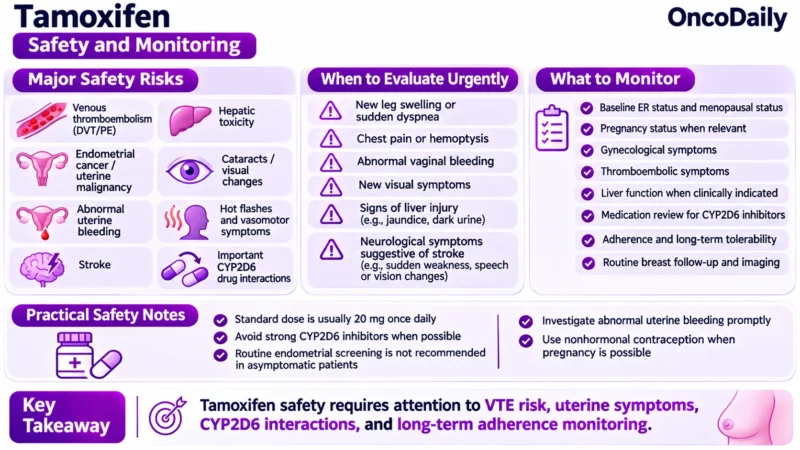
What Monitoring Is Required During Tamoxifen Treatment?
Baseline Assessment
Before treatment, assess:
- ER and PR status
- Menopausal status
- Pregnancy status when relevant
- History of thromboembolism
- Gynecological history
- Liver disease
- Concomitant medications
- Planned endocrine treatment duration
Gynecological Monitoring
Assess new vaginal bleeding, pelvic pain, or abnormal discharge.
Patients should receive routine age-appropriate gynecological care.
Symptom-driven evaluation is essential; routine endometrial screening is not recommended in asymptomatic patients solely because of tamoxifen.
Thromboembolic Monitoring
Assess symptoms of DVT or pulmonary embolism.
Review thrombosis risk before major surgery or prolonged immobilization, and consider perioperative management according to individual risk.
Liver Function
Liver biochemical monitoring may be appropriate at baseline and periodically, particularly in patients with pre-existing hepatic disease or clinical suspicion of liver injury.
Ophthalmological Assessment
Evaluate new visual symptoms promptly.
Routine specialist monitoring may be individualized according to patient risk and local practice.
Menstrual and Reproductive Assessment
Monitor menstrual changes and pregnancy risk.
Amenorrhea does not necessarily indicate menopause or infertility.
Treatment Adherence
Evaluate adherence during follow-up.
Address adverse effects, medication interactions, and barriers to long-term endocrine treatment.
Cancer Surveillance
Continue recommended breast imaging and clinical follow-up according to disease stage and treatment setting.
FAQ
What Is Tamoxifen Used For?
What Is Its Mechanism of Action?
Is Tamoxifen Chemotherapy?
What Is the Standard Dose?
How Long Should Tamoxifen Be Taken?
Can Premenopausal Women Take Tamoxifen?
Does Tamoxifen Require Ovarian Suppression?
Can Tamoxifen Cause Endometrial Cancer?
Can Tamoxifen Cause Blood Clots?
Can Tamoxifen Be Used in Men?
Does Tamoxifen Require CYP2D6 Testing?
Avoiding strong CYP2D6-inhibiting medications is important.