





Streptozocin: Understanding Its Mechanism, Dosing, and Clinical Role
Key takeaways
- Streptozocin is a DNA-damaging alkylating chemotherapy with particular activity in pancreatic neuroendocrine tumors.
- Its glucose-containing structure contributes to preferential uptake by pancreatic β cells through GLUT2, although the complete basis for its antitumor selectivity is not fully established.
- Streptozocin inhibits DNA synthesis and produces DNA damage that can ultimately lead to cancer-cell death.
- It is administered intravenously and has historically been given using daily, weekly, or fractionated schedules.
- The drug remains an established chemotherapy option for selected patients with advanced pancreatic neuroendocrine tumors.
- Nephrotoxicity is the defining dose-limiting toxicity and can be severe, cumulative, and potentially fatal.
- Streptozocin-based combinations, particularly with 5-fluorouracil, have demonstrated meaningful antitumor activity in pancreatic islet-cell carcinoma.
- Modern panNET treatment has expanded to include targeted therapies and peptide receptor radionuclide therapy, but streptozocin remains an important chemotherapy option in selected patients.
Streptozocin, also known as streptozotocin (STZ), is an intravenous alkylating chemotherapy and nitrosourea derivative with a distinctive tropism for pancreatic islet cells. It causes DNA damage and inhibits DNA synthesis and has a long-established role in the treatment of metastatic pancreatic islet-cell carcinoma, now generally classified within pancreatic neuroendocrine tumors (panNETs).
This article aims to review streptozocin’s mechanism of action, dose, administration, supportive-care requirements, pharmacokinetics, clinical-trial findings, safety profile, approval status, and current role in oncology. Because streptozocin can cause severe and potentially fatal renal toxicity, treatment should be administered by an experienced oncology team with close renal, hepatic, and hematologic monitoring.
Streptozocin Key Facts
- Generic name: Streptozocin
- Common abbreviation: STZ
- Brand name: Zanosar
- Drug class: Alkylating agent; nitrosourea derivative
- Administration: Intravenous
- Main FDA-approved use: Metastatic islet-cell carcinoma of the pancreas
- Main contemporary clinical setting: Pancreatic neuroendocrine tumors (panNETs)
- Common combinations: Streptozocin plus fluorouracil or doxorubicin
- Daily schedule: 500 mg/m² IV daily for 5 consecutive days every 6 weeks
- Weekly schedule: Initially 1,000 mg/m² IV weekly
- Maximum single dose: 1,500 mg/m²
- Major toxicity: Renal toxicity
- Other important toxicities: Severe nausea and vomiting, hepatotoxicity, myelosuppression, diarrhea, metabolic abnormalities, and injection-site injury
- Important supportive care: Aggressive hydration and serial renal-function monitoring
- Approval history: FDA approved for metastatic pancreatic islet-cell carcinoma; current U.S. Zanosar labeling has also appeared under an unapproved-drug-for-shortage marketing category.
What Is Streptozocin?
Streptozocin is a synthetic nitrosourea alkylating agent that damages DNA and inhibits DNA synthesis.
It is chemically related to other nitrosourea chemotherapies but has a distinctive glucose-containing structure. Streptozocin was originally recognized for its ability to selectively damage pancreatic islet β cells, an effect related to its uptake through glucose transport pathways.
Its principal oncology use is metastatic islet-cell carcinoma of the pancreas. In contemporary terminology, these tumors are generally categorized as pancreatic neuroendocrine tumors.
The NCI notes that streptozocin has demonstrated antitumor activity in pancreatic NETs, although the evidence base is considerably older and less robust than that supporting many newer systemic therapies.
Streptozocin has been used both as a single agent and in combination with other chemotherapy agents, particularly:
- Fluorouracil (5-FU)
- Doxorubicin.
Streptozocin Mechanism of Action
Streptozocin primarily acts through DNA damage and inhibition of DNA synthesis.
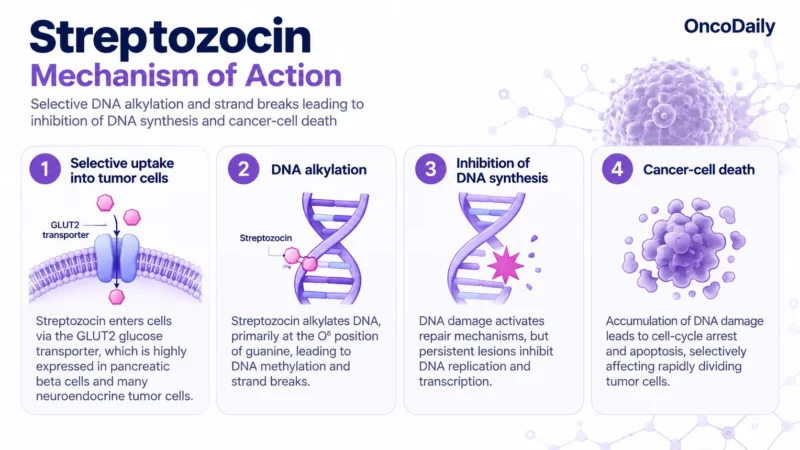
Its mechanism can be summarized as:
Cellular uptake → DNA alkylation/methylation → DNA damage → impaired DNA synthesis → inhibition of cellular proliferation → cancer-cell death
The glucose moiety of streptozocin contributes to cellular uptake through glucose transport mechanisms, particularly GLUT2. This helps explain its marked toxicity toward pancreatic islet β cells and its activity in pancreatic neuroendocrine tumors. Recent pharmacologic research has emphasized both GLUT2-mediated uptake and DNA-methylating activity as important components of its mechanism.
The historical product labeling states that streptozocin inhibits DNA synthesis in bacterial and mammalian cells, although the precise biochemical mechanism responsible for mammalian-cell death has not been completely established.
Streptozocin can also reduce cellular NAD levels and produce significant injury to pancreatic islet β cells, which explains its well-known diabetogenic effects.
What Is the Dose of Streptozocin?
Streptozocin dosing is schedule- and disease-specific.
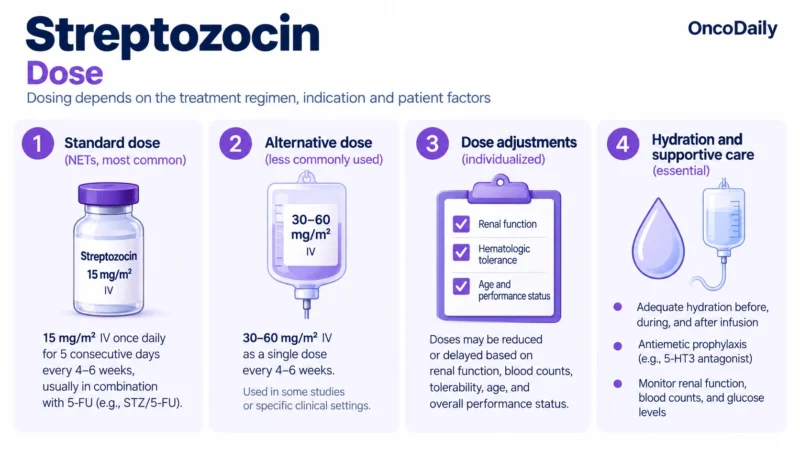
Two principal schedules have historically been used.
Daily Schedule
The recommended daily schedule is:
500 mg/m² IV once daily for 5 consecutive days every 6 weeks
Treatment continues until maximum benefit is achieved or treatment-limiting toxicity develops.
Dose escalation is not recommended with this schedule.
Weekly Schedule
The recommended initial weekly dose is:
1,000 mg/m² IV once weekly
for the first two treatment weeks.
In patients who have not responded and who have not experienced significant toxicity, subsequent doses may be increased.
However:
A single dose should not exceed 1,500 mg/m².
Higher single doses increase the risk of azotemia and renal toxicity.
Fractionated Three-Weekly Schedule
European product information also describes a fractionated regimen consisting of:
500 mg/m²/day IV for 5 consecutive days during Cycle 1, followed by 1,000 mg/m² every 3 weeks during subsequent cycles.
The exact regimen should therefore follow the applicable product information and institutional pancreatic NET protocol.
How Is Streptozocin Administered?
Streptozocin is administered intravenously.
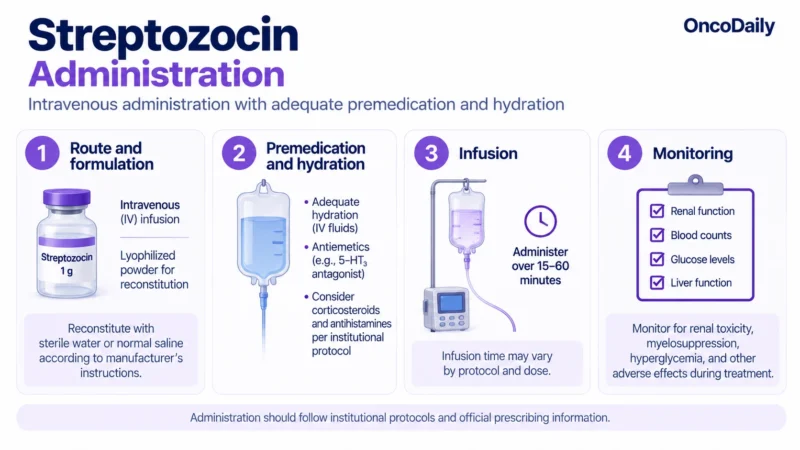
It is not active orally.
The historical Zanosar prescribing information permits administration by:
- Rapid IV injection
- Short IV infusion
- Prolonged IV infusion.
Intra-arterial administration has been described historically but is not recommended because of concerns about more rapid renal toxicity.
The drug is supplied as a sterile powder and must be reconstituted before administration.
For the historical Zanosar formulation, the vial is reconstituted with:
- 9.5 mL of 5% dextrose injection, or
- 0.9% sodium chloride injection.
This produces a solution containing approximately 100 mg/mL of streptozocin. Further dilution can be performed when a more dilute infusion solution is required.
The prepared solution should not be stored for more than 12 hours according to the historical U.S. product information.
Because streptozocin is cytotoxic and potentially hazardous, appropriate handling and disposal precautions should be followed.
Does Streptozocin Require an In-Line Filter?
There is no universal in-line-filter requirement specified in the historical Zanosar prescribing information.
Filter requirements should therefore follow:
- The specific product information
- Institutional pharmacy policy
- The infusion system being used
- Local chemotherapy administration standards.
The major administration concerns with streptozocin are appropriate IV preparation, protection from extravasation, hydration, and renal monitoring.
Is Premedication Required?
Antiemetic prophylaxis is strongly relevant to streptozocin treatment because severe nausea and vomiting are among its most common and sometimes treatment-limiting toxicities.
Antiemetic treatment should be selected according to the complete chemotherapy regimen and patient-specific risk.
Hydration is particularly important because it may reduce renal exposure to streptozocin and its metabolites and potentially reduce nephrotoxicity.
Patients receiving combination regimens may also receive corticosteroids or other supportive medications according to the specific protocol.
Are Dose Reductions Used?
Yes.
Treatment may need to be delayed, reduced, or discontinued when significant toxicity develops.
The most important reason for dose modification is renal toxicity.
Dose reduction or discontinuation should be considered when clinically significant renal abnormalities develop. The product information recommends close renal monitoring before and after treatment and emphasizes that nephrotoxicity is cumulative.
Dose modification may also be necessary for:
- Severe nausea and vomiting
- Significant hepatotoxicity
- Hematologic toxicity
- Significant metabolic abnormalities
- Other clinically important nonhematologic toxicity.
Because renal injury may become irreversible, continuing treatment despite progressive renal abnormalities requires careful assessment of benefit versus risk.
What Is Known About Streptozocin Pharmacokinetics?
Streptozocin has rapid systemic clearance following intravenous administration.
Experimental pharmacokinetic studies have shown that it disappears rapidly from the bloodstream and concentrates particularly in the kidneys and liver. Approximately 20% of the administered drug or metabolites containing an N-nitrosourea group may undergo renal metabolism and/or excretion.
Recent pharmacologic work describes streptozocin as having:
- Rapid systemic clearance
- A relatively narrow volume of distribution
- Predominantly renal elimination
- Short systemic exposure.
These characteristics have supported interest in fractionated dosing schedules that attempt to maintain antitumor activity while limiting renal toxicity.
The pharmacokinetic profile also helps explain why renal function is central to safe administration.
Are Renal or Hepatic Dose Adjustments Required?
Renal Impairment
Renal function is one of the most important considerations before and during streptozocin therapy.
The historical prescribing information recommends:
- Serum creatinine
- BUN
- Electrolytes
- Creatinine clearance
- Urinalysis
before treatment, during therapy, and for four weeks after drug administration.
Proteinuria may be an early indicator of renal toxicity.
Streptozocin should not be combined with other potentially nephrotoxic drugs whenever possible because additive renal toxicity may occur.
Some contemporary oncology formularies recommend dose reductions according to creatinine clearance, but these adjustments vary by protocol. Therefore, renal dosing should follow the specific institutional or product-based regimen rather than a single universal table.
Hepatic Impairment
Streptozocin can cause hepatic toxicity, although renal toxicity is the dominant concern.
There is no universally established hepatic dose-adjustment algorithm.
Patients with hepatic dysfunction should be monitored closely with:
- AST
- ALT
- Bilirubin
- Albumin
- Other clinically appropriate liver-function parameters.
Dose reduction or discontinuation may be appropriate when significant hepatic toxicity develops.
What Did Streptozocin Clinical Trials Show?
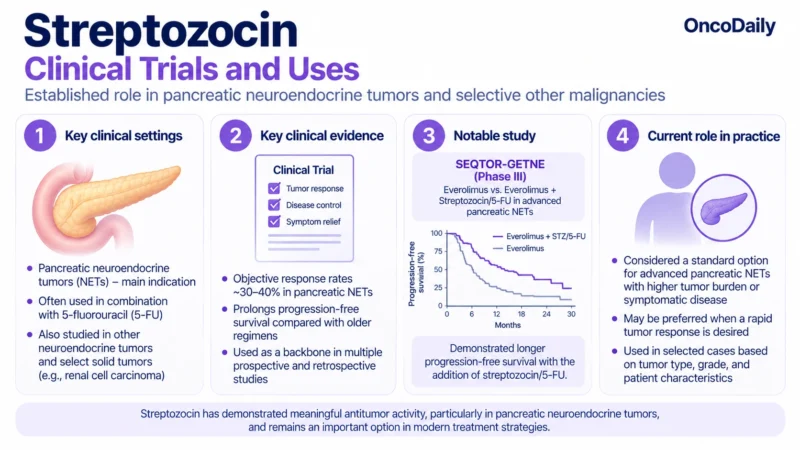
Streptozocin Alone Versus Streptozocin Plus 5-FU
One of the landmark randomized studies evaluated 84 patients with advanced islet-cell carcinoma, comparing streptozocin alone with streptozocin plus fluorouracil.
The combination demonstrated:
- Overall response rate: 63% vs 36%
- Complete response rate: 33% vs 12%
compared with streptozocin alone.
Responses were generally durable, with a median response duration of approximately 17 months.
Streptozocin Plus Doxorubicin Versus Streptozocin Plus 5-FU
A subsequent randomized study compared streptozocin plus doxorubicin with streptozocin plus fluorouracil.
The streptozocin–doxorubicin combination demonstrated:
- Tumor regression: 69% vs 45%
- Median time to progression: 20 vs 6.9 months
- Median survival: 2.2 vs 1.4 years
compared with streptozocin plus fluorouracil.
These historical studies established streptozocin-based combination chemotherapy as an important treatment strategy for advanced pancreatic islet-cell carcinoma.
Capecitabine and Streptozocin With or Without Cisplatin
NCT00602082 evaluated capecitabine plus streptozocin with or without cisplatin in patients with unresectable or metastatic neuroendocrine tumors.
The study was designed to evaluate:
- Objective response rate
- Progression-free survival
- Overall survival
- Toxicity
- Quality of life
- Optimal drug dosing.
Patients received streptozocin IV with oral capecitabine, with cisplatin added in one treatment arm.
SEQTOR
The Phase III SEQTOR study, NCT02246127, compared treatment sequencing with everolimus and streptozocin–5-FU in advanced pancreatic neuroendocrine tumors.
The study enrolled 141 patients and investigated whether the sequence of targeted therapy and streptozocin-based chemotherapy influenced outcomes.
BETTER2
The Phase II BETTER2 study, NCT03351296, is evaluating chemotherapy strategies in well-differentiated pancreatic neuroendocrine tumors.
It compares:
- LV5FU2 + streptozocin
- Capecitabine + temozolomide
with or without bevacizumab.
The trial is designed to compare progression-free survival and evaluate whether bevacizumab adds benefit to these chemotherapy approaches.
Watch more: Streptozocin in Pancreatic Neuroendocrine Tumors – YouTube
Is Streptozocin FDA Approved?
Historically, yes.
The FDA approved streptozocin in 1982 for the treatment of pancreatic neuroendocrine/islet-cell tumors. A 2022 review marking 40 years since the approval describes streptozocin as the first drug specifically approved for pancreatic neuroendocrine tumors.
However, there is an important current regulatory distinction.
The currently listed Zanosar product on DailyMed has a marketing category of “unapproved drug for use in drug shortage,” rather than a conventional current FDA-approved marketing application.
Therefore, the article should distinguish between streptozocin’s historical FDA approval and the regulatory status of the currently listed Zanosar product.
What Is the Current Role of Streptozocin?
Streptozocin remains an established chemotherapy option for selected patients with advanced pancreatic neuroendocrine tumors, particularly when tumor burden, progression, or tumor biology makes chemotherapy appropriate.
Its role has changed substantially with the development of:
- Everolimus
- Sunitinib
- Somatostatin analogues
- Peptide receptor radionuclide therapy
- Cabozantinib
- Other contemporary systemic approaches.
The NCI continues to list streptozocin among chemotherapy agents with antitumor activity in pancreatic NETs, while emphasizing that the evidence for an overall-survival benefit from chemotherapy is less certain than the evidence supporting some newer therapies.
Streptozocin remains particularly relevant when a rapid tumor response is desired or when chemotherapy is favored based on disease characteristics.
Read more: SEQTOR-GETNE Phase III Study: Everolimus and Streptozocin/5-FU in Advanced Pancreatic NETs on OncoDaily.
What Are the Side Effects of Streptozocin?
Important adverse effects include:
- Nephrotoxicity
- Severe nausea
- Vomiting
- Hepatotoxicity
- Diarrhea
- Myelosuppression
- Abnormal glucose tolerance
- Hypoglycemia
- Injection-site injury
- Fatigue
- Rare nephrogenic diabetes insipidus.
Renal Toxicity
Renal toxicity is the major dose-limiting toxicity of streptozocin.
It is dose-related and cumulative and can become severe or fatal. Reported manifestations include:
- Azotemia
- Anuria
- Hypophosphatemia
- Glycosuria
- Renal tubular acidosis
- Proteinuria
- Progressive renal dysfunction.
Proteinuria can be an early warning sign.
Renal function should therefore be evaluated before treatment, during therapy, and following treatment. Adequate hydration may help reduce renal exposure.
Nausea and Vomiting
Severe nausea and vomiting are among the most frequent adverse effects.
They can occasionally become treatment-limiting and may require intensive antiemetic therapy and IV fluid support.
Hepatotoxicity
Streptozocin can produce hepatic toxicity characterized by:
- Increased liver enzymes
- Hypoalbuminemia
- Other abnormalities in hepatic function.
Liver-function testing should be performed regularly during therapy.
Hematologic Toxicity
Hematologic toxicity is generally less prominent than renal toxicity but can occur.
Reported abnormalities include reductions in:
- Leukocytes
- Platelets
- Hematocrit.
Severe and even fatal hematologic toxicity has been reported.
Metabolic Effects
Because of its effects on pancreatic β cells, streptozocin can alter glucose metabolism.
Reported effects include:
- Abnormal glucose tolerance
- Hyperglycemia
- Hypoglycemia
- Rare insulin shock.
Patients with functional pancreatic NETs and those receiving intensive treatment should have glucose monitored when clinically appropriate.
Extravasation and Injection-Site Injury
Streptozocin is irritating to tissues.
Extravasation can cause severe local tissue injury and necrosis.
The IV site should therefore be monitored carefully throughout administration.
Nephrogenic Diabetes Insipidus
Rare cases of nephrogenic diabetes insipidus have been reported after streptozocin therapy.
This complication further highlights the drug’s potential for significant renal tubular injury.
Secondary Malignancy and Mutagenicity
Streptozocin is mutagenic, and carcinogenic effects have been observed in animal studies.
Because it is a DNA-damaging cytotoxic agent, appropriate hazardous-drug handling and long-term clinical surveillance are important.
Written by Mirna Antabian, MD