





Pralatrexate: Understanding Its Mechanism, Dosing, and Clinical Role
Key takeaways
- Pralatrexate is an intravenous antifolate antimetabolite used primarily for relapsed or refractory peripheral T-cell lymphoma (PTCL).
- It enters cells through the reduced folate carrier and undergoes intracellular polyglutamation.
- Pralatrexate inhibits dihydrofolate reductase (DHFR) and disrupts folate-dependent nucleotide synthesis.
- The standard dose is 30 mg/m² IV over 3–5 minutes once weekly for 6 weeks of a 7-week cycle.
- Folic acid and vitamin B12 supplementation are required to reduce treatment-related toxicity.
- The pivotal PROPEL trial demonstrated a 29% overall response rate in relapsed or refractory PTCL.
- Mucositis, thrombocytopenia, neutropenia, and anemia are among the most important adverse effects.
- Pralatrexate received FDA accelerated approval in 2009 for relapsed or refractory PTCL.
- Renal function is important for dosing, with dose reduction recommended in severe renal impairment.
- Pralatrexate continues to be investigated in cutaneous T-cell lymphoma and combination treatment strategies.
Pralatrexate is an intravenous antifolate antimetabolite designed for efficient cellular uptake and intracellular retention. It is primarily used for relapsed or refractory peripheral T-cell lymphoma (PTCL) and works by disrupting folate-dependent pathways required for DNA and RNA synthesis.
This article aims to review pralatrexate’s mechanism of action, dose, administration, clinical-trial findings, safety profile, pharmacokinetics, and current approval status, with particular focus on its established role in relapsed or refractory PTCL.
Key Facts
- Generic name: Pralatrexate
- Brand name: Folotyn
- Drug class: Antifolate antimetabolite
- Route: Intravenous
- FDA-approved use: Relapsed or refractory peripheral T-cell lymphoma
- FDA approval: 2009
- Standard dose: 30 mg/m² IV over 3–5 minutes once weekly for 6 weeks of a 7-week cycle
- Main mechanism: Inhibition of folate-dependent nucleotide synthesis
- Key target: Dihydrofolate reductase (DHFR)
- Required supplementation: Folic acid and vitamin B12
- Major toxicities: Mucositis, thrombocytopenia, neutropenia, anemia, fatigue, nausea, and hepatotoxicity
- Pivotal study: PROPEL
What Is Pralatrexate?
Pralatrexate is a folate analog metabolic inhibitor developed to achieve efficient uptake through the reduced folate carrier (RFC).
Once inside the cell, pralatrexate undergoes polyglutamation by folylpolyglutamate synthetase (FPGS). This increases intracellular retention and enhances inhibition of folate-dependent enzymes.
By interfering with folate metabolism, pralatrexate decreases the availability of nucleotides required for DNA synthesis and ultimately inhibits tumor-cell proliferation.
Its established oncology role is in relapsed or refractory PTCL, an aggressive group of mature T-cell malignancies with historically limited treatment options.
What Is the Mechanism of Action of Pralatrexate?
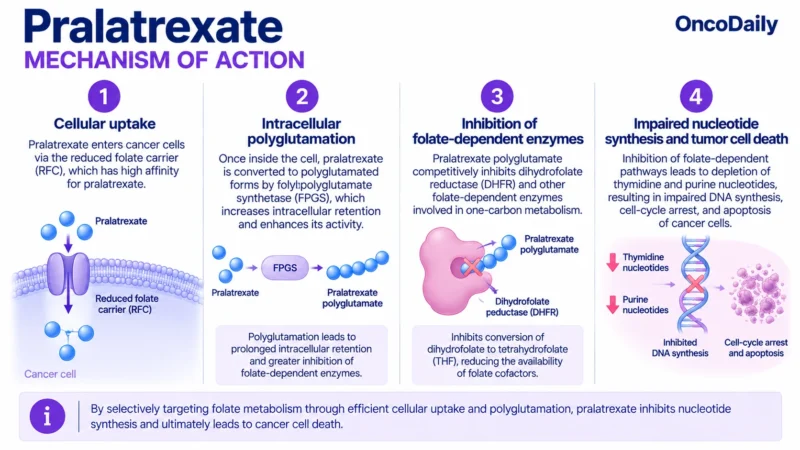
Pralatrexate acts through several interconnected steps:
1. Cellular Uptake
Pralatrexate has a high affinity for the reduced folate carrier, facilitating its transport into cells.
2. Intracellular Polyglutamation
After entering the cell, pralatrexate is converted into polyglutamated metabolites by folylpolyglutamate synthetase.
This increases intracellular retention and enhances its ability to inhibit folate-dependent enzymes.
3. DHFR Inhibition
Pralatrexate competitively inhibits dihydrofolate reductase (DHFR), interfering with regeneration of tetrahydrofolate derivatives required for one-carbon metabolism.
4. Nucleotide Depletion
Disruption of folate metabolism reduces synthesis of thymidine and purine nucleotides, impairing DNA synthesis and ultimately leading to inhibition of cancer-cell proliferation.
Overall pathway:
Pralatrexate → RFC uptake → polyglutamation → folate-pathway inhibition → impaired nucleotide synthesis → DNA synthesis disruption → tumor-cell death
What Is the Dose of Pralatrexate?
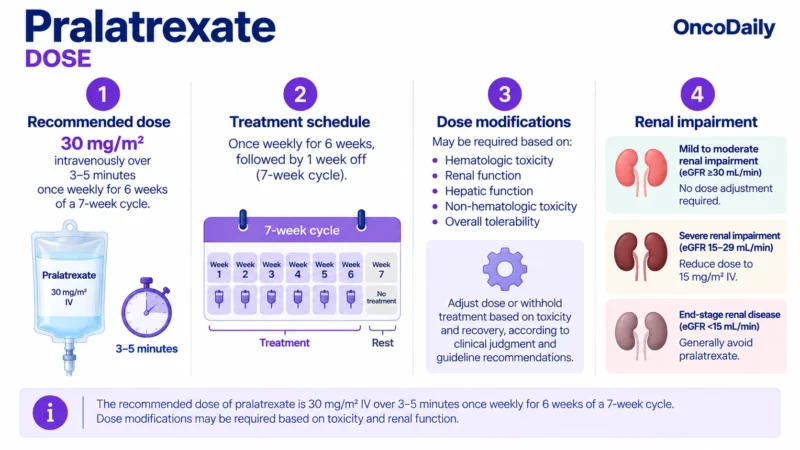
The recommended dose for relapsed or refractory PTCL is:
30 mg/m² IV over 3–5 minutes once weekly for 6 weeks in a 7-week cycle.
The treatment schedule is:
Weeks 1–6: Treatment
Week 7: Rest
Treatment may continue until disease progression or unacceptable toxicity.
Renal Impairment
For patients with severe renal impairment:
eGFR 15–29 mL/min/1.73 m² → 15 mg/m² IV
Pralatrexate should generally be avoided in patients with end-stage renal disease (eGFR <15 mL/min/1.73 m²).
How Is Pralatrexate Administered?
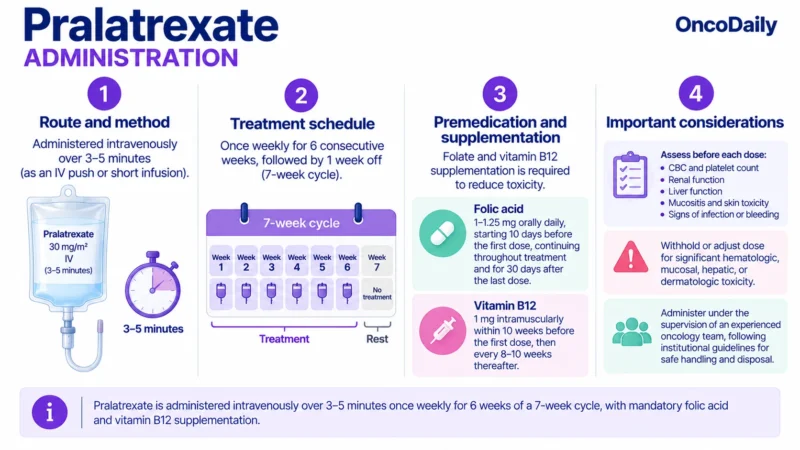
Pralatrexate is administered by intravenous injection over 3–5 minutes.
It is given once weekly for six weeks followed by one week without treatment.
Before treatment, patients should have appropriate laboratory assessment, including:
- CBC and platelet count
- Renal function
- Liver function
- Assessment for mucositis
- Assessment for skin toxicity
- Assessment for infection and bleeding
Dose interruptions or reductions may be required for clinically significant toxicity.
Does Pralatrexate Require an In-Line Filter?
No routine in-line filter is specified in the prescribing information.
Preparation and administration should follow the product information and institutional hazardous-drug handling procedures.
Does Pralatrexate Require Premedication?
The most important supportive treatment is folic acid and vitamin B12 supplementation.
Folic Acid
Patients should receive:
Folic acid 1–1.25 mg orally once daily
starting 10 days before the first pralatrexate dose, continuing throughout treatment and for 30 days after the final dose.
Vitamin B12
Patients should receive:
Vitamin B12 1 mg intramuscularly
within 10 weeks before the first pralatrexate dose and every 8–10 weeks thereafter.
These supplements help reduce treatment-related toxicity, particularly hematologic and mucosal toxicity.
Are Dose Reductions Used?
Yes.
Dose modification may be required for:
- Neutropenia
- Thrombocytopenia
- Anemia
- Febrile neutropenia
- Significant mucositis
- Hepatic toxicity
- Renal impairment
- Significant dermatologic toxicity
- Other severe nonhematologic toxicities
Treatment should be withheld until clinically significant toxicity improves and then resumed at an appropriate reduced dose when indicated.
What Is the Pharmacokinetic Profile of Pralatrexate?
Pralatrexate is administered intravenously and demonstrates approximately dose-proportional systemic exposure across the studied dose range.
Its distinctive pharmacologic properties include:
- Efficient uptake through the reduced folate carrier
- Intracellular polyglutamation
- Prolonged intracellular retention
- Inhibition of folate-dependent enzymes
Renal function is clinically important because impaired renal clearance can increase systemic exposure and toxicity.
What Are the Clinical Uses of Pralatrexate?
Relapsed or Refractory Peripheral T-Cell Lymphoma
The primary FDA-approved indication is relapsed or refractory peripheral T-cell lymphoma.
Read more: Peripheral T-Cell Lymphoma (PTCL): Types, Symptoms, Diagnosis, and Treatment
PTCL includes several mature T-cell lymphoma subtypes, including:
- PTCL-not otherwise specified
- Angioimmunoblastic T-cell lymphoma
- Anaplastic large-cell lymphoma
- Other mature T-cell lymphomas
Pralatrexate is generally used after prior systemic therapy.
Cutaneous T-Cell Lymphoma
Pralatrexate has demonstrated activity in cutaneous T-cell lymphoma (CTCL) in clinical studies.
However, CTCL is not the primary FDA-approved indication for pralatrexate in the United States.
Combination Strategies
Pralatrexate has also been investigated in combination with other agents, including:
- Romidepsin
- Other epigenetic therapies
- Targeted therapies
These combinations remain investigational unless specifically approved for a particular indication.
Watch more: Brentuximab Vedotin Overview and Treatment Advice — OncLive
What Did Clinical Trials Show?
PROPEL Trial
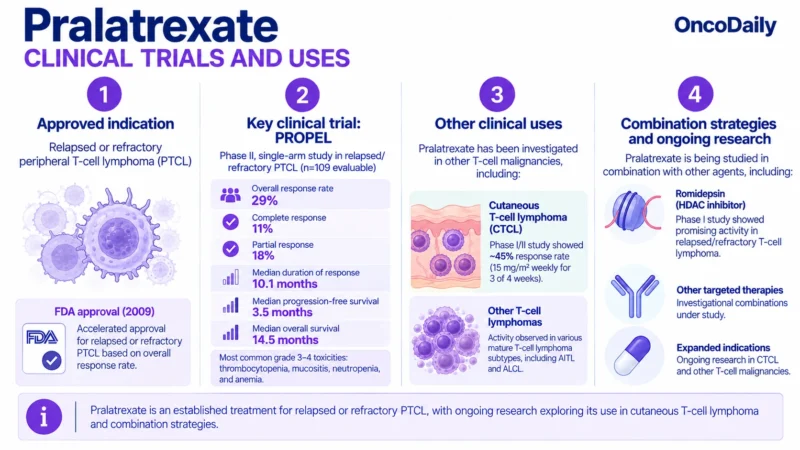
The pivotal PROPEL phase II study evaluated pralatrexate in patients with relapsed or refractory PTCL.
Among 109 evaluable patients:
- Overall response rate: 29%
- Complete response: 11%
- Partial response: 18%
- Median duration of response: 10.1 months
- Median progression-free survival: 3.5 months
- Median overall survival: 14.5 months
The most important grade 3–4 toxicities included:
- Thrombocytopenia
- Mucositis
- Neutropenia
- Anemia
The study provided the pivotal evidence supporting FDA accelerated approval.
Pralatrexate Plus Romidepsin
A phase I study investigated pralatrexate combined with the HDAC inhibitor romidepsin in relapsed/refractory T-cell lymphoma.
Among evaluable patients, the combination demonstrated substantial antitumor activity, including responses in PTCL.
This combination remains an investigational approach rather than the standard FDA-approved use of pralatrexate.
Cutaneous T-Cell Lymphoma
Clinical studies have also demonstrated activity in CTCL. In one phase I/II study, a recommended regimen of 15 mg/m² weekly for 3 of 4 weeks produced a response rate of approximately 45% among patients treated at the recommended dose.
This provides evidence for pralatrexate’s broader activity across T-cell malignancies, although the indication remains distinct from its FDA-approved PTCL indication.
Is Pralatrexate FDA Approved?
Yes.
Pralatrexate received FDA accelerated approval in 2009 for:
Relapsed or refractory peripheral T-cell lymphoma.
The approval was based primarily on overall response rate demonstrated in the pivotal clinical study.
What Is the Current Clinical Role of Pralatrexate?
Pralatrexate remains an established systemic treatment option for relapsed or refractory PTCL.
Its distinctive mechanism, based on reduced folate carrier uptake and intracellular polyglutamation, differentiates it from conventional antifolate agents.
However, treatment is limited by clinically significant mucositis and hematologic toxicity, making vitamin supplementation, laboratory monitoring, and dose modification essential.
The treatment landscape for PTCL has continued to expand, with targeted therapies, antibody-drug conjugates, epigenetic agents, cellular therapies, and transplantation all contributing to individualized treatment strategies.
What Are the Major Side Effects of Pralatrexate?
Mucositis
Mucositis is one of the characteristic toxicities of pralatrexate.
It can range from mild oral discomfort to severe mucosal ulceration that interferes with oral intake.
Myelosuppression
Important hematologic toxicities include:
- Thrombocytopenia
- Neutropenia
- Anemia
- Febrile neutropenia
CBC monitoring is therefore required throughout treatment.
Gastrointestinal Toxicity
Patients may experience:
- Nausea
- Vomiting
- Diarrhea
- Constipation
- Decreased appetite
Hepatotoxicity
Elevations in liver enzymes and other hepatic abnormalities may occur, requiring monitoring during treatment.
Dermatologic Toxicity
Skin reactions can occur and may occasionally become severe. Patients should be monitored for progressive or severe dermatologic reactions.
Tumor Lysis Syndrome
Patients with a high tumor burden may be at risk for tumor lysis syndrome, particularly when treatment produces a rapid response.