


Pertuzumab (Perjeta): Mechanism of Action, Dosing, Clinical Uses, Trials, and Side Effects
Key takeaways
- Pertuzumab is a HER2-directed monoclonal antibody targeting extracellular subdomain II.
- It inhibits HER2 heterodimerization, particularly HER2–HER3 interactions.
- It was initially FDA approved in 2012.
- It complements trastuzumab through a different HER2-binding mechanism.
- Standard dosing is 840 mg IV loading, followed by 420 mg every three weeks.
- CLEOPATRA demonstrated a substantial overall survival benefit in metastatic HER2-positive breast cancer.
- NeoSphere established improved pathological complete response with neoadjuvant dual HER2 blockade.
- APHINITY demonstrated long-term disease-free and overall survival benefits, particularly in node-positive disease.
- DESTINY-Breast09 supported trastuzumab deruxtecan plus pertuzumab as a newer first-line metastatic treatment.
- Major safety concerns include diarrhea, cardiac dysfunction, infusion reactions, and embryo-fetal toxicity.
- Routine cardiac monitoring is essential.
- Pertuzumab remains important in modern HER2-positive breast cancer treatment.
Pertuzumab (Perjeta) is a humanized monoclonal antibody targeting human epidermal growth factor receptor 2 (HER2/ERBB2). By binding the extracellular dimerization domain of HER2, pertuzumab inhibits receptor interactions that activate oncogenic signaling pathways involved in tumor-cell proliferation and survival.
First approved by the FDA in June 2012, pertuzumab transformed the treatment of HER2-positive breast cancer by introducing effective dual HER2 blockade alongside trastuzumab. Unlike trastuzumab, which binds extracellular subdomain IV, pertuzumab binds subdomain II of HER2, preventing ligand-dependent heterodimerization, particularly with HER3.
Pertuzumab is approved in combination with trastuzumab and chemotherapy for selected patients with early and metastatic HER2-positive breast cancer. More recently, its clinical role expanded through combination with trastuzumab deruxtecan, which received FDA approval for first-line unresectable or metastatic HER2-positive breast cancer in December 2025.
Pertuzumab is administered intravenously, with a standard 840-mg loading dose followed by 420 mg every three weeks. Its clinical efficacy has been established in pivotal trials including CLEOPATRA, NeoSphere, APHINITY, and DESTINY-Breast09.
Key Facts
- Generic name: Pertuzumab
- Brand name: Perjeta
- Drug class: HER2-directed monoclonal antibody
- Antibody type: Humanized IgG1
- Molecular target: HER2/ERBB2
- Binding site: HER2 extracellular subdomain II
- Mechanism: Inhibition of HER2 heterodimerization and antibody-dependent cellular cytotoxicity
- Initial FDA approval: June 2012
- Administration: Intravenous infusion
- Loading dose: 840 mg IV
- Maintenance dose: 420 mg IV every 3 weeks
- Available strength: 420 mg/14 mL
- Primary indications: HER2-positive early and metastatic breast cancer
- Essential biomarker: HER2 overexpression or amplification
- Common combinations: Trastuzumab with chemotherapy; trastuzumab deruxtecan in eligible metastatic disease
- Subcutaneous option: PHESGO, containing pertuzumab, trastuzumab, and hyaluronidase
- Major adverse reactions: Diarrhea, fatigue, nausea, rash, alopecia, neutropenia
- Boxed warnings: Left ventricular dysfunction and embryo-fetal toxicity
- Important monitoring: LVEF, infusion reactions, hypersensitivity, blood counts, pregnancy status
- Metabolism: Proteolytic catabolism
- Elimination half-life: Approximately 18 days
What Is Pertuzumab?
Pertuzumab is a recombinant humanized monoclonal antibody that selectively binds subdomain II of the extracellular region of HER2.
HER2 is a member of the ERBB family of receptor tyrosine kinases and plays an important role in cellular growth and survival.
HER2 amplification and overexpression can drive excessive signaling through:
- PI3K–AKT–mTOR
- RAS–RAF–MEK–ERK
Pertuzumab inhibits HER2 dimerization with other ERBB receptors, particularly HER3, thereby reducing downstream oncogenic signaling.
Its binding site differs from trastuzumab, making the two antibodies complementary.
Dual HER2 blockade with pertuzumab and trastuzumab inhibits HER2 signaling through distinct mechanisms and enhances antitumor activity.
What Is the Mechanism of Action of Pertuzumab?
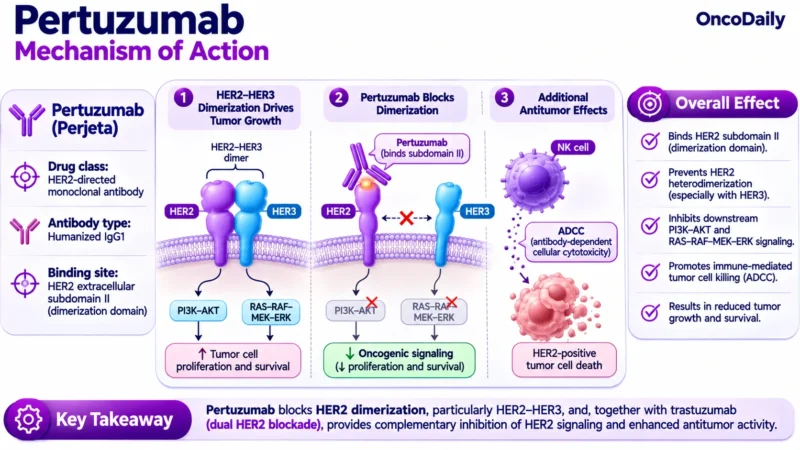
1. HER2 Overexpression Promotes Tumor Growth
HER2-positive tumor cells express increased levels of HER2 receptors.
HER2 can form heterodimers with other ERBB receptors, especially HER3.
HER2–HER3 signaling strongly activates pathways associated with tumor proliferation and survival.
2. Pertuzumab Binds HER2 Subdomain II
Pertuzumab attaches to the extracellular dimerization domain of HER2.
This prevents ligand-dependent HER2 heterodimerization.
3. Downstream Signaling Is Suppressed
Inhibition of HER2 heterodimerization reduces activation of:
- PI3K–AKT
- RAS–RAF–MEK–ERK
These effects limit tumor-cell proliferation and survival signaling.
4. Immune-Mediated Cytotoxicity Is Activated
Pertuzumab can recruit immune effector cells through its Fc region.
This promotes:
Antibody-dependent cellular cytotoxicity (ADCC).
5. Dual HER2 Blockade Enhances Antitumor Activity
Pertuzumab and trastuzumab target different extracellular regions of HER2.
Their combined effects provide complementary suppression of HER2-driven signaling.
Overall mechanism:
Pertuzumab → HER2 subdomain II binding → inhibition of HER2 heterodimerization + ADCC → reduced oncogenic signaling and tumor growth.
What Is the Recommended Dose of Pertuzumab?
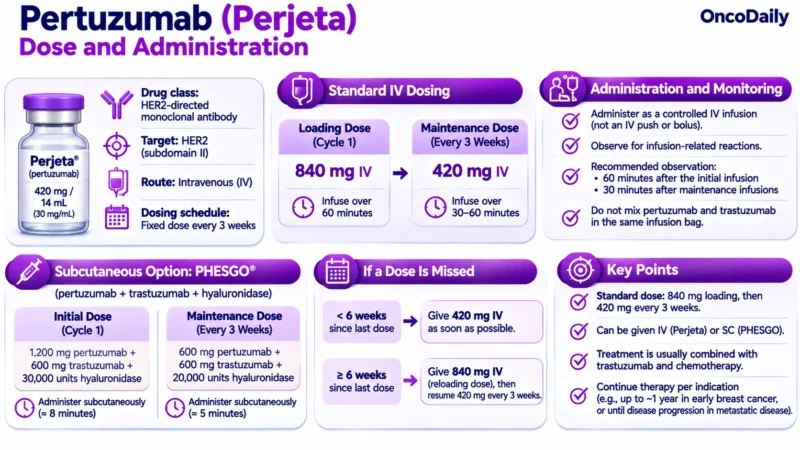
Standard Intravenous Schedule
The recommended dose is:
Loading dose: 840 mg IV
followed by:
Maintenance dose: 420 mg IV every 3 weeks.
This fixed-dose schedule is used across the approved intravenous indications.
Neoadjuvant HER2-Positive Breast Cancer
Pertuzumab is administered with trastuzumab and chemotherapy before surgery.
The FDA-approved approach includes:
840 mg loading, then 420 mg every three weeks.
Typically, 3–6 preoperative cycles are administered as part of the complete treatment regimen.
Following surgery, HER2-directed therapy generally continues to complete approximately one year, with subsequent treatment adapted to pathological response and clinical circumstances.
Adjuvant HER2-Positive Breast Cancer
For patients at high risk of recurrence:
840 mg IV loading, followed by 420 mg every 3 weeks.
Pertuzumab is administered with trastuzumab and appropriate systemic therapy.
Treatment generally continues for:
One year, up to 18 cycles.
Metastatic HER2-Positive Breast Cancer
Pertuzumab is administered with an appropriate HER2-directed combination.
The standard pertuzumab schedule remains:
840 mg IV initially, followed by 420 mg every 3 weeks.
Treatment continues until disease progression or unacceptable toxicity.
The specific combination regimen depends on the treatment line, clinical indication, and current treatment standards.
How Should Pertuzumab Be Administered?
Intravenous Administration
Pertuzumab must be administered as a controlled intravenous infusion.
It must not be administered as an IV push or bolus.
Initial Infusion
840 mg over 60 minutes.
Maintenance Infusions
420 mg over 30–60 minutes.
Patients should be monitored for infusion-related reactions.
Observation is recommended for:
- 60 minutes after the initial infusion
- 30 minutes after maintenance infusions
Combination With Trastuzumab
Pertuzumab and trastuzumab are administered as separate products when using intravenous formulations.
They must not be mixed in the same infusion bag.
Subcutaneous Formulation — PHESGO
A separate fixed-dose combination contains:
Pertuzumab + trastuzumab + hyaluronidase.
Initial dose:
1,200 mg pertuzumab + 600 mg trastuzumab + 30,000 units hyaluronidase.
Maintenance every three weeks:
600 mg pertuzumab + 600 mg trastuzumab + 20,000 units hyaluronidase.
PHESGO is administered subcutaneously into the thigh.
The initial administration takes approximately eight minutes, while maintenance administration takes approximately five minutes.
PHESGO must not be administered intravenously.
What Should You Do If a Pertuzumab Dose Is Missed?
Management depends on the interval since the previous dose.
Less Than Six Weeks Since the Previous Dose
Administer:
420 mg IV as soon as possible.
Do not wait until the next scheduled treatment date.
Six Weeks or More Since the Previous Dose
Readminister the loading dose:
840 mg IV over 60 minutes.
Then resume:
420 mg every three weeks.
When administered with trastuzumab, the trastuzumab dosing schedule must also be reviewed for possible reloading.
How Are Pertuzumab Dose Modifications Managed?
Pertuzumab does not have a routine stepwise dose-reduction schedule.
Management generally involves treatment interruption, infusion-rate adjustments, or discontinuation.
Left Ventricular Dysfunction
Assess LVEF before treatment and at regular intervals.
For metastatic breast cancer, withhold pertuzumab and trastuzumab for at least three weeks if LVEF decreases to:
- Less than 40%; or
- 40–45% with a decrease of at least 10 percentage points from baseline.
For early breast cancer, treatment should be withheld when LVEF falls below 50% with a decrease of at least 10 percentage points from baseline.
Resumption depends on recovery to the indication-specific LVEF thresholds.
Infusion-Related Reactions
For clinically significant reactions:
- Slow or interrupt the infusion.
- Provide appropriate supportive treatment.
- Assess whether treatment can safely resume.
For severe hypersensitivity or anaphylaxis:
Immediately discontinue the infusion and administer emergency treatment.
Permanent Discontinuation
Pertuzumab should be permanently discontinued when clinically indicated for severe cardiac dysfunction, serious hypersensitivity, or other unacceptable toxicity.
When trastuzumab is permanently discontinued, pertuzumab must also be discontinued under the IV product labeling.
What Drug Interactions Are Important With Pertuzumab?
Anthracyclines
The most important treatment-related concern is additive cardiotoxicity.
Concurrent administration with anthracyclines may increase the risk of left ventricular dysfunction.
When an anthracycline-based regimen is used, pertuzumab and trastuzumab are administered after completing the anthracycline component.
Trastuzumab
Pertuzumab is intentionally combined with trastuzumab to provide complementary HER2 inhibition.
However, the combination requires regular cardiac monitoring.
Cytotoxic Chemotherapy
Chemotherapy combinations may increase:
- Neutropenia
- Diarrhea
- Fatigue
- Peripheral neuropathy
- Infection risk
CYP450 Interactions
Pertuzumab is not primarily metabolized through CYP450 enzymes.
Conventional CYP-mediated interactions are not expected to be clinically significant.
Does Pertuzumab Require Dose Adjustment in Renal or Hepatic Impairment?
Renal Impairment
No routine dose adjustment is required for mild or moderate renal impairment.
Data in severe renal impairment are limited.
Hepatic Impairment
Pertuzumab is cleared predominantly through antibody catabolism.
Its pharmacokinetics in hepatic impairment have not been adequately studied.
No established hepatic dose-adjustment algorithm is available.
What Is the Pharmacokinetic Profile of Pertuzumab?
Half-Life
Pertuzumab has a median elimination half-life of approximately:
18 days.
Distribution
Distribution occurs mainly within vascular and extracellular compartments.
Metabolism
Pertuzumab undergoes:
Proteolytic catabolism
into peptides and amino acids.
Clearance
Median clearance is approximately:
0.24 L/day.
Steady State
With the recommended 840-mg loading dose followed by 420 mg every three weeks, steady-state concentrations are reached after the first maintenance dose.
What Are the Clinical Uses of Pertuzumab?
Neoadjuvant HER2-Positive Breast Cancer
Pertuzumab is used with trastuzumab and chemotherapy for selected patients with:
- Locally advanced HER2-positive breast cancer
- Inflammatory breast cancer
- Early-stage disease with tumor size greater than 2 cm or node-positive disease
Dual HER2 blockade improves pathological complete response rates.
Adjuvant HER2-Positive Breast Cancer
Pertuzumab is approved with trastuzumab and chemotherapy in patients at high risk of recurrence.
The clearest long-term benefit has been demonstrated in node-positive disease.
Metastatic HER2-Positive Breast Cancer
Pertuzumab is an important component of HER2-directed combination treatment.
Historically, the combination of:
Pertuzumab + trastuzumab + docetaxel
established a major first-line standard.
In 2025, the FDA also approved:
Trastuzumab deruxtecan + pertuzumab
for first-line treatment of eligible unresectable or metastatic HER2-positive breast cancer.
What Molecular Testing Is Required Before Pertuzumab?
HER2 Testing
HER2 status must be confirmed using validated tests.
Common methods include:
- Immunohistochemistry (IHC)
- In situ hybridization (ISH)
HER2-positive disease is generally defined by:
IHC 3+ or HER2 amplification by ISH.
HER2-low disease alone is not an established indication for pertuzumab.
Baseline Cardiac Assessment
Measure:
Left ventricular ejection fraction (LVEF).
Additional evaluation may include cardiovascular risk assessment, previous anthracycline exposure, and existing cardiac disease.
What Did the Pivotal Clinical Trials Show?
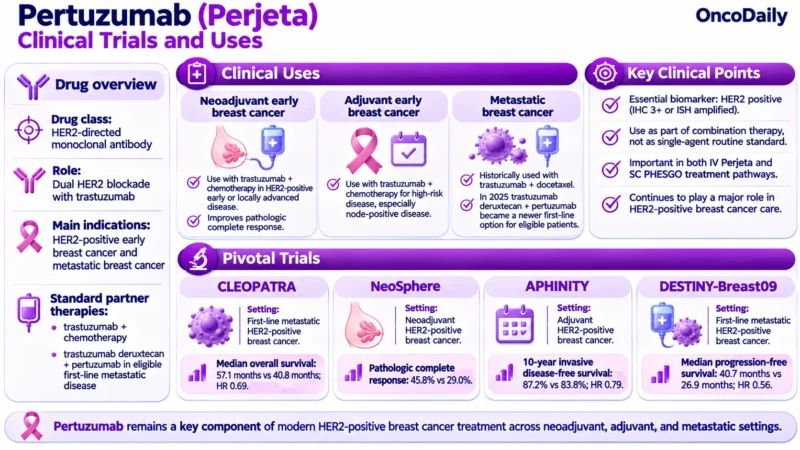
CLEOPATRA — Metastatic HER2-Positive Breast Cancer
The phase III CLEOPATRA study evaluated:
- Pertuzumab + trastuzumab + docetaxel
- Placebo + trastuzumab + docetaxel
The trial randomized 808 patients with previously untreated HER2-positive metastatic breast cancer.
Median Overall Survival
- Pertuzumab combination: 57.1 months
- Control: 40.8 months
HR: 0.69
Eight-Year Overall Survival
- Pertuzumab combination: 37%
- Control: 23%
CLEOPATRA established a substantial survival advantage from dual HER2 blockade.
NeoSphere — Neoadjuvant HER2-Positive Breast Cancer
The randomized phase II NeoSphere study evaluated pertuzumab and trastuzumab with or without docetaxel in early or locally advanced HER2-positive breast cancer.
The trial enrolled 417 patients.
Pathological Complete Response in the Breast
- Pertuzumab + trastuzumab + docetaxel: 45.8%
- Trastuzumab + docetaxel: 29.0%
p = 0.0141
NeoSphere demonstrated improved pathological complete response with dual HER2 blockade.
APHINITY — Adjuvant HER2-Positive Breast Cancer
The phase III APHINITY trial compared:
- Pertuzumab + trastuzumab + chemotherapy
Placebo + trastuzumab + chemotherapy
Approximately 4,800 patients with operable HER2-positive breast cancer were randomized.
Ten-Year Invasive Disease-Free Survival
- Pertuzumab: 87.2%
- Placebo: 83.8%
HR: 0.79
Ten-Year Overall Survival
- Pertuzumab: 91.6%
- Placebo: 89.8%
HR: 0.83
Final long-term results presented in 2025 demonstrated an overall survival advantage, particularly in patients with node-positive disease.
Read More: APHINITY Trial Update Shows Overall Survival Benefit With Pertuzumab in HER2-Positive Breast Cancer by OncoDaily.
DESTINY-Breast09 — First-Line Metastatic Breast Cancer
The phase III DESTINY-Breast09 trial compared:
- Trastuzumab deruxtecan + pertuzumab
- Taxane + trastuzumab + pertuzumab
The full trial enrolled 1,157 patients across three treatment arms.
Median Progression-Free Survival
- Trastuzumab deruxtecan + pertuzumab: 40.7 months
- Taxane + trastuzumab + pertuzumab: 26.9 months
HR: 0.56
p < 0.00001
Objective Response Rate
- Trastuzumab deruxtecan + pertuzumab: 85.1%
- Control: 78.6%
These findings supported the December 2025 FDA approval of trastuzumab deruxtecan plus pertuzumab for first-line metastatic HER2-positive breast cancer.
Does Pertuzumab Have CNS Activity?
Pertuzumab is a large monoclonal antibody with limited penetration across an intact blood–brain barrier.
Consequently, pertuzumab alone is not considered a CNS-directed treatment.
It may be included in systemic HER2-directed regimens for patients with brain metastases, depending on the broader treatment strategy.
Other agents, including tucatinib-containing regimens and trastuzumab deruxtecan, have demonstrated clinically relevant intracranial activity.
Is Pertuzumab FDA Approved?
Yes.
Pertuzumab received initial FDA approval in:
June 2012.
The intravenous reference product Perjeta is approved with trastuzumab and chemotherapy for selected patients with:
- HER2-positive metastatic breast cancer
- HER2-positive breast cancer requiring neoadjuvant treatment
- HER2-positive early breast cancer at high risk of recurrence requiring adjuvant treatment
In December 2025, pertuzumab also became part of the FDA-approved first-line combination with trastuzumab deruxtecan for eligible metastatic disease.
The separate subcutaneous combination PHESGO was approved in June 2020.
An interchangeable pertuzumab biosimilar, Poherdy (pertuzumab-dpzb), also received FDA approval in 2025.
What Is the Current Clinical Role of Pertuzumab in 2026?
Early HER2-Positive Breast Cancer
Pertuzumab remains an important component of neoadjuvant HER2-directed treatment in eligible patients.
In the adjuvant setting, the strongest evidence supports additional benefit in node-positive or otherwise high-risk disease.
For patients with residual invasive disease following neoadjuvant therapy, post-neoadjuvant treatment should be adapted to the response and current standards.
Watch More: Trastuzumab (Herceptin) & Pertuzumab (Perjeta) for HER2+ Breast Cancer: A Complete Guide.
Metastatic HER2-Positive Breast Cancer
Pertuzumab remains an important component of first-line treatment.
Historically, taxane–trastuzumab–pertuzumab was the leading first-line standard.
The approval of trastuzumab deruxtecan plus pertuzumab in December 2025 expanded treatment options and established a new first-line approach for eligible patients.
Thus, pertuzumab remains clinically relevant despite the transition toward HER2-directed antibody-drug conjugates.
Subcutaneous HER2-Directed Treatment
PHESGO offers an alternative administration route for selected patients receiving pertuzumab and trastuzumab.
It can reduce administration time compared with separate intravenous infusions.
What Are the Major Side Effects of Pertuzumab?
Diarrhea
Diarrhea is one of the most common adverse reactions.
It may be more frequent when pertuzumab is combined with chemotherapy.
Severe diarrhea may cause dehydration and electrolyte abnormalities.
Left Ventricular Dysfunction
Pertuzumab can cause:
- Reduced LVEF
- Asymptomatic ventricular dysfunction
- Symptomatic heart failure
The risk is particularly important with previous or concurrent cardiotoxic treatment.
Infusion-Related Reactions
Symptoms may include:
- Fever
- Chills
- Fatigue
- Nausea
- Hypotension
- Dyspnea
Severe reactions can occur.
Hypersensitivity and Anaphylaxis
Rare severe hypersensitivity reactions may include:
- Bronchospasm
- Angioedema
- Hypotension
- Anaphylaxis
Neutropenia
Neutropenia is particularly relevant in combination with cytotoxic chemotherapy.
Febrile neutropenia may occur.
Other Common Adverse Reactions
Additional reactions include:
- Nausea
- Fatigue
- Alopecia
- Rash
- Peripheral neuropathy
- Vomiting
Embryo-Fetal Toxicity
Pertuzumab can cause fetal harm, including embryo-fetal death and birth defects.
Effective contraception is essential during treatment and for the recommended period afterward.
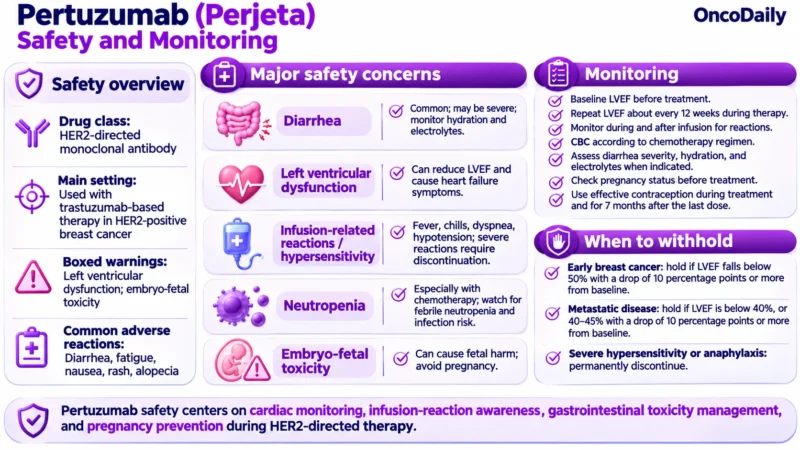
What Monitoring Is Required During Pertuzumab Treatment?
Cardiac Monitoring
Assess LVEF:
- Before treatment
- Approximately every 12 weeks during treatment
In neoadjuvant therapy, the FDA label recommends assessment at least once during the neoadjuvant phase.
Additional monitoring may be necessary in patients with cardiac risk factors.
Infusion Monitoring
Monitor for:
- Fever and chills
- Hypotension
- Dyspnea
- Hypersensitivity reactions
Observe patients during and after infusions according to the product instructions.
Gastrointestinal Monitoring
Assess:
- Diarrhea severity
- Hydration
- Electrolyte abnormalities when clinically indicated
Complete Blood Count
Monitor CBC according to the accompanying chemotherapy regimen.
Particular attention should be given to neutropenia and febrile neutropenia.
Pregnancy Monitoring
Verify pregnancy status before treatment in females of reproductive potential.
Effective contraception is recommended during treatment and for:
7 months after the final dose.
General Clinical Monitoring
Assess for:
- Fatigue
- Rash
- Neuropathy
- Infections
- Treatment-related toxicity affecting quality of life