


Pemigatinib (Pemazyre): Understanding Its Mechanism, Dosing, Clinical Uses, and Role in FGFR-Driven Cancers and Myeloid/Lymphoid Neoplasms
Key takeaways
- Pemigatinib is an oral FGFR1–3 inhibitor.
- It is FDA approved for previously treated FGFR2-rearranged cholangiocarcinoma and relapsed/refractory FGFR1-rearranged myeloid/lymphoid neoplasms.
- Cholangiocarcinoma dosing is 13.5 mg daily for 14 days followed by 7 days off.
- FGFR1-rearranged MLN dosing is 13.5 mg once daily continuously.
- FIGHT-202 showed ORR around 37%, median DoR 9.1 months, PFS 7.0 months, and OS 17.5 months in FGFR2-rearranged cholangiocarcinoma.
- FIGHT-203 showed a 78% CR rate in chronic-phase FGFR1-rearranged MLN and 79% complete cytogenetic response overall.
- The defining toxicity is hyperphosphatemia.
- Retinal toxicity, particularly RPED, requires scheduled OCT monitoring.
- Strong/moderate CYP3A inhibitors require dose reduction, while CYP3A inducers should generally be avoided.
- Severe renal or hepatic impairment requires reduction to 9 mg using the indication-specific schedule.
- Molecular testing is essential before treatment.
Pemigatinib (Pemazyre) is an oral selective inhibitor of FGFR1, FGFR2, and FGFR3. It is FDA approved for adults with previously treated, unresectable locally advanced or metastatic cholangiocarcinoma harboring an FGFR2 fusion or rearrangement, and for adults with relapsed or refractory myeloid/lymphoid neoplasms with an FGFR1 rearrangement. The current U.S. label was updated in June 2026.
Key Facts
- Generic name: Pemigatinib
- Brand name: Pemazyre
- Drug class: FGFR1–3 tyrosine kinase inhibitor
- Route: Oral
- Initial U.S. approval: 2020
- Major targets: FGFR1, FGFR2, FGFR3
- Cholangiocarcinoma dose: 13.5 mg once daily for 14 days, followed by 7 days off
- FGFR1-rearranged MLN dose: 13.5 mg once daily continuously
- Tablet strengths: 4.5 mg, 9 mg, 13.5 mg
- Food: With or without food
- Key characteristic toxicity: Hyperphosphatemia
- Major ocular toxicity: Retinal pigment epithelial detachment / serous retinal changes
- Other common toxicities: Alopecia, nail toxicity, stomatitis, diarrhea, dry eye, fatigue
- Major metabolic pathway: CYP3A4
- Important drug interaction: Strong or moderate CYP3A inhibitors and CYP3A inducers.
What Is Pemigatinib?
Pemigatinib is a small-molecule kinase inhibitor that selectively targets:
- FGFR1
- FGFR2
- FGFR3
FGFR signaling regulates:
- Cell proliferation
- Survival
- Differentiation
- Angiogenesis
In certain malignancies, genomic alterations create constitutively active FGFR signaling.
Two clinically important examples are:
FGFR2 fusions/rearrangements in cholangiocarcinoma
and:
FGFR1 rearrangements in myeloid/lymphoid neoplasms.
Pemigatinib directly inhibits these dysregulated receptors and suppresses the downstream signaling that supports malignant-cell growth.
What Is the Mechanism of Action of Pemigatinib?
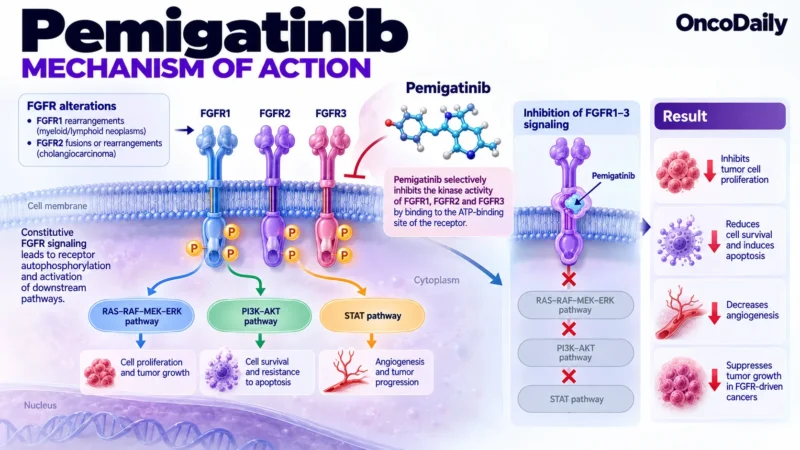
1. FGFR Alterations Activate Oncogenic Signaling
In cholangiocarcinoma, an:
FGFR2 fusion or rearrangement
can create constitutive FGFR2 kinase activation.
In FGFR1-rearranged myeloid/lymphoid neoplasms, chromosomal rearrangements can generate oncogenic FGFR1 fusion proteins.
2. Activated FGFR Drives Downstream Pathways
Constitutive FGFR signaling activates pathways including:
- RAS–RAF–MEK–ERK
- PI3K–AKT
- STAT-associated signaling
These promote:
- Proliferation
- Survival
- Resistance to apoptosis
- Tumor growth
3. Pemigatinib Inhibits FGFR1–3
Pemigatinib binds the kinase domain of FGFR receptors and inhibits their kinase activity.
4. FGFR Phosphorylation Falls
This blocks receptor autophosphorylation and downstream signaling.
5. Malignant-Cell Growth Is Suppressed
Overall:
Pemigatinib → FGFR1/2/3 inhibition → ↓ receptor phosphorylation → ↓ MAPK/PI3K signaling → ↓ proliferation and survival
This explains its activity in both:
- FGFR2-rearranged cholangiocarcinoma
- FGFR1-rearranged myeloid/lymphoid neoplasms
What Is the Recommended Dose of Pemigatinib?
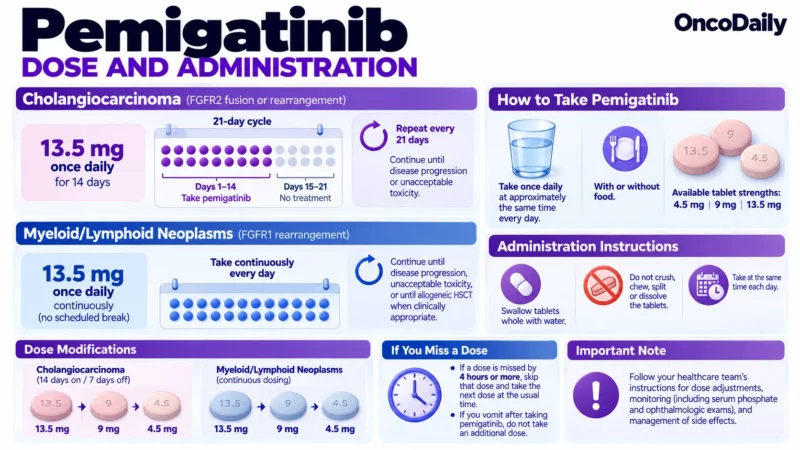
Cholangiocarcinoma
For adults with previously treated, unresectable locally advanced or metastatic cholangiocarcinoma with an FGFR2 fusion or rearrangement:
13.5 mg orally once daily for 14 consecutive days
followed by:
7 days off treatment
in each:
21-day cycle.
Continue until:
- Disease progression
- Unacceptable toxicity.
Myeloid/Lymphoid Neoplasms With FGFR1 Rearrangement
Recommended dose:
13.5 mg orally once daily continuously.
Unlike cholangiocarcinoma, there is no scheduled 7-day treatment break.
Continue until:
- Disease progression
- Unacceptable toxicity
- Or until the patient can proceed to allogeneic HSCT when clinically appropriate.
How Should Pemigatinib Be Taken?
Pemigatinib should be taken:
- Once daily
- At approximately the same time every day
- With or without food
Tablets should be swallowed whole.
Do not:
- Crush
- Chew
- Split
- Dissolve
the tablets.
What Should You Do If You Miss a Dose of Pemigatinib?
If a dose is missed by:
4 hours or more
skip that dose and take the next dose at the usual scheduled time.
If vomiting occurs after taking pemigatinib:
- Do not replace the dose
- Resume with the next scheduled dose.
How Are Pemigatinib Dose Reductions Managed?
Cholangiocarcinoma
Standard reduction sequence:
13.5 mg → 9 mg → 4.5 mg
using the same:
14 days on / 7 days off schedule.
If 4.5 mg cannot be tolerated:
discontinue pemigatinib.
FGFR1-Rearranged Myeloid/Lymphoid Neoplasms
Standard reduction sequence:
13.5 mg daily → 9 mg daily → 4.5 mg daily
If further reduction is needed, the label allows:
4.5 mg once daily for 14 days of each 21-day cycle.
Hyperphosphatemia
If serum phosphate is:
>7 to ≤10 mg/dL
- Begin phosphate-lowering therapy
- Monitor serum phosphate weekly
- Withhold pemigatinib if phosphate does not fall below 7 mg/dL within 2 weeks
- Resume at the same dose after the first event when phosphate is <7 mg/dL
- Reduce dose for subsequent recurrences.
If phosphate is:
>10 mg/dL
- Begin phosphate-lowering therapy
- Monitor weekly
- Withhold treatment if levels are not ≤10 mg/dL within 1 week
- Resume at the next lower dose when phosphate is <7 mg/dL
- Permanently discontinue for recurrence after two dose reductions.
Retinal Pigment Epithelial Detachment
If retinal abnormalities are:
asymptomatic and stable
treatment may continue with close ophthalmic follow-up.
If symptomatic or worsening:
- Withhold pemigatinib
- Resume at a lower dose if findings improve
- Consider permanent discontinuation if persistent or progressive.
Other Toxicities
For Grade 3 toxicity:
- Withhold until recovery to Grade 1 or baseline
- Resume at the next lower dose if recovery occurs within 2 weeks
Persistent or recurrent severe toxicity may require permanent discontinuation.
Grade 4 toxicity generally requires:
permanent discontinuation.
What Drug Interactions Are Important With Pemigatinib?
Pemigatinib is predominantly metabolized by:
CYP3A4.
Strong or Moderate CYP3A Inhibitors
Avoid when possible.
Itraconazole increased pemigatinib:
- Cmax by 17%
- AUC by 88%.
If a strong or moderate CYP3A inhibitor cannot be avoided:
- 13.5 mg → 9 mg
- 9 mg → 4.5 mg
After the inhibitor is discontinued, return to the previous dose after approximately:
3 plasma half-lives of the CYP3A inhibitor.
CYP3A Inducers
Strong or moderate CYP3A inducers should generally be avoided.
Rifampin reduced pemigatinib:
- Cmax by 62%
- AUC by 85%.
Examples include:
- Rifampin
- Carbamazepine
- Phenytoin
- Phenobarbital
- St. John’s wort
Does Pemigatinib Require Dose Adjustment in Renal or Hepatic Impairment?
Renal Impairment
For severe renal impairment:
eGFR 15–29 mL/min/1.73 m²
reduce the dose to:
9 mg
using the schedule appropriate for the indication.
No routine dose adjustment is recommended for:
- Mild renal impairment
- Moderate renal impairment
- ESRD on intermittent hemodialysis.
Hepatic Impairment
For severe hepatic impairment:
Total bilirubin >3 × ULN with any AST
reduce the dose to:
9 mg
using the indication-specific schedule.
No routine adjustment is required for mild or moderate hepatic impairment.
What Is the Pharmacokinetic Profile of Pemigatinib?
Half-Life
The mean elimination half-life is approximately:
15.4 hours.
Protein Binding
Pemigatinib is approximately:
90.6% protein bound.
Metabolism
Pemigatinib is primarily metabolized by:
CYP3A4.
Renal Transporters
Pemigatinib inhibits:
- OCT2
- MATE1
and can increase serum creatinine by reducing tubular secretion without necessarily reflecting a true reduction in glomerular filtration.
What Are the Clinical Uses of Pemigatinib?
Previously Treated FGFR2-Rearranged Cholangiocarcinoma
Pemigatinib is approved for adults with:
previously treated, unresectable locally advanced or metastatic cholangiocarcinoma
with an:
FGFR2 fusion or other rearrangement
detected by an FDA-approved test.
Relapsed or Refractory FGFR1-Rearranged Myeloid/Lymphoid Neoplasms
Pemigatinib is also approved for adults with:
relapsed or refractory myeloid/lymphoid neoplasms with an FGFR1 rearrangement.
These are rare neoplasms caused by chromosome 8p11 rearrangements that generate constitutively active FGFR1 fusion proteins.
What Did the Pivotal Clinical Trials Show?
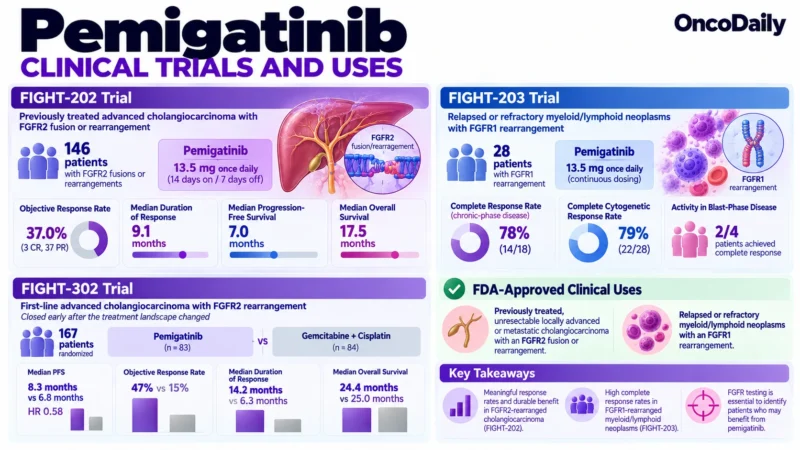
FIGHT-202
The phase II FIGHT-202 trial established pemigatinib in previously treated advanced cholangiocarcinoma with FGFR2 alterations.
Patients received:
13.5 mg once daily for 14 days, followed by 7 days off
in 21-day cycles.
In the final analysis, among patients with FGFR2 fusions or rearrangements:
Objective Response Rate
37.0%
with:
- 3 complete responses
- 37 partial responses
Median Duration of Response
9.1 months
Median Progression-Free Survival
7.0 months
Median Overall Survival
17.5 months.
The FDA-label efficacy population reported an ORR of approximately:
36%
with a median DoR of:
9.1 months.
FIGHT-203
The phase II FIGHT-203 study evaluated pemigatinib in adults with FGFR1-rearranged myeloid/lymphoid neoplasms.
The current FDA-label analysis included:
28 patients.
Among patients with chronic-phase disease in the marrow with or without extramedullary disease:
Complete response: 78% (14/18).
Median duration of complete response was:
not reached.
Among four patients with blast-phase disease:
2 achieved complete response.
Across all 28 patients:
Complete cytogenetic response: 79% (22/28).
The mature 2025 publication confirmed particularly high activity in chronic-phase MLN-FGFR1 and clinically meaningful responses in blast-phase disease.
FIGHT-302
The phase III FIGHT-302 trial evaluated first-line pemigatinib versus gemcitabine/cisplatin in advanced FGFR2-rearranged cholangiocarcinoma.
The trial closed early after the standard-of-care landscape changed, but among:
167 randomized patients
median PFS was:
- Pemigatinib: 8.3 months
- Chemotherapy: 6.8 months
HR:
0.58
Objective response rate was:
- 47%
- 15%
respectively.
Median duration of response was:
- 14.2 months
- 6.3 months
while median OS was similar:
- 24.4 months
- 25.0 months.
These data are important scientifically but do not change the current FDA indication, which remains previously treated FGFR2-rearranged cholangiocarcinoma.
Is Pemigatinib FDA Approved?
Yes.
Current FDA-approved indications include:
Cholangiocarcinoma
Adults with:
previously treated, unresectable locally advanced or metastatic cholangiocarcinoma
with an:
FGFR2 fusion or other rearrangement.
This indication remains under:
accelerated approval.
Myeloid/Lymphoid Neoplasms
Adults with:
relapsed or refractory myeloid/lymphoid neoplasms with FGFR1 rearrangement.
What Is the Current Clinical Role of Pemigatinib in 2026?
FGFR2-Rearranged Cholangiocarcinoma
Pemigatinib remains an established precision-therapy option for patients with previously treated advanced cholangiocarcinoma harboring an actionable FGFR2 fusion or rearrangement.
Its use requires molecular testing because benefit is concentrated in the FGFR2-rearranged population.
The mature FIGHT-202 data support:
- Durable responses
- Clinically meaningful PFS
- Median OS of approximately 17.5 months.
The 2026 FIGHT-302 results also demonstrate significant first-line antitumor activity compared with chemotherapy, although first-line regulatory use should be distinguished from the current label.
Read more: Pemigatinib (Pemazyre): Uses in Cancer, Side Effects, Dosage, Expectations and More by OncoDaily.
Watch more: The rapid growth of FGFR2 inhibitors: pemigatinib in FIGHT-202 — Arndt Vogel, MD, PhD, discusses pemigatinib in advanced cholangiocarcinoma and the FIGHT-202 trial, including the ~37% response rate that supported regulatory approval.
FGFR1-Rearranged Myeloid/Lymphoid Neoplasms
Pemigatinib has a unique role in these rare hematologic malignancies.
FIGHT-203 showed:
- Very high complete-response rates in chronic-phase disease
- Cytogenetic responses across the overall population
- Activity in blast-phase disease.
For some patients, pemigatinib may function as:
disease control or a bridge to allogeneic HSCT.
Molecular Testing Is Essential
Before treatment:
- Confirm FGFR2 fusion/rearrangement in cholangiocarcinoma using an FDA-approved test.
- Confirm FGFR1 rearrangement in MLN; no FDA-approved companion diagnostic is currently specified for this indication.
What Are the Major Side Effects of Pemigatinib?
Hyperphosphatemia
This is the most characteristic on-target toxicity.
Across clinical studies, laboratory-defined hyperphosphatemia occurred in approximately:
93%
of patients receiving 13.5 mg pemigatinib.
Median onset was approximately:
8 days.
Phosphate-lowering therapy was required in approximately:
33%.
Complications may include:
- Soft-tissue mineralization
- Cutaneous calcification
- Calcinosis
- Non-uremic calciphylaxis
Management includes:
- Low-phosphate diet
- Phosphate-lowering therapy
- Dose interruption/reduction when required.
Ocular Toxicity
Pemigatinib can cause retinal pigment epithelial detachment and related retinal changes.
Across clinical trials:
RPED occurred in approximately 11%
with Grade 3–4 events in approximately:
1.3%.
Median onset was:
56 days.
Patients may experience:
- Blurred vision
- Floaters
- Photopsia
- Visual changes
Urgent ophthalmologic evaluation is required for new visual symptoms.
Dry Eye
Dry eye occurred in approximately:
31%
of patients.
Artificial tears or ocular lubricants may be used as needed.
Gastrointestinal Toxicity
Common adverse effects include:
- Diarrhea
- Nausea
- Constipation
- Stomatitis
- Dyspepsia
- Abdominal pain
Nail and Skin Toxicity
FGFR inhibition commonly produces:
- Nail toxicity
- Onycholysis
- Nail discoloration
- Dry skin
- Rash
- Alopecia
Other Common Toxicities
These can include:
- Fatigue
- Decreased appetite
- Dry mouth
- Peripheral edema
- Extremity pain
- Dizziness
- Epistaxis.
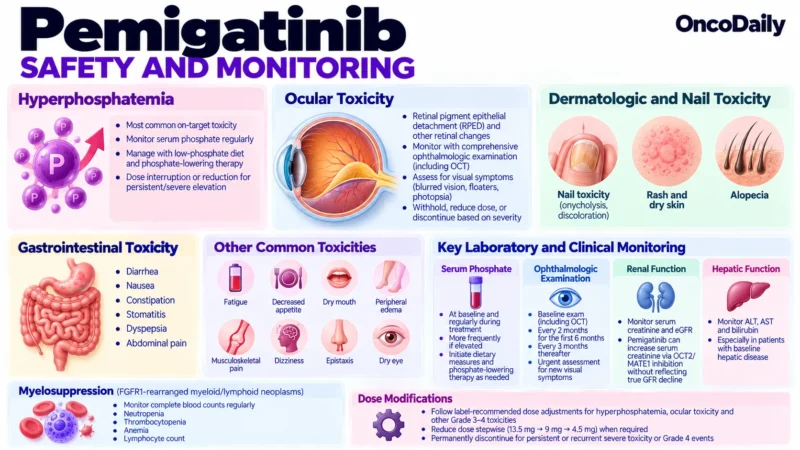
What Monitoring Is Required During Pemigatinib Treatment?
Serum Phosphate
Monitor serum phosphate:
- At baseline
- Regularly during treatment
- More frequently if elevated
If serum phosphate exceeds:
5.5 mg/dL
initiate a:
low-phosphate diet.
If levels exceed:
7 mg/dL
consider phosphate-lowering therapy and follow label-directed dose modification.
Ophthalmologic Monitoring
Perform a comprehensive ophthalmologic examination including:
optical coherence tomography (OCT)
- Before treatment
- Every 2 months for the first 6 months
- Every 3 months thereafter
If new visual symptoms occur:
- Arrange urgent ophthalmologic evaluation
- Repeat approximately every 3 weeks until resolution or discontinuation.
Renal Function
Monitor:
- Serum creatinine
- eGFR
while recognizing that pemigatinib can increase serum creatinine through OCT2/MATE1 inhibition without necessarily reducing true GFR.
Hepatic Function
Monitor:
- ALT
- AST
- Bilirubin
especially in patients with baseline hepatic disease.
Other Monitoring
Also assess:
- GI symptoms
- Nail changes
- Skin toxicity
- Dry eye
- Nutritional status
- Drug interactions
- Pregnancy status when relevant
FAQ
What is pemigatinib used for?
- Previously treated FGFR2-rearranged advanced cholangiocarcinoma
- Relapsed or refractory FGFR1-rearranged myeloid/lymphoid neoplasms
What is the standard cholangiocarcinoma dose?
What is the dose for FGFR1-rearranged MLN?
Can pemigatinib be taken with food?
It may be taken:
with or without food.
What is the most characteristic toxicity?
Does pemigatinib cause retinal toxicity?
RPED and other retinal abnormalities can occur, so scheduled ophthalmologic examination with OCT is required.
What should be done if phosphate rises?
- Dietary phosphate restriction
- Phosphate-lowering therapy when indicated
- Treatment interruption or dose reduction for persistent/severe elevation.
Does severe renal impairment require dose reduction?
For eGFR 15–29 mL/min/1.73 m²:
9 mg using the appropriate treatment schedule.
Does severe hepatic impairment require dose reduction?
The recommended dose is:
9 mg using the indication-specific schedule.
What are the main trials? -
- FIGHT-203: FGFR1-rearranged myeloid/lymphoid neoplasms
- FIGHT-302: first-line advanced FGFR2-rearranged cholangiocarcinoma