





Pembrolizumab (Keytruda): Understanding Its Mechanism, Dosing, and Clinical Role in Cancer
Key takeaways
- Pembrolizumab is a PD-1-blocking monoclonal antibody that prevents PD-1 interaction with PD-L1 and PD-L2 and restores antitumor T-cell activity.
- The standard adult IV dose is 200 mg every 3 weeks or 400 mg every 6 weeks, infused over 30 minutes.
- A subcutaneous formulation, Keytruda Qlex, is also available.
- Pembrolizumab now has one of the broadest roles in oncology, including lung, melanoma, head and neck, breast, bladder, renal, gynecologic, gastrointestinal, skin and hematologic malignancies, as well as MSI-H/dMMR and TMB-high tumor-agnostic indications.
- There are no routine dose reductions. Clinically significant immune toxicity is managed by withholding therapy, immunosuppression when indicated, or permanent discontinuation.
Pembrolizumab (Keytruda) is a humanized monoclonal antibody immune checkpoint inhibitor targeting programmed death receptor-1 (PD-1). By preventing PD-1 from interacting with its ligands PD-L1 and PD-L2, pembrolizumab releases inhibitory signaling on T cells and helps restore antitumor immune activity.
Since its first US approval in 2014, pembrolizumab has developed one of the broadest indications of any anticancer medicine. Its current role extends from neoadjuvant and adjuvant treatment of potentially curable cancers to first-line and later-line treatment of metastatic disease, as well as biomarker-defined tumor-agnostic therapy. In 2026, its label expanded further in platinum-resistant ovarian cancer, adjuvant renal cell carcinoma with belzutifan, and perioperative muscle-invasive bladder cancer with enfortumab vedotin.
Key Facts
- Generic name: Pembrolizumab
- Brand name: Keytruda
- Drug class: PD-1 immune checkpoint inhibitor
- Route: Intravenous; subcutaneous formulation also available as Keytruda Qlex
- Initial US approval: 2014
- Standard adult IV dose: 200 mg every 3 weeks or 400 mg every 6 weeks
- IV infusion time: 30 minutes
- IV formulation: 100 mg/4 mL — 25 mg/mL
- Subcutaneous formulation: Pembrolizumab + berahyaluronidase alfa-pmph
- Main mechanism: PD-1 blockade → restoration of T-cell antitumor activity
- Dose reductions: Not recommended; toxicity is managed by withholding or discontinuation
- Major safety concern: Immune-mediated adverse reactions
- In-line filter: Sterile low-protein-binding 0.2–5 micron filter
- Major monitoring: Liver enzymes, creatinine, thyroid function, respiratory symptoms, bowel symptoms, skin, endocrine function, and other organ-specific immune toxicities.
What Is Pembrolizumab?
Pembrolizumab is a humanized IgG4 monoclonal antibody against PD-1, an inhibitory receptor expressed on activated T cells.
Under physiologic conditions, PD-1 helps limit excessive immune activation. When PD-1 interacts with PD-L1 or PD-L2, intracellular inhibitory signaling reduces T-cell proliferation, cytokine production, and cytotoxic activity.
Cancer cells can exploit this pathway by expressing PD-L1, effectively creating an immune “brake” that allows them to evade T-cell-mediated destruction.
Pembrolizumab blocks PD-1 rather than PD-L1. This differentiates it mechanistically from agents such as atezolizumab, which directly binds PD-L1.
What Is the Mechanism of Action of Pembrolizumab?
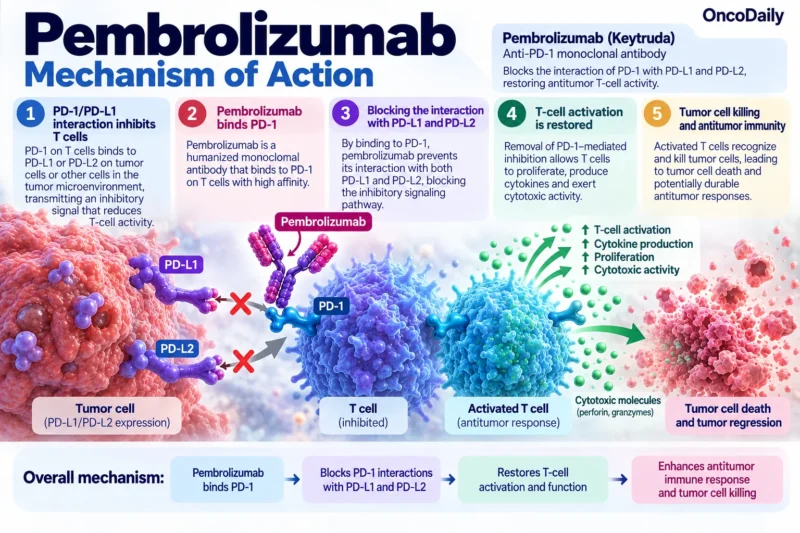
1. PD-1–Mediated Immune Suppression
PD-1 is expressed on activated T cells.
PD-L1 or PD-L2 expressed by tumor cells and other cells within the tumor microenvironment can bind PD-1 and reduce T-cell activation.
2. Pembrolizumab Binds PD-1
Pembrolizumab binds directly to the extracellular domain of PD-1.
3. PD-L1 and PD-L2 Signaling Is Blocked
The antibody prevents PD-1 from interacting with:
PD-L1
and
PD-L2.
This interrupts inhibitory checkpoint signaling.
4. T-Cell Activity Is Restored
Removal of PD-1-mediated suppression can increase:
T-cell activation, proliferation, cytokine production, tumor recognition, and cytotoxic activity.
5. Tumor Cells Are Attacked
Reactivated immune cells can recognize and destroy malignant cells, producing tumor regression or durable disease control in responsive cancers.
The mechanism can be summarized as:
Pembrolizumab → PD-1 blockade → prevents PD-L1/PD-L2 signaling → restores T-cell activity → enhanced antitumor immunity → tumor-cell killing.
What Is the Dose of Pembrolizumab?
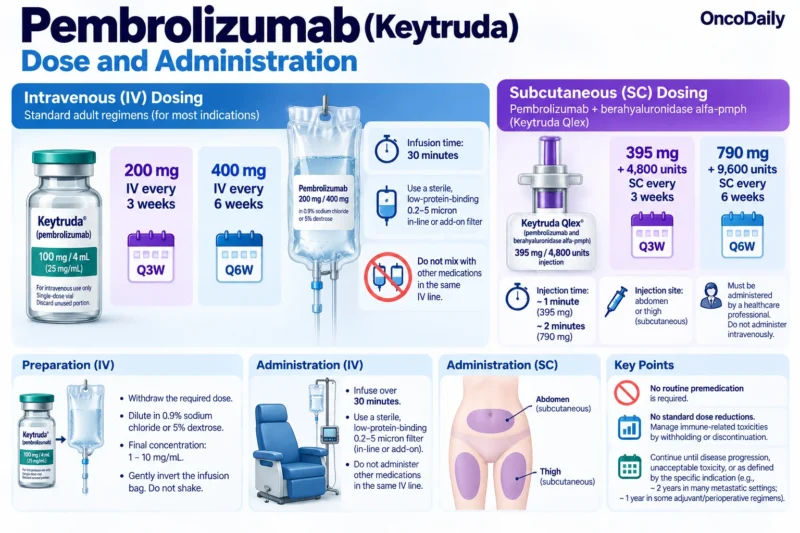
For most adult indications, the standard intravenous dose is:
200 mg IV every 3 weeks
or:
400 mg IV every 6 weeks.
Pembrolizumab is generally continued until disease progression, unacceptable toxicity, or the indication-specific maximum treatment duration. In many metastatic settings, the maximum planned duration is approximately 24 months, while several perioperative or adjuvant regimens use approximately 1 year of treatment.
For many pediatric indications, weight-based dosing is used according to the specific indication and current prescribing information.
How Is Pembrolizumab Administered?
Intravenous pembrolizumab is administered over:
30 minutes.
The commercial IV formulation contains:
100 mg in 4 mL
at:
25 mg/mL.
Before administration, the required amount is diluted in:
0.9% sodium chloride
or:
5% dextrose.
The final pembrolizumab concentration should be:
1–10 mg/mL.
The infusion bag should be mixed by gentle inversion.
Do not shake.
Does Pembrolizumab Require an In-Line Filter?
Yes.
The diluted infusion is administered through a sterile, non-pyrogenic, low-protein-binding:
0.2–5 micron in-line or add-on filter.
Other medications should not be infused simultaneously through the same line.
Does Pembrolizumab Require Premedication?
Routine corticosteroid or antihistamine premedication is not generally required in patients without a previous infusion-related reaction.
Patients who develop mild or moderate infusion reactions may require interruption or slowing of the infusion and supportive medication. Severe or life-threatening reactions generally require permanent discontinuation.
Is There a Subcutaneous Form of Pembrolizumab?
Yes.
Keytruda Qlex combines pembrolizumab with berahyaluronidase alfa-pmph and was FDA-approved in 2025 for eligible solid-tumor indications covered by intravenous pembrolizumab.
The recommended subcutaneous schedules are:
395 mg pembrolizumab + 4,800 units berahyaluronidase every 3 weeks
or:
790 mg pembrolizumab + 9,600 units berahyaluronidase every 6 weeks.
The every-3-week dose is administered subcutaneously over approximately 1 minute, while the every-6-week dose is administered over approximately 2 minutes.
It is injected into the abdomen or thigh by a healthcare professional and must not be administered intravenously.
Does Pembrolizumab Require Dose Reduction?
No standard dose reduction is recommended.
This is an important difference from many cytotoxic drugs and targeted therapies.
For clinically significant immune-mediated toxicity, treatment is generally:
withheld
or:
permanently discontinued
depending on the organ involved and severity.
In general, Grade 3 immune-mediated reactions require treatment interruption, while many Grade 4 immune-mediated reactions require permanent discontinuation. Corticosteroids or other immunosuppressive treatment may be required.
What Are the Clinical Uses of Pembrolizumab?
Pembrolizumab now has an unusually broad oncology footprint.
Lung Cancer
Pembrolizumab is used across multiple NSCLC settings, including first-line metastatic nonsquamous NSCLC with pemetrexed/platinum, first-line metastatic squamous NSCLC with carboplatin and a taxane, PD-L1-selected monotherapy, adjuvant therapy after surgery and chemotherapy, and perioperative treatment of resectable node-positive or ≥4 cm NSCLC.
It is also approved with pemetrexed and platinum chemotherapy for unresectable advanced or metastatic malignant pleural mesothelioma.
Melanoma
Pembrolizumab is used for:
Unresectable or metastatic melanoma and adjuvant treatment after complete resection of stage IIB, IIC, or III melanoma.
Head and Neck Cancer
In recurrent or metastatic HNSCC, pembrolizumab is used either alone in PD-L1-positive disease or with platinum plus fluorouracil.
A major newer indication is perioperative pembrolizumab for resectable locally advanced HNSCC with PD-L1 CPS ≥1, beginning before surgery and continuing with postoperative radiotherapy with or without cisplatin and then maintenance pembrolizumab.
Breast Cancer
Pembrolizumab is an established component of treatment for high-risk early-stage triple-negative breast cancer, given with neoadjuvant chemotherapy and continued after surgery.
It is also used with chemotherapy for PD-L1 CPS ≥10 locally recurrent unresectable or metastatic TNBC.
Urothelial and Bladder Cancer
Pembrolizumab is used with enfortumab vedotin for locally advanced or metastatic urothelial carcinoma and in selected single-agent settings.
It also has a role in BCG-unresponsive high-risk non-muscle-invasive bladder cancer with carcinoma in situ.
In July 2026, the FDA expanded perioperative pembrolizumab plus enfortumab vedotin to all adults with muscle-invasive bladder cancer who are candidates for cystectomy, extending the indication beyond the previously cisplatin-ineligible population.
Renal Cell Carcinoma
Pembrolizumab is used with:
Axitinib
or:
Lenvatinib
for first-line advanced RCC.
It is also established as adjuvant therapy after nephrectomy in patients at increased risk of recurrence.
In June 2026, the FDA additionally approved belzutifan + pembrolizumab as adjuvant treatment for selected clear-cell RCC following nephrectomy.
Gynecologic Cancers
Pembrolizumab has major roles in cervical and endometrial cancer.
It is used with chemoradiotherapy in FIGO 2014 stage III–IVA cervical cancer, and with chemotherapy ± bevacizumab in PD-L1-positive persistent, recurrent, or metastatic cervical cancer.
For endometrial cancer, pembrolizumab may be combined with carboplatin/paclitaxel in primary advanced or recurrent disease, combined with lenvatinib in selected pMMR disease, or used alone in selected MSI-H/dMMR tumors.
In February 2026, pembrolizumab plus paclitaxel with or without bevacizumab was approved for PD-L1 CPS ≥1 platinum-resistant epithelial ovarian, fallopian-tube, or primary peritoneal carcinoma after one or two prior systemic regimens.
Gastrointestinal Cancers
Pembrolizumab has indications in gastric/GEJ cancer, esophageal cancer, biliary tract cancer, MSI-H/dMMR colorectal cancer, and selected hepatocellular carcinoma.
Its gastric indications include both HER2-positive disease with trastuzumab and chemotherapy and HER2-negative disease with fluoropyrimidine/platinum chemotherapy in appropriately PD-L1-selected populations.
Tumor-Agnostic Therapy
One of pembrolizumab’s most important contributions to precision oncology has been approval based on a molecular biomarker rather than tumor origin.
It has tumor-agnostic indications for selected:
MSI-H/dMMR solid tumors
and:
TMB-high tumors ≥10 mutations/megabase
after appropriate prior therapy when satisfactory alternatives are unavailable.
Pembrolizumab additionally has established indications in classical Hodgkin lymphoma, primary mediastinal large B-cell lymphoma, Merkel cell carcinoma, and cutaneous squamous cell carcinoma.
What Did Pembrolizumab Clinical Trials Show?
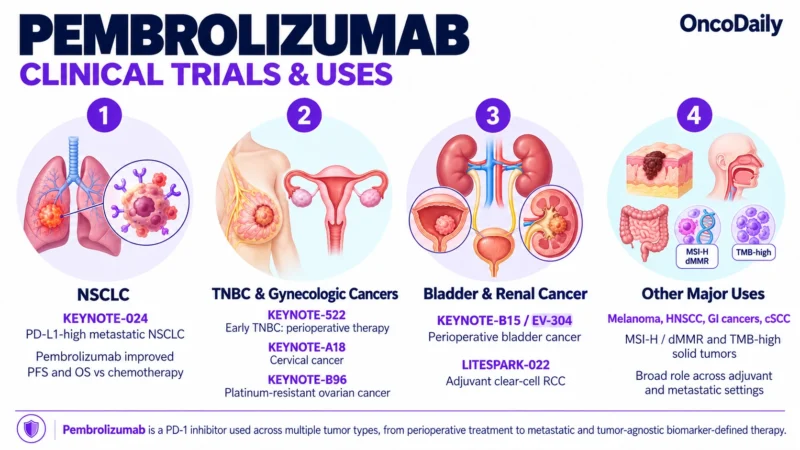
KEYNOTE-024 — First-Line PD-L1-High NSCLC
KEYNOTE-024 compared pembrolizumab with platinum chemotherapy in previously untreated metastatic NSCLC with PD-L1 TPS ≥50%.
Median PFS:
- Pembrolizumab: 10.3 months
- Chemotherapy: 6.0 months
Median overall survival:
- Pembrolizumab: 30.0 months
- Chemotherapy: 14.2 months
The trial helped establish pembrolizumab monotherapy as a major first-line option for appropriately selected PD-L1-high metastatic NSCLC.
KEYNOTE-671 — Perioperative NSCLC
KEYNOTE-671 evaluated neoadjuvant pembrolizumab plus chemotherapy followed by surgery and adjuvant pembrolizumab.
Median event-free survival was:
Not reached with pembrolizumab
versus:
17 months with control.
The hazard ratio for an EFS event was 0.58.
Overall survival also improved, with an HR for death of 0.72.
Watch more: KEYNOTE-671: Perioperative Pembrolizumab for NSCLC — Millie Das, MD, discussing perioperative pembrolizumab in stage II–IIIB NSCLC and the implications of the KEYNOTE-671 trial.
KEYNOTE-522 — Early Triple-Negative Breast Cancer
KEYNOTE-522 established the perioperative strategy of pembrolizumab plus neoadjuvant chemotherapy followed by adjuvant pembrolizumab in high-risk early TNBC.
The study demonstrated improvements in pathologic complete response and event-free survival, leading to a major shift in curative-intent TNBC management.
KEYNOTE-A18 — Locally Advanced Cervical Cancer
In FIGO 2014 stage III–IVA cervical cancer, adding pembrolizumab to chemoradiotherapy reduced the risk of progression or death.
The PFS hazard ratio was:
0.59
and the overall-survival hazard ratio in the final analysis was:
0.65.
KEYNOTE-689 — Perioperative Head and Neck Cancer
In patients with PD-L1 CPS ≥1 resectable locally advanced HNSCC:
Median event-free survival:
- Pembrolizumab strategy: 59.7 months
- Control: 29.6 months
Hazard ratio:
0.70.
KEYNOTE-B96 — Platinum-Resistant Ovarian Cancer
This 2026 trial evaluated pembrolizumab plus paclitaxel with or without bevacizumab.
Among patients with PD-L1 CPS ≥1:
- Median PFS: 8.3 vs 7.2 months
- Median OS: 18.2 vs 14.0 months
The trial led to the February 2026 FDA approval.
KEYNOTE-B15/EV-304 — Muscle-Invasive Bladder Cancer
In cisplatin-eligible patients undergoing cystectomy, perioperative pembrolizumab plus enfortumab vedotin was compared with neoadjuvant gemcitabine/cisplatin.
Median EFS was:
Not reached
versus:
48.5 months
with chemotherapy.
The hazard ratio was:
0.53.
Overall survival also significantly favored the pembrolizumab/enfortumab vedotin strategy, with an HR of 0.65.
LITESPARK-022 — Adjuvant RCC
In 1,841 patients with high-risk clear-cell RCC following nephrectomy, adding belzutifan to pembrolizumab reduced the risk of recurrence, metastasis, or death compared with pembrolizumab alone.
The DFS hazard ratio was:
0.72.
These results led to the 2026 FDA approval of the combination.
What Is the Current Clinical Role of Pembrolizumab?
Pembrolizumab is no longer simply a treatment for advanced PD-L1-positive tumors. Its role now spans the full cancer continuum.
It may be used before surgery, after surgery, with definitive chemoradiation, as first-line metastatic treatment, as maintenance or later-line therapy, and according to molecular biomarkers independent of tumor site.
The 2026 expansions are particularly illustrative of this evolution: perioperative pembrolizumab plus enfortumab vedotin in MIBC, pembrolizumab plus paclitaxel in PD-L1-positive platinum-resistant ovarian cancer, and pembrolizumab plus belzutifan in adjuvant clear-cell RCC.
Pembrolizumab has also reshaped curative-intent treatment in resectable NSCLC. Read the 5-year KEYNOTE-671 update on OncoDaily.
What Are the Major Side Effects of Pembrolizumab?
The defining toxicities of pembrolizumab are immune-mediated adverse reactions, which can involve almost any organ system and may occur during treatment or after treatment has stopped.
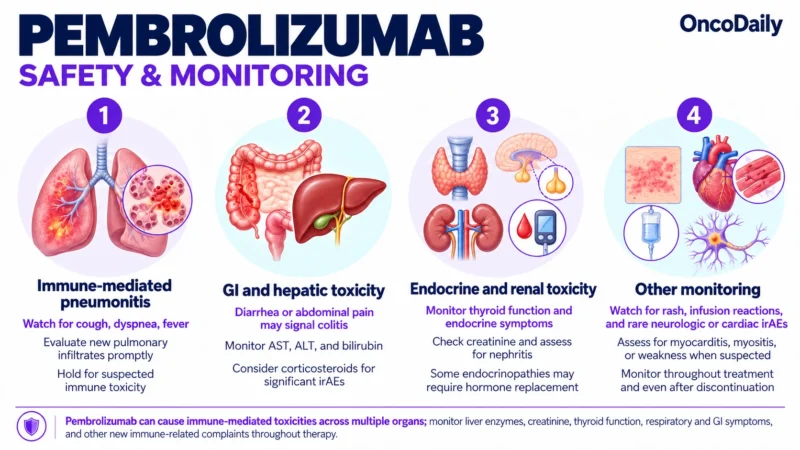
Immune-Mediated Pneumonitis
Patients may develop:
New or worsening cough, dyspnea, fever, hypoxemia, or pulmonary infiltrates.
Previous thoracic radiation can complicate assessment.
Moderate or severe immune-mediated pneumonitis generally requires treatment interruption and corticosteroids; severe or recurrent cases may require permanent discontinuation.
Immune-Mediated Colitis
Symptoms can include:
Diarrhea, abdominal pain, mucus or blood in the stool, and lower gastrointestinal bleeding.
Persistent diarrhea during checkpoint inhibition should always raise the possibility of immune-mediated colitis rather than being treated automatically as routine chemotherapy-associated diarrhea.
Immune-Mediated Hepatitis
Pembrolizumab may cause elevations in:
ALT, AST, and bilirubin.
Liver tests should therefore be assessed before and periodically during treatment.
Endocrine Toxicity
Immune-mediated endocrine disorders include:
Hypothyroidism, hyperthyroidism, thyroiditis, adrenal insufficiency, hypophysitis, and type 1 diabetes mellitus.
Some endocrinopathies can be permanent and require long-term hormone replacement.
Nephritis
Immune-mediated nephritis can present with rising creatinine and renal dysfunction.
Renal function should be monitored periodically.
Dermatologic Toxicity
Pembrolizumab can cause:
Rash, pruritus, vitiligo, and rare severe immune-mediated skin reactions including Stevens–Johnson syndrome, toxic epidermal necrolysis, and DRESS.
Neurologic, Muscular, and Cardiac Toxicity
Rare but potentially life-threatening immune toxicities include:
Myocarditis, myositis, myasthenia gravis, encephalitis, meningitis, Guillain–Barré syndrome, and peripheral neuropathies.
A 2026 US safety-label update specifically highlighted myocarditis–myositis–myasthenia gravis overlap syndrome, an uncommon but particularly serious immune-mediated presentation. FDA Access Data
Infusion-Related Reactions
Pembrolizumab can cause infusion reactions including:
Chills, fever, flushing, wheezing, hypotension, hypoxemia, and hypersensitivity reactions.
Severe reactions require permanent discontinuation.
What Monitoring Is Required?
Patients should be assessed for immune-mediated toxicity throughout therapy and even after treatment has ended.
Important routine monitoring includes liver enzymes, bilirubin, serum creatinine, and thyroid function at baseline and periodically during treatment. Clinical review should also specifically address respiratory symptoms, diarrhea and bowel habits, skin changes, endocrine symptoms, neurologic or muscular symptoms, and possible cardiac manifestations.
CBC, glucose, cortisol, pituitary testing, ECG, troponin, CK/CPK, or other organ-specific studies may be required according to symptoms and the accompanying treatment regimen.
The central safety principle is early recognition: checkpoint-inhibitor toxicity may initially appear mild but can progress rapidly in certain organ systems.
FAQ
What Is Pembrolizumab Used For?
How Does Pembrolizumab Work?
What Is the Standard Dose?
or:
400 mg IV every 6 weeks.