
The integration of immune checkpoint inhibitors into early-stage non–small-cell lung cancer (NSCLC) has changed the treatment approach for patients with resectable disease. While surgery remains the cornerstone of curative-intent treatment, recurrence after resection remains a major challenge, particularly among patients with stage II and III disease.
The phase III KEYNOTE-671 trial provides mature five-year evidence that adding pembrolizumab before and after surgery can improve long-term outcomes compared with chemotherapy and surgery alone in patients with resectable NSCLC.
Published in Annals of Oncology, the updated analysis demonstrates sustained improvements in both event-free survival (EFS) and overall survival (OS), supporting the continued development of perioperative immunotherapy strategies in early-stage lung cancer.
KEYNOTE-671 Evaluated Pembrolizumab Across the Perioperative Treatment Continuum
KEYNOTE-671 was a randomized, double-blind, placebo-controlled phase III trial evaluating perioperative pembrolizumab in patients with previously untreated, resectable stage II, IIIA, or IIIB (N2) NSCLC.
A total of 797 patients were randomized to receive either pembrolizumab or placebo in combination with platinum-based chemotherapy before surgery, followed by surgical resection and continued postoperative pembrolizumab or placebo.
The treatment approach consisted of:
- Four cycles of neoadjuvant pembrolizumab plus chemotherapy followed by surgery
- Adjuvant pembrolizumab after surgery for up to 13 cycles
The primary endpoints were event-free survival and overall survival.
The rationale behind this approach is based on the concept that immune activation before surgery may enhance recognition of tumor-specific antigens, while postoperative treatment may help eliminate residual microscopic disease.
Five-Year Follow-Up Demonstrates Sustained Event-Free Survival Improvement
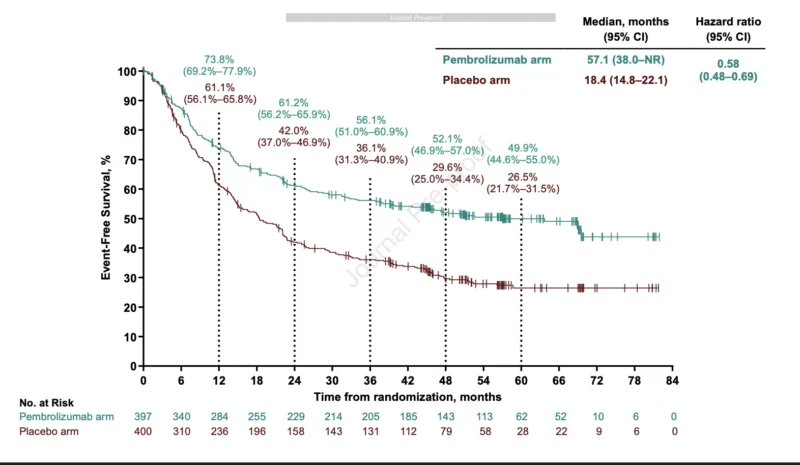
After a median follow-up of 60.4 months, pembrolizumab continued to demonstrate a clinically meaningful improvement in EFS.
At five years:
- EFS was 49.9% with pembrolizumab
- EFS was 26.5% with placebo
The median EFS was:
- 57.1 months with pembrolizumab
- 18.4 months with placebo
The risk of recurrence, progression, or death was reduced by approximately 42% with perioperative pembrolizumab:
- HR 0.58 (95% CI, 0.48–0.69).
The persistence of benefit after extended follow-up is clinically important because recurrence remains the dominant cause of treatment failure after surgery in locally advanced NSCLC.
These findings suggest that perioperative immune checkpoint inhibition can influence long-term disease control beyond the period of active treatment.
Overall Survival Benefit Continues to Mature
The updated analysis also confirmed improvement in overall survival.
Five-year OS rates were:
- 64.6% with pembrolizumab
- 53.6% with placebo
The hazard ratio for death was:
- HR 0.74 (95% CI, 0.59–0.92).
Median overall survival was not reached in the pembrolizumab group, while it was 70.7 months in the placebo group.
The survival findings strengthen previous evidence that immune checkpoint blockade can provide durable benefit when incorporated around surgical treatment.
Benefit Was Observed Beyond Pathological Complete Response
Pathological complete response (pCR) after neoadjuvant therapy is an important marker of treatment activity, but its relationship with long-term outcomes in NSCLC remains complex.
In KEYNOTE-671, the benefit of perioperative pembrolizumab was not restricted only to patients achieving pCR.
Among patients without pathological complete response, pembrolizumab continued to demonstrate improved EFS:
- EFS HR: 0.63
- Five-year EFS: 50.0% with pembrolizumab and 29.7% with placebo
This suggests that the clinical benefit of immunotherapy may involve mechanisms beyond complete pathological tumor eradication at surgery, including suppression of microscopic residual disease.
Biomarker Selection Remains an Important Unresolved Question
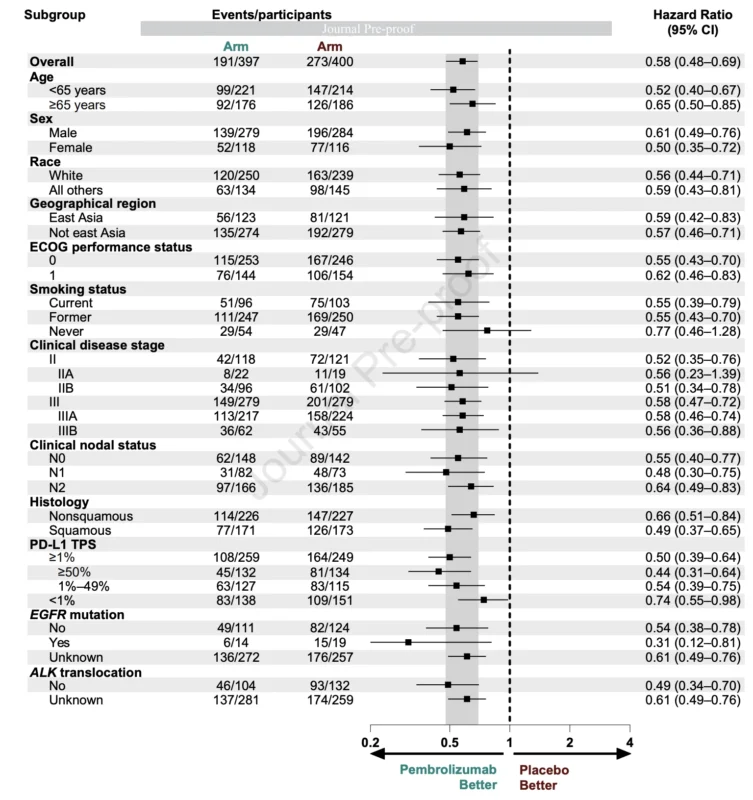
Although KEYNOTE-671 demonstrated benefit across the overall study population, identifying which patients derive the greatest benefit from perioperative immunotherapy remains a major research priority.
The trial evaluated outcomes across multiple clinical and biological subgroups, including PD-L1 expression, histology, disease stage and genomic characteristics.
However, subgroup analyses were not powered to provide definitive conclusions for smaller molecular populations.
A particularly important clinical question concerns patients with oncogenic driver alterations, such as EGFR mutations and ALK rearrangements, where targeted therapies have established roles and the optimal integration of immunotherapy remains uncertain.
Future studies will need to define which molecular subsets benefit most from perioperative checkpoint inhibition and which may require alternative treatment strategies.
Safety Profile Remained Consistent With Pembrolizumab Experience
The safety findings were consistent with the known profile of pembrolizumab.
Grade 3–5 treatment-related adverse events occurred in:
- 45.2% of patients receiving pembrolizumab
- 37.8% receiving placebo
Treatment-related deaths occurred in:
- 1.0% of the pembrolizumab group
- 0.8% of the placebo group
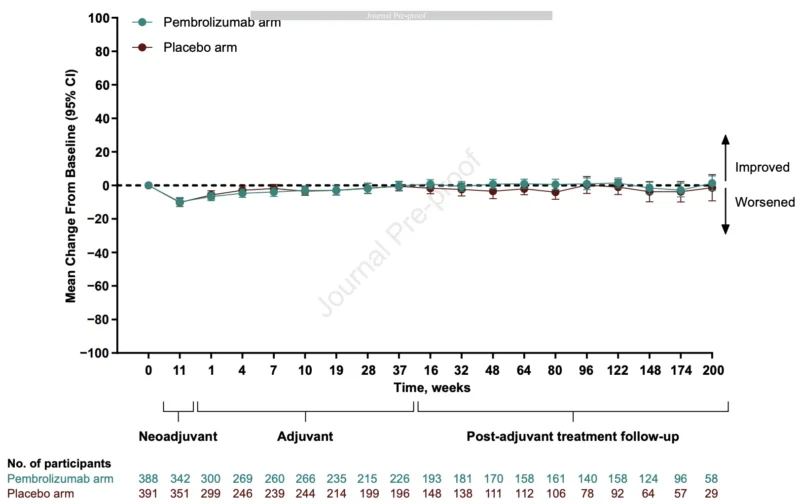
Importantly, long-term follow-up did not demonstrate clinically meaningful deterioration in health-related quality of life compared with placebo.
These findings are particularly relevant in early-stage disease, where treatment decisions must balance survival improvement with long-term toxicity.
KEYNOTE-671 Within the Changing Landscape of Perioperative Immunotherapy
KEYNOTE-671 is part of a broader transformation in early-stage NSCLC treatment.
Several phase III trials have demonstrated benefit from incorporating immune checkpoint inhibitors into perioperative treatment strategies, including studies evaluating nivolumab, durvalumab, tislelizumab and other checkpoint inhibitors.
Together, these studies are shifting the treatment model from surgery followed by postoperative therapy toward a more integrated approach in which systemic therapy begins before tumor removal.
The remaining challenge is determining how to personalize these strategies according to tumor biology, molecular alterations and individual risk of recurrence.
Remaining Questions After KEYNOTE-671
Despite the mature survival results, several questions remain.
The optimal duration of perioperative immunotherapy remains an area of investigation.
The role of biomarkers beyond PD-L1 expression requires further clarification.
The management of patients with actionable driver mutations remains particularly important because targeted therapies may provide superior disease-specific approaches in selected populations.
Additionally, future studies will need to determine whether perioperative immunotherapy can be combined effectively with emerging targeted therapies, antibody-drug conjugates and other novel strategies.
Conclusion
The five-year KEYNOTE-671 analysis provides durable evidence that perioperative pembrolizumab improves both event-free and overall survival in patients with resectable stage II–III NSCLC.
The findings reinforce the concept that early-stage lung cancer treatment is becoming increasingly systemic, with immune checkpoint inhibition playing an important role alongside surgery and chemotherapy.
However, the next phase of progress will depend on refining patient selection, understanding molecular differences in treatment response and identifying which patients require immunotherapy, targeted therapy, or alternative approaches.
KEYNOTE-671 represents an important milestone in the evolution of curative-intent therapy for early-stage NSCLC, while also highlighting the need for more precise treatment strategies.
Reference
- Wakelee H, Spicer JD, Gao S, Liberman M, Tsuboi M, Kato T, Chen KN, Dooms C, Majem M, Martinengo GL, Bylicki O, Rodríguez-Abreu D, Halmos B, Jones DR, Chaft JE, Reck M, Jensen E, Keller SM, Samkari A, Garassino MC. Five-Year Outcomes of Perioperative Pembrolizumab for Early-Stage Non–Small-Cell Lung Cancer From the Randomized KEYNOTE-671 Study. Annals of Oncology. 2026.