


Pazopanib: Understanding Its Mechanism, Dosing, Clinical Uses, and Role in Renal Cell Carcinoma and Soft Tissue Sarcoma
Key takeaways
- Pazopanib is an oral multitargeted antiangiogenic tyrosine kinase inhibitor.
- Major targets include VEGFR-1/2/3, PDGFR-α/β, and KIT.
- Standard dosing is 800 mg once daily without food.
- It is FDA approved for advanced RCC and previously treated advanced STS.
- In RCC, VEG105192 demonstrated median PFS 9.2 vs 4.2 months, HR 0.46.
- COMPARZ demonstrated noninferior PFS versus sunitinib, while quality-of-life outcomes generally favored pazopanib.
- In PISCES, 70% of evaluable patients preferred pazopanib versus 22% preferring sunitinib.
- In PALETTE, median PFS was 4.6 vs 1.6 months, HR 0.31, in previously treated non-adipocytic STS.
- Pazopanib carries a boxed warning for hepatotoxicity.
- Other major risks include hypertension, cardiac dysfunction, QT prolongation, hemorrhage, VTE, proteinuria, hypothyroidism, GI perforation, and impaired wound healing.
- In 2026, pazopanib has a more selective role in RCC, while remaining an important oral option in previously treated advanced non-adipocytic STS.
Pazopanib is an oral, multitargeted tyrosine kinase inhibitor with predominantly antiangiogenic activity. It inhibits several receptor tyrosine kinases involved in tumor vascularization and growth, particularly VEGFR-1, VEGFR-2, VEGFR-3, PDGFR-α, PDGFR-β, and KIT. Through inhibition of these pathways, pazopanib reduces endothelial-cell proliferation, tumor angiogenesis, and tumor growth. DailyMed
In the United States, pazopanib is FDA approved for adults with advanced renal cell carcinoma (RCC) and for advanced soft tissue sarcoma (STS) after prior chemotherapy. Its efficacy has not been established for adipocytic STS or gastrointestinal stromal tumors (GIST).
Key Facts
- Generic name: Pazopanib
- Drug class: Multitargeted tyrosine kinase inhibitor
- Major targets: VEGFR-1/2/3, PDGFR-α/β, KIT
- Route: Oral
- Initial US approval: 2009
- Tablet strength: 200 mg
- Standard dose: 800 mg once daily
- Administration: Without food, at least 1 hour before or 2 hours after a meal
- FDA-approved indications: Advanced RCC; previously treated advanced STS
- Boxed warning: Hepatotoxicity
- Major toxicities: Hepatotoxicity, hypertension, diarrhea, cardiac dysfunction, QT prolongation, hemorrhage, proteinuria, hypothyroidism, impaired wound healing
- Major interaction concerns: CYP3A4 inhibitors/inducers, P-gp/BCRP inhibitors, gastric acid-reducing agents, QT-prolonging drugs.
What Is Pazopanib?
Pazopanib is a small-molecule tyrosine kinase inhibitor designed primarily to suppress angiogenic signaling.
Its principal targets include:
- VEGFR-1
- VEGFR-2
- VEGFR-3
- PDGFR-α
- PDGFR-β
- KIT
These receptors contribute to:
- Tumor blood-vessel formation
- Endothelial-cell proliferation
- Stromal support
- Tumor-cell growth and survival
Pazopanib therefore acts mainly by disrupting the vascular support system that many tumors require for continued growth.
What Is the Mechanism of Action of Pazopanib?
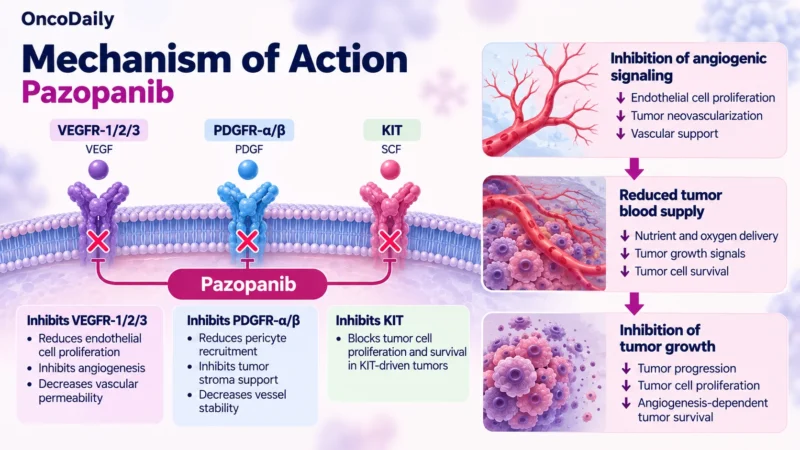
1. Tumors Depend on Angiogenic Signaling
Many solid tumors produce:
VEGF
and other growth factors that stimulate endothelial cells and support formation of new blood vessels.
These signals act through receptors including:
- VEGFR-1
- VEGFR-2
- VEGFR-3
- PDGFR
2. VEGFR and PDGFR Activation Promotes Tumor Vascularization
Activated receptors stimulate intracellular pathways that promote:
- Endothelial-cell proliferation
- Migration
- Survival
- New blood-vessel formation
3. Pazopanib Blocks VEGFR and PDGFR Signaling
Pazopanib inhibits several receptor tyrosine kinases, particularly:
VEGFR-1/2/3 and PDGFR-α/β.
It also inhibits:
KIT.
4. Angiogenesis Falls
Reduced VEGFR and PDGFR signaling leads to:
- Less endothelial-cell proliferation
- Less tumor neovascularization
- Reduced vascular support
5. Tumor Growth Is Suppressed
The overall effect is:
- Reduced angiogenesis
- Reduced tumor-cell support
- Reduced proliferation
- Slower tumor progression
The mechanism can be summarized as:
Pazopanib → VEGFR/PDGFR/KIT inhibition → reduced angiogenic signaling → decreased tumor blood supply and growth.
What Is the Dose of Pazopanib?
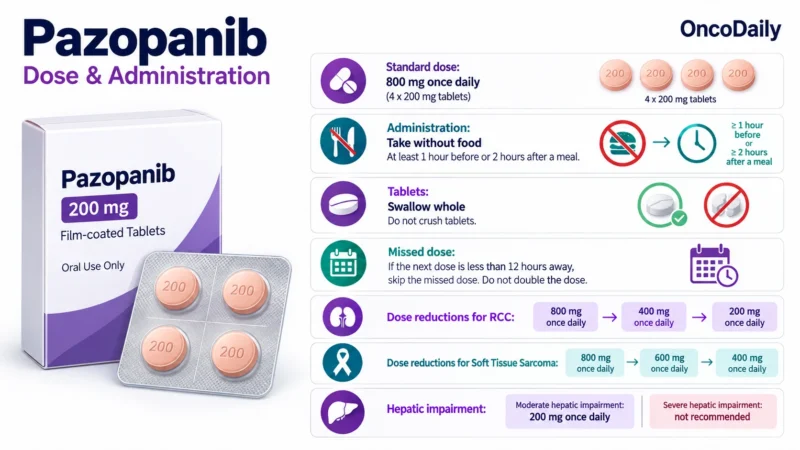
The recommended dose is:
800 mg orally once daily
which equals:
Four 200 mg tablets once daily.
Treatment is continued until:
- Disease progression
- Unacceptable toxicity.
How Should Pazopanib Be Taken?
Pazopanib should be taken:
Without food.
Specifically:
- At least 1 hour before a meal, or
- At least 2 hours after a meal
The tablets should be:
Swallowed whole.
They should not be crushed because crushing increases systemic exposure and peak drug concentrations.
What If a Dose Is Missed?
If a dose is missed:
Do not take it if the next scheduled dose is less than 12 hours away.
Do not double the dose to compensate.
How Are Pazopanib Dose Reductions Made?
Dose reduction differs between RCC and STS.
Renal Cell Carcinoma
- Starting dose: 800 mg once daily
- First reduction: 400 mg once daily
- Second reduction: 200 mg once daily
If the patient cannot tolerate the second dose reduction, pazopanib should be permanently discontinued.
Soft Tissue Sarcoma
- Starting dose: 800 mg once daily
- First reduction: 600 mg once daily
- Second reduction: 400 mg once daily
If the patient cannot tolerate the second dose reduction, permanent discontinuation is recommended.
Dose Adjustment for Hepatic Impairment
Mild Hepatic Impairment
No routine starting-dose reduction is required.
Moderate Hepatic Impairment
Alternative treatment should be considered.
If pazopanib is used:
200 mg orally once daily.
Severe Hepatic Impairment
Pazopanib is:
Not recommended.
What Are the Important Drug Interactions With Pazopanib?
Pazopanib is metabolized primarily by:
CYP3A4
with smaller contributions from:
- CYP1A2
- CYP2C8.
Strong CYP3A4 Inhibitors
These can increase pazopanib exposure.
Examples include:
- Ketoconazole
- Itraconazole
- Clarithromycin
- Ritonavir
They should preferably be:
Avoided.
If unavoidable, reduce pazopanib to:
400 mg once daily.
Strong CYP3A4 Inducers
Strong inducers can reduce pazopanib concentrations.
Examples include:
- Rifampin
- Carbamazepine
- Phenytoin
- St. John’s wort
Alternative medications are preferred.
Chronic strong CYP3A4 induction should generally be avoided.
P-gp and BCRP Inhibitors
Strong inhibitors of:
- P-glycoprotein
- BCRP
may increase pazopanib concentrations and should generally be avoided.
Gastric Acid-Reducing Agents
Pazopanib absorption decreases when gastric pH rises.
For example, esomeprazole reduced pazopanib exposure by approximately:
40%.
Therefore avoid:
- Proton-pump inhibitors
- H2-receptor antagonists
when possible.
If acid suppression is unavoidable, short-acting antacids may be considered and should be separated from pazopanib by several hours.
Simvastatin
Concomitant simvastatin increases the risk of:
ALT elevations.
Liver monitoring should be intensified if this combination is used.
QT-Prolonging Drugs
Pazopanib can prolong QTc.
Avoid concomitant medications known to significantly prolong QT whenever possible.
Does Pazopanib Require Renal Dose Adjustment?
Pazopanib has very little renal elimination.
Less than:
4%
of the administered dose is eliminated renally.
Therefore routine starting-dose adjustment is generally not required for renal impairment.
Clinical data in severe renal dysfunction remain more limited than in patients with preserved renal function.
What Is the Pharmacokinetic Profile of Pazopanib?
Absorption
Peak concentrations are reached approximately:
2–4 hours
after administration.
Food Effect
Food substantially increases pazopanib exposure.
Both high-fat and low-fat meals increase:
- AUC by approximately 2-fold
- Cmax by approximately 2-fold
which is why pazopanib should be taken fasting.
Protein Binding
Pazopanib is:
>99% protein bound.
Half-Life
The mean elimination half-life is approximately:
31 hours.
Metabolism
Pazopanib is metabolized mainly by:
CYP3A4
with smaller contributions from:
- CYP1A2
- CYP2C8.
Elimination
Elimination is primarily:
Fecal.
Renal elimination accounts for:
<4% of the administered dose.
What Are the Clinical Uses of Pazopanib?
1. Advanced Renal Cell Carcinoma
Pazopanib is FDA approved for adults with:
Advanced RCC.
It became one of the major VEGFR-targeted agents used in metastatic clear-cell RCC and was historically an important first-line option.
2. Advanced Soft Tissue Sarcoma
Pazopanib is FDA approved for adults with:
Advanced soft tissue sarcoma after prior chemotherapy.
However, the label specifically notes that efficacy has not been established in:
- Adipocytic STS
- GIST.
Its use is therefore primarily relevant to non-adipocytic soft tissue sarcoma.
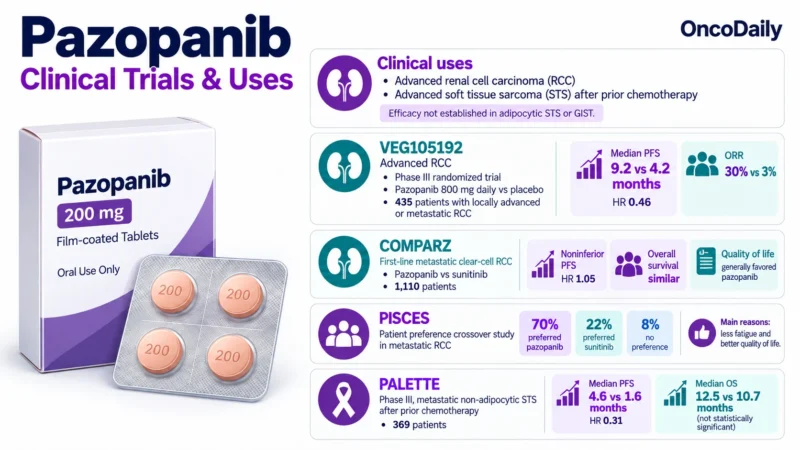
What Did the VEG105192 RCC Trial Show?
The pivotal randomized phase III study enrolled:
435 patients
with locally advanced or metastatic RCC.
Patients received:
- Pazopanib 800 mg once daily
- Placebo.
Progression-Free Survival
In the overall population:
- Pazopanib: 9.2 months
- Placebo: 4.2 months
Hazard ratio:
0.46
95% CI:
0.34–0.62
P < 0.0001.
Treatment-Naïve Patients
Median PFS:
- 11.1 months
- 2.8 months
HR:
0.40.
Cytokine-Pretreated Patients
Median PFS:
- 7.4 months
- 4.2 months
HR:
0.54.
Objective Response Rate
ORR was:
- 30% with pazopanib
- 3% with placebo.
Final Overall Survival in RCC
Final overall survival analysis was complicated by crossover from placebo to pazopanib.
The phase III trial nevertheless confirmed durable activity and established pazopanib as an effective VEGFR-targeted therapy in advanced RCC.
What Did the COMPARZ Trial Show?
COMPARZ directly compared:
Pazopanib 800 mg once daily
with:
Sunitinib 50 mg once daily on a 4-weeks-on/2-weeks-off schedule
in:
1,110 patients
with previously untreated metastatic clear-cell RCC.
The study demonstrated that pazopanib was:
Noninferior to sunitinib for progression-free survival.
Hazard ratio for progression or death:
1.05
95% CI:
0.90–1.22.
Overall survival was also similar:
HR 0.91.
Quality-of-life measures generally favored pazopanib, while toxicity profiles differed between the drugs.
What Did the PISCES Trial Show?
The randomized crossover PISCES study examined patient preference between:
- Pazopanib
- Sunitinib
among patients with metastatic RCC.
Among evaluable patients:
- 70% preferred pazopanib
- 22% preferred sunitinib
- 8% had no preference
P < 0.001.
The main reasons for preferring pazopanib were:
- Less fatigue
- Better overall quality of life.
What Did the PALETTE Trial Show?
The pivotal phase III PALETTE trial evaluated pazopanib in:
Metastatic non-adipocytic soft tissue sarcoma after previous chemotherapy.
A total of:
369 patients
were randomized:
- Pazopanib: 246
- Placebo: 123.
Progression-Free Survival
Median PFS was:
- 4.6 months with pazopanib
- 1.6 months with placebo
Hazard ratio:
0.31
95% CI:
0.24–0.40
P < 0.0001.
Overall Survival in PALETTE
Median OS was:
- 12.5 months
- 10.7 months
Hazard ratio:
0.86
P = 0.25.
The difference was not statistically significant.
Is Pazopanib FDA Approved?
Yes.
FDA-approved indications are:
Advanced RCC
For adults with advanced renal cell carcinoma.
Advanced STS
For adults with advanced soft tissue sarcoma after prior chemotherapy.
However, efficacy has not been demonstrated for:
- Adipocytic STS
- GIST.
What Is the Current Clinical Role of Pazopanib in 2026?
Renal Cell Carcinoma
Pazopanib remains FDA approved and biologically active in advanced RCC, but its role has narrowed substantially because contemporary RCC treatment is dominated by:
- Immune-checkpoint inhibitor combinations
- ICI + VEGFR-TKI combinations
- Newer targeted agents
Pazopanib therefore tends to be considered more selectively when an established VEGFR TKI is clinically appropriate.
Its historical relevance remains important because COMPARZ demonstrated efficacy comparable with sunitinib, while PISCES showed strong patient preference for pazopanib based largely on quality-of-life considerations.
Soft Tissue Sarcoma
Pazopanib remains an important oral targeted option for:
Previously treated advanced non-adipocytic soft tissue sarcoma.
This remains one of its most clinically relevant roles because PALETTE demonstrated a substantial PFS benefit after prior chemotherapy.
Its activity has been particularly incorporated into treatment strategies for selected sarcoma subtypes such as:
- Leiomyosarcoma
- Synovial sarcoma
- Other eligible non-adipocytic STS
while adipocytic sarcoma and GIST fall outside its established FDA evidence base.
Read more: ASTAR IMCB study led by Valerie Yang identified AZD5153 and Pazopanib drug combination for soft tissue sarcoma treatment — OncoDaily coverage of a precision-oncology study using pazopanib in STS.
Watch more: OncoDaily discussion on immunotherapy in Soft Tissue – 5 min Sarcoma Talk with Sandra D’Angelo
What Are the Major Side Effects of Pazopanib?
Common adverse effects include:
- Diarrhea
- Hypertension
- Nausea
- Fatigue
- Reduced appetite
- Vomiting
- Weight loss
- Hair-color changes
- Elevated liver enzymes
Important serious toxicities include:
- Hepatotoxicity
- QT prolongation
- Cardiac dysfunction
- Hemorrhage
- Arterial thromboembolic events
- Venous thromboembolism
- Thrombotic microangiopathy
- GI perforation or fistula
- ILD/pneumonitis
- PRES
- Proteinuria
- Hypothyroidism
- Impaired wound healing.
Hepatotoxicity
Pazopanib carries an FDA:
Boxed warning for hepatotoxicity.
Severe and fatal liver injury has occurred.
Monitor:
- ALT
- AST
- Bilirubin
at:
- Baseline
- Regularly during treatment
- As clinically indicated
Most transaminase elevations occur relatively early; approximately 92% of any-grade transaminase elevations occurred within the first 18 weeks in clinical development.
Depending on severity, management may require:
- Interruption
- Dose reduction
- Permanent discontinuation
with intensified weekly liver-function monitoring in selected cases.
Hypertension
Hypertension occurs in approximately:
40%
of patients treated with pazopanib.
Grade 3 hypertension occurs in approximately:
4%–7%.
A substantial proportion develops early:
- About 40% of cases by Day 9
- About 90% within the first 18 weeks.
Do not start pazopanib in patients with uncontrolled hypertension.
Blood pressure should be optimized before treatment and monitored regularly thereafter.
Cardiac Dysfunction
Pazopanib can cause:
- Decreased LVEF
- Congestive heart failure
In COMPARZ, myocardial dysfunction occurred in approximately:
13%
of patients with baseline and follow-up LVEF measurements.
Congestive heart failure occurred in approximately:
0.5%.
Patients at higher risk include those with:
- Previous anthracycline exposure
- Cardiovascular disease
- Uncontrolled hypertension
Consider baseline and periodic LVEF assessment in at-risk patients.
QT Prolongation
Pazopanib can prolong the:
QT/QTc interval.
QT prolongation ≥500 msec occurred in approximately:
2%
of monitored RCC-trial patients.
Torsades de pointes occurred in:
<1% of pazopanib-treated patients across monotherapy trials.
In patients at increased risk:
Monitor:
- ECG
- Potassium
- Magnesium
- Calcium
and correct electrolyte abnormalities.
Hemorrhage
Pazopanib can increase bleeding risk.
In the pivotal RCC trial:
13%
of patients receiving pazopanib experienced at least one hemorrhagic event.
Potential events include:
- Hematuria
- Epistaxis
- Hemoptysis
- Gastrointestinal bleeding
- Genitourinary hemorrhage
Serious bleeding may require:
- Treatment interruption
- Dose reduction
- Permanent discontinuation.
Venous Thromboembolism
VTE, including pulmonary embolism, has been reported.
In the pivotal STS trial:
5%
of pazopanib-treated patients experienced VTE.
Fatal pulmonary embolism occurred in approximately:
1%.
Monitor for:
- Leg swelling
- Chest pain
- Dyspnea
- Hypoxia
Proteinuria
Proteinuria occurred in:
9%
of pazopanib-treated patients in the randomized RCC trial.
Monitoring should include:
- Baseline urinalysis
- Periodic urinalysis
- 24-hour urine protein measurement when clinically indicated
Nephrotic syndrome requires:
Permanent discontinuation.
Hypothyroidism
Hypothyroidism occurred in approximately:
- 7% in the pivotal RCC trial
- 5% in the pivotal STS trial.
Monitor thyroid function:
- At baseline
- During treatment
- As clinically indicated.
Gastrointestinal Perforation and Fistula
GI perforation or fistula occurred in approximately:
- 0.9% in RCC trials
- 1% in STS trials.
GI perforation requires:
Permanent discontinuation.
Interstitial Lung Disease/Pneumonitis
ILD/pneumonitis is rare but potentially fatal.
It occurred in approximately:
0.1% of pazopanib-treated patients.
Pazopanib should be permanently discontinued if ILD/pneumonitis develops.
Impaired Wound Healing
Because pazopanib inhibits VEGF signaling, it may impair wound healing.
Withhold pazopanib:
At least 1 week before elective surgery.
After major surgery:
Do not resume for at least:
2 weeks
and until adequate wound healing has occurred.
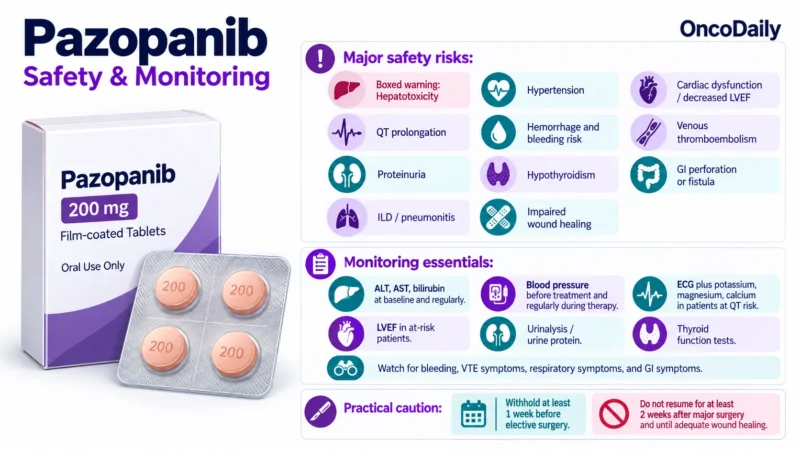
What Monitoring Is Required?
Monitoring during pazopanib therapy should include:
- ALT
- AST
- Bilirubin
- Blood pressure
- ECG in patients at QT risk
- Potassium
- Magnesium
- Calcium
- Clinical signs of heart failure
- LVEF in at-risk patients
- Signs of bleeding
- Signs of arterial or venous thromboembolism
- Urinalysis / urine protein
- Thyroid function tests
- Respiratory symptoms
- GI symptoms suggesting perforation or fistula
- Wound healing around surgery
- Concomitant CYP3A4, P-gp, BCRP, acid-suppressive, and QT-prolonging medications.
FAQ
What Is Pazopanib Used For?
- Advanced renal cell carcinoma
- Advanced soft tissue sarcoma after prior chemotherapy.
What Is the Standard Pazopanib Dose?
How Many Tablets Is 800 mg?
200 mg tablets.
Should Pazopanib Be Taken With Food?
Take it:
At least 1 hour before or 2 hours after a meal.
How Does Pazopanib Work?
VEGFR, PDGFR, and KIT
thereby reducing tumor angiogenesis and vascular support.
What Did the RCC Trial Show?
- 9.2 months
- 4.2 months
with pazopanib versus placebo.
HR:
0.46.
What Did PALETTE Show?
- 4.6 months
- 1.6 months
with pazopanib versus placebo.
HR:
0.31.
What Did COMPARZ Show?
Noninferior to sunitinib for progression-free survival
with differentiated toxicity and quality-of-life profiles.
What Is the Most Important Safety Warning?
It carries an FDA boxed warning. DailyMed